August 14, 2026
When Geology Meets Climate Science: The Professional Archetype Mining Has Been Waiting For
The global mining sector has spent well over a century perfecting the science of extraction. It has trained world-class geologists, built sophisticated mineral processing operations, and developed financial models capable of evaluating resources worth billions of dollars. Yet for most of that history, one dimension of the earth system remained conspicuously absent from mainstream mining expertise: the carbon cycle. Understanding how carbon moves through rock, soil, ocean, and atmosphere over geological timescales requires a fundamentally different kind of scientific training. And that gap, long overlooked, is now at the centre of the industry's most pressing challenge.
The emergence of the Evelyn Mervine mining climate change expert archetype reflects a broader structural shift in how the resources sector must think about risk, accountability, and long-term viability. As mandatory climate disclosure frameworks tighten across major mining jurisdictions, and as physical climate risks begin materialising at operational sites, the demand for professionals who can bridge deep earth science with applied carbon management is accelerating rapidly.
When big ASX news breaks, our subscribers know first
A Background Built for Complexity
Associate Professor Evelyn Mervine's career trajectory is a case study in the value of unconventional professional pathways. Her undergraduate studies at Dartmouth College covered Earth Sciences alongside Arabic, an early signal of the interdisciplinary thinking that would come to define her career. From there, she was admitted into one of the most competitive earth science research environments in the world: the joint doctoral programme between MIT and the Woods Hole Oceanographic Institution (WHOI).
Her PhD research took an unexpectedly terrestrial form. Rather than working from ships or submersibles, she conducted marine geology fieldwork in the mountains of northern Oman, where a rare geological process called obduction has lifted a slice of ancient ocean crust and part of the Earth's mantle onto land. Walking across the seafloor in the middle of a desert, as she describes it, offers a direct window into processes that govern the deep carbon cycle, specifically how the weathering of these unusual rock types draws carbon dioxide out of the atmosphere over geological timescales.
This type of foundational carbon cycle understanding, developed not through policy frameworks but through actual geochemical research, is precisely what distinguishes Mervine's later climate work from that of professionals trained purely in environmental compliance or sustainability reporting.
After completing her doctorate, she entered the mining industry directly, beginning in geology roles before progressively transitioning into climate-focused positions. That industry immersion, spanning years of hands-on experience with how mine sites and mineral exploration programmes actually function, proved foundational to her later sustainability work. It is a perspective she holds firmly: understanding operational realities is a prerequisite for designing interventions that actually work in the field, not an optional detour from more prestigious academic careers.
Around 2015, she became her employer's designated climate change expert, and she quickly recognised that a PhD examining one narrow portion of the carbon cycle was insufficient preparation for the breadth of the role. She pursued a Master's degree in Carbon Management from the University of Edinburgh on a part-time basis while continuing industry work, acquiring training in climate change law, carbon accounting methodology, and environmental economics. That combination of hard geoscience, operational mining experience, and applied climate policy remains exceptionally rare across the global workforce.
What It Actually Means to Lead a Carbon and Climate Research Group
Mervine now leads the Carbon and Climate Change Research Group within the Centre for Environmental Responsibility in Mining (CERM) at the University of Queensland's Sustainable Minerals Institute (SMI). This institutional positioning matters enormously.
SMI has a deliberately applied research philosophy. It is not an environment where researchers identify problems and publish findings that sit untouched in academic journals. The explicit model is to develop practical, implementable solutions in genuine collaboration with industry partners. For Mervine, who initially avoided pursuing a traditional academic career because it felt too disconnected from real-world impact, this environment represents an alignment between intellectual rigour and operational consequence.
Why Industry-Embedded Research Produces Better Outcomes
The barriers between academic climate science and mining operations have historically been significant. These two communities operate on different time horizons, tolerate risk differently, and use different languages to describe similar problems. Institutions like SMI exist precisely to reduce that friction. By bringing together researchers and practitioners in shared problem-solving environments, they increase the probability that findings translate into changed practices, not just changed publications.
The Carbon and Climate Change Research Group's current priorities reflect this practical orientation. One immediate focus is developing better methodologies for measuring and reporting carbon emissions from land use change at mine sites, an area where the gap between what companies currently report and what they actually generate is, by available research estimates, potentially enormous. Furthermore, the natural capital in mining context adds another layer of complexity to these measurement challenges.
The Carbon Accounting Blind Spots That Are Undermining Industry Credibility
Carbon accounting in the mining sector is far more uneven than public sustainability reports typically suggest. The industry has developed relatively robust protocols for measuring emissions from diesel combustion and purchased electricity, the categories that fall neatly into established Scope 1 and Scope 2 frameworks. Beyond those familiar categories, however, the picture deteriorates significantly.
The following table reflects the current state of emissions reporting proficiency across key categories:
| Emissions Category | Reporting Proficiency | Primary Technical Barrier |
|---|---|---|
| Diesel and fuel combustion (Scope 1) | Relatively strong | Established measurement protocols widely implemented |
| Purchased electricity (Scope 2) | Moderate to strong | Regional grid emissions factors introduce variability |
| Land use change emissions | Very poor | Ecosystem carbon stock quantification requires specialist expertise |
| Geochemical reactions in mine waste | Very poor | Tailings and waste rock chemistry is poorly characterised |
| Fugitive methane emissions | Poor | Atmospheric measurement methodologies remain underdeveloped |
This gap in reporting completeness is not a minor administrative deficiency. It represents a structural failure to account for some of the most significant emission sources generated by mine development, particularly at sites in high-biodiversity, high-carbon landscapes. Reaching carbon neutrality without measuring all emission sources is, as the research makes clear, a logical impossibility dressed up in sustainability language.
The Hidden Chemistry of Mine Waste
One of the least understood emission sources in mining involves the geochemical reactions that occur within tailings storage facilities and waste rock dumps after mineral processing. These reactions can include oxidation of sulphide minerals, carbonate dissolution, and microbial processes that generate carbon dioxide or methane. Because these processes are slow, diffuse, and geochemically complex, they require specialist expertise to measure accurately and are rarely included in corporate emissions inventories.
Similarly, fugitive methane emissions from coal mines have long been partially measured, but methane emissions from other mineral extraction contexts, including those associated with organic-rich sedimentary sequences intersected during drilling, remain largely uncharacterised at the industry scale.
The Nickel Mining Carbon Paradox: When Clean Energy Technology Has a Dirty Footprint
In 2025, research published in Nature Communications delivered a significant challenge to simplistic assumptions about the climate credentials of critical mineral supply chains. The study examined 481 nickel mine sites and undeveloped deposits across international jurisdictions and produced findings with profound implications for how policymakers, investors, and companies evaluate the climate cost of nickel extraction.
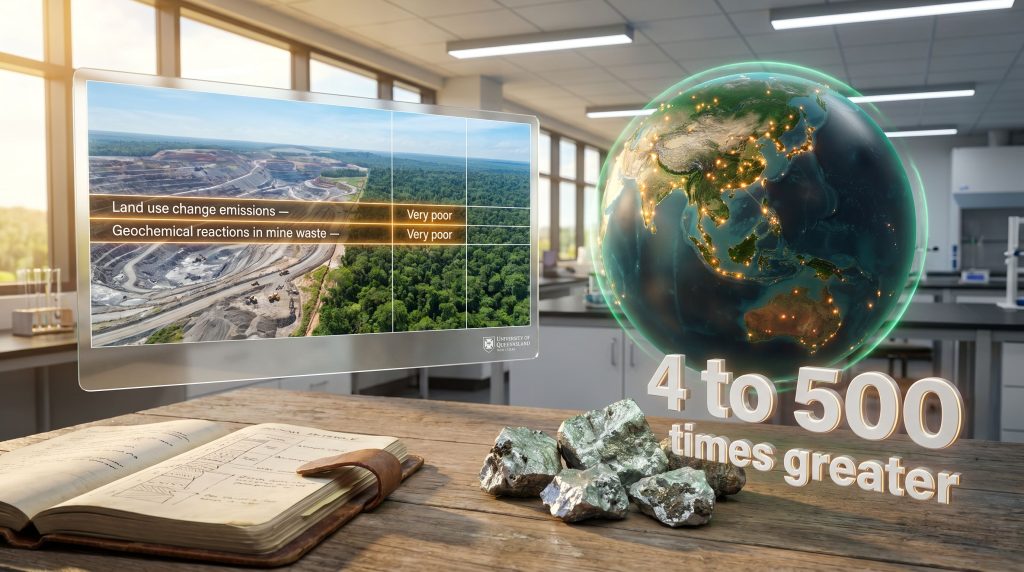
The headline finding was stark: land-clearing carbon emissions from nickel mining operations may be 4 to 500 times larger than previously reported estimates, depending on the specific ecosystem characteristics of the mine site. This enormous range reflects genuine variability in ecosystem carbon density across different geographic settings, but even the lower bound of that range represents a fundamental challenge to standard environmental impact assessments.
The study placed particular emphasis on the concept of irrecoverable carbon, which refers to carbon stocks held in ecosystems such as old-growth forests, mangroves, and tropical peatlands that cannot be meaningfully restored within human-relevant timescales once they are cleared or disturbed. When a nickel mine is developed in one of these landscapes, the resulting carbon release is effectively permanent on any policy-relevant horizon.
The implications are uncomfortable for anyone who assumes that mining more critical minerals automatically accelerates the energy transition. Where mine development destroys irrecoverable carbon in high-density ecosystems, the net climate benefit of the resulting battery technology or clean energy infrastructure may be substantially reduced, or in extreme cases, negative over meaningful timeframes.
Understanding the Structural Paradox
Nickel is an essential input for lithium-ion battery cathodes, stainless steel, and a range of industrial applications central to clean energy infrastructure. Global demand for nickel is projected to grow substantially as electric vehicle penetration expands and stationary energy storage scales up. In addition, the role of critical minerals and energy transition planning adds further strategic urgency to this structural tension, which does not resolve easily:
- The decarbonisation agenda requires significantly more nickel to manufacture batteries, electrolysers, and grid infrastructure
- Developing new nickel deposits in tropical and equatorial regions frequently means operating in landscapes with extremely high ecosystem carbon density
- Existing environmental impact assessment frameworks do not consistently require or accurately measure the carbon consequences of land clearing at these sites
- Irrecoverable carbon losses cannot be offset through reforestation or other conventional carbon removal approaches within timescales that matter for climate targets
This paradox does not argue against nickel mining per se. It argues for fundamentally better site selection, more rigorous pre-development carbon stock assessment, and the integration of irrecoverable carbon avoidance into mine permitting and planning processes from the earliest stages of project development.
A Three-Part Framework for Meaningful Mining Decarbonisation
Mervine's approach to mining decarbonisation follows a clear and sequenced framework that reflects best-practice climate science rather than the marketing convenience that has shaped many corporate net-zero strategies. The mining decarbonisation benefits are most effectively realised when the three priorities below are applied in deliberate order:
-
Comprehensive measurement first — Before any reduction target can be credible, companies must account for all material emission sources, including the land use change, geochemical waste, and fugitive methane categories that are currently systematically underreported across the sector.
-
Operational emissions reduction as the dominant lever — Decarbonising mining fleets, transitioning to renewable energy in mining operations, and reforming processing methods should constitute a minimum of 90% of any carbon neutrality strategy. This is not an aspirational proportion; it reflects the scientific consensus that absolute emissions reductions are the only pathway to genuine climate stabilisation.
-
Offsets strictly as a last resort — Land restoration, mineral carbon storage, and emerging carbon removal technologies have legitimate roles in addressing genuinely residual emissions that cannot be eliminated through operational changes. Using offsets as a substitute for operational decarbonisation, however, constitutes greenwashing regardless of the quality of the offset instrument.
Positioning carbon offsets as a primary strategy rather than a residual management tool is a form of greenwashing. The sequencing matters: measure everything, reduce as much as operationally possible, then address only what remains through verified offset mechanisms.
The Adaptation Dimension That Most Companies Are Still Underweighting
Beyond emissions reduction, climate adaptation represents a second and often underappreciated strategic imperative. Even under optimistic emissions scenarios, a significant degree of climate change is now locked into the physical system. Mining assets with 20 to 40-year operational lifespans will be exposed to climate conditions substantially different from those that existed when they were designed and permitted.
The physical risk categories that mining operations face are diverse and span both gradual-onset and acute climate hazards:
- Extreme heat increasing energy consumption for cooling, reducing worker productivity, and degrading equipment performance at open-cut operations in already-hot environments
- Intensifying drought cycles threatening water-dependent processing operations, particularly hydrometallurgical facilities reliant on consistent water supply
- More severe precipitation events damaging tailings storage facilities, haul roads, and surface infrastructure
- Coastal and port exposure affecting shipping infrastructure and offshore mineral operations
- Supply chain instability from climate-driven disruption in regions supplying fuel, reagents, spare parts, and labour
Companies that treat climate adaptation as a secondary concern, or as something to address once emissions reduction strategies are in place, are systematically underestimating the physical risks already materialising across their asset portfolios.
The next major ASX story will hit our subscribers first
How the Sector Has Evolved Since 2015: And Where the Gaps Remain
When Mervine entered her first dedicated climate change role in 2015, carbon teams were virtually non-existent across the mining industry. The decade since has seen genuine structural change. Dedicated sustainability and climate functions now exist at most major mining companies. Mandatory climate-related financial disclosure requirements are being introduced in Australia and other key mining jurisdictions. Institutional investors and ESG-focused capital allocation frameworks have elevated climate risk from a peripheral reputational concern to a boardroom-level priority.
Some mining companies have reduced internal climate and sustainability headcount in recent years, prompting debate about whether the sector is quietly retreating from commitments made during a period of more intense ESG scrutiny. However, the analytical case for viewing this as a temporary contraction rather than a structural reversal is grounded in several converging pressures:
- Regulatory escalation — Mandatory climate reporting obligations in Australia, the UK, and increasingly across Asian markets are tightening, creating compliance obligations that cannot be met with reduced internal expertise
- Physical risk materialisation — Climate-related operational disruptions are becoming more frequent and financially significant, making robust adaptation planning a direct commercial necessity
- Capital market differentiation — Institutional investors with climate-integrated allocation frameworks are increasingly distinguishing between companies with credible climate risk management and those without
- Downstream supply chain pressure — Battery manufacturers, automotive companies, and clean energy developers are beginning to impose lower-carbon sourcing requirements on their critical mineral supply chains
Furthermore, the broad shift towards electrification and decarbonisation across the resources sector is reinforcing the commercial case for climate competency. Mervine's assessment, expressed through her publicly documented perspectives, is that mining companies with the deepest and most genuine climate competency will ultimately be the most commercially competitive, not because climate action is mandated, but because it is inseparable from operational efficiency and long-term investor confidence.
The "It's Too Late" Myth and Why the Research Rejects It
A narrative is gaining cultural traction in some quarters that climate mitigation is now futile because the problem has already advanced beyond the point of meaningful intervention. This framing is both scientifically inaccurate and strategically dangerous for sectors like mining that are being called upon to supply the materials for a clean energy transition.
The scientific consensus is clear: while some degree of climate impact is now unavoidable, the severity of future outcomes remains highly sensitive to the pace and scale of near-term emissions reductions. The difference between 1.5 degrees and 3 degrees of warming is not a marginal footnote. It represents profoundly different risk profiles for ecosystems, communities, and the long-lived infrastructure assets that mining companies operate.
Mervine has articulated this position clearly in her publicly documented work: the tools and technologies required to substantially mitigate climate change already exist. The barriers are predominantly political and social rather than technical or economic. The mining sector's role in this context is to supply the materials needed for decarbonisation responsibly, which means accounting honestly for its own emissions, avoiding the destruction of irreplaceable carbon stores, and building assets that can withstand the physical climate conditions of the coming decades.
Frequently Asked Questions About Evelyn Mervine and Mining Climate Research
What is Evelyn Mervine's area of expertise?
Evelyn Mervine is an Evelyn Mervine mining climate change expert specialising in carbon management, carbon accounting, and the climate impacts of mining operations. Her work spans emissions measurement methodology, decarbonisation strategy for mining operations, land use change carbon accounting, and climate adaptation planning for resource sector assets. She leads the Carbon and Climate Change Research Group within the Centre for Environmental Responsibility in Mining at the University of Queensland's Sustainable Minerals Institute.
What were Mervine's academic qualifications?
She completed an undergraduate degree majoring in Earth Sciences and Arabic at Dartmouth College, followed by a joint PhD between MIT and the Woods Hole Oceanographic Institution focused on marine geology and the carbon cycle. She later completed a Master's degree in Carbon Management from the University of Edinburgh, providing complementary training in carbon accounting, climate change law, and environmental economics.
What did the 2025 nickel mining carbon study find?
Research published in Nature Communications in 2025 analysed 481 nickel mine sites and undeveloped deposits globally, finding that land-clearing carbon emissions from nickel mining may be between 4 and 500 times larger than previously reported estimates. The study highlighted the particular risk of destroying irrecoverable carbon stored in old-growth forests, mangroves, and tropical peatlands, ecosystems whose carbon stores cannot be meaningfully restored once cleared.
Why is carbon accounting in mining so technically difficult?
While measuring emissions from fuel combustion and purchased electricity is relatively well-established, mining operations also generate emissions from land use change, geochemical reactions within tailings and waste rock, and fugitive methane, all of which are technically complex to characterise and are currently underreported across the industry. Addressing these gaps requires specialist expertise that sits at the intersection of geochemistry, ecology, and atmospheric science.
What is irrecoverable carbon and why does it matter for mine site selection?
Irrecoverable carbon refers to carbon stored in ecosystems, particularly old-growth forests, peatlands, and mangroves, that cannot be meaningfully restored within human-relevant timescales once it is released. When mine development occurs in these landscapes, the resulting carbon loss is effectively permanent on any timescale that matters for climate targets. This makes avoidance through smarter site selection the only viable mitigation strategy; offsetting or restoration cannot adequately substitute.
How should mining companies sequence their carbon neutrality strategies?
Best-practice frameworks aligned with the scientific consensus prescribe a clear sequence: first, comprehensively measure all material emission sources including currently underreported categories; second, achieve operational emissions reductions covering a minimum of 90% of the neutrality target through fleet decarbonisation, renewable energy transition, and process improvements; and third, apply high-quality offset instruments only to genuinely residual emissions that cannot be eliminated through operational means.
The Dual Role That Defines Mining's Place in the Climate Transition
The mining sector occupies a uniquely contradictory position in the global climate narrative. It is simultaneously a source of greenhouse gas emissions through energy consumption, land clearing, and geochemical processes, and an essential enabler of decarbonisation by supplying the copper, nickel, lithium, cobalt, and rare earth elements that underpin clean energy technologies. This dual role cannot be resolved by simply doing more mining or by treating the sector as inherently incompatible with climate goals.
The resolution requires a more sophisticated approach: fundamentally better mining, with lower land-use footprints, more complete and honest emissions accounting, smarter siting decisions that avoid irrecoverable carbon zones, and stronger post-mining rehabilitation outcomes. Researchers like Evelyn Mervine, who bring the combined credibility of deep geological training, operational industry experience, and applied climate policy expertise, are consequently among the most important professionals in accelerating that transition.
The work being built at UQ's Sustainable Minerals Institute through the Carbon and Climate Change Research Group represents a deliberate structural response to the gap between what the mining industry currently measures and what it actually needs to account for before meaningful decarbonisation can occur. Whether the sector ultimately rises to that challenge will depend not just on technology or regulation, but on whether it develops the internal capacity to understand its own carbon footprint with the same rigour it has long applied to understanding ore grades.
Disclaimer: This article is intended for informational purposes only. It does not constitute financial, investment, or professional advice. Forward-looking statements and projections referenced herein involve inherent uncertainty and should not be relied upon as predictions of future outcomes. Readers should seek independent professional advice before making any decisions based on the information presented.
Want to Stay Ahead of the Next Major Mineral Discovery on the ASX?
Discovery Alert's proprietary Discovery IQ model scans ASX announcements in real time, instantly identifying significant mineral discoveries across more than 30 commodities — including the critical minerals at the heart of the clean energy transition — and delivering actionable insights directly to subscribers. Explore Discovery Alert's discoveries page to see how major ASX mineral discoveries have historically generated substantial returns, and begin your 14-day free trial today to position yourself ahead of the broader market.