
June 7, 2026
The Hidden Cost of Building an Industry From Scratch
Every major mining nation on earth carries the scars of decisions made before anyone fully understood the consequences. Contaminated river systems, communities stranded after mine closure, tailings facilities that failed decades after the engineers who built them had retired. These are not anomalies; they are the predictable outcomes of an industry that learned by doing, at enormous human and environmental cost.
Nations now entering large-scale mineral extraction face a fundamentally different set of choices. They can trace the same trajectory, or they can treat the accumulated knowledge of established mining regions as infrastructure in its own right, something to be studied, absorbed, and deliberately applied before the first blast hole is drilled.
This is the logic underlying Saudi Arabia mining training in Mount Isa, and it is a model that carries implications well beyond any single training program.
When big ASX news breaks, our subscribers know first
Saudi Arabia's $2.5 Trillion Mineral Frontier
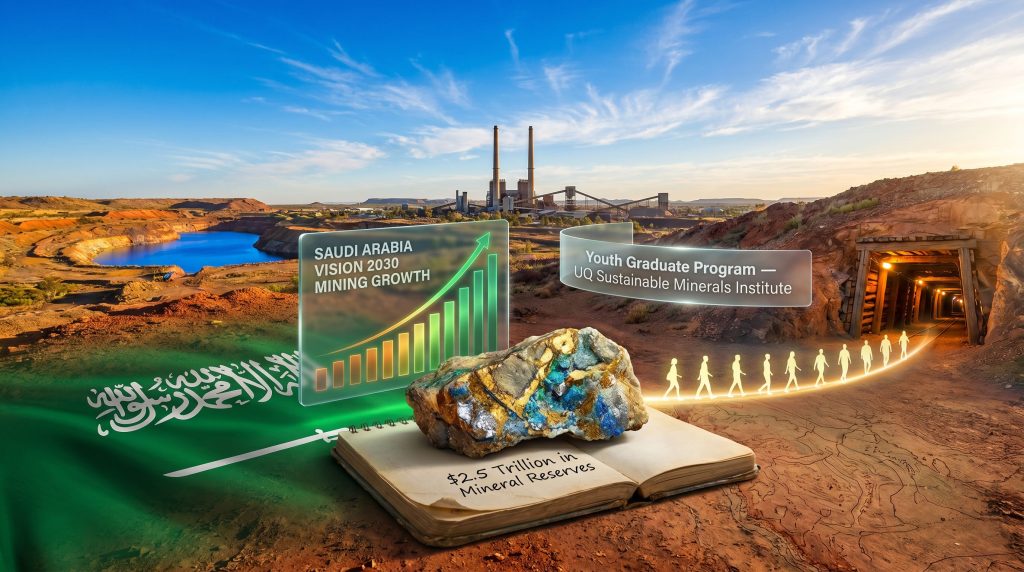
Saudi Arabia's global identity has been shaped almost entirely by hydrocarbons, but the geological story beneath the Kingdom's surface is considerably more complex. Beneath the Arabian Shield, one of the world's oldest exposed geological formations, lies an estimated $2.5 trillion in mineral reserves encompassing gold, zinc, copper, lithium, and potential rare earth element deposits, according to the Saudi Ministry of Industry and Mineral Resources and reporting from the University of Queensland's Sustainable Minerals Institute.
This endowment represents one of the least-developed significant mineral frontiers on earth. Unlike the mature basins of Western Australia, southern Africa, or the Canadian Shield, Saudi Arabia's mineral resources remain largely untouched at commercial scale, with exploration data still incomplete across much of the prospective terrain. Furthermore, Saudi exploration licences are now being issued at scale, signalling that the pace of development is accelerating.
What Minerals Are at Stake and Why They Matter
The strategic relevance of Saudi Arabia's identified mineral commodities spans multiple global demand sectors:
| Mineral | Primary Strategic Relevance | Key Demand Drivers |
|---|---|---|
| Gold | Sovereign wealth, export value, financial reserves | Jewellery, electronics, central bank holdings |
| Copper | Industrial and energy infrastructure | EV manufacturing, renewable grid deployment, construction |
| Zinc | Manufacturing and galvanisation | Automotive, construction, corrosion protection |
| Lithium | Battery technology supply chain | EV batteries, grid-scale energy storage |
| Rare Earths (potential) | Advanced technology supply chains | Semiconductors, permanent magnets, defence systems |
The combination of copper and lithium is particularly significant. Both commodities are central to the critical minerals transition, and securing domestic supply would position Saudi Arabia as a participant in the clean energy economy rather than simply a supplier of the fossil fuels it displaces.
The Late-Entrant Structural Advantage
One participant in the 2026 Youth Graduate Program offered a perspective that reframes Saudi Arabia's relatively limited mining history from liability to opportunity. Casi Fada Alsubaei, a mining analyst within the Ministry of Industry and Mineral Resources, articulated that because the Kingdom is developing its mining sector rapidly from a relatively early-stage baseline, it retains the ability to design proactive solutions to known problems before those problems emerge operationally.
Historical documentation from established mining regions provides the empirical foundation for this forward-looking approach, according to reporting from the University of Queensland's Sustainable Minerals Institute (May 2026). This is not a marginal advantage. Nations that built their mining industries in earlier decades did so without access to modern environmental monitoring tools, without community engagement frameworks, and in many cases without meaningful regulatory oversight. Saudi Arabia can incorporate all of this learning into the architectural design of its industry from day one.
What Is the Youth Graduate Program?
The Youth Graduate Program (YGP) was developed by Saudi Arabia's Ministry of Industry and Mineral Resources as a structured pathway for converting academically qualified graduates into field-capable mining professionals. The Ministry selected the University of Queensland's Sustainable Minerals Institute (SMI) as its delivery partner, a choice that reflects SMI's distinctive positioning as a multi-disciplinary research institution covering the complete mining value chain.
Unlike institutions that specialise in a single domain, such as extraction engineering or processing technology, SMI houses expertise across field geology, mineral processing, social responsibility, environmental rehabilitation, and post-mining land use. This breadth directly matches the capability gaps Saudi Arabia needs to address.
Program Structure and Curriculum Design
The program runs for six weeks and deliberately combines formal instruction with experiential field learning. The 2026 cohort of nine participants, all university graduates employed within the Ministry of Industry and Mineral Resources, completed an extended field component to Cloncurry and Mount Isa in April 2026, led by Professor Nick Cook, Acting Director of the W.H. Bryan Mining and Geology Research Centre (BRC), alongside Dr Sally Allan, BRC research assistant.
Core learning domains covered within the program include:
- Field geology and deposit characterisation across active and legacy mining sites
- Mineral processing fundamentals, including ore beneficiation and recovery optimisation
- Environmental rehabilitation methodologies and post-closure land use assessment
- Social responsibility and community engagement frameworks applicable to resource-dependent communities
- Research institute immersion in Brisbane, including laboratory engagement with SMI specialists across disciplines
The 2026 program represents the second iteration following a successful inaugural run in 2025, confirming the initiative as an ongoing structured partnership rather than a pilot exercise.
The program reflects a deliberate philosophy that classroom instruction alone cannot produce field-ready mining professionals. Operational exposure, practitioner mentorship, and direct engagement with the consequences of past decisions are treated as core educational inputs, not optional supplements.
Why UQ's Sustainable Minerals Institute?
SMI's selection as delivery partner is grounded in institutional capability that few comparable organisations can match. The Institute's research spans the full mining lifecycle, making it uniquely positioned to expose participants to every phase from exploration through post-closure rehabilitation within a single program framework. Participant Casi Fada Alsubaei described the quality of access as exceptional, noting that having researchers across so many specialised fields give their direct attention to a small cohort is a rare professional privilege, as reported by the University of Queensland's Sustainable Minerals Institute (May 2026).
Why Saudi Arabia Mining Training in Mount Isa Makes Sense
The decision to base the field component of Saudi Arabia mining training in Mount Isa reflects a specific and deliberate geographic logic. North-west Queensland is not simply an active mining region; it is one of the few places on earth where trainees can observe and study every phase of the mining lifecycle within a single compact area.
Mount Isa as a Living Mining Laboratory
What distinguishes Mount Isa from other potential training destinations is the simultaneous presence of:
- Active multi-commodity mining operations producing copper, zinc, and lead
- Accessible heritage underground infrastructure maintained for educational access
- Post-mining rehabilitation case studies at various stages of completion
- A functioning regional governance structure managing the economic and social dimensions of a mining-dependent community
- Proximity to additional legacy sites with documented environmental outcomes
No training simulator, university campus, or single-purpose facility can replicate this combination. The region functions as a compressed representation of the entire mining industry's history and present, with consequences visible at every turn. In addition, TAFE Queensland's Mount Isa campus offers supplementary vocational pathways that further enrich the region's educational ecosystem.
Comparing Training Environments
| Training Environment | Primary Strength | Key Limitation |
|---|---|---|
| Mount Isa, Australia | Full mining lifecycle exposure across multiple phases | Remote location, logistical complexity |
| Underground simulators | Controlled safety environments | No authentic operational context or stakeholder complexity |
| Saudi domestic facilities (SMP) | Local access, TVTC-accredited qualifications | Limited legacy site diversity, emerging regulatory frameworks |
| South African mining schools | Deep hard-rock expertise, significant operational scale | Different regulatory and social systems, limited post-closure case studies |
Mount Isa's comparative advantage is not any single feature but the density of learning opportunities within a manageable geographic footprint. For a six-week immersion program, this concentration of experience is operationally essential.
Field Experiences: What the Cohort Encountered
Mary Kathleen: The Human Cost Made Visible
The abandoned Mary Kathleen uranium mine, located near Cloncurry, functioned as one of the program's most analytically rich field sites. The mine operated commercially until 1982 and at its peak supported a self-contained township of over 1,000 residents, complete with housing, community infrastructure, and a functioning social ecosystem entirely dependent on continued mineral production.
Today, nothing remains of that community. The buildings were removed following mine closure, and the land has been subject to environmental rehabilitation efforts aimed at returning the site toward pre-mining conditions. Consequently, the site stands as a powerful case study in the importance of mine reclamation planning embedded from the earliest stages of project design.
The original ore deposit was discovered through a technique that illustrates how dramatically exploration methodology has evolved: a geologist identified the uranium mineralisation using a Geiger counter. Contemporary exploration programs deploy airborne electromagnetic surveys, 3D seismic reflection, hyperspectral remote sensing, and machine learning-assisted geochemical analysis, each capable of detecting mineralisation at depths and scales entirely inaccessible to earlier methods.
The former open pit at Mary Kathleen now contains a lake whose intense blue colouration results from ongoing geochemical processes: sulfide mineral oxidation drives acid generation, which in turn mobilises dissolved metals and salts that produce the characteristic visual signature. This visible chemical reaction serves as a concrete illustration of why long-term environmental monitoring at legacy sites remains an active scientific discipline rather than a completed administrative task.
Participant Abdulrahman Musfir Alsubaei, a chemical engineering graduate working within the Ministry's Mineral Resources division, described the emotional weight of standing at a location where an entire community once lived and finding no physical trace of it remaining, as documented by the University of Queensland's Sustainable Minerals Institute (May 2026). This response reflects precisely the educational intent of the site visit: connecting abstract policy concepts around mine closure planning to their tangible human outcomes.
Hard Times Mine: The Value of Irreplaceable Experience
The Hard Times Mine, a volunteer-operated heritage underground facility in Mount Isa, provided the cohort with a fundamentally different category of learning. This is not a reconstructed exhibit but an authentic underground environment with real tunnels, operational equipment, and a functioning crib room — the underground rest area where miners historically took breaks during shifts.
The tour was led by Steve Carson, a veteran underground miner whose career spans decades of operational experience. Carson communicated a message about safety discipline that resonated strongly with participants: that procedural shortcuts, regardless of time pressure or circumstance, represent an unacceptable professional compromise. His perspective conveyed something formal qualifications cannot encode — the personal conviction that safety culture must be built on values rather than compliance frameworks.
Casi Fada Alsubaei noted that Carson's career narrative, including his statement that he would make the same professional choices again if given the opportunity to start over, transmitted a form of commitment and craft dedication that proved unexpectedly motivating, according to the University of Queensland's Sustainable Minerals Institute (May 2026).
This experience highlights a structural gap in many formal mining education programs. Tacit knowledge, the kind accumulated through decades of operational exposure, cannot be fully transferred through curriculum design. Programs that integrate practitioner mentorship alongside academic instruction address a capability dimension that classroom delivery alone cannot reach.
Abdulrahman Musfir Alsubaei described Carson's impact as likely to remain with him for the following two decades, a response that speaks to the long-term professional influence of authentic practitioner engagement over standardised instruction, as reported by the University of Queensland's Sustainable Minerals Institute (May 2026).
The Governance Dimension: Lessons from Mount Isa City Council
Beyond the geological and operational learning components, the program incorporated a direct governance engagement through a formal meeting with Mount Isa's Mayor, Peta MacRae, and City Council CEO, Tim Rose. This session examined how a historically mono-industry regional economy approaches long-term economic diversification.
Key discussion topics included:
- The Australian Critical Minerals Industrial Precinct (TACMIP), a planned innovation district adjacent to Mount Isa's airport designed to attract critical minerals processing and advanced manufacturing investment
- Economic resilience strategies for communities historically dependent on commodity cycle performance
- Community planning frameworks that attempt to balance current resource dependency with structural diversification over time
Participant Casi Fada Alsubaei described the quality of strategic thinking encountered during this meeting as impressive, noting that the council leadership had already considered, analysed, and acted on many of the questions he had prepared, dismissing some approaches for reasons he had not anticipated. His observation that what Mount Isa seeks to achieve at a municipal level mirrors what Saudi Arabia seeks at a national scale captures the direct policy relevance of this governance exposure, according to the University of Queensland's Sustainable Minerals Institute (May 2026).
Saudi Arabia's Broader Mining Workforce Development Architecture
The YGP program does not operate in isolation. It forms one layer within a deliberate, multi-tiered capability development strategy.
The Saudi Mining Polytechnic
The Saudi Mining Polytechnic (SMP), established through collaboration involving Ma'aden and the Technical and Vocational Training Corporation (TVTC), serves as the Kingdom's only dedicated domestic mining training institution. Its primary offering is a two-year Underground Mining diploma that integrates classroom instruction with structured on-the-job training, delivering pathways into underground operations, ventilation systems, and mine safety roles.
Complementary short-course offerings based in Riyadh cover Mining Essentials, Mine Closure Essentials, and Drilling Management, providing accessible entry-level professional development without requiring multi-year enrolment commitments. Furthermore, Saudi mining licences are being issued at an increasing rate, meaning demand for trained professionals is only set to grow.
A Phased Capability Development Model
Saudi Arabia's approach to mining workforce development follows a recognisable multi-phase progression:
- Foundation training through domestic SMP diploma programs and short-course offerings
- International immersion through programs like the UQ-SMI YGP, combining field experience with research institute engagement
- In-country application as graduates return to Ministry and industry roles carrying internationally-informed frameworks
- Knowledge transfer and localisation as experienced graduates contribute to designing and delivering domestic programs informed by global best practice
This phased model reflects an understanding that workforce capability cannot be imported wholesale. International programs accelerate learning but must ultimately be translated into locally-grounded professional practice.
International Partnerships Expanding the Model
Beyond the UQ-SMI partnership, a 2026 collaboration between Hexagon and Ma'aden with Saudi universities is deploying digital platforms and structured internship programs to modernise mining education delivery across the Kingdom. This digital layer complements field-based learning by building data literacy and technology competency alongside operational knowledge. However, field immersion programs like the YGP remain irreplaceable precisely because definitive feasibility studies and project decisions ultimately depend on professionals who have witnessed real-world mining consequences firsthand.
The next major ASX story will hit our subscribers first
What Late-Entry Mining Nations Can Apply From This Model
Designing Forward Rather Than Retrofitting Backward
Nations that industrialised their mining sectors in earlier decades now face the expensive, technically complex, and often politically contentious task of retrofitting modern environmental, safety, and social standards onto legacy infrastructure. Saudi Arabia and comparable emerging mining economies can sidestep this challenge entirely by embedding contemporary frameworks into project design from inception.
The practical applications of this proactive approach include:
| Challenge | Conventional Approach | Informed Forward-Design Approach |
|---|---|---|
| Community displacement | Managed reactively after conflict emerges | Pre-emptive social impact assessment integrated into feasibility |
| Post-closure planning | Addressed near end-of-mine-life | Rehabilitation obligations embedded in initial project design |
| Environmental monitoring | Compliance-driven, reactive measurement | Proactive geochemical baseline mapping before operations begin |
| Safety culture | Procedural compliance systems | Values-based practitioner mentorship alongside formal training |
| Economic diversification | Addressed when commodity dependence becomes a crisis | Structural diversification planning built into regional development strategy |
The Geopolitics of Mining Education
Programs like the YGP carry strategic significance beyond their immediate training outcomes. By embedding Saudi mining professionals within Australian research institutions and operational environments, both nations build bilateral research linkages, shared governance frameworks, and professional networks that persist long after any single program cycle concludes.
The graduates of the YGP will, over the course of their careers, occupy senior positions within the Ministry of Industry and Mineral Resources, within Ma'aden, and within emerging private sector operators. The frameworks, networks, and professional philosophies they carry will shape how Saudi Arabia's mineral resources are extracted, processed, and managed for decades. This is not simply skills transfer; it is the export of institutional knowledge and professional culture across national boundaries.
The globalisation of mining education represents a form of knowledge diplomacy with long-term consequences for how the next generation of mineral wealth is developed. The values embedded in training programs, around safety, environmental responsibility, and community engagement, travel with the professionals who complete them.
Frequently Asked Questions
Why Was Australia Selected for Saudi Arabia Mining Training Rather Than a Closer Location?
Australia's mining sector combines operational scale, regulatory maturity, environmental management depth, and accessible educational infrastructure. Mount Isa specifically concentrates multi-commodity operations, heritage underground facilities, post-mining rehabilitation case studies, and regional governance structures within a compact geographic area, providing lifecycle exposure that alternative locations cannot match.
How Many Participants Were in the 2026 Cohort?
The 2026 program enrolled nine participants, all university graduates currently employed within Saudi Arabia's Ministry of Industry and Mineral Resources across disciplines including mining analysis, chemical engineering, and mineral resources management.
Is This a Recurring Program?
Yes. The 2026 program was the second iteration following the inaugural 2025 run, establishing it as an ongoing structured partnership between the Ministry and UQ's Sustainable Minerals Institute.
What Is TACMIP and Why Is It Relevant to Saudi Arabia?
The Australian Critical Minerals Industrial Precinct is a planned innovation district near Mount Isa's airport designed to cluster critical minerals processing and advanced manufacturing. Its economic diversification model offers a practical reference point for Saudi Arabia's ambition to build processing and manufacturing capacity around domestic mineral resources rather than exporting raw ore.
What Happens After the Field Component Concludes?
Following the Mount Isa field trip, participants return to Brisbane to engage with SMI laboratory facilities and undertake structured learning activities alongside specialist researchers across disciplines including mineral processing, environmental science, and social responsibility.
Disclaimer: This article contains forward-looking observations and analysis regarding Saudi Arabia's mineral sector development and workforce strategy. These represent informed perspectives based on publicly available information and should not be interpreted as investment advice or financial projections. Estimates regarding mineral reserve valuations are subject to revision as geological data evolves. Readers should conduct independent research before making investment or strategic decisions.
Want to Identify the Next Major Mineral Discovery Before the Market Does?
Discovery Alert's proprietary Discovery IQ model delivers real-time alerts on significant ASX mineral discoveries, instantly translating complex geological data into actionable investment insights for both short-term traders and long-term investors — explore Discovery Alert's discoveries page to see how historic finds have generated extraordinary returns, and begin your 14-day free trial today to position yourself ahead of the broader market.