June 16, 2026
The LNG Architecture Flaw That Put Coal Back in the Spotlight
There is a structural assumption embedded in Asia's energy transition planning that the 2026 Gulf crisis has exposed with uncomfortable clarity. The Asia coal demand surge from LNG shortfall represents one of the most significant near-term dislocations in the current energy cycle. For over a decade, liquefied natural gas has been positioned as the indispensable bridge fuel between coal-heavy power systems and a renewable-dominated future.
The implicit logic was straightforward: as coal plants retired, LNG-fired generation would provide the dispatchable reliability that solar and wind cannot consistently deliver, until storage and grid flexibility technologies matured sufficiently to take over. However, what that framework failed to adequately model was the fragility of concentrated LNG supply infrastructure and the cascading consequences of its disruption.
When damage to Qatar's Ras Laffan facility triggered force majeure and removed approximately 10.2 million tonnes per annum (Mtpa) of processing capacity from global seaborne supply, the ripple effect across Asian power markets was immediate and substantial. The LNG supply market outlook had already identified structural vulnerabilities well before this crisis materialised.
When big ASX news breaks, our subscribers know first
Why the LNG Supply Chain Cannot Self-Heal Quickly
Understanding the depth of the current disruption requires appreciating how structurally rigid LNG supply chains actually are. Unlike pipeline gas or even crude oil markets, LNG infrastructure involves multiple sequential chokepoints, each requiring years and billions of dollars to construct or reconfigure.
The reasons why this gap cannot be rapidly closed include:
- Regasification terminals operate near capacity across Northeast Asia, leaving limited room to absorb alternative supplies even if volumes were available
- Long-term contract structures dominate LNG trade, meaning spot market purchases are both expensive and volume-constrained
- The Japan Korea Marker (JKM), which serves as the regional spot price benchmark for LNG delivered into Northeast Asia, has climbed toward three-year highs, effectively pricing out the most cost-sensitive buyers across Southeast Asia
- New LNG liquefaction capacity from alternative exporters in the United States, Australia, and Qatar cannot be commissioned within a 12 to 24 month horizon regardless of price signals
- Island and peninsular geographies across much of Northeast and Southeast Asia eliminate pipeline gas as a practical diversification route
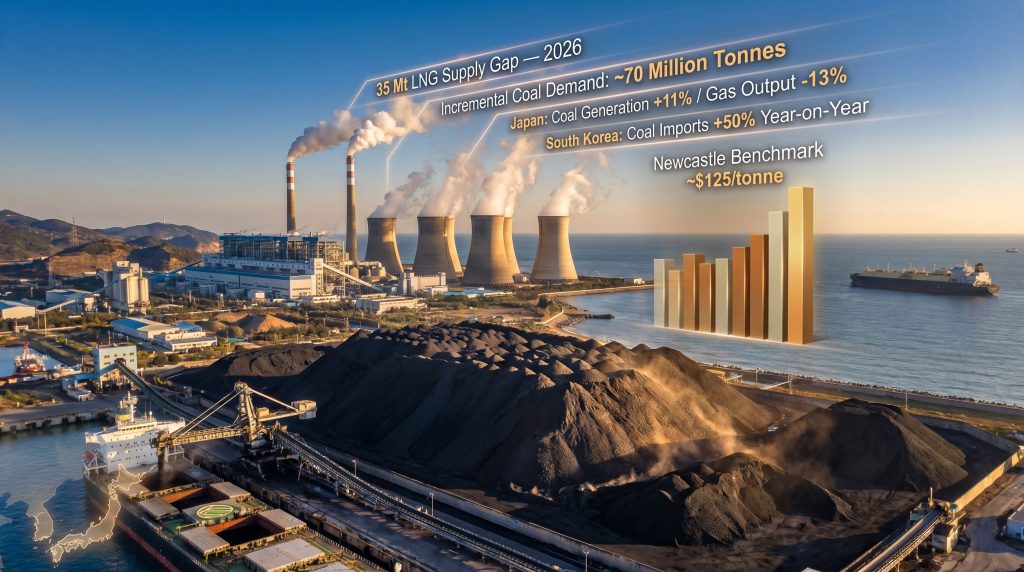
The estimated regional supply shortfall for 2026 stands at approximately 35 million tonnes, according to analysis published by Rystad Energy via OilPrice.com. This is not a marginal imbalance; it represents a meaningful volume that existing infrastructure is struggling to absorb through any mechanism other than fuel switching.
Quantifying the Scale of Asia's Coal Demand Response
The numerical dimensions of the current coal demand surge are striking, particularly when viewed through the lens of power system economics rather than raw commodity volumes.
| Metric | Value |
|---|---|
| LNG processing capacity removed (Ras Laffan) | ~10.2 Mtpa |
| Estimated 2026 regional LNG supply shortfall | ~35 Mt |
| Generation volume redirected from gas to coal | ~90 TWh |
| Incremental coal demand, base case 2026 | ~70 million tonnes |
| Cumulative incremental demand through 2030 | ~150 million tonnes |
| Incremental demand, downside scenario 2026 | ~90 million tonnes |
| Cumulative demand, downside scenario | ~190 million tonnes |
| Newcastle benchmark forecast, 2026 average | ~$125/tonne |
| Newcastle benchmark forecast, 2027 average | ~$115/tonne |
The 90 TWh of generation being redirected from gas to coal deserves particular emphasis. For context, that figure approximates the total annual electricity consumption of a mid-sized European country. Crucially, this volume cannot be absorbed by renewables, nuclear, or new-build coal on any reasonable timeframe.
The only asset class positioned to absorb this quantum of generation within weeks rather than years is existing coal-fired capacity that is already grid-connected, already staffed, and already permitted to operate. Furthermore, this is a utilisation rate story, not a capacity build story — the surge reflects existing fleets running harder, not new infrastructure being commissioned.
Country-by-Country: Who Is Absorbing the Shortfall?
The geographic distribution of coal demand acceleration maps almost precisely onto the intensity of LNG import dependence across Asia. Countries carrying the greatest gas exposure are experiencing the sharpest utilisation increases across their coal fleets. These coal supply challenges are reshaping procurement strategies across the region.
Japan: The Largest Demand Growth Market
Japan's power system has responded more dramatically than any other Northeast Asian market. Coal-fired generation increased by 11% while gas-fired output contracted by 13%, reflecting a direct fuel substitution at the dispatch level. Coal import volumes for May tracked more than 20% above year-ago levels, driven by regulatory adjustments that have eased operational constraints on coal plant utilisation. Nuclear restart programmes are proceeding but remain insufficient in scale to meaningfully offset the immediate gas shortfall.
South Korea: Steepest Import Acceleration
South Korea is recording the most striking year-on-year import increase among all Northeast Asian buyers. May coal import volumes tracked more than 50% above year-prior levels, reflecting the acute sensitivity of a power system with significant LNG exposure to spot price spikes. Authorities have extended regulatory flexibility on coal generation caps in direct response to supply tightness.
Taiwan: Reactivating Mothballed Capacity
Taiwan's position is complicated by concurrent reductions in nuclear output alongside LNG supply disruptions. Grid operators have initiated reactivation processes for coal units that were previously placed in reserve, reflecting a prioritisation of reserve margins over near-term decarbonisation targets.
Southeast Asia: Vietnam, Thailand, and the Philippines
All three economies are running existing coal generation assets at elevated utilisation rates. Both Thailand and Taiwan have initiated formal procedures to reactivate coal capacity that had been scheduled for decommissioning, a move that illustrates how quickly formal retirement timelines can be suspended when grid security is threatened.
China: Comparatively Insulated
China commodity demand dynamics differ meaningfully from the rest of the region. China's comparatively low reliance on gas-fired generation as a share of total power output provides a meaningful buffer. Domestic coal production capacity further insulates Chinese utilities from seaborne market dynamics. As a result, China's contribution to incremental seaborne thermal coal demand in 2026 is assessed as marginal relative to Northeast Asian peers, according to Rystad Energy's analysis.
The Newcastle Benchmark: Reading the Price Signal
Newcastle 6000 kcal coal functions as the global reference price for seaborne thermal coal flowing into Northeast Asian markets. Its sensitivity to regional supply-demand imbalances makes it one of the most reliable real-time indicators of fuel-switching pressure anywhere in the world.
| Period | Newcastle Forecast | Primary Drivers |
|---|---|---|
| 2026 average (base case) | ~$125/tonne | LNG tightness, geopolitical risk premium, stockpiling |
| 2027 average (base case) | ~$115/tonne | Nuclear restarts, gradual LNG supply recovery |
The current price trajectory reflects a market engaged in cautious, deliberate stockpiling rather than the kind of panic purchasing that characterised European coal markets in mid-2022. The geopolitical risk premium embedded in current prices reflects genuine uncertainty about how long the Ras Laffan disruption persists, not a reassessment of long-term structural demand.
Critically, strong coal inventory positions across both India and China, combined with record renewable energy availability in both economies, are preventing the kind of acute physical scarcity that drove truly exceptional price spikes during the post-Ukraine European energy crisis. The market is tight, but it is not structurally broken.
How 2026 Differs From the 2022 Energy Crisis
The comparison to the post-Ukraine coal surge of 2022 is instructive, both for the similarities it reveals and for the important distinctions that make the current episode a more contained dynamic.
| Factor | 2022 Russia-Ukraine Crisis | 2026 Gulf LNG Disruption |
|---|---|---|
| Primary disruption source | Russian pipeline gas to Europe | Gulf LNG processing infrastructure |
| Primary region affected | Europe, with Asian contagion | Asia-Pacific directly |
| Coal inventory levels at onset | Low across major Asian markets | Strong across India and China |
| Renewable capacity at onset | Limited | Record levels in India and China |
| Producer capital response | Investment signals emerged | No new mine sanctions to date |
| Market characterisation | Partially structural | Cyclical and emergency-driven |
The absence of a capital investment response from major producers is analytically significant. Rystad Energy's research notes that companies including Glencore, BHP, Adaro, and Bumi have not moved to sanction new large-scale mining projects or materially extend existing mine lives in response to current demand levels. This restraint stands in sharp contrast to producer behaviour following the 2022 disruption and provides the clearest available market signal that the industry views current conditions as temporary.
The key variable to monitor is not import volumes or generation dispatch data. It is capital expenditure decisions at the mine level. New mine sanctions would signal a structural reassessment. Their continued absence confirms a cyclical interpretation.
The next major ASX story will hit our subscribers first
What the JKM Benchmark Reveals That Most Analysis Misses
One of the less-commonly understood dynamics in the current crisis involves how the Japan Korea Marker functions as both a symptom and an amplifier of the fuel-switching response. The JKM is the spot price benchmark for LNG delivered into Northeast Asia, and its elevation toward three-year highs is doing something counterintuitive: it is simultaneously discouraging some LNG demand while failing to attract meaningful new supply.
This creates an asymmetric market dynamic. Price-sensitive buyers across Southeast Asia, particularly those without long-term contract coverage, are effectively being priced out of LNG spot markets entirely. Rather than reducing electricity generation, these buyers are redirecting dispatch toward coal, which has its own supply chain entirely insulated from the Gulf disruption.
The result is a demand destruction effect in LNG markets that simultaneously becomes a demand creation effect in thermal coal markets. This energy market disruption transmission mechanism — from spot LNG price elevation to coal dispatch acceleration — is faster and more automatic than most energy transition planning frameworks account for. It operates at the level of individual power station dispatch decisions, occurring within operational timeframes rather than policy timeframes.
Regulatory Responses Reinforcing the Coal Pivot
Across the region, governments have implemented a consistent set of policy adjustments that are reinforcing the market-driven shift toward coal:
- Japan and South Korea have eased operational restrictions on coal plant utilisation to protect grid reliability through peak summer demand periods
- India has directed coal-fired power stations to operate at maximum available capacity, reflecting the government's prioritisation of supply security over near-term emissions targets
- Thailand and Taiwan have initiated formal reactivation procedures for coal units previously earmarked for decommissioning, effectively extending asset lives that were considered legally and operationally concluded
- Vietnam and the Philippines have accelerated coal dispatch to compensate for reduced gas availability, running existing fleets well above their previously expected utilisation rates
The consistent logic underpinning all of these decisions is straightforward. The political and economic cost of intermittent supply or load shedding substantially exceeds the political cost of temporarily increasing coal consumption. Grid operators and energy ministries across the region are making rational, system-preserving choices within the constraints available to them.
Scenario Analysis: What Happens If Hostilities Escalate?
Rystad Energy has modelled two distinct scenarios for how the LNG supply disruption evolves through the remainder of 2026 and into 2027.
Base Case Scenario
- Ras Laffan disruption resolves partially by late 2026
- Nuclear restarts in Japan and South Korea proceed broadly on schedule
- Newcastle coal averages $125/tonne in 2026, easing to $115/tonne in 2027
- Incremental coal demand reaches approximately 70 million tonnes in 2026
- Cumulative demand increase through 2030 totals approximately 150 million tonnes
Downside Scenario (Conflict Resumption)
- Renewed hostilities extend the LNG supply gap through 2027
- Incremental coal demand in 2026 alone reaches approximately 90 million tonnes
- Cumulative near-term demand approaches 190 million tonnes
- Newcastle pricing would likely exceed the base case average materially
- Capital allocation decisions by major producers become the critical market-turning variable
Disclaimer: These are modelled scenarios, not predictions. Energy market forecasts carry inherent uncertainty, and actual outcomes will depend on geopolitical developments, weather patterns, technology deployment rates, and regulatory decisions that cannot be reliably predicted. This article does not constitute investment advice.
What the 2026 Coal Surge Reveals About Transition Architecture Risk
Perhaps the most durable insight from this episode is not what it says about coal, but what it reveals about the gaps in Asia's current energy transition architecture. The region has been systematically reducing firm fossil fuel capacity through coal plant retirements without yet deploying sufficient firm low-carbon alternatives to cover peak demand periods or supply disruption scenarios.
The structural vulnerabilities now visible include:
- Excessive concentration of transition-period gas supply in geopolitically exposed LNG infrastructure
- Insufficient grid-scale storage capacity to buffer renewable intermittency during peak demand events
- Limited cross-border interconnection that could allow surplus capacity sharing between markets
- Premature retirement of coal assets before firm, dispatchable low-carbon replacements are fully operational and proven at scale
As Rystad Energy's analysis articulates, coal is functioning as a system fallback during this period — not because regional governments have abandoned decarbonisation ambitions, but because the transition architecture has not yet been built to a standard that can withstand major supply shocks. The energy transition demand for resilient infrastructure has never been more evident than in the current crisis.
The ultimate consequence of the 2026 crisis may well be an acceleration of investment in the very technologies that could prevent a repeat scenario: long-duration storage, grid flexibility infrastructure, supply diversification away from concentrated LNG sources, and dispatchable low-carbon capacity such as advanced nuclear. The lesson is not that coal is back permanently — it is that the clean energy transition needs a more resilient engineering design to handle the inevitable shocks that accompany any multi-decade infrastructure transformation.
Furthermore, the Asia's gas shock playbook documented by Columbia University's Centre on Global Energy Policy underscores how this cycle of coal curtailment and LNG competition is a recurring feature of Asian energy security, not an isolated anomaly.
Frequently Asked Questions: Asia Coal Demand Surge From LNG Shortfall
Why is Asia experiencing a coal demand surge from the LNG shortfall in 2026?
Damage to Qatar's Ras Laffan LNG processing facility has removed approximately 10.2 Mtpa of supply from Asian markets, creating a 35 Mt regional shortfall. Gas-dependent utilities are compensating by running existing coal-fired plants at higher utilisation rates, producing the Asia coal demand surge from LNG shortfall that analysts are now closely tracking.
How much additional thermal coal will Asia consume in 2026?
Under the base case scenario modelled by Rystad Energy, approximately 70 million tonnes of incremental thermal coal demand is projected for 2026. A downside scenario involving conflict resumption could push this figure to 90 million tonnes in 2026 alone.
Which markets are seeing the largest coal demand increases?
Japan is the largest single market for incremental coal demand, with coal-fired generation rising 11% and imports running more than 20% above year-ago levels. South Korea is recording the steepest import acceleration at more than 50% above year-prior levels for May. As detailed analysis from The Coal Hub confirms, utilities across the region are responding to LNG shortages with a swift coal pivot.
Is this a permanent reversal of Asia's coal exit?
Current evidence strongly suggests a cyclical emergency response rather than a structural policy reversal. No major coal producers have sanctioned new mines or extended mine lives in response to current demand, which is the clearest available signal that the industry views conditions as temporary.
What is the Newcastle coal price forecast for 2026 and 2027?
Newcastle 6000 kcal is projected to average approximately $125/tonne in 2026 before easing toward $115/tonne in 2027 as nuclear restarts and gradual LNG supply recovery reduce regional fuel tightness.
How does this compare to the 2022 energy crisis?
The 2022 post-Ukraine crisis featured lower coal inventories, less renewable capacity, and some structural investment signals from producers. In contrast, the 2026 episode features stronger inventories, record renewable availability in India and China, and no producer capital response — making it a more contained and clearly cyclical market dynamic, rather than a signal of the Asia coal demand surge from LNG shortfall becoming a permanent structural shift.
Want To Identify ASX Opportunities From Global Energy Market Dislocations?
Discovery Alert's proprietary Discovery IQ model delivers real-time alerts on significant ASX mineral discoveries, instantly translating complex market data into actionable investment insights — ensuring subscribers are positioned ahead of the broader market. Explore why major mineral discoveries can generate substantial returns on Discovery Alert's dedicated discoveries page, or begin your 14-day free trial at Discovery Alert today to secure a market-leading edge.