May 19, 2026
Asia oil dependence after US-Israel strikes on Iran has emerged as a critical concern, as the global manufacturing landscape faces mounting pressure from energy security concerns reshaping economic fundamentals across developed and emerging markets. Supply chain vulnerabilities, once considered theoretical risks, have evolved into tangible constraints affecting industrial competitiveness and macroeconomic stability. This transformation reflects deeper structural dependencies that extend beyond immediate price fluctuations to encompass strategic resource allocation, geopolitical risk management, and long-term economic resilience planning.
Manufacturing economies demonstrate varying degrees of sensitivity to energy market disruptions based on their industrial composition, import dependency ratios, and strategic reserve capacities. The interconnected nature of global supply chains means that localised disruptions can cascade through international trade networks, creating ripple effects that extend far beyond the initial point of impact.
Understanding Asia's Strategic Energy Vulnerability in Global Markets
The Manufacturing Economy's Energy Foundation
Asia's industrial output depends fundamentally on stable energy pricing structures that enable predictable production costs and competitive export margins. Manufacturing-intensive economies across the region demonstrate heightened sensitivity to energy price volatility compared to service-oriented Western counterparts, with energy representing a substantially larger percentage of total production expenses.
Regional GDP sensitivity to sustained oil price increases operates through multiple transmission mechanisms. According to Morgan Stanley's analysis, every sustained $10 per barrel oil price increase reduces Asia's GDP growth by 0.2 to 0.3 percentage points through direct cost channels. This sensitivity reflects the region's manufacturing-intensive economic structure and export-dependent growth models.
Trade deficit implications create additional currency stability pressures during energy price spikes. Furthermore, oil price movements demonstrate that Asia's oil and gas trade deficit represents approximately 2.1% of regional GDP. This creates direct currency pressure when international energy prices rise, differing significantly from energy-producing regions where domestic production provides natural hedging.
Import Dependency Across Key Asian Economies
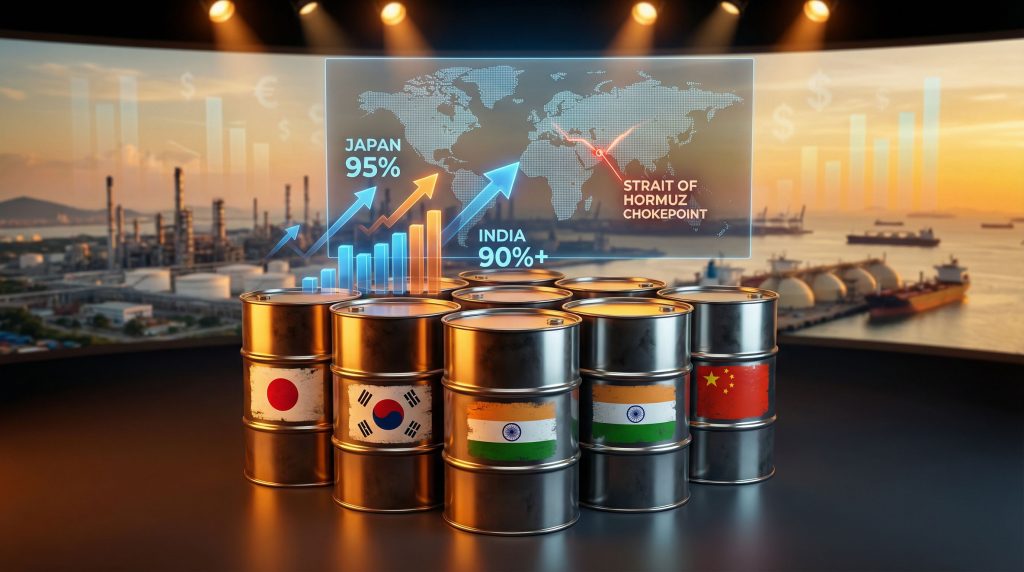
Regional energy import patterns reveal stark dependencies that create structural vulnerabilities across major Asian economies. These dependencies vary significantly in terms of concentration risk, supplier diversification, and strategic reserve capacities.
Asian Energy Import Dependence by Country
| Country | Oil Import Dependence | Primary Source Regions | Strategic Reserve Capacity |
|---|---|---|---|
| Japan | 92-95% | Middle East (87%) | 254 days |
| South Korea | 81-85% | Persian Gulf | 90 days |
| India | 85-90% | Middle East/Russia | 20-25 days |
| China | 72% | Multiple sources | 90 days |
Japan's near-total fossil fuel import dependency creates extreme vulnerability to supply disruptions. However, this risk is partially mitigated through substantial strategic reserve holdings equivalent to 254 days of consumption. This reserve capacity provides considerable policy response time during supply disruptions, representing one of the highest reserve-to-consumption ratios among developed Asian economies.
South Korea combines high manufacturing intensity with more limited strategic buffering capacity. The nation's heavy manufacturing base represents approximately 28% of GDP, with energy-intensive sectors including petrochemicals, steel, and semiconductors accounting for roughly 40% of industrial energy consumption. This concentration creates asymmetric vulnerability where supply shocks disproportionately impact high-value export sectors.
India's rapid economic expansion amplifies energy security challenges through structurally increasing demand. Energy consumption grows approximately 3-4% annually, driven by GDP growth rates of 6-7%, creating persistent supply-demand imbalances. The country's minimal 20-25 day strategic reserve capacity means geopolitical supply disruptions translate immediately into economic pressure without policy buffering mechanisms.
China demonstrates relative resilience through supply diversification and state sector control. The country receives oil imports from diversified sources including the Middle East (50%), Russia (15%), Africa (20%), and Southeast Asia (15%). State control of energy distribution provides policy flexibility unavailable to market-based competitors, including strategic reserve deployment and domestic price controls.
When big ASX news breaks, our subscribers know first
How Geopolitical Tensions Amplify Regional Economic Risk
Supply Chain Chokepoints and Critical Infrastructure
Maritime transit chokepoints represent critical vulnerabilities in Asian energy supply chains, with limited alternative routing options during disruptions. The Strait of Hormuz handles approximately 21 million barrels per day, representing roughly 20% of global seaborne oil trade and 37% of total seaborne petroleum movements worldwide.
Asian economies face particular exposure to chokepoint disruptions due to geographic concentration of supplier relationships. Unlike diversified pipeline networks available to European consumers, Asian importers rely predominantly on maritime transport from concentrated Middle Eastern production centres, creating structural dependency rather than supply optionality.
However, lng supply implications present additional vulnerabilities for industrial operations across the region. Asia accounts for approximately 63% of global LNG imports, with Japan, South Korea, and China combined consuming roughly 52% of global LNG production. This concentration means regional demand competes intensively during supply constraints, driving price volatility that affects industrial competitiveness.
Maritime insurance premium escalations during geopolitical tensions create direct cost increases for energy imports. The 2023-2024 Red Sea shipping crisis demonstrated these dynamics, with insurance premiums increasing 200-400% for vessels transiting high-risk zones. These premium increases translate to 3-5% cost increases for energy imports during sustained high-tension periods.
Price Volatility Impact on Manufacturing Competitiveness
Direct GDP reduction mechanisms operate through multiple channels when energy prices spike. Industrial input cost inflation affects manufacturing competitiveness immediately, whilst transportation and logistics price increases create broader supply chain pressures. Consumer energy expenditure increases crowd out discretionary spending, reducing domestic demand for manufactured goods.
Export margin compression in manufacturing sectors creates immediate competitive disadvantages in international markets. South Korean export industries experience approximately 0.5-1.5% margin compression per $10 barrel oil price increase, directly affecting the profitability of key export sectors including petrochemicals, electronics, and automotive manufacturing.
Currency depreciation pressures emerge from widening trade deficits as energy import costs increase. Countries with large current account deficits, particularly India where energy imports represent 35-40% of the total import bill, face amplified currency pressure during oil price spikes. These currency movements create secondary inflationary pressures that further constrain economic growth.
Which Asian Economies Face the Greatest Exposure?
High-Risk Economies: Japan and South Korea
Japan's Energy Profile:
Japan's energy security challenges stem from near-total fossil fuel import dependency combined with limited domestic alternative energy resources. Oil import dependency reaches 92-95% of consumption, with approximately 87% of supplies originating from Middle Eastern producers. This geographic concentration creates significant exposure to regional supply disruptions.
Nevertheless, Japan has developed substantial risk mitigation through strategic reserve accumulation. The country maintains confirmed strategic petroleum reserves equivalent to 254 days of consumption, providing approximately 9 months of policy response time during supply disruptions. This represents the highest reserve-to-consumption ratio among major developed Asian economies.
Manufacturing sector energy costs represent 6-8% of production expenses in heavy industries, creating direct transmission mechanisms between energy price volatility and industrial competitiveness. LNG terminal capacity of approximately 200 million cubic metres per day provides demand flexibility during supply constraints.
South Korea's Industrial Vulnerability:
South Korea combines intensive manufacturing exposure with more limited strategic buffering capacity. Heavy manufacturing represents approximately 28% of GDP, with energy-intensive industries concentrated in export sectors that compete internationally on cost competitiveness.
Strategic petroleum reserves of approximately 90 days provide only 3 months of policy response time, significantly less buffering capacity than Japan's reserves. This limited reserve capacity means supply disruptions translate more rapidly into economic pressures and policy constraints.
Export economy sensitivity to input costs creates amplified vulnerability during energy price spikes. Manufacturing sectors experience direct margin compression when energy costs increase, affecting the competitiveness of key export industries in global markets.
Emerging Market Pressures: India's Critical Position
India's energy security challenges reflect rapid economic growth increasing energy demand at rates exceeding supply capacity expansion. Energy consumption grows approximately 3-4% annually, driven by GDP expansion of 6-7%, creating structural supply-demand mismatches that increase import dependency over time.
Minimal strategic reserve capacity of 20-25 days provides virtually no policy buffering during supply disruptions. This limited capacity means all geopolitical supply disruptions immediately transmit to domestic prices and economic activity without policy intervention capabilities.
Furthermore, geopolitical constraints limit supplier diversification options, with traditional suppliers concentrated in regions experiencing increasing political instability. Current account deficit vulnerability emerges because energy imports represent approximately 35-40% of the total import bill, meaning energy price increases create immediate currency pressure and inflation transmission.
Energy deficit expansion occurs structurally as demand growth outpaces domestic production capacity additions. This widening deficit, currently approximately $50-60 billion annually, creates persistent external financing requirements that increase vulnerability to international capital market conditions.
China's Relative Resilience Through Scale and Reserves
China demonstrates relative resilience through diversified supplier relationships and state-controlled energy sector management. Oil imports represent 72% of consumption, but supply sources include diversified geographic regions that reduce concentration risk compared to other Asian economies.
Substantial strategic petroleum reserves equivalent to approximately 90 days of consumption provide policy response capabilities. However, these reserves translate to substantially more absolute volume than comparable reserve periods in smaller economies due to China's consumption scale of approximately 14 million barrels daily.
State-controlled energy sector provides policy flexibility unavailable to market-oriented competitors. These capabilities include strategic reserve deployment, domestic price controls through state-owned enterprises, and supply-demand management via administrative directives that can absorb short-term price shocks without full pass-through to industrial users and consumers.
However, growing Middle East dependency partially offsets diversification benefits, with Middle Eastern suppliers now representing 50% of imports compared to 45% in 2015. This increasing concentration creates gradual erosion of the diversification advantages that previously provided China with relative supply security.
Economic Transmission Mechanisms: From Energy Shocks to Growth Impact
Direct Cost Channels
Industrial input cost inflation represents the primary transmission mechanism through which energy price shocks affect Asian manufacturing economies. Energy represents a larger percentage of production costs in manufacturing-intensive Asian economies compared to service-oriented Western counterparts, creating immediate competitiveness pressures when energy prices spike.
Transportation and logistics price increases create secondary effects throughout supply chains, affecting both input costs and distribution expenses. These costs compound across multiple supply chain stages, creating cumulative cost pressures that extend beyond immediate energy users to affect broader economic sectors.
Consumer energy expenditure increases crowd out discretionary spending on manufactured goods and services. This demand destruction affects domestic markets for manufactured products, creating additional pressure on industrial sectors already facing increased input costs from oil price crash analysis.
Indirect Macroeconomic Effects
Central bank policy responses to imported inflation create additional economic constraints during energy price shocks. Monetary authorities face difficult trade-offs between accommodating energy-driven inflation and maintaining price stability, often leading to policy tightening that amplifies economic contraction pressures.
Current account deterioration and currency pressure emerge as energy import costs increase trade deficits. Countries with substantial energy import bills experience immediate balance of payments pressure that can trigger currency depreciation, creating secondary inflationary pressures through other imported goods and services.
Investment postponement in energy-intensive sectors occurs as businesses delay expansion plans during periods of energy price uncertainty. This investment reduction creates longer-term growth implications beyond immediate production cost increases, affecting capital formation and productivity growth prospects.
Historical Context: Learning from Previous Energy Crises
2007-2008 Oil Shock Parallels
The 2007-2008 energy crisis provides instructive parallels for understanding potential Asian economic impacts during sustained energy price increases. Oil prices reached $147 per barrel in July 2008, creating severe economic pressures across energy-importing economies globally.
Asian manufacturing sectors experienced significant contractions during this period, with regional GDP growth declining from approximately 7-8% in 2007 to near zero or negative growth in 2008-2009. South Korea's economy contracted 5.1% in 2009 following the oil shock, demonstrating the severe economic transmission effects of sustained energy price increases.
Price trajectory patterns during the 2008 crisis showed rapid acceleration from moderate levels to extreme peaks, creating severe adjustment pressures for energy-importing economies. The speed of price increases limited policy response capabilities and created sudden competitiveness shocks for manufacturing exporters.
Regional economic growth deceleration patterns varied based on energy dependency levels and strategic reserve capacities. Countries with limited strategic reserves experienced more severe immediate impacts, whilst economies with substantial reserve holdings demonstrated greater resilience during the initial shock period.
COVID-19 Supply Chain Lessons Applied to Energy Security
The COVID-19 pandemic revealed supply chain vulnerabilities that parallel energy security challenges facing Asian economies. Just-in-time inventory systems that optimise efficiency during normal conditions create severe vulnerabilities during supply disruptions, limiting buffer capacity for managing unexpected shocks.
Geographic concentration risks became apparent as localised disruptions cascaded through global supply networks. These lessons apply directly to energy supply chains, where geographic concentration of suppliers creates system-wide vulnerabilities that extend beyond individual country exposure levels.
Strategic stockpiling importance emerged as a critical lesson for managing supply chain resilience. Countries and companies with substantial inventory buffers demonstrated superior capability for managing disruptions, providing policy space for adjustment without immediate economic contraction pressures.
Risk Mitigation Strategies and Policy Responses
Short-Term Crisis Management
Strategic petroleum reserve deployment provides immediate policy response capability during supply disruptions. Countries with substantial reserves can release stored petroleum to domestic markets, moderating price increases and providing adjustment time for supply chain adaptation.
Emergency supplier diversification involves rapidly developing alternative supply relationships during crisis periods. This approach requires pre-existing diplomatic and commercial relationships that can be activated quickly, as establishing new supply chains during crisis periods typically involves substantial time delays and cost premiums.
Industrial production scheduling adjustments allow energy-intensive industries to optimise consumption patterns during high-price periods. These adjustments can include shifting production to off-peak periods, temporary capacity reductions, or prioritising high-value products that can absorb increased energy costs.
Long-Term Structural Reforms
Renewable energy transition acceleration reduces long-term import dependency and provides greater energy security through domestic production capacity. However, renewable transitions require substantial capital investment and typically involve 5-10 year development timelines that limit short-term crisis response capabilities.
Regional energy cooperation frameworks can provide mutual support during supply disruptions through shared strategic reserves and coordinated procurement strategies. These frameworks require multilateral diplomatic coordination and shared infrastructure development that extends beyond individual country capabilities.
Alternative supply route development includes pipeline infrastructure and LNG terminal capacity expansion that provides greater supply flexibility. Infrastructure development typically requires 3-5 years minimum for project completion, meaning these solutions address medium-term rather than immediate vulnerability.
The next major ASX story will hit our subscribers first
Investment and Market Implications
Sector Rotation Opportunities
Energy security infrastructure investments create substantial capital allocation opportunities across power generation, storage, and distribution sectors. These investments benefit from policy support and strategic importance that can provide attractive risk-adjusted returns during energy transition periods.
Renewable technology deployment accelerates during energy security crises as governments and businesses seek alternatives to volatile fossil fuel imports. Solar, wind, and energy storage technologies experience increased demand and policy support that creates favourable investment conditions.
Regional energy storage solutions become increasingly valuable as energy security concerns drive demand for buffer capacity and supply flexibility. Battery storage, hydrogen production, and other storage technologies provide strategic value beyond pure economic returns during energy security crises.
Currency and Commodity Market Dynamics
Asian currency depreciation pressures emerge systematically during energy price spikes as trade deficits widen and current account balances deteriorate. These currency movements create investment opportunities in commodity-linked assets and export-oriented companies that benefit from currency depreciation.
Energy commodity futures positioning provides direct exposure to energy price movements and can serve as portfolio hedging mechanisms during geopolitical tensions. However, commodity futures involve substantial volatility and require sophisticated risk management capabilities.
Regional equity market sector impacts vary based on energy intensity and import dependency levels. Energy-intensive sectors typically underperform during price spikes, whilst domestic service sectors and renewable energy companies may outperform due to substitution effects and policy support.
Future Outlook: Building Resilient Energy Systems
Technology-Driven Solutions
LNG terminal capacity expansion provides increased import flexibility and supply source diversification for Asian economies. New terminal development enables access to global LNG markets and reduces dependence on pipeline imports from concentrated geographic regions.
Smart grid infrastructure development optimises energy distribution efficiency and enables integration of diverse energy sources including renewable generation and storage systems. These technological improvements reduce overall system vulnerability and provide greater operational flexibility during supply constraints.
In addition, energy security strategies through energy efficiency improvements in manufacturing reduce total energy consumption requirements and decrease import dependency over time. Industrial efficiency technologies provide both cost savings and strategic security benefits by reducing overall energy intensity of economic production.
Geopolitical Diversification Strategies
Alternative supplier relationship building requires diplomatic and commercial initiatives to develop supply sources beyond traditional Middle Eastern producers. This diversification reduces concentration risk but requires sustained policy effort and may involve cost premiums for less convenient supply sources.
Regional energy sharing agreements enable mutual support during supply disruptions through coordinated strategic reserve releases and shared procurement capabilities. These agreements require multilateral coordination but provide enhanced security through collective action capabilities.
Consequently, declining us oil production creates both challenges and opportunities for Asian economies seeking supplier diversification. Strategic reserve coordination mechanisms optimise regional buffer capacity and provide more effective crisis response through coordinated rather than competitive reserve deployment.
According to detailed analysis of oil and LNG dependence, coordination requires sharing sensitive information about reserve levels and consumption patterns but creates superior overall security outcomes. Asia oil dependence after US-Israel strikes on Iran remains a critical factor in regional economic planning, requiring sophisticated risk management approaches that balance immediate vulnerabilities with long-term strategic positioning.
This analysis presents market perspectives and economic projections that involve inherent uncertainties. Energy market dynamics, geopolitical developments, and economic impacts remain subject to rapid changes that may differ substantially from historical patterns and current forecasts. Investment decisions should consider multiple scenarios and risk factors beyond those discussed in this analysis.
Looking to Invest in Energy Security Solutions?
Discovery Alert's proprietary Discovery IQ model delivers real-time alerts on significant ASX mineral discoveries, including critical energy transition minerals essential for Asia's long-term energy independence. With geopolitical tensions highlighting the urgent need for supply chain diversification, subscribers receive instant notifications about lithium, rare earths, and other strategic mineral discoveries that could reshape regional energy security. Begin your 14-day free trial today to identify actionable investment opportunities ahead of the broader market.