May 19, 2026
The Execution Gap: Why African Mining's Partnership Era Is Being Tested Right Now
Across the global resources sector, the distance between high-level commitment and ground-level delivery has long been one of the most persistent sources of investor frustration. Forums produce declarations. Declarations produce MoUs. MoUs produce filing cabinets. For decades, this cycle defined how the mining industry approached collaboration, particularly across the African continent where resource wealth and institutional complexity exist in sharp tension. Mining Indaba partnerships in practice represent what is changing now, and changing with unusual deliberateness: the architecture being built to close that gap permanently.
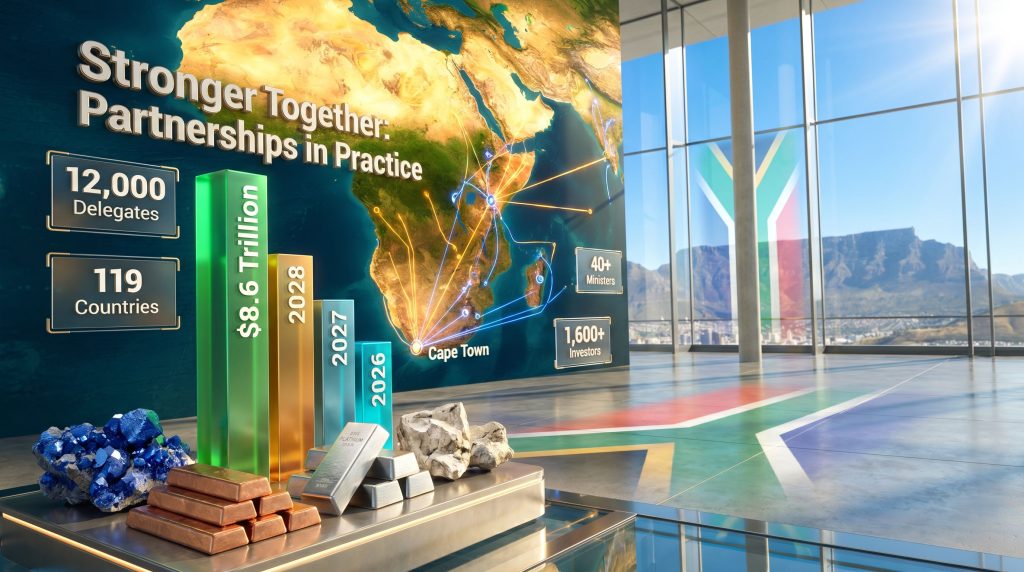
The Investing in African Mining Indaba has positioned itself at the centre of this shift. Its 2027 edition, scheduled for Cape Town from February 8 to 11, carries the theme Stronger Together: Partnerships in Practice, and it represents far more than a rebranding exercise. It is the second phase of a structured, multi-year framework designed to force accountability into the partnership conversation that has defined African mining discourse for years.
When big ASX news breaks, our subscribers know first
Understanding the Three-Year Strategic Architecture
What distinguishes the current Mining Indaba trajectory from previous annual summits is the explicit sequencing of its thematic purpose across three consecutive years. This is not accidental framing. It reflects a recognition that genuine collaboration requires a progression that annual one-off events simply cannot deliver.
The three phases are structured as follows:
-
2026 – Partnerships established as the foundational framework for industry growth, with renewed focus on collaboration as a prerequisite for capital mobilisation.
-
2027 – Activation phase, where the theme Partnerships in Practice signals a decisive shift from relationship-building to concrete deployment: capital unlocked, policy reformed, projects advanced.
-
2028 – Accountability and measurement phase, where the tangible outcomes of the partnership framework are assessed, reported, and scrutinised by the broader investment community.
The 2027 edition occupies a uniquely pressured position in this sequence. It is the inflection point between intent and evidence, and the mining investment community will be watching whether the activation rhetoric translates into verifiable project-level outcomes.
Mining Indaba's industry director has articulated this progression by describing the 2027 event as the moment partnerships shift decisively from concept to action, with 2026 having laid the foundational relationships and 2028 set to measure what those relationships actually produced. The executive advisory board has reinforced this by noting that execution, not dialogue, is what determines competitive resilience in African mining. Furthermore, the PDAC conference insights from the Canadian equivalent highlight how structured multi-year thematic frameworks can meaningfully elevate a forum's strategic credibility.
What the 2026 Record Attendance Signals About Investor Appetite
Before examining where Mining Indaba 2027 is headed, it is worth understanding the scale of momentum the 2026 edition created. The event attracted 12,000 delegates from 119 countries, making it the largest in the forum's 32-year history. Notably, this included:
- More than 1,600 investors actively engaged across deal-making and due diligence activities
- Over 1,700 senior executives from mining companies spanning exploration through to major producers
- More than 40 government ministers, a figure that represents a near-tripling from the approximately 14 ministers who attended in 2024
That last data point is worth dwelling on. The leap from roughly 14 to over 40 ministerial participants in just two years is not a cosmetic measure of popularity. It signals that heads of government across the continent have recalibrated mining's position within their economic policy priorities. When finance ministries and resource ministries send senior representation to a private sector forum in this volume, it reflects a political consensus that mining investment capacity is a tier-one economic objective, not a sectoral afterthought. In addition, the African mining finance trends emerging in 2025 suggest this ministerial engagement is directly correlated with improved sovereign debt and equity market conditions for resource-aligned economies.
The Deals That Defined Mining Indaba 2026
The 2026 edition produced a portfolio of concrete agreements that, collectively, illustrate what the Partnerships in Practice framework is designed to scale. These transactions spanned financing, formalisation, exploration, infrastructure, and trade, demonstrating the ecosystem breadth the event has developed.
| Deal Type | Parties Involved | Strategic Focus |
|---|---|---|
| Critical minerals trade | Metalex Commodities (US) and Anzana Electric Group | Cross-continental commodity supply architecture |
| Trade finance expansion | Afreximbank and Development Bank of Southern Africa | De-risking transactions, accelerating beneficiation |
| Artisanal mining formalisation | ERG Africa and Entreprise Générale du Cobalt (DRC) | Governance of cobalt supply chains |
| Junior mining capital | Anglo American and Junior Mining Exploration Fund | R200-million injection, total fund R600-million |
| Natural diamond sector | Namibia and the Luanda Accord | Sovereignty over diamond market positioning |
| Infrastructure co-investment | Valterra Platinum, Roads Agency Limpopo, mining partners | R100-million road and logistics investment |
Each of these transactions carries strategic weight beyond its headline figure. The Afreximbank and DBSA pact, for instance, addresses one of the most persistent barriers to African mining investment: the cost and availability of trade finance for critical minerals beneficiation. When multilateral institutions commit to scaling de-risked financing instruments, they lower the effective capital cost for junior and mid-tier miners trying to move up the value chain.
The ERG Africa and Entreprise Générale du Cobalt agreement deserves particular attention. Artisanal and small-scale mining (ASM) accounts for a significant portion of the Democratic Republic of Congo's cobalt output, yet it has historically sat outside formal supply chain governance. The DRC cobalt supply chains are increasingly subject to geopolitical scrutiny, and with battery manufacturers and EV producers facing growing due diligence obligations under international frameworks, formalising ASM cobalt production is not merely a social good. It is becoming a commercial necessity for any supply chain seeking to access regulated end markets in Europe and North America.
Africa's $8.6 Trillion Strategic Minerals Opportunity
The Africa Finance Corporation has estimated that the continent holds a strategic minerals opportunity valued at $8.6 trillion. This figure encompasses the critical minerals demand that underpins the global energy transition, including lithium, cobalt, copper, platinum group metals (PGMs), and rare earth elements.
To understand why this figure remains largely unrealised, it is important to distinguish between resource endowment and economic value capture. Africa holds a disproportionate share of the world's critical mineral reserves:
- The DRC holds an estimated 70% of global cobalt reserves
- South Africa contains approximately 90% of the world's known platinum group metal reserves
- Zimbabwe holds some of the world's highest-grade lithium pegmatite deposits
- Namibia and Botswana are among the most significant diamond-producing jurisdictions globally
Yet the continent processes and benefits from only a fraction of the value these resources represent. The structural barriers include inadequate energy infrastructure, thin domestic capital markets, inconsistent regulatory environments, limited processing and refining capacity, and historically underdeveloped logistics corridors. This is precisely why the Mining Indaba partnerships in practice framework matters beyond the conference room. Closing the gap between reserve endowment and economic value capture requires exactly the kind of multi-stakeholder, cross-sector collaboration that the three-year thematic arc is trying to institutionalise.
The Five Partnership Dimensions That Will Define Outcomes
Translating the partnership agenda into something operationally meaningful requires understanding the specific domains where collaboration is most urgently needed. Mining Indaba's 2027 programme organises this across five distinct dimensions:
| Partnership Dimension | Core Challenge | Measurable Outcome |
|---|---|---|
| Government-industry regulatory alignment | Licensing unpredictability, sovereign risk | Faster approvals, greater investment certainty |
| Digital infrastructure | Manual cadastre systems, permitting bottlenecks | Transparent, efficient permitting pipelines |
| Energy and transport | Grid access gaps, logistics deficits | Improved project bankability thresholds |
| Local value creation | Procurement leakage, skills shortages | Shared economic participation |
| Regional integration | Fragmented cross-border rules, corridor limitations | Scalable mineral value chain development |
Each of these dimensions carries a specific investment thesis. Regulatory alignment reduces the risk premium that investors price into African project valuations. Digital permitting modernisation compresses project timelines and reduces the informal costs associated with administrative uncertainty. Energy and infrastructure partnerships directly affect the operating cost profile and bankability of individual mines. Consequently, permitting and community trust frameworks developed in jurisdictions such as British Columbia offer transferable lessons for African regulators seeking to accelerate approval processes without sacrificing stakeholder integrity.
The next major ASX story will hit our subscribers first
How Mining Indaba Compares to Global Peer Forums
To appreciate what makes Mining Indaba structurally distinctive, it is useful to situate it within the broader landscape of global mining conferences.
| Forum | Primary Orientation | Geographic Focus | Key Differentiator |
|---|---|---|---|
| Mining Indaba | Investment and partnerships | Africa-centric, global reach | Government-investor-industry convergence at scale |
| PDAC (Canada) | Exploration and junior capital | Global | Exploration-stage financing and prospecting |
| IMARC (Australia) | Technology and operations | Asia-Pacific | Operational innovation and mining technology |
| African Mining Week | Policy and governance | Africa | Regulatory and legislative emphasis |
What sets Mining Indaba apart is not simply its attendance scale, though that is significant, but the deliberate convergence it creates between government decision-makers, institutional capital, major producers, junior explorers, development finance institutions, and community representatives within a single structured environment. No other forum replicates this combination at the same level of seniority or deal-making density.
The Barriers That Still Threaten Partnership Credibility
Optimism about Mining Indaba's partnership architecture must be balanced against the structural obstacles that have undermined African mining collaboration historically. Several of these barriers remain acute:
Regulatory inconsistency continues to erode investor confidence even after formal agreements are reached. When a government minister signs an MoU at a forum but licensing timelines on the ground remain unpredictable, the credibility of the entire partnership framework is damaged. Investors with capital allocation choices between Africa, South America, and Australia will price this inconsistency into their required return thresholds.
Infrastructure deficits represent perhaps the most tangible constraint on project bankability. Power access, water availability, and transport corridor capacity are not problems that partnership MoUs alone can resolve. They require committed co-investment from utilities, independent power producers, and logistics operators, alongside patient public capital from development finance institutions.
Capital access constraints have tightened globally as interest rates remained elevated through much of the post-2022 cycle. Junior mining companies, which depend heavily on equity capital markets for early-stage exploration financing, face a more competitive environment for investor attention than they did during the commodity supercycle of the previous decade.
Community trust deficits represent an underappreciated risk to the partnership model. Agreements between governments and corporations that fail to include affected communities as genuine participants, rather than passive beneficiaries, are increasingly vulnerable to social licence challenges that can delay or derail projects regardless of their technical and financial merits. The World Bank's guidance on partnering with the mining industry in both favourable and difficult conditions reinforces why inclusive stakeholder engagement is not optional but foundational to long-term project resilience.
Execution is what will shape the competitiveness and resilience of African mining. This framing from the Mining Indaba executive advisory board is instructive precisely because it places the burden of proof squarely on what happens between summits, not during them.
A Practical Framework for Maximising Mining Indaba 2027 Engagement
For participants attending Mining Indaba 2027 in Cape Town, the shift toward partnerships in practice demands a more structured approach to engagement than previous editions required.
For institutional investors:
- Map existing portfolio exposure to African critical minerals against the specific partnership gaps being addressed at the event, particularly in energy access, beneficiation finance, and community procurement.
- Use ministerial access to assess the credibility of regulatory reform timelines, not merely their existence. Ask for specific legislative milestones and delivery dates.
- Evaluate companies not only on resource estimates but on their demonstrated ability to construct and maintain multi-stakeholder partnership structures.
For mining companies:
- Arrive with specific collaboration mandates, not general presentations. Identify the infrastructure, energy, or skills gaps in your project pipeline that require co-investment to resolve.
- Engage proactively with community platforms to understand social licence requirements before they materialise as project constraints rather than after.
- Position partnership commitments made at the 2027 event within the accountability framework that the 2028 edition will apply. Committing to measurable outcomes now signals credibility to both investors and government counterparts.
For government representatives:
- Translate policy aspirations into specific regulatory reform timelines with named milestones and responsible institutions attached.
- Use bilateral ministerial engagement opportunities to advance cross-border corridor agreements that unlock regional value chain integration.
- Treat cadastre modernisation and digital permitting as investor credibility signals, not merely administrative upgrades.
Frequently Asked Questions: Mining Indaba Partnerships in Practice
What is the theme of Mining Indaba 2027?
The official theme is Stronger Together: Partnerships in Practice, representing the activation phase of a three-year strategic progression. It shifts the forum's focus from establishing partnerships to converting them into capital deployment, regulatory reform, and measurable project delivery outcomes.
When and where is Mining Indaba 2027?
Mining Indaba 2027 will be held in Cape Town, South Africa, from February 8 to 11, 2027.
How significant was Mining Indaba 2026's attendance?
The 2026 edition drew 12,000 delegates from 119 countries, including more than 1,600 investors, over 1,700 executives, and more than 40 government ministers, making it the largest gathering in the event's 32-year history.
What is Africa's estimated strategic minerals value?
The Africa Finance Corporation has placed the continent's strategic minerals opportunity at $8.6 trillion, encompassing critical minerals central to the global energy transition including cobalt, lithium, copper, and platinum group metals.
How does the 2028 phase hold the partnership agenda accountable?
The 2028 edition is designed as a measurement and reporting phase, where the outcomes of partnerships activated in 2027 will be assessed against tangible metrics including capital deployed, projects advanced, regulatory reforms enacted, and community benefits delivered.
The True Test Lies Between Summits
The credibility of the Mining Indaba partnerships in practice framework will ultimately be determined not by what is announced in Cape Town in February 2027, but by what is built, financed, permitted, and producing in the months and years that follow. Africa's $8.6 trillion strategic minerals opportunity is not a passive asset waiting to be unlocked by good intentions. It requires the kind of disciplined, multi-stakeholder execution that the Mining Indaba three-year architecture is deliberately designed to enforce.
The expansion of Mining Indaba's scope to include the full mineral value chain, from grassroots exploration through to processing, manufacturing, and local value-addition, signals an institutional maturation that goes beyond event management. It reflects an understanding that African mining's long-term competitive positioning in the global critical minerals cycle depends on building an ecosystem, not just extracting resources.
Whether the 2027 activation phase produces the execution discipline the continent's resource endowment demands will be one of the defining questions of this decade in African mining.
This article contains forward-looking statements and projections based on publicly available information and industry analysis. Readers should exercise independent judgement when making investment decisions. Past forum outcomes are not necessarily indicative of future project or market performance.
Further coverage of the Mining Indaba programme and African mining sector developments is available through Mining Weekly at miningweekly.com.
Want to Track the Next Major Mineral Discovery Before the Broader Market Does?
Africa's $8.6 trillion strategic minerals opportunity is reshaping global investment flows, and Discovery Alert's proprietary Discovery IQ model delivers real-time ASX alerts the moment significant mineral discoveries are announced — turning complex data across 30+ commodities into clear, actionable insights for both traders and long-term investors. Explore historic discoveries and the returns they generated to understand what early positioning can mean, then start your 14-day free trial to ensure you're never behind the market on the next major find.