May 19, 2026
The Geological Lottery That Redrew the Global Mining Map
Few regions on earth have been dealt a geological hand as consequential as Latin America. The Andean copper belt stretching from northern Chile through Peru and into Ecuador represents the single largest concentration of copper mineralisation on the planet. Beneath the high-altitude salt flats of the Atacama and Puna regions sit lithium brine systems so chemically concentrated they bear little resemblance to the dilute deposits found elsewhere. Brazil's cratonic basement hosts rare earth element deposits and a near-monopoly on global niobium production. This is not coincidence — it is the product of tectonic processes spanning hundreds of millions of years, and it is precisely why mining mergers and acquisitions in Latin America have become the defining dealmaking story of the current commodity cycle.
Understanding why capital is flowing south requires more than a commodity price chart. It demands an appreciation of geology, geopolitics, technology, and the structural realities of how global supply chains are being rebuilt from the ground up.
When big ASX news breaks, our subscribers know first
A Structural Shift, Not a Cyclical Spike
Why the Current M&A Wave Is Different From Previous Cycles
Latin America has attracted mining capital before. The commodity supercycle of the 2000s brought significant investment into the region, particularly in copper and gold. What distinguishes the current period is the nature of the demand driving acquisitions. Previous cycles were largely commodity-price-responsive: capital chased high prices and retreated when they fell. The current wave is being driven by something more durable: the systematic restructuring of global industrial supply chains around a new set of critical minerals.
Governments across North America, Europe, Japan, South Korea, and Australia have formally designated copper, lithium, nickel, cobalt, and rare earth elements as critical minerals essential to national economic and defence security. This policy architecture creates a floor under acquisition demand that is largely independent of short-term commodity price movements. Corporate boards at major mining groups are not simply chasing margin; they are responding to shareholder pressure, offtake obligations, and strategic mandates to secure resource positions that cannot be replicated on any reasonable timeline through greenfield development.
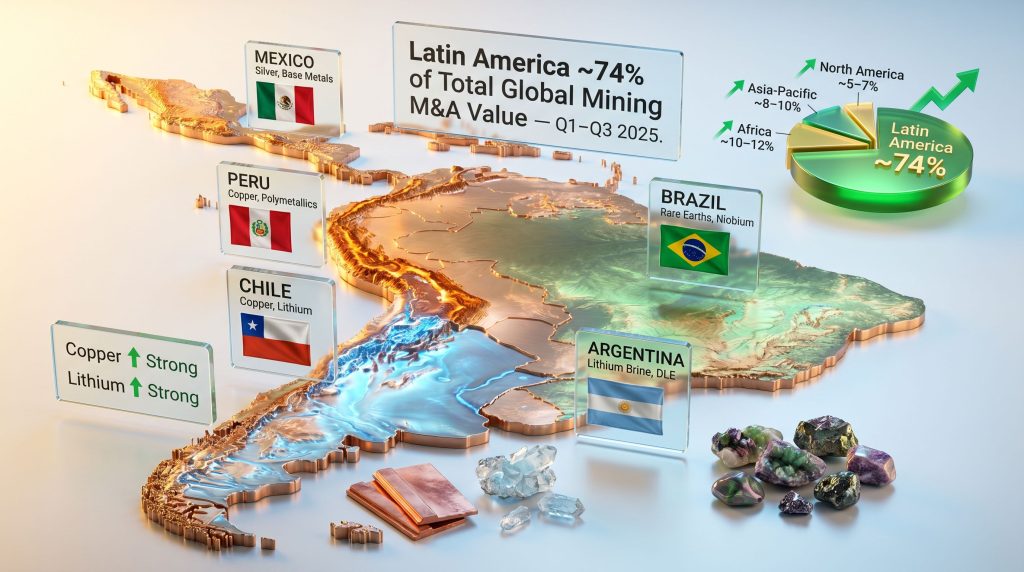
The numbers reflect this structural shift. Latin America captured an estimated 74% of total global mining M&A value in the first three quarters of 2025, against a backdrop of approximately $30 billion in worldwide mining deal activity during the same period. This concentration is not a statistical anomaly — it reflects the region's irreplaceable role as the primary supplier of minerals that the global economy has decided it urgently needs. According to global mining M&A data, deal flows into the region have risen sharply over recent years, reinforcing this trend.
Note: M&A value estimates are drawn from aggregated industry reporting and should be treated as indicative. Independent verification of precise deal values across all jurisdictions requires access to proprietary transaction databases.
Comparing Latin America's M&A Share Against Other Global Mining Regions
| Region | Estimated Share of Global Mining M&A Value (Q1–Q3 2025) | Primary Commodity Focus |
|---|---|---|
| Latin America | ~74% | Copper, Lithium, Gold, Rare Earths |
| Africa | ~10–12% | Gold, Cobalt, Manganese |
| Asia-Pacific | ~8–10% | Iron Ore, Nickel, Coal |
| North America | ~5–7% | Gold, Uranium, Potash |
| Rest of World | ~3–5% | Mixed |
Estimates are indicative and derived from aggregated industry reporting.
Four Forces Driving Acquisition Activity Simultaneously
A Multi-Factor Framework for Understanding Deal Motivation
Mining mergers and acquisitions in Latin America are not being driven by a single thesis. At least four distinct strategic imperatives are operating simultaneously, and the interaction between them is compressing deal timelines and elevating acquisition premiums.
1. Supply-Chain Sovereignty
The most powerful force reshaping mining M&A globally is the imperative for industrial nations to secure domestic or allied-nation supply of minerals classified as strategically critical. What makes this force particularly potent for Latin America is the absence of viable substitutes. The Lithium Triangle, comprising the salt flat systems of Chile, Argentina, and Bolivia, contains the majority of the world's economically accessible lithium brine resources. There is no comparable alternative geography. Acquirers cannot simply redirect capital to a different region and achieve the same outcome.
2. Portfolio Rationalisation Among Diversified Majors
Large global mining corporations have spent the past several years aggressively divesting exposure to thermal coal, mature iron ore positions, and lower-grade base metal assets. The capital released through these divestments is being systematically redeployed into high-quality critical mineral positions. Latin American assets, particularly in Chile and Peru, frequently satisfy the grade, scale, and cost-curve requirements for inclusion in a tier-one portfolio. This creates a persistent pool of acquisition capital seeking a limited number of genuinely premium assets. Furthermore, mining industry consolidation trends suggest this rationalisation cycle still has considerable momentum remaining.
3. Valuation Arbitrage at the Junior and Mid-Tier Level
The 2022 to 2023 capital market contraction was unusually severe for junior and mid-tier mining companies. Equity financing dried up, project development timelines extended, and market capitalisations compressed to levels that in many cases implied negative value for exploration and development assets beyond the core project. This created a rare arbitrage window: major acquirers could secure substantial resource tonnage at a cost per pound or tonne of contained metal that was materially below the marginal cost of greenfield development. That window has not fully closed, and it continues to drive transaction activity across the region.
4. Downstream Integration and Processing Premiums
A less-discussed but increasingly significant driver is the downstream dimension of Latin American mining M&A. Regional governments and multilateral development institutions are investing heavily in refining and processing capacity, seeking to capture a greater share of the value chain rather than exporting raw ore or concentrate. Acquirers who secure upstream assets now may find that those assets appreciate materially in value as proximate processing infrastructure comes online.
Country-by-Country: Where Deals Are Concentrating
Chile: The Dual-Anchor Jurisdiction
Chile's position at the centre of Latin American mining M&A rests on two entirely separate geological realities. Its copper endowment, concentrated in the Atacama and Antofagasta regions, is the world's largest and has been the foundation of the country's export economy for decades. Separately, the Atacama salt flat hosts lithium brine with lithium concentrations that are among the highest recorded globally, often exceeding 1,500 mg/L in the most productive zones — a grade that makes extraction economics dramatically superior to hard-rock spodumene deposits found in Australia or the Americas.
The Chilean government's evolving posture on lithium, including requirements for state participation through Codelco or its affiliated entities in new lithium development contracts, has restructured the M&A landscape. Outright acquisitions of lithium assets are increasingly replaced by joint venture arrangements that incorporate state partners. This is not necessarily a deterrent for sophisticated acquirers; however, it creates a more complex deal structure, one that can also provide political risk mitigation through alignment with the state's economic interests.
Peru: Deep Value With a Risk Premium
Peru's copper and polymetallic endowment, encompassing zinc, silver, lead, and molybdenum co-products at many operations, makes it geologically among the most compelling mining jurisdictions in the world. The challenge is that social licence risk in Peru is not abstract. Community opposition to mining projects has been the primary cause of project delays and value destruction for well over a decade.
Analytical note: Investors evaluating Peruvian mining M&A should treat social licence due diligence as a first-order analytical task, not a box-ticking exercise. The cost of community opposition at a Peruvian mine can extend timelines by years and add hundreds of millions of dollars to project costs.
The risk premium embedded in Peruvian asset valuations is real and, for acquirers with genuine community engagement capability, potentially the source of above-market returns. Consequently, understanding the broader copper supply crunch is essential context for any investor assessing Peruvian deal opportunities.
Mexico: Silver, Base Metals, and Structural Accessibility
Mexico has quietly strengthened its M&A profile over the current cycle, driven by its dominant position in global silver production and a diversified base metals profile that includes copper, zinc, and lead. The country's established mining regulatory framework, its physical proximity to North American manufacturing and processing infrastructure, and the depth of its experienced mining workforce make it structurally accessible in ways that some deeper Andean jurisdictions are not.
Recent deal flow in Mexico has concentrated heavily around operating assets rather than development-stage projects. This reflects a broader acquirer preference in the current environment: cash-flow-generating operations command premiums because they eliminate the development risk that has burned investors repeatedly in recent cycles.
Brazil: The Rare Earth and Niobium Frontier
Brazil occupies a genuinely unique position in the global critical minerals landscape. It accounts for approximately 90% of global niobium production, a concentration that has few parallels in any major industrial metal. Niobium's relevance is expanding: beyond its established role as a hardening agent in high-strength low-alloy steel, it is increasingly being evaluated as a component in solid-state battery chemistries and other advanced energy storage applications.
This emerging demand vector is attracting a new category of acquirer, including technology companies and defence-adjacent investors, that has historically had no presence in mining M&A. In addition, Brazil's rare earth element deposits are drawing attention from sovereign wealth funds seeking supply diversification — particularly given the importance of rare earth supply chains outside of China's dominant processing capacity.
Argentina: DLE Technology and the Lithium Brine Opportunity
Argentina's Puna plateau hosts lithium brine resources that, in aggregate, rival those of Chile's Atacama. The distinction is that many Argentine brines present more complex chemistry, with higher concentrations of magnesium, sulfate, and other impurities that make conventional evaporation pond processing less efficient and more time-consuming. For a deeper understanding of these dynamics, Argentina lithium brine insights reveal the scale of the opportunity in greater detail.
This is where direct lithium extraction technology, commonly referred to as DLE, becomes transformative. Rather than relying on solar evaporation ponds that require 12 to 24 months to concentrate brine to processable levels, DLE technologies use selective adsorption, ion exchange, or membrane-based processes to extract lithium directly from raw brine in a matter of hours. This fundamentally changes the economics of deposits that were previously considered marginal.
The M&A implication is substantial: acquirers are now explicitly incorporating DLE deployment potential into their valuation models for Argentine lithium assets. In some transactions, the technology IP itself is as strategically important as the resource.
Commodity Classes Driving Value
The Structural Reorientation Toward Energy-Transition Minerals
The commodity composition of Latin American mining M&A has shifted materially over the past five years. Gold and silver historically dominated deal count in the region. The current cycle shows a clear reorientation toward energy-transition and technology-critical minerals, with precious metals maintaining relevance primarily as portfolio diversifiers and inflation hedges.
| Commodity | M&A Trend Direction | Primary Jurisdictions | Strategic Rationale |
|---|---|---|---|
| Copper | Strong Uptrend | Chile, Peru, Mexico | EV motors, grid infrastructure, renewables |
| Lithium | Strong Uptrend | Chile, Argentina | EV batteries, grid-scale storage |
| Gold | Stable | Mexico, Brazil, Peru | Portfolio diversification, inflation hedge |
| Nickel | Moderate Uptrend | Brazil, Colombia | Battery cathodes, stainless steel |
| Rare Earths | Emerging Uptrend | Brazil | Technology supply chains, defence |
| Niobium | Emerging Uptrend | Brazil | Advanced steel, battery chemistries |
| Silver | Stable | Mexico, Peru | Industrial and precious metals exposure |
Copper remains the single largest value driver in the region's M&A landscape, and the reason is structural rather than cyclical. Greenfield copper mine development from initial discovery to first production routinely takes 15 to 20 years. Given that the global copper supply deficit is widely projected to widen through the 2030s as electrification demand accelerates, acquiring existing or near-production copper assets is the only mechanism through which major consumers can secure supply on any near-term timeline. The International Energy Agency has projected that critical mineral demand could increase 3 to 6 times by 2040 under accelerated energy transition scenarios, with copper among the most heavily constrained.
How Deal Structures Are Evolving
From Simple Acquisitions to Complex Multi-Party Arrangements
One of the least-discussed but most consequential shifts in Latin American mining M&A is the structural evolution of how transactions are assembled. The straightforward acquisition of a private mining company or a publicly listed junior has become the exception rather than the rule in the most strategically significant jurisdictions. Indeed, mining M&A trends globally confirm that deal complexity is increasing across most major resource regions.
Four distinct deal architectures are becoming standard across the region:
- State joint ventures: Particularly prevalent in Chile and increasingly required in Argentina and Brazil for certain resource categories. Acquirers must integrate state partner dynamics into governance structures, profit-sharing arrangements, and long-term operational planning.
- Staged earn-in agreements: Common where resource definition is still maturing, particularly in lithium and rare earth transactions. These structures allow acquirers to limit upfront capital commitment while preserving the right to increase ownership as technical milestones are achieved.
- Royalty and streaming transactions: Royalty companies have become increasingly active across Latin America, providing development-stage capital in exchange for production-linked revenue streams. These instruments allow asset owners to retain operational control while accessing non-dilutive capital.
- Technology-linked acquisitions: The emergence of DLE technology as a value enabler has created transactions in which the technology IP and the resource asset are inseparable. Acquirers are in some cases targeting the technology developer as the primary asset, with the resource position as a secondary consideration.
The next major ASX story will hit our subscribers first
Key Risk Factors That Acquirers Must Price In
A Structured Risk Framework for Cross-Border Deal Assessment
Critical consideration: The opportunity set in Latin American mining M&A is genuine and substantial, but the region presents a layered risk profile that cannot be managed through generalised optimism. Each jurisdiction requires specific, granular risk assessment.
- Political and regulatory risk: Lithium nationalisation frameworks in Chile and Bolivia create structural uncertainty around long-term ownership. Mexico has experienced moratoriums on new mining concessions that affected project pipelines materially.
- Social licence risk: Indigenous land rights, water access disputes, and community opposition are the most common sources of project delay and value destruction across the region. This risk is particularly acute in Peru and parts of Chile's Atacama region.
- Currency and macroeconomic risk: Argentine peso depreciation has historically been a significant source of USD-denominated return compression for foreign investors. Cost inflation in operating jurisdictions can erode margin even when commodity prices are supportive.
- Water and environmental risk: Copper and lithium extraction in arid environments, particularly the Atacama and Puna plateaus, faces intensifying regulatory scrutiny over water consumption. ESG-linked financing covenants are elevating the compliance bar for assets in these regions.
- Geological risk specific to brine deposits: A less-discussed technical reality is that lithium brine deposits are not static resources. Brine aquifer behaviour under sustained extraction — including pressure decline, chemical re-equilibration, and inflow dynamics — remains imperfectly understood at many deposits. Acquirers who rely solely on surface-level resource estimates without deep hydrological modelling face material reserve realisation risk.
Outlook Through 2027: Three Scenarios
Scenario Analysis for Deal Activity Trajectories
Scenario 1: Accelerated Consolidation (Base Case)
Copper and lithium prices remain elevated, supported by structural energy transition demand. Major global miners continue portfolio rationalisation. Regional governments maintain broadly open investment frameworks, with state participation requirements becoming structurally embedded rather than exceptional. Deal volumes and values increase at a rate of 15 to 25% annually through 2027.
Scenario 2: Selective Activity With Jurisdictional Divergence (Moderate Case)
Commodity price volatility creates periodic windows of acquirer hesitation. Chile tightens its lithium investment framework while Argentina becomes more open, creating a jurisdictional rotation in deal flow. Mexico consolidates its position as the most accessible and transparent M&A market in the region. Deal activity remains robust but geographically concentrated.
Scenario 3: Disrupted M&A Environment (Downside Case)
A significant lithium price correction — similar to the 2023 to 2024 downturn that saw spodumene prices fall by more than 80% from their 2022 peaks — reduces appetite for development-stage assets across the region. Escalating political risk in Peru and Bolivia creates contagion effects in neighbouring jurisdictions. Global financing conditions tighten. Deal volumes contract sharply, with activity narrowing to only the highest-quality operating assets.
Frequently Asked Questions
What percentage of global mining M&A does Latin America represent?
Based on aggregated industry estimates, Latin America accounted for approximately 74% of total global mining M&A value in the first three quarters of 2025. This figure reflects the region's concentration of critical mineral resources that are central to the global energy transition.
Which countries are most active in mining M&A across Latin America?
The five core jurisdictions are Chile, Peru, Mexico, Brazil, and Argentina. Chile and Peru dominate by deal value given their copper endowments. Argentina and Chile compete for lithium transaction flow. Mexico is strengthening its position through silver and base metals activity, and Brazil is emerging as the primary destination for rare earth and niobium deals.
What is DLE and why does it matter for lithium M&A in Argentina?
Direct lithium extraction is a processing approach that recovers lithium from brine using selective adsorption, ion exchange, or membrane technologies, eliminating the need for multi-year solar evaporation ponds. In Argentina's Puna region, where brine chemistry is more complex than in Chile's Atacama, DLE technology can unlock deposits that are uneconomic under conventional processing. Consequently, this has created a category of M&A transaction where the technology deployment potential is a primary valuation driver.
Why does copper dominate Latin American mining M&A by value?
Because greenfield copper development takes 15 to 20 years from discovery to production, and global copper deficits are projected to widen materially through the 2030s. Acquiring existing or near-production assets is the only realistic mechanism for securing near-term supply. Latin America's Andean copper belt contains the highest concentration of large-scale, low-cost copper deposits outside of Central Africa, making the region structurally irreplaceable for major copper consumers.
What are the main structural risks in Latin American mining deals?
Key risks include lithium nationalisation frameworks in Chile and Bolivia, social licence and community opposition particularly in Peru, Argentine currency instability, water use regulatory risk in arid mining regions, and brine hydrological uncertainty at lithium deposits where long-term aquifer behaviour remains incompletely modelled.
This article is intended for informational purposes only and does not constitute financial or investment advice. Forward-looking statements, scenario projections, and commodity demand forecasts involve inherent uncertainty. Readers should conduct independent due diligence before making any investment decisions.
Want to Catch the Next Major Mineral Discovery Before the Market Does?
Discovery Alert's proprietary Discovery IQ model scans ASX announcements in real time, instantly converting complex mineral data into actionable investment insights across copper, lithium, rare earths, and beyond — exactly the commodities reshaping Latin America's M&A landscape. Explore how historic mineral discoveries have generated extraordinary returns and begin a 14-day free trial to position yourself ahead of the market.