
July 14, 2026
The Hidden Physics of Industrial Smelting: Why Energy Reliability Is South Africa's Most Critical Industrial Variable
The economics of modern titanium processing are governed less by ore grade or market price than by a single, unforgiving physical reality: a smelting furnace, once lit, cannot simply be paused. Unlike a factory that can cease production overnight and restart the following morning, a continuous-process titanium smelter operates as a living thermal system. The molten charge inside an electric arc furnace must be maintained at temperatures between 1,600°C and 1,800°C at all times. Interrupt the power, and the contents solidify. Restart the process, and you are not simply resuming production but reconstructing it from scratch, at enormous cost, with potential damage to refractory linings that can take months to remediate.
This physical constraint sits at the heart of why Electricity and Energy Minister Dr Kgosientsho Ramokgopa's decision to personally visit Tronox's Namakwa Sands smelter in Saldanha Bay carries weight that extends well beyond a routine ministerial engagement. When Ramokgopa visits Tronox smelter operations, the signal transmitted to the investment community is precise: South Africa's post-loadshedding recovery strategy now includes direct government engagement with the specific industrial facilities whose viability depends on baseload power continuity.
When big ASX news breaks, our subscribers know first
What the Namakwa Sands Smelter Actually Does: A Technical Foundation
Ilmenite to Titanium Dioxide Slag: The Carbothermic Transformation
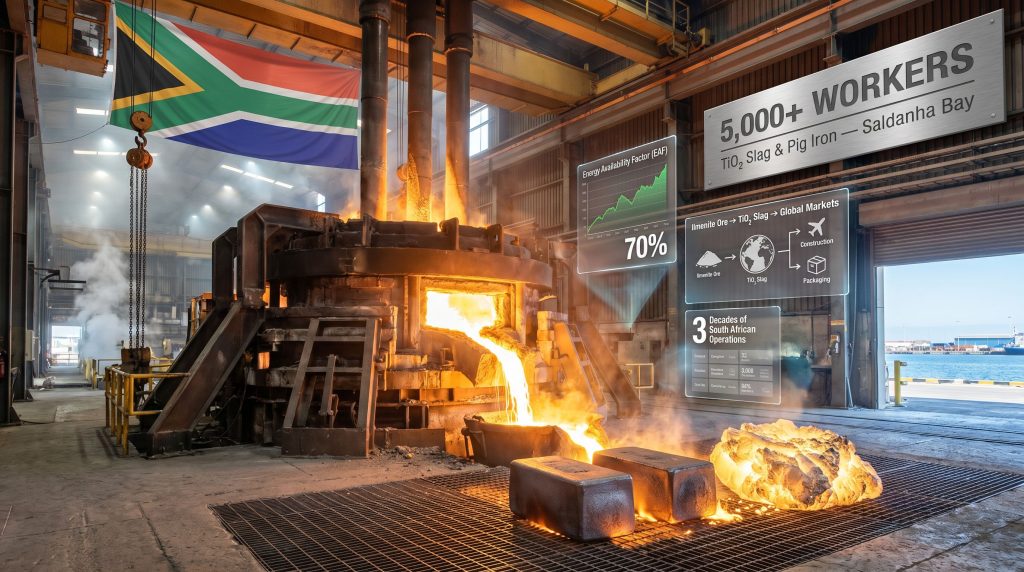
The Namakwa Sands smelter performs a chemical transformation that most consumers encounter daily without realising it. The process begins with ilmenite ore, chemically expressed as FeTiO₃, a naturally occurring iron-titanium oxide mined from the heavy mineral sands deposits along South Africa's coastline. Through carbothermic reduction inside electric arc furnaces drawing approximately 180 megawatts of continuous baseload power, the ilmenite is separated into two commercially valuable products: titanium dioxide slag containing roughly 85% TiO₂, and pig iron with an iron content of approximately 92% Fe.
The titanium dioxide slag produced at Saldanha Bay enters a global supply chain that touches nearly every sector of the modern economy. Titanium dioxide pigment, manufactured from this slag, is the world's most widely used white pigment, appearing in architectural paints, plastic packaging, paper coatings, cosmetics, sunscreen formulations, and food-safe materials. At the higher end of the value spectrum, titanium-derived materials are critical inputs in aerospace components, surgical implants, and medical devices.
The pig iron byproduct, while less headline-worthy, feeds directly into steel manufacturing supply chains and contributes meaningfully to the operation's commercial economics. The simultaneous production of two high-value outputs from a single ore input is precisely what makes the ilmenite smelting process economically significant. Furthermore, it is why the Namakwa Sands facility represents a beneficiation asset of national importance rather than simply another mining operation.
Facility Profile and Operational Structure
| Operational Hub | Location | Primary Function | Province |
|---|---|---|---|
| Namakwa Sands | Saldanha Bay | Smelting: ilmenite to TiO₂ slag and pig iron | Western Cape |
| KZN Sands | Empangeni | Mining and mineral separation | KwaZulu-Natal |
The two-hub structure of Tronox's South African operations creates an integrated value chain in which disruption at either node affects total output. The KZN Sands operation at Empangeni feeds separated mineral concentrates into the processing pipeline, while the Namakwa Sands smelter handles the energy-intensive transformation stage. Tronox has maintained this integrated South African presence for more than three decades, establishing supply relationships, workforce ecosystems, and community dependencies that would be extraordinarily difficult to replicate if operations were to contract or close.
Workforce and Economic Footprint: Numbers That Demand Attention
The employment dimension of Tronox's South African operations is substantial enough to function as a macroeconomic argument in its own right. The company directly employs over 2,200 permanent workers, supported by approximately 2,800 contractors, bringing the total workforce dependency to more than 5,000 individuals across KwaZulu-Natal and Western Cape. In the Saldanha Bay municipal area, where formal unemployment sits at elevated levels consistent with South Africa's national average of 32.9% as recorded in the 2025 Quarterly Labour Force Survey, a single employer of this scale represents a foundational pillar of the local economy.
The downstream economic effect amplifies these direct figures considerably. Industrial employment in mineral processing typically generates a multiplier effect of approximately 2.5 to 3.0 times the direct workforce, as employees spend wages locally, contractors source materials regionally, and ancillary service providers cluster around large industrial operations. This means the effective economic footprint of Tronox's South African operations likely supports upward of 12,000 to 15,000 livelihoods when indirect and induced employment effects are factored in.
"These facilities represent jobs, livelihoods and confidence in the future of South African industry. Our priority is to keep the business operating, protect jobs and continue contributing to the broader economy." — Tronox Asia Pacific and South Africa operations VP Mpho Mothoa, as reported by Mining Weekly, May 2026.
Mothoa's framing is instructive because it deliberately expands the definition of what a smelter operation represents. The choice to describe the facility in terms of confidence, livelihoods, and future sustainability, rather than production capacity or export tonnage, reflects a sophisticated understanding of what government stakeholders and communities most urgently need to hear in a post-loadshedding recovery context.
What Ramokgopa's Smelter Visit Actually Communicates
The Policy Signal Behind the Site Engagement
Cabinet-level ministers do not conduct in-person operational tours of private industrial facilities without deliberate intent. When Ramokgopa visits Tronox smelter facilities, the act itself functions as a form of sovereign communication — one that no press release or policy document can replicate with the same credibility. Direct physical presence at an operating facility signals operational endorsement, investment security, and governmental alignment with the long-term viability of the sector.
The minister's stated objective — channelling surplus electricity generation capacity toward industrial revival — deserves careful unpacking. South Africa's energy landscape in 2026 is fundamentally different from the crisis conditions of 2022 and 2023, when Stage 6 loadshedding became a near-permanent feature of industrial planning. The improvement in Eskom's energy availability factor (EAF) has created a gap between supply capability and current demand. The minister's articulation of a strategy to deploy this surplus supply toward high-value industrial users represents a sequenced activation approach rather than a broad policy announcement.
The specific language used during the visit is worth examining. Ramokgopa communicated the view that available generation capacity should be actively directed toward economic activation, framing the approach as a systematic industrial revival effort proceeding facility by facility across South Africa's energy-intensive sector. This framing implies a prioritisation framework for surplus power allocation — one in which large beneficiation operations like titanium smelters are positioned near the front of the queue due to their employment intensity, export contribution, and continuous-process requirements. Broader discussions around critical minerals and energy security reinforce why facilities such as this are treated as strategic national assets.
Beyond the Handshake: What Industry Requires from Government
From the perspective of a company like Tronox, which makes multi-decade capital commitments to smelter infrastructure, a ministerial visit is a welcome signal but not a sufficient condition for investment confidence. What large mineral processing operators require, beyond physical energy supply, is a combination of long-term price certainty, supply reliability guarantees, and policy consistency across electoral cycles. A smelter furnace relining, for example, represents a capital expenditure commitment of R350 million or more per unit, with a decision horizon of 15 to 20 years.
This gap between symbolic engagement and structural certainty is where the real work of government-industry collaboration must occur. Formal mechanisms such as special pricing agreements for energy-intensive industries, interruptible supply contracts with defined compensation frameworks, and industrial energy efficiency incentive schemes exist internationally and represent the infrastructure of trust that converts ministerial goodwill into bankable investment decisions. Understanding the industrial decarbonisation economics at play further clarifies why these structural agreements are indispensable to long-term operational viability.
South Africa in the Global Titanium Feedstock Market
Where South Africa Sits in the Supply Hierarchy
South Africa consistently ranks among the world's top three producers of titanium feedstock, alongside Australia and China. The country's heavy mineral sands deposits, concentrated along the eastern and western coastlines, contain significant reserves of ilmenite, rutile, and zircon, providing a resource base capable of sustaining processing operations for decades. The competitive landscape, however, is not static.
Key titanium feedstock producing jurisdictions and their comparative dynamics:
-
Australia maintains the most stable processing environment, with consistent grid infrastructure and a mature regulatory framework that has supported long-term supply agreements with European and Asian buyers.
-
Mozambique has emerged as a growing producer with dedicated energy infrastructure developments, attracting investment partly on the basis of South Africa's energy instability during the loadshedding era.
-
China dominates downstream titanium dioxide pigment manufacturing, integrating feedstock processing with pigment production in a vertically integrated model that South African processors cannot easily replicate.
-
Norway operates titanium smelting under a framework of dedicated long-term energy agreements between government, industrial operators, and state energy utilities — providing a model that South Africa's policymakers have studied but not yet fully replicated.
The Beneficiation Premium: Why Processing Beats Mining Alone
The difference between exporting raw ilmenite ore and exporting titanium dioxide slag is substantial. Raw ilmenite typically trades at USD 130 to USD 180 per tonne, while high-grade titanium dioxide slag commands USD 500 to USD 700 per tonne in international markets, representing a value addition of approximately three to four times per unit of raw material processed. This beneficiation premium is the economic rationale for South Africa's longstanding policy emphasis on domestic processing.
The broader context of critical minerals demand reinforces this beneficiation logic. Titanium and zircon are increasingly classified as strategic materials by the European Union, the United States, and Australia, driven by their applications in aerospace, defence systems, medical devices, and advanced manufacturing technologies. South Africa's ability to supply processed feedstock, rather than raw ore, positions it as a higher-value participant in global supply chains that are actively seeking diversification away from single-source dependencies.
The Loadshedding Legacy: Structural Damage That Outlasts the Grid Crisis
Quantifying the Damage to Industrial Confidence
South Africa's extended loadshedding era inflicted costs on the mineral processing sector that extend well beyond lost production tonnage. The South African Reserve Bank estimated in its 2024 Monetary Policy Review that the cumulative GDP loss attributable to load-shedding between 2020 and 2024 exceeded R1.4 trillion, with energy-intensive industries bearing a disproportionate share. For continuous-process smelters specifically, the consequences included:
-
Thermal cycling damage to refractory furnace linings, reducing maintenance intervals by an estimated 40 to 50% and accelerating capital expenditure requirements.
-
Production loss quantified in South Africa's mineral sands sector at approximately 25 to 30% of theoretical capacity during peak loadshedding periods.
-
Market share erosion, with Australian and Mozambican producers capturing order volumes redirected away from South African suppliers citing reliability concerns.
-
Investor confidence impairment, manifesting as deferred capital expenditure decisions across multiple smelter operators who declined to commit to major infrastructure upgrades while grid stability remained uncertain.
-
Safety risk escalation, as uncontrolled furnace cooling creates hazards associated with solidified charge management and remelting procedures.
The final category deserves emphasis because it is the least discussed and most consequential. The safety implications of power interruptions in active smelting operations are severe: molten metal at 1,700°C does not respond predictably to sudden thermal changes, and the restarting of a solidified furnace requires specialised procedures that themselves carry elevated accident risk.
Grid Recovery Metrics and What They Mean for Heavy Industry
South Africa's improved generation position in 2025 and 2026 has been measured primarily through Eskom's energy availability factor, which represents the proportion of total installed capacity available for dispatch at any given time. Industry observers note that sustained EAF above the 70% threshold creates conditions in which large industrial consumers can begin planning around stable power supply with reasonable confidence.
The unplanned capacity loss factor (UCLF), a complementary metric measuring unscheduled generation outages as a proportion of total installed capacity, provides the operational refinement necessary for industrial planning. When UCLF exceeds 25%, the frequency of grid disturbances reaches a level that undermines continuous-process operations regardless of average supply availability. The distinction between average availability and operational reliability is critical for smelter operators, for whom a single unscheduled interruption during a critical production phase can cost more than weeks of stable but slightly reduced supply.
The next major ASX story will hit our subscribers first
Government-Industry Frameworks for Energy-Intensive Sectors: International Lessons
Structural Models That Work
The international landscape offers several precedents for formalising energy relationships between governments and continuous-process industrial operators. Norway's aluminium smelting sector, which accounts for a significant proportion of global primary aluminium production, operates under long-term power purchase agreements negotiated directly between smelter operators and the state energy utility. These agreements typically span 10 to 25 years and include provisions for energy price stabilisation during commodity downturns, in exchange for operational continuity commitments and employment maintenance obligations.
Australia's critical minerals processing incentive framework provides a more recent model, offering production tax credits and concessional financing for processing operations that retain value addition onshore. The energy-intensive smelter models operating within Australia's incentive structure demonstrate how governments can structure support that makes domestic processing commercially viable over long investment timeframes. In addition, South Africa's evolving critical minerals trade strategy offers a complementary framework worth examining alongside these international precedents.
The Investor Lens: Reading Political Risk Through Ministerial Behaviour
For international investors assessing South Africa's mineral processing sector, ministerial behaviour toward operating facilities functions as a form of observable political risk data. A minister who physically visits a private industrial operation, publicly validates its economic contribution, and articulates a framework for energy supply prioritisation is transmitting information that cannot be extracted from policy documents or regulatory frameworks alone.
This matters particularly for the capital allocation decisions that govern smelter reinvestment. The decision to commit R500 million to a furnace rebuild or processing capacity expansion is not made on the basis of current conditions alone but on an assessment of political commitment to maintaining those conditions over the investment's productive life. Ramokgopa's offer of support to resuscitate South African smelters has consequently been interpreted by analysts as a meaningful reduction in sovereign risk perception for the sector.
The Tronox case illustrates this dynamic precisely. With over 30 years of operational history in South Africa, the company's continued presence itself represents a form of demonstrated political risk tolerance. The question facing investors is whether the current phase of improved energy supply and enhanced government engagement represents a durable structural shift or a cyclical improvement that may not survive the next infrastructure challenge.
Frequently Asked Questions
What is the Tronox Namakwa Sands smelter and what does it produce?
The Namakwa Sands smelter is a continuous baseload industrial facility located at Saldanha Bay on South Africa's West Coast. It processes ilmenite ore through carbothermic reduction to produce titanium dioxide slag and pig iron. These outputs serve global healthcare, construction, packaging, aerospace, and manufacturing industries. It is one of two titanium smelters Tronox operates in South Africa, the other being associated with the KZN Sands operation in Empangeni, KwaZulu-Natal.
Why did Minister Ramokgopa visit the Tronox smelter?
The visit formed part of a government engagement programme with energy-intensive industries whose operational viability depends on reliable electricity supply. Ramokgopa visits Tronox smelter infrastructure to identify how improved generation capacity could be directed toward industrial recovery, with the smelter representing a high-priority beneficiation asset in terms of employment, export earnings, and continuous-process energy requirements.
How many people does Tronox employ in South Africa?
Tronox directly employs over 2,200 permanent staff and works with approximately 2,800 contractors across its KwaZulu-Natal and Western Cape operations, bringing the total workforce footprint to more than 5,000 individuals. When indirect and induced economic effects are considered, the broader livelihood dependency on these operations is significantly larger.
Why are smelters particularly vulnerable to electricity disruptions?
Smelting is a continuous thermal process that cannot be paused and resumed without substantial consequences. Power interruptions cause the molten furnace charge to solidify, requiring energy-intensive and technically demanding remelting procedures. Frequent thermal cycling accelerates refractory lining degradation, reducing maintenance intervals and increasing capital expenditure requirements. Additionally, restarting a solidified smelter furnace carries elevated safety risks.
What is titanium dioxide slag used for?
Titanium dioxide slag is an intermediate product refined into titanium dioxide pigment, the world's most widely used white pigment. It appears in architectural paints, plastic packaging, food coatings, cosmetics, and sunscreens. At higher performance specifications, titanium-derived materials serve aerospace structural applications, surgical implants, and advanced medical devices where biocompatibility and strength characteristics are critical.
What is the difference in value between raw ilmenite ore and processed titanium dioxide slag?
Raw ilmenite typically trades at approximately USD 130 to USD 180 per tonne in international markets. Processed titanium dioxide slag of the grade produced at Namakwa Sands commands USD 500 to USD 700 per tonne, representing a beneficiation premium of approximately three to four times the raw ore value per unit of feedstock processed.
Key Takeaways for Industry Observers and Investors
-
Tronox's Namakwa Sands smelter represents a technically irreplaceable beneficiation asset whose continuous operation depends entirely on stable baseload power, making energy reliability the primary variable governing its long-term viability.
-
The ministerial visit communicates investor-relevant information about South Africa's political commitment to maintaining large industrial employers, but structural certainty requires formal energy pricing frameworks and long-term supply agreements beyond symbolic engagement.
-
South Africa's position as a top-three global titanium feedstock producer is under competitive pressure from Australia and Mozambique, with market share recovery dependent on demonstrating operational reliability over sustained periods.
-
The loadshedding era inflicted structural damage to industrial confidence that will take longer to repair than the grid itself, with capital investment decisions in smelter infrastructure requiring 24 to 36 months of demonstrated stability before reinvestment cycles activate.
-
Tronox's 30-year operational commitment and 5,000-strong workforce make it a bellwether for investor sentiment toward South Africa's broader beneficiation and mineral processing sector, and the trajectory of its capital investment decisions in coming years will reflect how effectively the current energy recovery translates into structural industrial confidence.
Disclaimer: This article contains forward-looking scenario analysis and market assessments that represent analytical projections rather than confirmed outcomes. Energy sector metrics, employment figures, and market pricing data are subject to change. Readers should conduct independent research before making investment decisions related to South Africa's mineral processing sector or any associated companies.
Want to Track the Next Major Mineral Discovery Before the Market Catches On?
Discovery Alert's proprietary Discovery IQ model delivers real-time alerts on significant ASX mineral discoveries — transforming complex mineral and commodity data into actionable investment insights the moment they hit the exchange. Explore Discovery Alert's dedicated discoveries page to understand how historic finds have generated substantial returns, and begin your 14-day free trial today to position yourself ahead of the broader market.