
August 20, 2026
The Fracturing Economics of Global LNG and What It Means for Coal
When a single supply corridor disappears from the global energy system, the reverberations extend far beyond the commodity in question. That is precisely what has unfolded across Asian energy markets in 2026, as constrained LNG availability from the Middle East has forced utilities, grid operators, and procurement teams across the region to recalibrate their fuel strategies with remarkable speed.
The result is a seaborne thermal coal market that is simultaneously rebounding and fracturing. Asia thermal coal imports rebound except for India has become the defining narrative of mid-2026 commodity trade flows. The regional picture is not a uniform recovery but a mosaic of sharply divergent demand signals, each shaped by domestic supply conditions, price sensitivity thresholds, and the specific role that LNG plays, or does not play, in each country's electricity generation stack.
When big ASX news breaks, our subscribers know first
Asia's July 2026 Import Surge: Reading the Headline Numbers Correctly
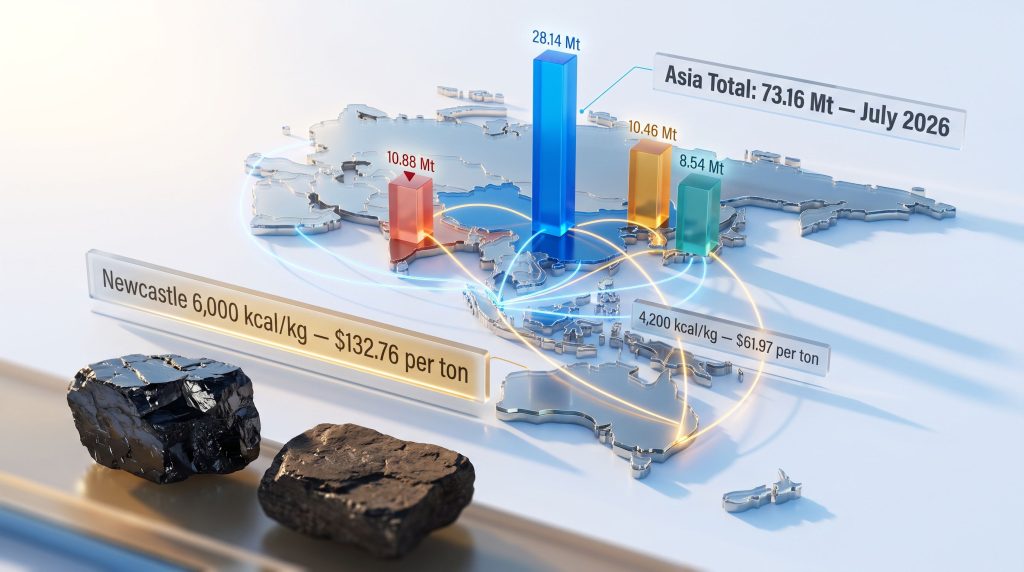
Total seaborne thermal coal arrivals across Asia are forecast at 73.16 million metric tons in July 2026, according to data compiled by commodity analysts tracking vessel activity and port data. That figure represents an increase from 70.31 million tons in June and sits above the 71.04 million tons recorded in July 2025, marking the third consecutive monthly gain for the region as a whole.
The headline aggregate, however, conceals a more complex story. Asia accounts for roughly 90% of all global seaborne thermal coal trade, which means that shifts within the region effectively set the price and volume trajectory for the entire international market. Understanding which countries are driving the rebound, and why one major buyer is moving in the opposite direction, is essential for accurate market assessment.
July 2026 Seaborne Thermal Coal Import Snapshot
| Importer | July 2026 (Mt) | June 2026 (Mt) | Direction | Key Driver |
|---|---|---|---|---|
| Asia Total | 73.16 | 70.31 | ↑ | Multi-country demand rebound |
| China | 28.14 | 25.67 | ↑ | Domestic supply disruption |
| Japan | 10.46 | 7.51 | ↑ | LNG substitution effect |
| South Korea | 8.54 | 6.08 | ↑ | LNG substitution effect |
| India | 10.88 | 12.30 | ↓ | Price resistance |
The divergence between India's trajectory and that of its regional peers is not a temporary anomaly. It reflects fundamentally different market structures, price tolerance levels, and long-run energy transition dynamics operating simultaneously across the same geographic region.
China's Coal Import Surge: A Supply Shock, Not a Fuel Switch
The Shanxi Disaster and Its Cascading Production Effects
The immediate catalyst for China's accelerated seaborne coal procurement is traceable to a single event. On May 22, 2026, a mine collapse in Shanxi Province, China's dominant coal-producing region, killed 82 workers, making it the country's deadliest mining accident in 17 years. The human toll triggered mandatory nationwide safety inspections that swept across the sector with significant operational consequences.
Domestic coal production fell 9.7% year-on-year in June 2026, landing at 380.88 million tons for the month. Shanxi Province alone typically accounts for a disproportionate share of China's total output, and any disruption to its operating mines creates outsized effects on the national supply balance. Consequently, when safety inspection protocols require production halts across multiple sites simultaneously, the supply shortfall accumulates rapidly.
Electricity Demand Growth Compounds the Import Pressure
The supply contraction would be manageable if electricity demand were flat. It is not. Thermal power generation in China expanded 0.5% in June and 2.9% across the first six months of 2026, reflecting both industrial activity and rising residential consumption driven by summer cooling demand. Total electricity demand for the full year is expected to grow by approximately 5%, a pace that even China's aggressive renewable energy buildout cannot fully absorb in the near term.
A critical distinction that is often misunderstood in Western market commentary: coal and LNG do not compete for the same generation role in China. Unlike Japan and South Korea, where gas-fired power plants can be partially displaced by coal-fired alternatives, China's thermal power fleet is overwhelmingly coal-dependent with only marginal natural gas participation. This means China's import acceleration is a pure supply-side response to domestic production gaps, not a fuel-switching decision driven by the LNG supply outlook.
China's July import figure of 28.14 million tons represents the highest monthly total of 2026 to date, and the year-on-year comparison against 24.10 million tons in July 2025 underscores the structural nature of the shift. Even as safety inspections eventually ease and domestic production recovers, the underlying electricity demand trajectory suggests elevated import volumes will persist through the second half of the year.
Japan and South Korea: The LNG Price Shock and the Coal Substitution Response
How Qatar's Effective Absence Reshaped Northeast Asian Procurement
The geopolitical disruption stemming from the Iran-Qatar conflict has removed approximately 20% of global LNG supply from accessible markets, at least from a spot procurement perspective. For Japan and South Korea, economies that have invested heavily in LNG infrastructure, this energy trade disruption has translated directly into surging spot LNG prices and an urgent search for cost-effective alternatives.
Thermal coal is that alternative. It is storable, it can be sourced from multiple geographies, and it burns in existing coal-fired capacity that both countries maintain as baseload or cycling generation. The economics are straightforward: when LNG spot prices spike, coal-fired generation becomes cheaper on a per-megawatt-hour basis, and utilities respond by maximising coal burn and building inventory.
Japan's July thermal coal arrivals are projected at 10.46 million tons, the highest monthly volume since January 2026 and a sharp increase from 7.51 million tons in June. South Korea's July forecast of 8.54 million tons similarly represents its strongest import month since August 2025, rising from 6.08 million tons the prior month.
Newcastle Benchmark Pricing and the Premium Grade Dynamic
The surge in Northeast Asian demand is exerting upward pressure on the benchmark price for high-calorific-value thermal coal. The weekly index for 6,000 kcal/kg Australian thermal coal at Newcastle Port reached $132.76 per ton in the week ending July 24, 2026, its highest level in four weeks, according to pricing data from globalCOAL.
This grade specification matters enormously for understanding market segmentation. Japan and South Korea require high-energy-content coal because their power plant technology is optimised for consistent fuel quality. Lower-grade material simply cannot be substituted without significant efficiency penalties or equipment modifications.
The Grade Premium Explained: A rough comparison of the two dominant seaborne grades illustrates the bifurcation clearly. Australian 6,000 kcal/kg coal was trading near $132.76/ton while Indonesian 4,200 kcal/kg coal closed at approximately $61.97/ton. The price gap is not purely a function of energy content ratio; it also reflects supply chain preferences, long-term contract structures, and the geopolitical routing constraints that different buyer groups operate under.
Furthermore, Australia's energy exports remain the primary beneficiary of Northeast Asian demand strength. Newcastle Port serves as the physical and pricing hub for this trade, and sustained Japanese and South Korean procurement supports both volume flows and benchmark price levels that ripple through the broader seaborne market.
India's Counter-Trend: Price Resistance Overrides Energy Urgency
The Structural Paradox at the Heart of India's Coal Market
India presents perhaps the most analytically interesting case study in the current thermal coal cycle. The country faces record electricity demand driven by persistent heat and a weaker-than-expected monsoon season, domestic coal inventories at power plants have fallen to a critically low 14 days of operational cover (against a normal buffer of three to four weeks), and yet seaborne thermal coal imports are declining rather than rising.
July thermal coal arrivals are forecast at 10.88 million tons, down from 12.3 million tons in June and the lowest monthly figure since August 2025. This is not a demand destruction story in the conventional sense. It is a price threshold story.
Indonesian Coal Pricing and India's Import Economics
Indian power utilities predominantly use lower-grade coal with an energy content of 4,200 kcal/kg, sourced primarily from Indonesia. Singapore Exchange futures contracts for this grade closed at $61.97 per ton as of late July, down from a three-year high of $65.77 recorded on June 26, 2026, but still representing a 38% premium over the early-January 2026 low of $45.00 per ton.
The economics for Indian utilities are fundamentally different from their Northeast Asian counterparts. Indian power generators operate under regulated tariff structures and tighter cost recovery frameworks, which means they face harder price ceilings on fuel procurement than utilities in Japan or South Korea. When Indonesian coal prices move from $45 to $65, the impact on generation economics in India is severe enough to suppress procurement even when physical supply is urgently needed.
This creates the paradox that characterises India's current position: supply stress is high, inventories are dangerously low, but the price required to source additional seaborne coal exceeds what the market structure can absorb. Indian utilities appear to be accepting short-term supply risk rather than paying elevated spot prices, a rational but precarious strategy.
India's Long-Run Import Trajectory: Beyond the Cyclical
| Period | Power-Sector Imports | Change |
|---|---|---|
| FY2024-25 | 62.5 million tons | Baseline |
| FY2025-26 Full Year | 45.4 million tons | ↓ 27.45% YoY |
| Jan-May 2026 | Four-year low | Structural decline |
The scale of this decline suggests forces operating well beyond quarterly price movements. India commodity demand is being reshaped by two structural forces operating simultaneously: domestic coal production from Coal India and captive mining operations has expanded consistently, reducing the structural import gap, while India's renewable energy capacity additions, particularly solar, are accelerating and gradually displacing thermal generation requirements at the margin.
For commodity market participants focused on the India demand thesis, this data warrants careful attention. A price correction in Indonesian coal might generate a near-term import rebound, but the structural trajectory over a multi-year horizon points toward declining seaborne dependency. In addition, the energy transition demand dynamics in India suggest this structural shift will only accelerate in the years ahead.
The Two-Speed Seaborne Market and Its Implications for Exporters
How Supply Routing Is Evolving Under Divergent Demand Signals
The thermal coal seaborne market is effectively operating as two parallel ecosystems in 2026:
- The premium-grade market centred on 6,000 kcal/kg Australian coal, priced through the Newcastle benchmark, driven by Japanese and South Korean demand, and insulated to some degree from the price sensitivity constraints that define the low-grade segment.
- The discount-grade market centred on 4,200 kcal/kg Indonesian coal, priced through Singapore Exchange contracts, characterised by greater buyer price sensitivity and ongoing competition between Chinese and Indian procurement strategies.
For Australian exporters, the current environment is supportive. Newcastle benchmark pricing at a four-week high of $132.76/ton reflects tightening supply relative to Northeast Asian demand, and the LNG disruption dynamic that is driving substitution in Japan and South Korea is not expected to resolve quickly.
Indonesia faces a more complex picture. Chinese demand for lower-grade coal provides volume support, but India's price resistance caps upside potential in what would otherwise be a tight market. The June 2026 three-year high in Indonesian coal pricing at $65.77/ton may have already done measurable demand destruction in price-sensitive import markets, a dynamic that commodity markets sometimes underweight when assessing near-term price trajectories.
Russia continues to redirect thermal coal flows toward Asian buyers, serving primarily as a mid-grade alternative supplier to China. Western sanctions have structurally rerouted Russian coal exports eastward, adding a geopolitical dimension to supply competition that adds complexity to price modelling.
The next major ASX story will hit our subscribers first
Three Scenarios That Will Define India's Import Trajectory Through Q3 2026
Scenario 1: Indonesian Coal Returns to the $45-$50 Range
A sustained price correction in the 4,200 kcal/kg benchmark toward early-year lows would likely trigger a meaningful rebound in Indian utility procurement. However, achieving this would require simultaneous softening in Chinese demand and a meaningful increase in Indonesian export volumes. Neither condition is imminent, making this the least probable near-term outcome.
Scenario 2: Monsoon Improvement Reduces Demand Urgency
A stronger-than-forecast monsoon recovery across India's agricultural and industrial heartland would reduce peak cooling and irrigation-related electricity demand, easing pressure on coal inventories and reducing the urgency of import procurement. This scenario would suppress July-August import volumes but could set up a stronger restocking cycle in the October-December period.
Scenario 3: Domestic Production Acceleration Bridges the Gap
If Coal India's production expansion continues at its recent pace, the structural import requirement diminishes further regardless of international pricing. India's domestic coal sector has demonstrated consistent output growth over the past several years, and if that trajectory is maintained, seaborne coal's role in India's energy mix will continue to contract structurally.
Disclaimer: The scenario analysis presented here is based on publicly available market data and structural trend analysis. It does not constitute investment advice. Commodity markets are subject to significant uncertainty, and actual outcomes may differ materially from projections.
Frequently Asked Questions
Why are Asia thermal coal imports rebounding in mid-2026?
The rebound is driven by three distinct and reinforcing forces: geopolitical disruption to Qatari LNG supply has elevated spot gas prices, prompting Japan and South Korea to substitute toward coal; China is compensating for a domestic production shortfall caused by mandatory safety inspections following a major mining accident; and overall Asian electricity demand continues to grow faster than renewable capacity additions can absorb.
Why is the Asia thermal coal imports rebound except for India the defining market narrative?
India operates under fundamentally different procurement economics than Northeast Asian buyers. Indonesian coal prices have risen 38% from their January 2026 low, pushing procurement costs above acceptable thresholds for Indian utilities that face tighter cost recovery constraints. Meanwhile, domestic coal production is expanding and renewable capacity is growing, both of which reduce structural import dependency over time.
What is the significance of the Newcastle Port benchmark price?
Newcastle Port in New South Wales, Australia, serves as the global reference point for premium-grade thermal coal. The 6,000 kcal/kg specification traded through this benchmark is the grade predominantly procured by Japanese and South Korean utilities. When this price rises, as it has to $132.76/ton in late July 2026, it signals tightening supply relative to Northeast Asian demand and directly affects the economics of Australian coal export operations.
How do Indonesia's coal exports fit into the current market?
Indonesia is the world's largest thermal coal exporter and the primary supplier to both China and India for lower-grade material. Its 4,200 kcal/kg product has risen sharply in 2026, reaching a three-year high in June before a partial pullback. The pricing dynamic for Indonesian coal is the single most important variable for Indian import demand recovery in the near term.
What does dangerously low coal inventory at Indian power plants mean for the market?
Power plant coal stocks falling to 14 days of operational cover against a normal buffer of three to four weeks represents a genuine supply risk for grid stability. However, the market paradox is that price resistance is preventing utilities from restocking via seaborne imports despite this urgency, meaning the stress is being absorbed operationally rather than resolved through procurement.
Want to Track the Next Big Resource Discovery Before the Market Does?
Discovery Alert's proprietary Discovery IQ model scans ASX announcements in real time, instantly identifying actionable opportunities across the energy and commodities sectors — from thermal coal dynamics to the mineral discoveries underpinning the global energy transition. Explore historic discoveries and their returns to understand the scale of what early positioning can deliver, and begin your 14-day free trial today to stay ahead of the market.