August 8, 2026
The Architecture of a Multi-Decade Gold Realignment
Something profound is unfolding beneath the surface of global capital markets, and it has very little to do with short-term price momentum. Across Asia, a convergence of macroeconomic pressure, institutional conviction, and physical infrastructure investment is reshaping how wealth is stored, transferred, and protected. The forces at work are not reactive — they are deliberate. And the evidence is written not in trading charts, but in concrete, steel, and code: new vaults being constructed, clearing systems going live, and tokenization platforms opening gold access to millions of first-time investors.
Understanding the Asian gold demand structural wealth shift requires looking beyond the rally and examining what is being built underneath it.
When big ASX news breaks, our subscribers know first
Asia Already Owns the Gold Market — The Question Is What Comes Next
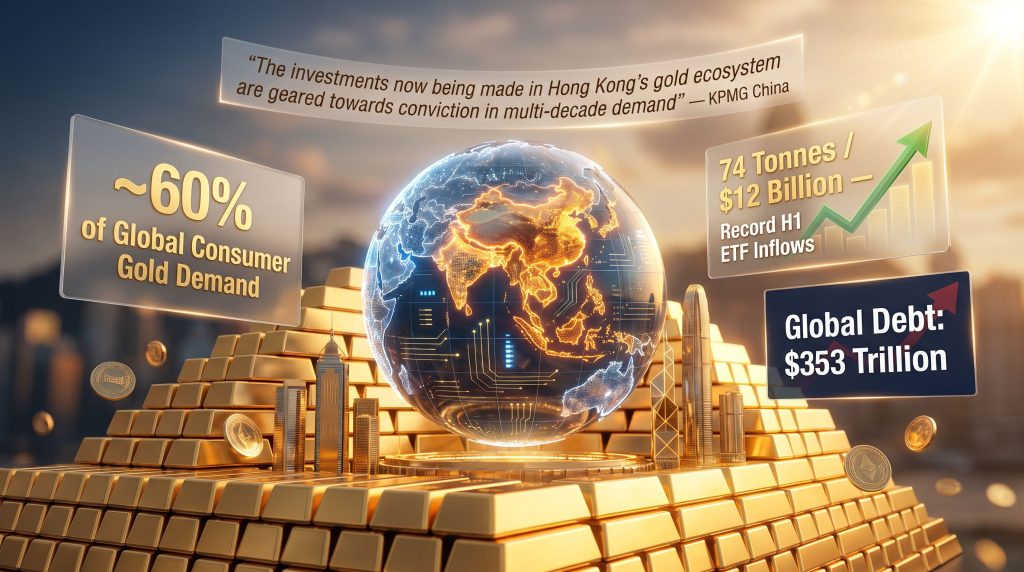
The scale of Asia's existing dominance in global gold consumption is frequently underestimated by Western analysts. The region accounts for approximately 60% of global consumer gold demand, with China and India functioning as twin pillars supporting the entire demand architecture. Historically, this demand was concentrated in jewellery, tied to cultural traditions around weddings, festivals, and gift-giving. That picture has fundamentally changed.
The past several years have seen a pronounced pivot toward investment-grade gold products: physical bars, coins, custody accounts, and exchange-traded funds. This transition matters because investment demand behaves differently from jewellery demand. It is less price-sensitive in the short run, more responsive to macroeconomic signals, and far more likely to be sustained across economic cycles.
The data from the first half of 2026 captures this shift in sharp relief:
| Demand Category | Asia's Share or Volume | Trend Direction |
|---|---|---|
| Consumer gold demand (global) | ~60% | Rising |
| H1 ETF gold inflows (Asia-based) | 74 tonnes / $12 billion | Record H1 high |
| Planned Hong Kong vault expansion | ~2,000 tonnes over 3 years | Accelerating |
| Global debt level (Q1 2026 record) | $353 trillion | Upward pressure on fiat hedging |
Furthermore, record gold ETF inflows from Asian-based funds accumulated over 74 tonnes of gold in the first half of 2026, a figure valued at $12 billion and representing the highest regional H1 ETF inflow on record. These are not retail speculators chasing momentum — they are institutions, funds, and informed retail savers making deliberate, medium-to-long-term allocations.
Why Fiat Erosion and Debt Are the Engine, Not the Catalyst
The $353 Trillion Debt Problem as a Structural Gold Driver
When global debt reached a record $353 trillion in the first quarter of 2026, it crossed a threshold that changes the nature of the macro conversation. At that scale, debt is no longer a cyclical concern; it becomes a permanent feature of the financial landscape, one that structurally impairs the credibility of sovereign currencies over time.
Asian investors, particularly in China, have lived through enough monetary history to treat fiat currency scepticism not as a fringe position but as a practical framework. The perception that paper currencies are subject to political manipulation, inflationary debasement, and systemic overextension has driven a growing portion of household and institutional capital toward assets with finite supply and no counterparty liability.
Gold satisfies both criteria. It cannot be printed, diluted, or restructured. It carries no credit risk because it represents no one else's obligation. As credit risk sensitivity has risen across Asian financial systems, gold safe-haven demand has moved from a philosophical attribute to a practical investment rationale. Consequently, gold safe-haven demand continues to attract capital from investors seeking protection against systemic financial risk.
Analysts in the banking sector have noted that as credit risks have become more prominent in investor thinking, gold's minimal counterparty exposure has become increasingly attractive. The trend of relocating gold holdings closer to home — often called nearshoring — is expected to intensify as this dynamic plays out across Asia's financial institutions.
The Collapse of Domestic Alternatives
Gold's ascent in Asian portfolios has been accelerated by the simultaneous deterioration of competing asset classes. Chinese real estate, once the default vehicle for household wealth storage, has faced prolonged structural stress. Property values in several major markets have declined significantly, and the political and regulatory environment around large-scale property investment has tightened considerably.
Bank deposits offer negligible real returns in a low-rate environment. Domestic equity markets have delivered inconsistent performance. Against this backdrop, gold has emerged not as a speculative bet but as a rational substitute: a store of value that holds purchasing power without counterparty dependency, regulatory interference, or geographic price distortion.
The household wealth reallocation occurring across China and, to a lesser extent, Southeast Asia is qualitatively different from prior gold demand cycles. It is driven by subtraction as much as by attraction: investors are not simply choosing gold — they are running out of convincing alternatives. Indeed, strong physical investment in Asia is increasingly shaping the entire direction of global gold demand.
The Infrastructure Tell: Why Physical Buildout Signals Long-Term Conviction
Vaulting, Clearing, and Tokenization: The Three Pillars of Asia's New Gold Architecture
The most compelling evidence that Asia's gold pivot is structural rather than cyclical lies not in demand statistics but in capital expenditure decisions. Across three distinct infrastructure categories, Asian financial institutions are committing multi-year, multi-billion-dollar resources to gold market development.
Vaulting Capacity
HSBC recently announced plans to expand its gold storage capacity in Hong Kong to 200 tonnes. More significantly, Hong Kong's broader plan involves adding approximately 2,000 tonnes of vaulting capacity over the next three years. Storage infrastructure of this scale takes years to plan, fund, permit, and construct. It is not built to capitalise on a price spike. It is built because institutions expect sustained, growing physical gold flows for an extended period.
Tokenization and Retail Access
DBS Bank in Singapore has introduced a fractionalized gold trading platform on its retail app, enabling customers to purchase tokens backed by as little as 1 gram of gold. This development is more strategically significant than it might initially appear. By lowering the minimum investment threshold to gram-level entry points, financial institutions are effectively democratising gold ownership for a mass-market audience across Southeast Asia.
Tokenised gold eliminates the logistical barriers of physical ownership while preserving the underlying asset's integrity. It also creates a scalable, digital-native demand channel that can absorb substantial capital flows without the storage and handling constraints of traditional physical markets.
Clearing and Settlement Infrastructure
Perhaps the most structurally consequential development has been the launch of a Hong Kong-based gold clearing and settlement system designed to operate independently of London's infrastructure. This platform enables gold to be quoted, traded, and settled entirely within Asian business hours, removing the time zone friction that has long made London the de facto centre of global gold price formation.
The operational and geopolitical implications of this are significant. A functional Asian clearing venue means that increasingly large volumes of gold can be priced and settled without any routing through Western financial infrastructure. Over time, this could shift the gravitational centre of global gold price discovery eastward, reinforcing gold's evolving role in the monetary system.
Infrastructure investments of this nature represent capital-intensive, multi-year commitments. They are geared toward conviction in multi-decade demand, not toward monetising a short-term rally. This is the distinction that separates a structural market shift from a cyclical price response. (KPMG China, Head of Banking and Capital Markets, Hong Kong, as reported by The Banker, 2026)
Is Hong Kong Becoming the World's New Gold Hub?
Singapore, Hong Kong, and Shanghai: The Emerging Eastern Gold Triad
The World Gold Council's head of Asia-Pacific has publicly assessed that Asia has the potential to function as a genuine global gold hub, with Singapore, Hong Kong, and Shanghai forming the operational backbone of a new eastern market architecture. Each city contributes a distinct function:
- Hong Kong provides the clearing, settlement, and custody infrastructure, along with physical proximity to mainland Chinese demand.
- Singapore brings regulatory credibility, regional financial connectivity, and an increasingly sophisticated retail gold market supported by platforms like DBS's tokenisation offering.
- Shanghai anchors mainland Chinese institutional and retail demand, home to the Shanghai Gold Exchange, which already handles enormous volumes of physical gold trade.
Together, these three centres are creating overlapping but complementary infrastructure that could support 24-hour gold trading ecosystems independent of Western market hours and Western financial intermediaries.
The strategic rationale for nearshoring gold holdings into Asia extends beyond convenience. Holding gold within Asian custody systems reduces exposure to cross-border settlement risk, eliminates dependence on Western clearing counterparties, and allows Asian institutions to manage gold positions within their own regulatory and operational frameworks. In addition, central bank gold reserves across the region have grown substantially, further reinforcing the case for localised custody and settlement infrastructure.
The Western Investor Gap and What It Means for Gold Prices
Late Arrivals to a Party That Started Years Ago
One of the most striking features of the current gold market is the asymmetry between Asian and Western investor participation. The foundational phase of this gold bull market was driven almost entirely by Asian central banks, institutional buyers, and retail investors. Western investors, by contrast, were largely absent from the early stages of the move.
This matters for several reasons. Western institutional portfolios, particularly in the United States and Europe, remain significantly underweight gold relative to historical allocations and relative to Asian counterparts. Even a modest reallocation of capital from Western portfolios toward gold would represent an enormous incremental demand impulse.
In 2025, Morgan Stanley Chief Investment Officer Michael Wilson recommended that investors consider shifting to a 60/20/20 portfolio structure, allocating 20% of assets to gold by replacing approximately half of the traditional bond allocation. The rationale was that gold offered more durable inflation resilience than fixed income in an environment of structurally elevated debt and suppressed real yields. Furthermore, central bank gold trends have demonstrated how institutional actors at the sovereign level have been ahead of retail and private investors in recognising gold's strategic value.
The scenario analysis for Western reallocation is striking:
| Scenario | Western Gold Allocation Shift | Estimated Demand Impact |
|---|---|---|
| Conservative | 2–3% portfolio allocation | Moderate incremental demand increase |
| Moderate | 5–10% portfolio allocation | Significant upward price pressure |
| Full Convergence | Matching Asian allocation levels | Structural supply-demand imbalance |
Given that most Western retail and institutional investors currently hold minimal or zero gold exposure, even the conservative scenario represents a substantial new demand pool entering a market where supply growth is constrained by geological and capital cycle factors.
The next major ASX story will hit our subscribers first
Risks That Could Challenge the Structural Thesis
Stress-Testing the Long-Term Gold Demand Case
No structural thesis is complete without honest engagement with the scenarios that could undermine it. Several credible risk factors deserve consideration:
- Price correction risk: A significant decline in gold prices could slow infrastructure investment timelines and reduce retail enthusiasm, though institutional commitments already underway are unlikely to reverse.
- Regulatory risk: Policy changes in China or Hong Kong regarding capital flows, gold ownership, or financial product structures could meaningfully alter demand dynamics.
- Competing asset class recovery: A sustained recovery in Chinese real estate or Asian equity markets could redirect household capital away from gold, at least partially.
- Geopolitical disruption: Escalating trade tensions or financial sanctions could disrupt cross-border gold flows and complicate the nearshoring strategies currently being developed.
- Currency stabilisation: If confidence in major fiat currencies were to recover materially, some of the fiat-hedge demand driving gold allocation would diminish.
These risks do not invalidate the structural thesis, but they do suggest that the pace and depth of Asia's gold market transformation is not guaranteed to proceed linearly.
Frequently Asked Questions: Asian Gold Demand and the Structural Wealth Shift
What does the Asian gold demand structural wealth shift actually mean?
It refers to a fundamental, long-term reorientation of capital allocation across Asian households, institutions, and governments toward gold as a core asset class. Unlike cyclical demand spikes tied to price movements, this shift is characterised by infrastructure investment, policy-level changes, and behavioural transformation across multiple buyer categories simultaneously.
Why are financial institutions investing in gold vaulting and clearing infrastructure now?
Vaulting capacity, clearing systems, and tokenisation platforms represent capital-intensive, multi-year commitments. They signal long-term institutional conviction rather than opportunistic positioning, and they are designed to support sustained demand growth across decades rather than a single price cycle.
How does Asia's share of global gold demand compare to other regions?
Asia accounts for approximately 60% of global consumer gold demand. Its ETF inflows alone set a first-half record in 2026, accumulating over 74 tonnes valued at $12 billion. According to the World Gold Council's demand trends, Asia's structural position within the global gold market continues to strengthen year on year.
What is the significance of Hong Kong's new gold clearing system?
It enables gold to be traded and settled entirely within Asian business hours without routing through London's infrastructure. Over time, this builds the operational foundation for Asia to become an independent centre of global gold price formation, with far-reaching implications for Western financial benchmarking systems.
What should Western investors take from Asia's gold repositioning?
The sustained, infrastructure-backed nature of the Asian gold demand structural wealth shift suggests its underlying drivers are unlikely to reverse in the near term. Western investors with minimal gold exposure may face a growing opportunity cost as Asian demand continues to support elevated price levels, and may find themselves entering the market significantly later than the major structural move has already occurred.
Disclaimer: This article is intended for informational and educational purposes only and does not constitute financial advice. Forecasts, scenarios, and market projections discussed herein involve inherent uncertainty and should not be treated as predictions. Past market performance is not indicative of future results. Readers should seek independent financial advice before making investment decisions.
Want to Identify ASX Gold Discoveries Before the Broader Market Does?
Discovery Alert's proprietary Discovery IQ model delivers real-time alerts on significant ASX mineral discoveries — including gold — instantly transforming complex data into actionable insights for investors at every level. Explore historic discovery returns on Discovery Alert's dedicated discoveries page and begin your 14-day free trial to position yourself ahead of the next major market move.