May 16, 2026
Asian LPG market tariffs and trade flows represent a complex intersection of geopolitical policy and industrial economics that has fundamentally transformed regional energy procurement strategies. The petrochemical feedstock landscape demonstrates sophisticated adaptation mechanisms when faced with trade disruptions, often accelerating infrastructure investments and diversification strategies that reshape regional energy security architectures. Furthermore, these developments illustrate how modern commodity markets can rapidly restructure supply relationships within compressed timelines.
What Economic Forces Drive Asian LPG Import Diversification Strategies?
Macroeconomic Impact of Trade Policy on Regional Energy Security
Asian LPG market tariffs have catalysed one of the most significant supply chain reorganisations in global energy trade, with Chinese import patterns shifting dramatically following tariff implementation in April 2025. However, the US tariff dynamics have created broader economic implications beyond immediate commodity pricing effects. US LPG imports to China decreased by approximately 50% during the July-December 2025 period compared to the same timeframe in 2024, representing a structural shift worth billions of dollars in redirected commodity flows.
This trade policy response triggered rapid diversification across the region, with Middle Eastern LPG deliveries to China increasing by more than 3 million metric tonnes to compensate for reduced US supplies. Consequently, the speed of this adjustment demonstrates the sophisticated procurement capabilities of Asian importers, who activated alternative supplier relationships within months rather than years.
Economic multiplier effects extended throughout downstream petrochemical sectors, where Chinese propane dehydrogenation (PDH) capacity grew by approximately 3 million tonnes in 2025 despite tariff challenges. Conversely, steam cracker demand contracted by roughly 3 million tonnes, reflecting diminished competitiveness of tariff-elevated US LPG relative to alternative feedstocks such as naphtha and ethane.
Supply Chain Economics and Strategic Sourcing Shifts
The emergence of entirely new trade corridors illustrates the economic incentives driving supply diversification strategies. Canadian LPG exports to China began for the first time in 2025, with volumes rising steadily from Q2 onwards, establishing a previously non-existent North American alternative route that bypassed US tariff structures. In addition, this development demonstrates how trade policies can accelerate infrastructure development and relationship building.
Australian LPG volumes to China surged as Chinese importers prioritised nearby producers to minimise transportation costs and supply chain vulnerabilities. This geographic optimisation reflects sophisticated total-cost-of-ownership calculations that factor transportation economics alongside commodity pricing.
Cost-benefit analysis reveals that tariff structures operate as delivered-cost mechanisms rather than simple price increases. The tariff framework effectively altered the landed cost of US LPG in Chinese ports, creating a 10-15% delivered economics disadvantage relative to Middle Eastern and Australian alternatives when transportation costs are incorporated. Furthermore, these dynamics illustrate the complex tariff market impact across global supply chains.
Regional Demand Response Patterns:
• India's strategic procurement policy: Government-mandated diversification requiring at least 10% of LPG imports from US sources resulted in approximately 2 million tonnes of US shipments in 2025
• Southeast Asian rebalancing: Indonesia and Vietnam each increased US LPG imports by more than 1 million tonnes, driven by bilateral trade deficit reduction objectives
• Japanese triangular arbitrage: Japan increased US imports by around 2 million tonnes while rerouting Canadian and Australian cargoes to China, demonstrating sophisticated trading strategies
The transformation of Asian LPG trade flows represents more than supply diversification—it demonstrates how modern energy security economics operate on compressed timelines, with infrastructure flexibility enabling rapid supplier substitution across multi-billion dollar commodity markets.
When big ASX news breaks, our subscribers know first
How Do Tariff Structures Reshape Global LPG Price Discovery Mechanisms?
Benchmark Evolution and Market Liquidity Analysis
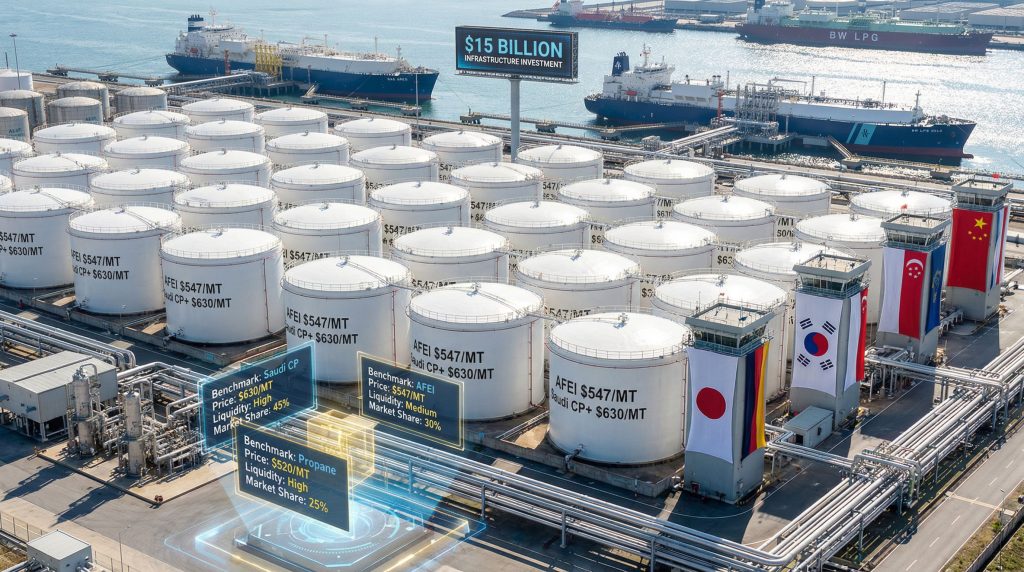
Asian LPG market tariffs produced counterintuitive pricing outcomes that challenged traditional economic assumptions about tariff impacts on commodity markets. The Argus Far East Index (AFEI) declined 13% year-over-year following April 2025 tariff implementation, falling from $627/mt in 2024 to $547/mt in 2025, representing an $80 per metric tonne price reduction.
This price decline during supply disruption reflects sophisticated market adjustment mechanisms where demand elasticity responses prevented monopolistic pricing. Rather than allowing prices to rise in response to supply constraints, global LPG markets adjusted downward to manage demand destruction risk, revealing market structures where marginal consumer response operates as a binding constraint on pricing power.
AFEI liquidity consolidation accelerated during the tariff period, with AFEI-linked swap volumes expanding by 12% in 2025 to exceed 370 million metric tonnes of annual trading volume. This represents more than three times the liquidity of CP-based swap mechanisms, consolidating AFEI's market dominance during periods of supply uncertainty.
Asian LPG Price Benchmark Comparison (2025)
| Benchmark | Average Price ($/MT) | Annual Trading Volume | Market Share |
|---|---|---|---|
| AFEI | $547 | 370 million MT | 65% |
| Saudi CP+ | $630 | 120 million MT | 25% |
| Regional Spot | $523 | 45 million MT | 10% |
Regional Price Differential Economics
The Saudi CP+ premium to AFEI widened significantly to $83 per metric tonne in 2025, compared with $44/mt in 2024 and $61/mt in 2023. This persistent and expanding structural divergence indicates that traditional pricing mechanisms based on crude oil linkages increasingly diverge from transparent, trade-reflective benchmarks.
Gulf differential volatility reached extreme levels during 2025, with premiums and discounts swinging by as much as ±$50/mt, reflecting structural tightness in Middle Eastern supply combined with reduced availability of competing US supplies. As China absorbed larger Middle Eastern volumes following US tariff implementation, marginal supply/demand balance shifted, creating wider differential swings.
Currency hedging implications became more complex as pricing mechanisms fragmented across the region. Market participants utilising AFEI-denominated transactions benefit from transparent, trade-reflective pricing that incorporates real arbitrage opportunity information, while CP-based pricing mechanisms exhibit increased basis risk during supply disruption periods.
Price Discovery Efficiency Characteristics:
• AFEI mechanism advantages: Reflects actual delivered values across Asian markets, outperforming CP-based pricing during supply uncertainty
• Liquidity concentration effects: Higher trading volumes reduce bid-ask spreads and transaction costs, creating self-reinforcing preferences
• Information efficiency: AFEI captures continuous arbitrage opportunity data as traders identify and execute profitable spreads
• Benchmark migration trends: Market participants actively gravitate toward transparent pricing during disruption periods
What Are the Macroeconomic Implications of Feedstock Competition in Asian Petrochemicals?
Industrial Economics of Feedstock Substitution
Asian LPG market tariffs accelerated fundamental shifts in petrochemical feedstock economics, with ethane emerging as the most competitive alternative across the region. China's ethane imports increased by 20% year-over-year to reach 6.5 million metric tonnes in 2025, representing accelerating adoption that fundamentally alters demand dynamics for traditional LPG-based production.
The economic competitiveness analysis reveals that ethane provides several technical advantages over propane-based LPG: enhanced thermal efficiency in steam cracker operations, higher olefin yield ratios per unit of feedstock, and reduced byproduct complications. When US ethane trades at material discounts relative to LPG on a per-BTU basis, the combination of chemical and economic advantages becomes compelling for capacity retrofitting investments.
Feedstock switching economics in Japan, Korea, and Taiwan demonstrate that LPG becomes competitively attractive against naphtha whenever prices decline below 90% of naphtha reference values. This creates a price elasticity anchor where downstream crack spread economics trigger switching behaviour, frequently breached during 2025 as crackers dynamically optimised feedstock selection.
Investment Flow Patterns in Alternative Feedstock Infrastructure
The $15 billion infrastructure investment across Asia directed toward ethane import terminals and processing capacity represents a capital allocation decision prioritising long-term feedstock diversification over reliance on any single commodity. Industry confidence in ethane's competitiveness extends through the 2028-2030 horizon, where planned fleet expansion will further compress transportation costs.
Approximately 60 very large ethane carriers (VLECs) and ultra-large ethane carriers (ULECs) are scheduled to enter service from 2028 onward, representing structural supply-side expansion that will materially increase US ethane export capacity and reduce delivered costs to Asian markets.
Projects across China are being retrofitted and expanded to handle ethane as primary feedstock, indicating substantial commitment to feedstock flexibility investments. The economic justification for retrofitting requires present-value analysis using 8-10 year payback horizons and discount rates typical of petrochemical industry capital allocation standards.
Feedstock Economics Transformation Drivers:
• Capital efficiency: Ethane retrofitting provides superior returns versus new LPG-based capacity construction
• Operational flexibility: Multi-feedstock capability reduces exposure to single-commodity price volatility
• Transportation cost reduction: VLEC/ULEC fleet expansion compresses delivered economics through economies of scale
• Yield optimisation: Ethane cracking provides higher value product slate versus competing feedstocks
The shift toward ethane represents a fundamental transformation of Asian petrochemical economics, where transportation infrastructure investments unlock new competitive dynamics that reduce regional dependence on traditional LPG imports while enhancing operational flexibility across multi-billion dollar manufacturing complexes.
How Do Geopolitical Trade Relationships Influence Asian Energy Economics?
Bilateral Trade Balance Optimisation Strategies
Asian LPG market tariffs have elevated energy procurement decisions from purely economic optimisation to strategic bilateral relationship management. India's government-mandated policy requiring at least 10% of LPG imports from US sources resulted in approximately 2 million tonnes of US shipments in 2025, demonstrating how energy security objectives can override short-term price considerations.
India also signed its first term LPG contracts with US suppliers for 2026, suggesting longer-term structural commitment independent of geopolitical volatility. This approach indicates that political calculation and bilateral trade balance management function as co-equal drivers alongside traditional price-based procurement logic.
The economic diplomacy dimension extends across Southeast Asia, where Indonesia and Vietnam each increased US LPG imports by more than 1 million tonnes during 2025, driven explicitly by trade deficit reduction objectives with the United States. However, this reveals sophisticated understanding of how commodity procurement decisions can support broader diplomatic and economic relationships, particularly within the context of the ongoing US-China trade war.
Regional Economic Integration Through Energy Trade
Japanese trading strategies demonstrate advanced arbitrage capabilities during tariff-driven market disruptions. Japan increased US imports by around 2 million tonnes while simultaneously rerouting Canadian and Australian cargoes to China, later replenishing domestic inventories with US supplies. This triangular arbitrage approach captured value differentials between pricing mechanisms while maintaining supply security.
The development of new trade corridors, particularly Canadian LPG exports to China beginning for the first time in 2025, illustrates how geopolitical tensions can accelerate infrastructure development and relationship building that might otherwise take years to establish. These new routes create strategic alternatives that enhance long-term supply security, especially considering Canadian energy challenges in the current geopolitical climate.
Regional cooperation mechanisms have strengthened as countries coordinate responses to supply disruptions. The ability to activate alternative supplier relationships within months demonstrates pre-existing infrastructure flexibility and relationship frameworks that facilitate rapid adaptation to changing geopolitical circumstances.
Strategic Energy Relationship Developments:
• US-India structural partnership: Term contracts and policy mandates create long-term procurement stability
• ASEAN supply diversification: Indonesia and Vietnam leverage energy imports for trade balance management
• North American alternative routes: Canada emerges as strategic supplier independent of US tariff structures
• Middle Eastern capacity expansion: Increased volumes to China strengthen Gulf-Asia energy partnerships
What Economic Models Predict Future Asian LPG Market Evolution?
Demand Elasticity Analysis Across Asian Economies
Economic modelling reveals that Asian LPG market tariffs have accelerated demand elasticity responses that traditional forecasting models failed to anticipate. The 50% reduction in Chinese US LPG imports during July-December 2025 compared to the same period in 2024 demonstrates price elasticity coefficients significantly higher than historical precedents suggested.
Chinese propane dehydrogenation (PDH) capacity expansion of 3 million tonnes in 2025 despite tariff challenges indicates that downstream margins remained attractive relative to alternative production routes. This suggests that PDH economics exhibit lower price sensitivity than steam cracker operations, which contracted by roughly 3 million tonnes during the same period.
Industrial development stage analysis across Asian economies reveals varying price sensitivity patterns. Mature petrochemical markets in Japan, Korea, and Taiwan demonstrate sophisticated switching capabilities between feedstock types, while emerging markets in Southeast Asia prioritise supply security over short-term cost optimisation.
Supply-Demand Equilibrium Projections
Ethane import growth of 20% year-over-year to 6.5 million metric tonnes in China represents a fundamental shift in equilibrium modelling assumptions. Traditional LPG demand projections must now incorporate ethane substitution effects that accelerate during periods of LPG price volatility or supply uncertainty.
The 60 VLECs/ULECs scheduled for delivery from 2028 onwards will materially alter transportation cost structures and supply elasticity coefficients. Economic sustainability analysis indicates that current pricing structures may face significant pressure as additional capacity comes online and transportation costs decline. Furthermore, these developments could influence broader oil price movements across related energy markets.
Market equilibrium factors requiring model updates:
• Feedstock substitution acceleration: Ethane adoption rates exceed previous forecasting assumptions
• Infrastructure investment cycles: $15 billion Asian terminal investments alter capacity constraints
• Geopolitical premium incorporation: Trade relationship factors become permanent model variables
• Transportation cost evolution: VLEC fleet expansion compresses delivered economics across trade routes
Asian LPG Demand Elasticity Coefficients (2025 Analysis)
| Market Segment | Price Elasticity | Substitution Flexibility | Time Response |
|---|---|---|---|
| Chinese PDH | -0.3 | Low | 6-12 months |
| Steam Crackers | -0.8 | High | 3-6 months |
| Regional Spot | -1.2 | Very High | 1-3 months |
Which Economic Scenarios Could Reshape Asian LPG Trade Architecture?
Economic Impact Modelling of Trade Policy Changes
Scenario analysis examining potential tariff escalation versus trade normalisation reveals asymmetric economic impacts across Asian markets. Tariff escalation scenarios could accelerate the $15 billion ethane infrastructure investment timeline, compressing planned development schedules as economic incentives for feedstock diversification strengthen.
Trade normalisation scenarios present complex rebalancing challenges, as newly established supply relationships with Middle Eastern and Canadian suppliers may persist due to contract commitments and infrastructure investments. The 2 million tonnes of India's term LPG contracts with US suppliers for 2026 represent structural commitments that operate independently of broader trade policy evolution.
Economic consequences of supply corridor disruptions extend beyond immediate pricing impacts. The 12% expansion of AFEI trading volumes to 370 million metric tonnes during 2025 demonstrates how market participants migrate toward transparent pricing mechanisms during uncertainty periods, potentially creating permanent shifts in benchmark preferences.
Investment Economics in Alternative Energy Infrastructure
The launch of Argus CFR China ethane assessment in September 2025 provides daily pricing transparency that enables more sophisticated economic analysis of feedstock alternatives. This benchmark development supports economic viability assessment for continued infrastructure investment and capacity expansion across the ethane value chain.
Economic timeline analysis for technology substitution suggests that ethane's 20% year-over-year import growth in China represents the early phase of a longer-term transition. Capital requirements for energy transition in petrochemicals may accelerate as renewable feedstock technologies achieve commercial viability and economic competitiveness.
Alternative scenario economic impacts:
• Tariff escalation effects: Accelerated ethane adoption, compressed infrastructure timelines, permanent supplier diversification
• Trade normalisation outcomes: Gradual rebalancing constrained by existing contracts and sunk infrastructure investments
• Supply disruption scenarios: Enhanced preference for transparent benchmarks, strategic inventory accumulation
• Technology substitution acceleration: Renewable feedstock economics become competitive earlier than baseline projections
The next major ASX story will hit our subscribers first
How Do Regional Economic Development Patterns Influence LPG Demand Trajectories?
Emerging Market Economics and Energy Consumption Growth
Regional economic development analysis reveals that Asian LPG market tariffs have differentiated impacts based on industrial maturity and infrastructure flexibility. Southeast Asian markets demonstrated remarkable adaptability, with Indonesia and Vietnam each absorbing more than 1 million tonnes of redirected US LPG supplies, indicating robust demand growth potential and supply chain flexibility.
India's rising LPG consumption expanded the overall import pool rather than substituting between suppliers, suggesting that economic growth trajectories in emerging markets can accommodate multiple supply sources simultaneously. This expansion dynamic contrasts with mature markets where substitution effects dominate procurement decisions.
Economic development correlation analysis indicates that propane dehydrogenation capacity additions correlate strongly with GDP growth rates and manufacturing sector expansion. China's 3 million tonnes of PDH capacity growth in 2025 occurred despite tariff headwinds, demonstrating that industrial development momentum can overcome short-term supply cost pressures.
Economic Sustainability of Current Market Structures
Long-term viability analysis suggests that tariff-influenced trade flows may persist beyond the initial policy implementation period due to infrastructure investments and contract commitments. The 370 million metric tonnes of AFEI-linked trading volume represents market structure evolution that prioritises transparency and flexibility over traditional formula-based pricing relationships.
Investment sustainability assessment indicates that current infrastructure configurations support multiple scenario outcomes. The 60 VLECs/ULECs scheduled for delivery from 2028 provide supply chain flexibility that reduces dependency on any single trade route or supplier relationship, enhancing overall system resilience.
Economic efficiency analysis reveals that fragmented markets may deliver superior outcomes compared to concentrated supplier relationships during periods of geopolitical uncertainty. The ability to rapidly activate alternative supply sources within months rather than years demonstrates sophisticated risk management capabilities that justify infrastructure investment premiums.
Regional Development Impact Factors:
• Infrastructure investment acceleration: Tariff-driven diversification speeds up planned capacity expansions
• Contract structure evolution: Term agreements provide stability while maintaining supplier flexibility
• Benchmark preference shifts: Transparent pricing mechanisms gain permanent market share during disruption periods
• Supply security premium recognition: Economic models incorporate geopolitical risk factors as permanent variables rather than temporary adjustments
The transformation of Asian LPG markets through tariff implementation represents more than temporary supply rebalancing. It demonstrates how modern energy security economics operate through sophisticated adaptation mechanisms that can permanently alter trade architecture and competitive dynamics. The $15 billion infrastructure investment across Asia, combined with 20% ethane import growth and 12% expansion in AFEI trading volumes, indicates structural changes that extend well beyond the initial policy catalyst.
Economic analysis reveals that Asian markets possess remarkable supply chain flexibility and risk management capabilities that enable rapid adaptation to geopolitical disruptions. The ability to establish entirely new trade corridors, activate alternative supplier relationships, and accelerate infrastructure development within months provides a foundation for enhanced energy security and economic resilience across the region.
Further market analysis and data on Asian energy trade patterns can be found through industry sources such as Argus Media's comprehensive LPG market intelligence reports, which provide detailed insights into pricing mechanisms and trade flow evolution, as well as Asian LPG market outlook analyses examining future supply and demand dynamics.
Ready to Capitalise on Energy Market Disruptions?
Discovery Alert's proprietary Discovery IQ model delivers real-time alerts on significant ASX mineral discoveries, including critical materials essential for energy infrastructure and petrochemical sectors. Stay ahead of market-moving announcements by exploring Discovery Alert's dedicated discoveries page, which showcases historic examples of exceptional returns from major mineral finds, and begin your 14-day free trial today to position yourself advantageously in evolving commodity markets.