May 16, 2026
The Aluminum Supply Chain's Upstream Vulnerability and Why It Matters Now
Few industrial metals carry as much strategic weight as aluminium. It is foundational to defence aerospace, electric vehicle manufacturing, construction, and packaging. Yet the raw material that makes aluminium possible, bauxite ore, is extracted from a relatively small number of countries, and the refining infrastructure that converts it into alumina before smelting is heavily concentrated in Asia. This structural concentration has quietly become one of the more pressing concerns in Western industrial policy, reshaping how governments in Washington and Brussels think about resource diplomacy.
Guyana, a small South American nation on the Atlantic coast, is increasingly at the centre of this recalibration. Long recognised as an established bauxite producer, the country is now drawing sustained diplomatic attention from the United States as Washington works to reduce its exposure to supply chains that run through Chinese-controlled refining infrastructure. Understanding what US involvement in Guyana's bauxite industry actually entails, who else is competing for influence, and what it could mean for global aluminium markets requires looking well beyond a single diplomatic meeting.
When big ASX news breaks, our subscribers know first
Why Bauxite Has Moved Up Washington's Strategic Priority List
Aluminium's production process is linear and unforgiving. Bauxite must first be refined into alumina through the Bayer process, and alumina must then be smelted into primary aluminium. Each step requires significant capital, energy, and technical expertise. Disruption at any stage, particularly at the bauxite or alumina level, reverberates throughout the entire value chain.
China has established an extraordinarily dominant position across this value chain. According to the US Geological Survey, China accounts for the largest share of global bauxite production and refining capacity, and its state-affiliated companies have made substantial investments in bauxite-producing nations across West Africa, Southeast Asia, and the Pacific. From a supply chain security standpoint, this creates a structural dependency that Western industrial nations have been slow to address.
The shift in US policy posture reflects a broader recognition that passive trade relationships with mineral-rich nations are no longer sufficient. Active mineral diplomacy, involving investment facilitation, technical cooperation, and infrastructure engagement, is increasingly the tool Washington is deploying to secure upstream access to critical raw materials before demand pressure makes competition for those resources far more intense.
The Bayer Process and Why Upstream Access Is Non-Negotiable
To understand the strategic logic, it helps to understand the chemistry. Bauxite ore contains aluminium hydroxide minerals, primarily gibbsite, boehmite, and diaspore, which must be dissolved in caustic soda under high pressure and temperature to extract alumina. The ratio of bauxite required to produce alumina, and then the energy required to smelt alumina into aluminium metal, means that securing high-quality bauxite at scale is the essential first step in any sovereign aluminium strategy.
Bauxite quality varies considerably by deposit. Reactive silica content, moisture levels, available alumina percentage, and the dominant mineral form all influence refinery economics. Deposits with high gibbsite content and low reactive silica are generally the most commercially attractive because they require less caustic soda and lower digestion temperatures, reducing both operating costs and environmental impact.
Guyana's Position in the Global Bauxite Landscape
Guyana has been a commercially active bauxite producer for decades, with operations dating back to the early twentieth century under colonial-era foreign control, followed by nationalisation in the 1970s under Prime Minister Forbes Burnham, and subsequently by re-opening to international investment. Today, the country is recognised as one of the world's significant bauxite-producing nations, though it does not rank among the absolute top-tier producers by volume in the way that Australia, Guinea, or Brazil do.
What makes Guyana particularly interesting to strategic planners is not its current production profile but rather its unexplored potential. Large portions of the country's interior mineral-bearing land have not undergone systematic geological surveying. The Guiana Shield, the ancient geological formation underlying much of Guyana, Suriname, French Guiana, and parts of Venezuela and Brazil, is known to host a range of mineral deposits, and the full extent of its bauxite resources remains incompletely characterised.
US Under Secretary for Economic Affairs Jacob Helberg, following meetings with Guyanese President Irfaan Ali in May 2026, confirmed publicly that known bauxite reserves are already established, while emphasising that deeper geological surveys could reveal the country's broader mineral potential beyond bauxite alone. That framing is significant. It positions the US engagement not merely as a transactional play for existing production but as a longer-term effort to establish geological knowledge as a strategic asset.
The Guiana Shield: A Geological Argument for Deeper Exploration
The Guiana Shield is one of the oldest exposed geological formations on Earth, estimated at approximately 1.7 billion years old. Ancient cratons of this nature frequently host deeply weathered laterite profiles, which are the geological settings most conducive to bauxite formation. Prolonged tropical weathering of aluminium-rich parent rocks over millions of years produces the thick laterite crusts from which bauxite is extracted.
Beyond bauxite, cratons like the Guiana Shield can host gold, diamonds, manganese, rare earth element concentrations, and other critical minerals depending on specific local geology. The absence of comprehensive airborne geophysical surveys and systematic geochemical sampling across much of Guyana's interior means the country's full mineral inventory remains an open question. This is precisely the gap that US officials have identified as an entry point for technical engagement and investment.
The Three Dimensions of US Engagement
The diplomatic signals emerging from the Helberg visit point to a structured, multi-dimensional approach rather than a single transactional investment. Furthermore, technical talks between Guyana and the US on bauxite and broader investment opportunities suggest a formalised framework is taking shape. Based on publicly reported discussions, three distinct engagement pillars are taking shape.
| Engagement Pillar | Description | Strategic Objective |
|---|---|---|
| Private Investment Facilitation | Reducing regulatory and logistical barriers for US-linked capital in Guyana's mining sector | Increase Western-aligned capital in bauxite and adjacent mineral extraction |
| Infrastructure and Logistics Development | Roads, haulage systems, port upgrades, and advanced transport technologies | Improve throughput from inland sites to export terminals |
| Geological Surveying and Mineral Mapping | Technical support for systematic surveys of unexplored mineral-bearing land | Build geological knowledge base and identify deposits beyond bauxite |
One notable element of the infrastructure discussion involves autonomous haulage systems. These technologies, already deployed at scale in large open-cut mining operations in Australia's Pilbara region, use GPS guidance, obstacle detection systems, and fleet management software to operate heavy haul trucks without human drivers. In remote inland mining environments with poor road infrastructure and difficult conditions, autonomous haulage can reduce operating costs materially and improve safety outcomes.
Discussions following the Helberg-Ali meetings signalled a move beyond diplomatic intent toward operational planning, with technical working groups established as a follow-up mechanism to translate policy objectives into concrete programmes.
First Bauxite's Bonasika Operation: A Proof of Concept Already in Motion
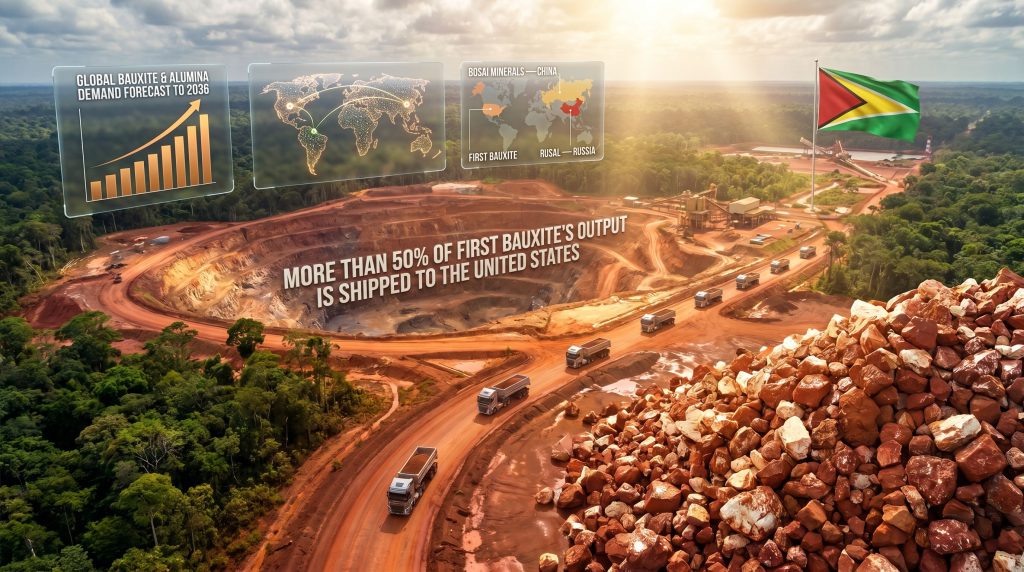
One of the clearest illustrations of what US involvement in Guyana's bauxite industry looks like in practice is the Bonasika operation run by First Bauxite. More than half of the output from this site is shipped directly to the United States, and over ninety percent of the workforce is drawn from Guyana's domestic labour pool. US Ambassador Nicole Theriot's visit to the Bonasika site during this period of heightened diplomatic activity was widely read as a signal of formal US endorsement of this operational model.
What the Bonasika case demonstrates is that US involvement in Guyana's bauxite industry is not speculative. It is already embedded in existing trade flows and employment structures. The current diplomatic push appears designed to formalise, deepen, and replicate this kind of arrangement at a larger scale, expanding beyond a single operation to reshape the broader sector. Consequently, the leading bauxite mines already active in Guyana provide a working template for this expanded engagement.
The Foreign Investment Landscape: Three Powers, One Small Nation
Guyana's bauxite sector is not a blank slate waiting for US capital. Multiple foreign interests are already operating or positioning themselves, creating a genuinely competitive investment environment. In addition, the presence of the leading bauxite mines globally provides useful context for how Guyana's operations compare in scale and strategic relevance.
| Operator | Country of Origin | Operational Status | Key Notes |
|---|---|---|---|
| BOSAI Minerals | China | Active | One of Guyana's largest bauxite producers by output |
| First Bauxite | United States | Active | Bonasika site; majority of exports to United States |
| RUSAL | Russia | Returning | Anticipated resumption of operations after 2018 exit |
BOSAI Minerals' position as an incumbent large-scale producer gives China a structural advantage in Guyana's bauxite sector that cannot be displaced quickly. The company's established operational footprint, existing workforce relationships, and sunk infrastructure investment create significant barriers to competitive entry by other foreign players in the near term.
RUSAL's anticipated return adds another dimension. Russia's largest aluminium company operated in Guyana before withdrawing in 2018, and its prospective re-entry into the market means Washington's engagement is occurring in an environment where two other major geopolitical rivals already hold or are seeking significant positions.
This dynamic creates genuine leverage for Georgetown. Guyana's government is in the unusual position of being courted simultaneously by US, Chinese, and Russian capital, a situation that historically allows resource-rich nations to negotiate better terms, extract larger infrastructure commitments, and push for more favourable revenue-sharing arrangements.
The Risk of Becoming a Proxy Arena
History offers cautionary examples of mineral-rich developing nations becoming contested spaces where great-power competition plays out through investment vehicles and diplomatic relationships. The Democratic Republic of Congo's cobalt sector, parts of West Africa's rare earth landscape, and certain Pacific island nations' infrastructure decisions all illustrate how rapidly resource competition can shift from purely economic to geopolitically charged.
For Guyana, the challenge is to attract the capital and technical expertise it needs to develop its mineral sector while maintaining genuine sovereignty over its resource base and the terms of its development. Regulatory frameworks, transparent concession awarding processes, and robust local content requirements are the primary instruments through which this balance is maintained.
The next major ASX story will hit our subscribers first
What Lies Beyond Bauxite: Critical Minerals and a Multi-Commodity Future
Perhaps the most strategically significant aspect of the current US engagement is its explicit framing as a surveying partnership rather than a pure extraction play. Helberg's public statements specifically referenced the potential to identify mineral deposits beyond bauxite through expanded geological programmes. This suggests Washington is thinking about Guyana not simply as a bauxite source but as a potential multi-commodity strategic partner.
The geological logic supports this ambition. Ancient shield formations are often polymetallic environments where bauxite, gold, manganese, and other critical minerals occur in proximity. A comprehensive national mineral mapping programme using modern airborne geophysical techniques, satellite remote sensing, and systematic geochemical sampling could substantially redefine Guyana's investment profile across multiple commodity categories.
Critical minerals with potential relevance to Guyana's geology include:
- Manganese: Essential for steel production and increasingly important in battery cathode chemistries for electric vehicles
- Rare earth elements: Concentrated in certain laterite profiles and increasingly targeted by Western supply chain strategies
- Gold: Already produced in Guyana, with significant small-scale and artisanal mining activity alongside formal operations
- Industrial minerals: Including kaolin and silica, which occur in certain weathered shield environments
Washington's Broader Western Hemisphere Resource Strategy
The Guyana engagement does not exist in isolation. It reflects a wider US policy orientation toward treating mineral-rich nations in the Western Hemisphere as strategic supply chain partners. However, this approach must also contend with broader market pressures. The top aluminium producers globally are navigating significant headwinds, including the impacts of US aluminium tariffs that are reshaping trade flows and investment decisions across the sector.
Infrastructure investment is consistently emphasised alongside mining investment in US official statements, and this is not accidental. Logistics bottlenecks, specifically the cost and difficulty of moving ore from remote interior sites to export terminals, represent a binding constraint on Guyana's bauxite sector's growth potential. Roads capable of handling heavy mining traffic, river transport upgrades, and port facility improvements are prerequisites for any significant production increase.
Global Aluminium and Bauxite Market Implications
From a market perspective, expanded Guyanese bauxite production could provide meaningful supply diversification for North American and European aluminium producers. The energy transition is a significant driver of this urgency. Aluminium demand is forecast to grow substantially through the mid-2030s, driven by electric vehicle platforms that use aluminium intensively for lightweighting, renewable energy infrastructure, and construction in growing economies.
Furthermore, the alumina market pressures currently affecting producers globally underscore the urgency of upstream supply chain diversification. Securing long-term supply agreements with Guyana's bauxite sector now, ahead of projected demand intensification, could represent a durable competitive advantage for US industrial interests that move early.
The alumina refining question remains an important medium-term consideration. Currently, Guyana exports raw bauxite rather than processing it domestically into alumina, which means that a substantial portion of the value-added step occurs elsewhere. Developing in-country refining capacity would dramatically increase the economic benefit Guyana captures from its resources, but it requires significant capital investment, reliable energy supply, and technical expertise not immediately available at the scale needed.
US investment that eventually supports downstream refining capacity development, even if on a longer horizon, would represent a qualitative deepening of the bilateral economic relationship and a more durable form of supply chain security than raw ore export arrangements alone. In this context, the top aluminium producers are watching Guyana's strategic realignment closely as a bellwether for future supply chain architecture.
Key Takeaways for Market Watchers and Industry Observers
The developing story of US involvement in Guyana's bauxite industry carries implications that extend well beyond a single diplomatic visit or a single commodity.
- The US engagement is multi-dimensional, spanning investment facilitation, infrastructure development, and geological surveying, rather than a narrow transactional play for existing production
- Guyana's mineral sector is becoming a genuinely contested space where US, Chinese, and Russian interests are simultaneously active, creating both opportunities and risks for Georgetown
- The geological case for Guyana's broader mineral potential is credible given the ancient shield geology of the region, but requires systematic modern surveying to quantify
- First Bauxite's Bonasika operation already demonstrates the template Washington seeks to replicate: US-bound exports, strong local employment, and commercially viable operations
- The longer-term prize may be a multi-commodity strategic partnership rather than bauxite alone, with geological surveying positioned as the foundational step toward that outcome
- For global aluminium supply chains, Guyana's expanded role could provide meaningful Western Hemisphere diversification, reducing structural exposure to Asia-Pacific concentrated supply routes
This article contains forward-looking analysis and market projections. Readers should note that forecasts regarding mineral demand, investment outcomes, and geopolitical developments involve inherent uncertainty and should not be treated as investment advice. Independent financial and geological due diligence is recommended for any investment decisions related to the bauxite, alumina, or aluminium sectors.
Want to Stay Ahead of the Next Major Mineral Discovery?
Discovery Alert's proprietary Discovery IQ model scans ASX announcements in real time, transforming complex mineral data into actionable insights across bauxite, aluminium, and more than 30 other commodities — explore historic discoveries and their exceptional returns, then begin your 14-day free trial to position yourself ahead of the broader market.