May 16, 2026
When Storage Becomes the Enemy: Understanding Iran's Forced Production Retreat
Global oil markets have spent decades absorbing the mechanics of sanctions, shadow fleets, and discounted crude flows from politically isolated producers. The prevailing assumption was that financial pressure and trade restrictions, while painful, could always be partially offset through creative routing and willing buyers. That assumption is now being tested as Iran cuts oil output as exports collapse, rooted not in financial deterrence but in the physical limits of infrastructure under stress.
When export infrastructure stops working, oil has nowhere to go. And when oil has nowhere to go, the wells themselves must stop producing.
When big ASX news breaks, our subscribers know first
Why Iran's Oil System Is Hitting a Physical Breaking Point
The Storage-Export Feedback Loop Explained
Crude oil production operates within a closed system where each node feeds the next. Oil travels from reservoir to wellhead, through pipeline to terminal storage, then onto tankers bound for international markets. This system is engineered with buffer capacity at every stage, but it is not infinitely elastic. When export throughput falls faster than producers can idle wells, storage facilities absorb the surplus until they cannot absorb any more.
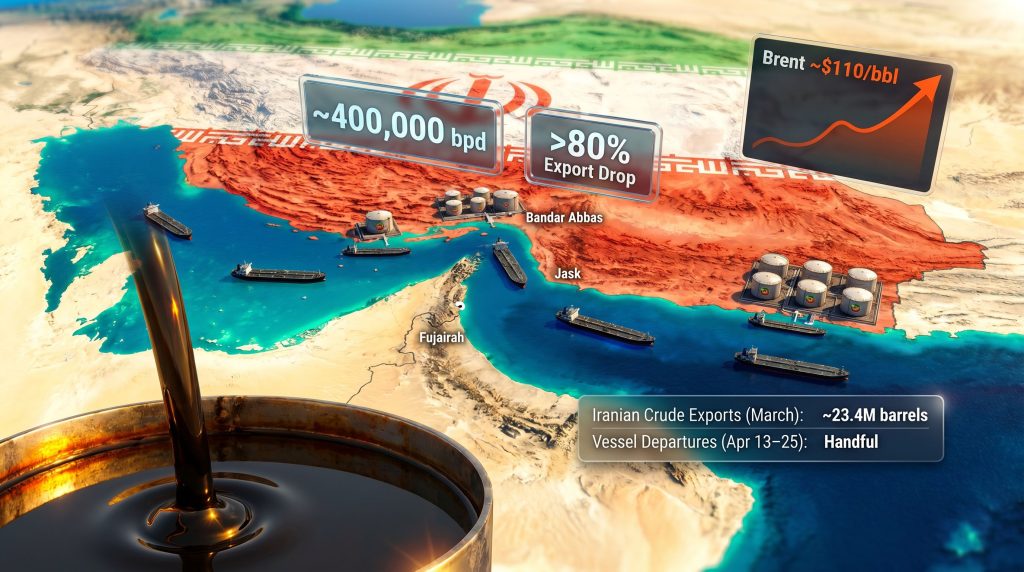
That is precisely the dynamic now playing out across Iranian oil infrastructure. With U.S. naval enforcement constraining tanker transit through Gulf exit routes, export throughput has collapsed dramatically. Vessel-tracking data from Vortexa shows that between April 13 and 25, 2026, only a handful of tankers carrying Iranian crude departed Gulf of Oman terminals. Against a March 2026 baseline of 23.4 million barrels exported over a comparable period (per LSEG data), this represents an export decline exceeding 80% within weeks.
The mechanical consequences are predictable and unavoidable. Onshore storage at Iranian terminal facilities, primarily Kharg Island and Sirri Island, began absorbing stranded barrels at accelerating rates. As storage approaches operational pressure limits, the only viable response is to reduce wellhead output. There is no override button for basic physics.
How Naval Enforcement Differs From Sanctions as a Supply Disruption Tool
This distinction carries enormous analytical weight for anyone trying to understand why this disruption is more acute than prior Iranian sanctions rounds. Understanding the broader geopolitical oil price factors at play is essential to contextualising these developments accurately.
Traditional sanctions work on the demand side. They reduce the pool of willing buyers and impose legal and financial penalties on intermediaries. But willing buyers can still be found, particularly in Asia, and shadow fleet operators have historically enabled Iranian crude to reach markets at a discount. Supply flows, just at lower prices and through less transparent channels.
Naval interdiction operates on an entirely different layer. It physically prevents vessel movement regardless of buyer interest, pricing arrangements, or transshipment creativity. Malaysia has already flagged a surge in ship-to-ship oil transfers in its waters, reflecting Iran's attempts to obscure cargo origins and keep some volumes moving. However, these workarounds have a ceiling imposed by the physical realities of tanker availability, port capacity, and the range of naval enforcement activity.
Unlike financial sanctions, which can be partially circumvented through discounted sales and shadow fleet operations, physical export blockades create hard infrastructure ceilings that cannot be resolved through market mechanisms alone. Once storage fills, the constraint becomes geological, not financial.
The Strait of Hormuz sits at the centre of this dynamic. Approximately 20% of global seaborne crude trade transits this 33-kilometre-wide chokepoint annually, making it the single most consequential energy passage on Earth. Its closure or restriction does not merely tighten supply — it removes a routing option that has no viable substitute at the required volume scale.
How Big Is Iran's Production Cut and What Triggered It?
Quantifying the Output Reduction
U.S. Energy Secretary Chris Wright publicly confirmed in May 2026 that Iran cuts oil output by approximately 400,000 barrels per day, with further reductions anticipated as storage continued filling and export capacity remained constrained. Wright's characterisation was explicit in framing these cuts as mechanically inevitable rather than a policy decision by Tehran.
The 400,000 bpd figure represents a meaningful supply removal from an already tight global balance. For context, this volume exceeds the entire production output of Ecuador, equals roughly one-third of Nigeria's current output, and surpasses the combined production of several smaller OPEC members. Furthermore, when reviewing current crude oil prices, the full scale of this supply shock becomes even more apparent.
| Metric | March 2026 Baseline | Late April 2026 |
|---|---|---|
| Iranian crude exports | 23.4 million barrels (comparable period) | Fraction of prior volumes |
| Tanker departures (Apr 13-25 window) | Normal flow | Handful of vessels |
| Estimated production reduction | Baseline | ~400,000 bpd |
| Export decline vs. March | — | Greater than 80% |
The Sequence of Events That Made Cuts Inevitable
The production reduction did not occur in isolation. It followed a clear operational sequence:
- U.S. naval enforcement tightened around Gulf exit routes during March-April 2026
- Insurance costs and transit risk premiums surged for tankers carrying Iranian crude
- Tanker departures from Iranian terminals fell sharply as commercial viability eroded
- Stranded crude began accumulating in onshore storage at Kharg Island, Sirri Island, and secondary terminals
- Storage utilisation approached operational pressure limits beyond which tank integrity becomes a concern
- Wellhead production was reduced to match the reduced export throughput, a standard operational response rather than a strategic choice
Iranian operators have institutional memory of this process from prior sanctions periods. Well idling procedures typically involve gradual pressure reduction, sequential shutdown of marginal producers, and nitrogen injection to maintain reservoir integrity. Modern Iranian fields at moderate depths can generally tolerate idling for several months without permanent damage, provided pressure management procedures are correctly executed.
What Does a Prolonged Iranian Supply Disruption Mean for Global Oil Prices?
Price Pressure Scenarios: Three Pathways
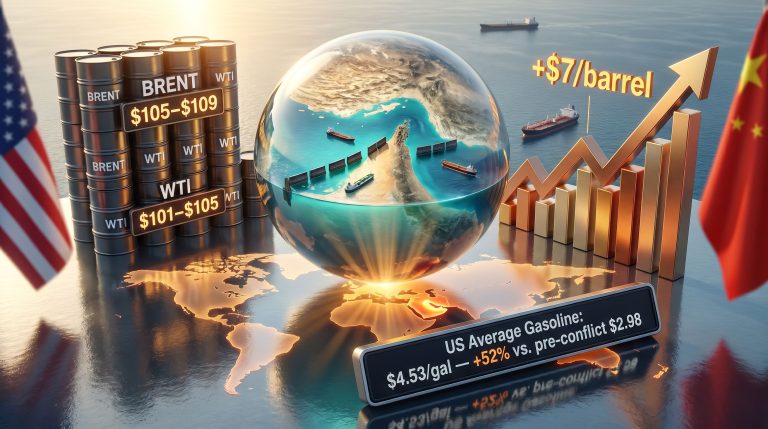
The EIA has modelled the price implications of sustained Hormuz constraint, concluding that a closure extending through late June 2026 could push oil prices up by as much as $20 per barrel above pre-disruption levels. Current market pricing reflects this risk premium in real time, with Brent crude approaching $110 per barrel and WTI trading above $105 per barrel as of mid-May 2026.
Three distinct scenarios define the range of possible outcomes:
Scenario A: Short-Term Resolution (Weeks)
- Strategic petroleum reserve releases absorb the near-term shock
- Price spike stabilises rather than compounds
- Iranian production restores without reservoir damage
- Market attention shifts back to demand-side fundamentals
Scenario B: Extended Disruption (Through June 2026)
- EIA-modelled price uplift of up to $20/bbl materialises progressively
- Global inventory drawdowns accelerate, eliminating buffer capacity
- Alternative suppliers face acute pressure to increase throughput
- Gasoline prices at the consumer level push meaningfully higher
Scenario C: Multi-Month Conflict Scenario
- Permanent damage risk to Iranian oilfield infrastructure becomes material
- Global supply deficit widens beyond the capacity of OPEC spare capacity to offset
- Demand destruction begins in price-sensitive developing economies
- Energy security becomes the dominant geopolitical theme across multiple diplomatic arenas
The longer the disruption persists, the higher the probability that Iran's production losses transition from temporary operational curtailments into structural capacity damage that requires substantial capital investment to reverse. This asymmetry between the speed of production loss and the pace of recovery is a critical but underappreciated risk factor.
How Is the Rest of OPEC Responding to the Supply Gap?
OPEC Production Dynamics Under Hormuz Stress
April 2026 OPEC output reportedly fell sharply, compounded by Iran-linked disruptions, representing one of the most acute production shocks the cartel has absorbed in recent decades. OPEC's market influence means that Saudi Arabia and the UAE hold the most meaningful spare production capacity within the cartel, positioning them as potential swing suppliers capable of partially offsetting Iranian losses, though neither has the ability to fully replace Iran's volumes at current rates.
The UAE's response carries a particular strategic dimension. Reports indicate ADNOC is planning to double its Hormuz-bypass export capacity through a new pipeline slated for completion in 2027. This development reflects long-term confidence in the value of Hormuz-independent routing infrastructure. This pipeline, running from Abu Dhabi's producing regions to the Port of Fujairah on the Gulf of Oman's eastern shore, already handles significant volumes but would represent a meaningful capacity expansion at a moment when its strategic value has never been more apparent.
The Geopolitical Leverage Dimension
Wright's public framing made clear that the production cuts are not purely an energy economics story. He explicitly characterised the output decline as additional pressure in the context of ongoing negotiations over Iran's nuclear programme and the conditions under which the Strait of Hormuz would be reopened to normal traffic. Consequently, this positions the production disruption as both a consequence of military enforcement and a negotiating instrument — a dual-use mechanism that complicates price forecasting because its resolution depends on diplomatic progress rather than market signals.
Historical analysis of prior Iran oil disruptions shows that production losses have sometimes accelerated negotiating timelines by concentrating economic pain on the Iranian government's budget, and sometimes prolonged them by hardening internal political opposition to concessions. The current situation sits at this same historical ambiguity.
Which Countries Are Most Exposed to Iran's Export Collapse?
Primary Demand-Side Vulnerabilities
The geographic concentration of Hormuz dependency creates a highly uneven distribution of exposure across global energy importers.
| Country/Region | Exposure Type | Risk Level |
|---|---|---|
| Japan | ~80% of energy imports via Hormuz | Very High |
| South Korea | ~80% of energy imports via Hormuz | Very High |
| India | Hormuz-dependent import routes + direct Iranian crude buyer | High |
| China | Major Iranian crude buyer via shadow fleet operations | High |
| Pakistan | LNG and energy supply via Hormuz routes | High |
| Europe | Indirect exposure via global benchmark pricing | Moderate |
| United States | Domestic producer but exposed via price benchmarks | Low-Moderate |
Asia's Structural Hormuz Dependency
Japan and South Korea route approximately 80% of their total energy imports through the Strait of Hormuz, a structural dependency with no short-term solution. Japan's refinery utilisation has dropped to 73% as operators draw down strategic oil stocks to maintain processing capacity, a finite strategy with a defined endpoint. Japanese and Korean buyers have also begun accelerating coal procurement as a partial substitute for disrupted LNG flows, though this substitution carries both environmental and capacity constraints.
India is experiencing direct economic transmission of the disruption. India's wholesale inflation has reached a 3.5-year high as fuel costs surge 25%, according to current reporting. India raised retail fuel prices for the first time in four years in May 2026, reflecting the extent to which global crude price increases could no longer be absorbed by downstream subsidy mechanisms. India's Prime Minister has ordered a 50% reduction in government motorcade sizes as a symbolic fuel conservation measure, signalling the political weight now attached to the crisis at the highest levels.
Pakistan has turned to active diplomatic engagement to secure LNG supply, issuing emergency tender requests for additional cargoes as its power sector faces escalating shortfalls. Two India-bound LPG tankers have been reported clearing Hormuz in dark mode (with AIS transponders disabled), providing an early indication of how commercial operators are navigating the enforcement environment.
The next major ASX story will hit our subscribers first
Can Iran Work Around the Export Blockade?
Alternative Routes and Their Practical Limits
Iranian officials and operators have historical experience navigating export disruptions, but the options available in this environment are substantially more constrained than in prior sanctions periods.
- Overland export corridors: Routes through Turkey, Pakistan, Afghanistan, and Central Asia exist in theory but cannot substitute for seaborne volumes at any meaningful scale. Pipeline infrastructure is either dormant, politically complex, or physically insufficient.
- Ship-to-ship transfers: Malaysia has flagged a significant surge in these operations in its territorial waters, where Iranian crude is transferred between vessels to obscure cargo origin. This method adds cost and complexity but can move some volumes when enforcement is not universal.
- Dark fleet operations: Vessels operating without AIS transponders have become more prevalent, as evidenced by two LPG tankers clearing Hormuz in dark mode. However, this approach carries elevated insurance costs and port access risks at the destination end.
- Chinese coordination: Iranian state media reported that Chinese tankers resumed Hormuz transit under coordinated arrangements. China's involvement as a buyer willing to test access creates a partial workaround, though the volumes achievable remain limited against Iran's total production capacity.
The fundamental constraint is that seaborne exports through the Gulf represent the overwhelming majority of Iran's crude export capacity. No combination of land routes and shadow fleet operations comes close to substituting for normal tanker traffic at the volumes required to sustain pre-disruption production levels.
What Happens to Iran's Economy as Oil Revenue Dries Up?
Domestic Economic Stress Indicators
Oil export revenue functions as the primary source of hard currency for the Iranian government. When export volumes collapse, the consequences cascade rapidly through the broader economy. In addition, the trade war impact on oil markets globally compounds these pressures further.
The transmission mechanism works as follows: reduced export volumes generate lower foreign exchange earnings, which compress the government's capacity to maintain the rial's purchasing power, fund subsidised energy and food programmes, and service operational government expenditure. Currency depreciation then amplifies imported inflation across consumer goods, compounding the cost-of-living pressure on the Iranian population.
Iran's economy was already operating under significant structural stress from prior sanctions rounds before this disruption intensified. Multiple years of constrained hard currency earnings had reduced the government's cushion for absorbing a further shock of this magnitude. The speed of the current export collapse — greater than 80% within weeks — removes the gradual adjustment period that allowed some adaptation during earlier sanctions tightening.
Historically, oil revenue collapses in Iran have triggered two distinct domestic political dynamics: public pressure intensifying demands for economic relief and negotiations, and hardline political factions using economic siege narratives to consolidate support. Which dynamic dominates in the current environment will heavily influence both the diplomatic trajectory and the duration of the supply disruption.
How Are Global Energy Markets Repricing the Risk?
Market Signals and Price Benchmarks
Current oil price movements reflect a sustained supply risk premium that has accumulated across successive weeks of Hormuz constraint. As of mid-May 2026, key benchmarks stand at:
- Brent Crude: $109.60 per barrel (up over 3.6% intraday)
- WTI Crude: $105.50 per barrel (up over 4.3% intraday)
- OPEC Basket: $115.10 per barrel (up nearly 7% in the most recent session)
- U.S. Gasoline: above $4.50 per gallon, approaching four-year highs
Brent is tracking toward a 6% weekly gain according to current market reporting, reflecting sustained investor conviction that the disruption will not resolve quickly. The headline from OilPrice.com noting Brent approaching $110 as Trump expressed reduced patience with Iran adds a diplomatic urgency dimension that markets are actively pricing.
Russia represents an unexpected beneficiary of the disruption. Russian oil revenues have surged by an estimated $6.3 billion as elevated global prices more than offset the volume constraints Russia continues to operate under. This dynamic creates a complex geopolitical incentive structure where one permanent UN Security Council member profits directly from the continuation of a conflict that others are attempting to resolve.
Strategic Reserve Deployment and Its Limits
Japan's 73% refinery utilisation rate, maintained through drawdowns of strategic petroleum stocks, illustrates both the effectiveness and the finite nature of reserve deployment as a price management mechanism. Strategic petroleum reserves are sized for weeks of disruption, not months. At the current pace of drawdown across multiple Asian economies simultaneously, the buffer provided by collective reserve releases will compress meaningfully over the coming weeks if export flows remain restricted.
The EIA has specifically provided new analytical frameworks for traders assessing Hormuz closure scenarios, acknowledging that this is no longer a theoretical tail risk but an active market condition requiring updated probabilistic modelling.
What Would a Resolution Look Like and What Would It Unlock?
Conditions for Export Normalisation
Resolution of the Hormuz disruption intersects diplomatic, military, and operational timelines in ways that make straightforward price normalisation projections unreliable. Based on available reporting and Wright's framing, the likely resolution pathway involves:
- Agreement on Iran's nuclear programme parameters as a prerequisite for naval enforcement withdrawal
- Formalised reopening of the Strait of Hormuz to commercial traffic
- Tanker operators and insurers restoring normal risk classifications for Gulf transits
- Gradual resumption of Iranian tanker departures from Kharg Island and Sirri Island terminals
- Wellhead production restoration through the reverse of the well idling sequence
Iranian operators have successfully managed this type of restart before. Provided the current disruption remains time-limited and pressure maintenance procedures have been correctly implemented at idled wells, production restoration to pre-disruption levels is operationally achievable within weeks to months of export resumption, not years.
The Upside Scenario: What Supply Restoration Would Mean
The return of approximately 400,000 bpd to global markets would provide meaningful relief to an inventory environment under accelerating pressure. Combined with potential OPEC production adjustments responding to price signals, a supply restoration announcement could trigger a rapid price correction.
The magnitude of that correction would depend on the pace of volume restoration, concurrent OPEC decisions, and the extent to which strategic reserve drawdowns have already softened the balance. A coordinated diplomatic resolution would likely produce a sharp, immediate market response given the scale of risk premium currently embedded in benchmark prices.
FAQ: Iran Oil Production Cuts and the Global Supply Crisis
Why Has Iran Cut Oil Production?
Iran has reduced production by approximately 400,000 barrels per day because U.S. naval enforcement has severely restricted tanker access through Gulf exit routes, causing export volumes to collapse and onshore storage to approach saturation. When storage reaches operational limits, wellhead production must be reduced to match actual export throughput.
How Much Have Iranian Oil Exports Fallen?
Vessel-tracking data from Vortexa indicates that Iranian crude exports fell by more than 80% between mid-March and late April 2026. Iran exported 23.4 million barrels over a comparable March period, while only a handful of tankers departed Gulf of Oman terminals during the April 13-25 window.
How Does the Strait of Hormuz Closure Affect Oil Prices?
EIA analysis indicates that a sustained Hormuz closure through late June 2026 could push global oil prices up by as much as $20 per barrel above pre-disruption levels. Current benchmarks show Brent approaching $110 and WTI above $105 per barrel, with the OPEC basket trading at $115.10.
Which Countries Are Most Affected by Iranian Export Disruptions?
Japan and South Korea are most exposed structurally, routing approximately 80% of their energy imports through the Strait of Hormuz. India is experiencing direct economic impact through a 3.5-year wholesale inflation high and a 25% fuel cost surge. China and Pakistan face elevated supply security risks. Europe faces indirect price exposure through global benchmark transmission.
Can Iran Resume Production Quickly if Exports Resume?
Iranian operators have institutional experience managing well idling and restart procedures from prior sanctions periods. A time-limited disruption is unlikely to cause permanent reservoir damage, meaning production could be restored relatively quickly once export routes reopen. The longer the shutdown persists, the greater the risk that permanent operational impacts emerge requiring capital-intensive remediation.
What Is the U.S. Government's Position on Iran's Production Cuts?
U.S. Energy Secretary Chris Wright confirmed the production decline in May 2026 and framed it as additional economic leverage in ongoing negotiations over Iran's nuclear programme and the status of the Strait of Hormuz, according to reporting by Julianne Geiger for OilPrice.com.
Key Takeaways: The Strategic Significance of Iran's Oil Output Squeeze
- Iran's production cut of approximately 400,000 bpd is a physical consequence of infrastructure failure, not a policy decision
- Exports fell by more than 80% between mid-March and late April 2026, according to Vortexa and LSEG data
- EIA modelling points to up to $20 per barrel of additional price pressure if the disruption extends through mid-2026
- Brent is trading near $110, WTI above $105, and the OPEC basket at $115.10 as of mid-May 2026
- Japan and South Korea route roughly 80% of energy imports through Hormuz; both face acute supply security pressure
- India's wholesale inflation has reached a 3.5-year high with fuel costs up 25%
- Russia's oil revenues have surged an estimated $6.3 billion as elevated prices offset its own volume constraints
- Resolution depends on diplomatic progress rather than market forces, creating unusual duration uncertainty for price forecasting
- The longer the disruption continues, the higher the risk of permanent production capacity damage inside Iran
This article is for informational purposes only and does not constitute financial, investment, or trading advice. Oil market forecasts and price projections involve significant uncertainty. Readers should conduct independent research before making investment decisions. Price data and market conditions referenced reflect reporting from OilPrice.com and Vortexa as of mid-May 2026.
Want to Stay Ahead of the Commodity Market Moves Driving ASX Opportunities?
Discovery Alert's proprietary Discovery IQ model scans ASX announcements in real time, instantly identifying high-potential mineral discoveries across 30+ commodities — including those most exposed to global energy and resource market shifts like the ones reshaping oil and commodity prices today. Explore how historic discoveries have delivered extraordinary returns on Discovery Alert's dedicated discoveries page, and begin your 14-day free trial to ensure you're positioned ahead of the market when the next major opportunity emerges.