May 15, 2026
When Supply Chains Break: The Logic Behind Oil's Geopolitical Price Premium
Every commodity market operates on a fundamental tension between what the data says and what traders fear. In most cycles, fundamental analysis wins. Demand forecasts, inventory levels, and production data form the scaffolding around which prices oscillate. However, there are rare, structurally distinct periods when that scaffolding collapses entirely, replaced by something harder to model and far more volatile: existential supply risk.
The global oil market entered one of those periods in May 2026. The Xi-Trump summit and oil prices became inseparable storylines as crude surged approximately $7 per barrel in a single week, even as both OPEC and the International Energy Agency issued downward demand revisions. Understanding this requires stepping outside conventional price discovery frameworks and examining the mechanics of geopolitical risk premium formation.
When big ASX news breaks, our subscribers know first
The Price Divergence That Tells You Everything
Under normal market conditions, simultaneous demand downgrades from two of the world's most authoritative energy forecasting institutions would exert clear downward pressure on crude prices. The logic is straightforward: lower expected consumption reduces the need for supply, loosening the supply-demand balance and dragging prices lower.
What happened instead during the week of May 12–15, 2026 was the opposite, and it was statistically striking.
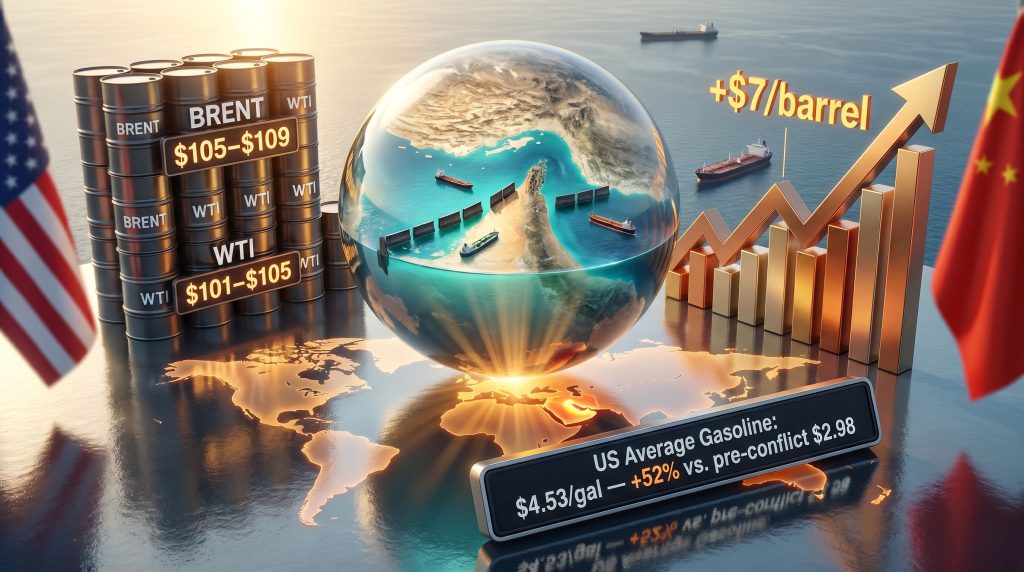
- WTI crude climbed into the $101–$105 per barrel range over the week
- Brent crude approached the $105–$109 per barrel range over the same period
- Both benchmarks posted a weekly gain of approximately $7 per barrel
- OPEC simultaneously cut its 2026 demand growth forecast by 200,000 barrels per day, revising its full-year estimate to 1.17 million b/d
- The IEA issued a parallel downgrade, projecting a widening supply deficit driven by Iranian production losses
The divergence between what fundamentals suggested (lower prices) and what markets delivered (higher prices) is itself a data point. Furthermore, analysts estimate the embedded geopolitical risk premium at approximately $10–$15 per barrel above fundamental value. This figure is derived from comparing where prices would likely have traded based on demand forecasts alone, versus where they actually settled.
When oil prices rise sharply in the same week that both OPEC and the IEA reduce their demand outlooks, it signals that supply-side fear has displaced demand-side analysis as the primary price determinant. This is a structurally rare condition that typically only emerges during genuine chokepoint crises.
OPEC's 2027 demand growth forecast was actually raised to 1.54 million b/d in the same report, implying the organisation expects consumption to recover once supply disruptions resolve. That forward-looking optimism only reinforces the interpretation that current pricing is driven by near-term supply anxiety rather than any structural demand collapse.
Xi-Trump Summit and Oil Prices: What Beijing Actually Delivered
The May 14, 2026 bilateral meeting between President Trump and President Xi in Beijing was perhaps the most anticipated geopolitical event for oil markets in 2026. Pre-summit positioning reflected genuine trader optimism, with market participants expecting concrete steps toward Strait of Hormuz normalisation to emerge from the two-hour meeting.
The reality proved more subdued. The summit produced three energy-relevant outcomes, none of which were operationally binding.
| Summit Commitment | Binding Status | Immediate Price Impact |
|---|---|---|
| Hormuz must remain open to global energy flows | Non-binding declaration | Minimal |
| Both sides oppose Iranian nuclear weapons capability | Rhetorical alignment | Negligible |
| China expressed interest in resuming US crude imports | Expressed interest only | Modest positive |
| Anti-militarisation of the Strait affirmed by Xi | Stated position, no enforcement mechanism | Unclear |
According to the White House, President Xi expressed interest in resuming Chinese purchases of American crude oil, which had ceased entirely in late February 2025 following a reported 20% year-over-year drop in Chinese crude inflows. While this signals supply diversification intent from Beijing, no timeline or volume commitment was attached to the statement.
The muted market reaction reflected trader scepticism. Brent crude posted only a 0.25% gain in the immediate post-summit window, with WTI rising just 0.32%. ING analysts noted that traders risked attaching too much weight to outcomes from a meeting that produced no enforcement architecture for Hormuz transit, characterising market sentiment as being in a cautious observational mode.
That scepticism was reinforced almost immediately when Iran publicly declared it maintained no trust in the United States and signalled readiness to resume hostilities. That declaration functionally cancelled whatever diplomatic optimism the summit had generated, leaving the bullish supply-disruption thesis fully intact. Consequently, the trade war's impact on energy markets remained firmly in focus.
The Strait of Hormuz: Anatomy of the World's Most Critical Chokepoint
The Strait of Hormuz is not simply important to global oil markets. It is, by virtually every measure, the single most consequential maritime chokepoint in the global energy system. Under normal operating conditions, approximately 20% of the world's crude oil supply transits through this narrow passage.
China's exposure is particularly acute. Between 40% and 60% of China's total crude oil requirements pass through the Strait, making Beijing simultaneously the world's most Hormuz-dependent importer and one of the key diplomatic actors capable of influencing Tehran's posture. China's commodity market challenges have, in addition, compounded the pressure Beijing faces on multiple resource fronts simultaneously.
Infrastructure Responses to the Blockage
As the disruption has persisted, major energy infrastructure operators have accelerated bypass and diversification strategies:
-
ADNOC Pipeline Expansion: The UAE's national oil company committed to doubling its Hormuz-bypass export pipeline capacity from the current 1.8 million barrels per day, with expanded infrastructure targeted for operational status by 2027. This represents the fastest near-term supply route diversification option available.
-
Chinese Tanker Transit Tests: Chinese-flagged tankers conducted test transits through the Strait under Iranian coordination, reflecting Beijing's decision to pursue direct diplomatic negotiation with Tehran to secure its own supply lines rather than relying solely on multilateral resolution.
-
Turkey's Eastern NATO Pipeline Proposal: Ahead of the July 2026 NATO summit in Ankara, Turkey proposed a $1.2 billion product pipeline connecting Romanian and Bulgarian markets to Turkish refining capacity. This initiative reflects the degree to which European energy security concerns have become embedded in military alliance planning.
Japan's response illustrates the real-world operational strain already materialising. The country's refinery utilisation rate fell to approximately 73% as strategic oil reserves were deployed to compensate for reduced seaborne import volumes. Strategic petroleum reserves were designed for exactly this scenario, but they are finite, and their drawdown rate signals the urgency of the situation.
The Dark Mode Navigation Phenomenon
One lesser-known dimension of the crisis involves tankers navigating in so-called dark mode, meaning vessels disable their Automatic Identification System (AIS) transponders to avoid detection. This practice, typically associated with sanctions evasion, has become increasingly common as carriers seek to manage risk during transit. Indian-bound LPG tankers have been reported clearing the Strait in dark mode, representing a structural erosion of maritime transparency that creates additional pricing uncertainty.
Malaysia has separately warned of a surge in Iranian ship-to-ship oil transfers, a technique used to obscure the origin of cargo. When the volume of crude whose provenance cannot be reliably tracked increases, market pricing becomes less anchored to physical reality.
Consumer Cost Transmission: From Benchmark to Pump
The translation of crude benchmark prices into consumer costs is rarely instantaneous. However, the speed of pass-through in 2026 has been faster than most historical precedents, partly because governments that previously cushioned prices through subsidies or capped domestic pricing are being forced to adjust.
United States
The US national average gasoline price reached $4.53 per gallon as of May 14, 2026, representing a 52% increase from the pre-conflict baseline of approximately $2.98 per gallon. Year-round E15 gasoline legislation passed the US House of Representatives during the week, offering a potential marginal relief mechanism. However, Senate approval and presidential signature both remain pending, meaning consumer relief from that measure is not imminent.
India: A Case Study in Import Vulnerability
India's situation illustrates the compounding pressure facing import-dependent emerging economies:
- Wholesale price inflation reached a 3.5-year high, with fuel costs surging approximately 25% year-over-year
- State-owned refiners implemented the first domestic diesel and gasoline price increase since March 2024, raising prices by approximately $0.03 per gallon
- Indian crude imports fell by approximately 800,000 barrels per day compared to pre-conflict levels
- India's Prime Minister ordered a 50% reduction in official motorcade sizes as a fuel conservation signal
- New Delhi formally requested that Washington extend its OFAC waiver on Russian crude purchases, with the existing authorisation expiring May 16, 2026
The OFAC waiver situation is particularly consequential. India has been using Russian crude as a partial substitute for disrupted Persian Gulf supply. Without an extension, Indian refiners would face a further collapse in import volumes at precisely the moment when domestic price pressure is already acute.
China's Demand Destruction Risk
Projections suggest Chinese gasoline consumption could decline by as much as 5.5% in 2026 if crude prices remain at current elevated levels. For the world's largest crude importer, a consumption contraction of that scale would ordinarily represent a significant bearish signal. The fact that this demand destruction scenario is unfolding simultaneously with Beijing's active pursuit of supply diversification through US crude imports suggests China is attempting to manage both sides of the equation.
Regional Stress Points: A Multi-Geography Breakdown
Europe: Windfall Taxation and Jet Fuel Fragility
EU energy ministers began discussions on a region-wide windfall profits tax targeting energy companies benefiting from war-driven price surges. The proposed structure would potentially mirror the United Kingdom's 38% Energy Profits Levy, which runs through 2030. This policy direction creates a secondary market risk: if windfall taxation reduces upstream investment incentives, medium-term supply development could be constrained precisely when the market needs new production capacity most.
A less widely discussed but acute vulnerability is UK aviation fuel supply. The country holds approximately one month's worth of jet fuel stocks, with seaborne imports accounting for 65% of total domestic jet consumption. Several European airlines have flagged this as a particular concern, especially heading into the northern hemisphere summer travel season.
Russia: The Beneficiary It Didn't Anticipate
Russia presents a paradoxical case. Despite being the target of an ongoing Ukrainian drone campaign targeting domestic refining infrastructure, Russia's oil export revenues surged by approximately $6.3 billion as elevated global prices more than compensated for lost downstream capacity. Ukraine's strikes on Rosneft's Ryazan refinery marked the 16th Russian refinery targeted in 2026, with cumulative downstream capacity losses estimated at approximately 700,000 b/d across January through May.
Cuba: The Extreme Case
Cuba's situation represents the severe end of the import-vulnerability spectrum. Cuba's energy minister confirmed the country had completely exhausted its diesel and fuel oil reserves, with domestic crude production of approximately 40,000 b/d covering only one-third of national requirements. The country has no strategic reserves remaining and no near-term import alternatives.
Iraq: Political Disruption Within OPEC
Iraq's parliament approved a new government under Prime Minister Ali al-Zaidi during the week, triggering a cabinet reshuffle in which Mohammed al-Khudair was named as the new oil minister. As OPEC's second-largest producer, ministerial transitions in Baghdad introduce execution risk at a moment when Iraqi production consistency matters acutely to global supply balances. Indeed, OPEC's broader market influence continues to shape how these supply shifts are interpreted globally.
The next major ASX story will hit our subscribers first
The Eneos-Chevron Singapore Deal: A Strategic Acquisition in Context
One development receiving less attention than the geopolitical headlines is Japan's Eneos acquiring Chevron's refining and lubricant subsidiaries across Southeast Asia and Australia for $2.17 billion. The deal includes a 50% stake in the 290,000 b/d Jurong Island refinery in Singapore, co-operated with PetroChina. This acquisition reflects a broader trend of Asian refining consolidation as major consuming nations seek to control more of their downstream processing capacity.
Scenario Pathways: Three Trajectories for Crude Prices
Analysts tracking crude oil prices through 2025 and into 2026 have outlined three distinct scenario pathways for markets navigating the current disruption.
| Scenario | Probability | Brent Crude Trajectory | Key Trigger |
|---|---|---|---|
| Hormuz Partial Reopening | 35% | Retraces to $85–$90/barrel range | Phased diplomatic resolution within 60–90 days |
| Prolonged Stalemate | 45% | Consolidates at $100–$115/barrel through Q3 2026 | Iran maintains distrust; no operational ceasefire framework |
| Full Escalation and Closure | 20% | Spikes above $130/barrel | Renewed hostilities trigger complete, extended Hormuz closure |
The most likely scenario, assigned approximately 45% probability, involves ongoing stalemate. Under this pathway, infrastructure bypass solutions including the UAE pipeline and Turkey's proposed NATO product pipeline accelerate but cannot fully compensate for lost Hormuz volumes within the 2026 timeframe. Consumer price pressures intensify across import-dependent economies, with demand destruction beginning to feed back into consumption data.
The tail-risk scenario of full closure carries a 20% probability but asymmetric price consequences. A credible and verified Hormuz reopening, conversely, would likely trigger a rapid $15–$25 per barrel decline in Brent crude as the risk premium unwound. Yahoo Finance has reported extensively on how markets are pricing these competing probabilities as diplomatic channels remain uncertain.
Key Data Reference: Oil Market Snapshot, May 15, 2026
| Metric | Value | Context |
|---|---|---|
| WTI Crude | ~$101–$105/barrel | Weekly gain of ~$7/barrel |
| Brent Crude | ~$105–$109/barrel | Post-summit gain of 0.25% |
| US Average Gasoline Price | $4.53/gallon | +52% vs. pre-conflict ~$2.98/gallon |
| India Fuel Cost Surge | +25% YoY | Wholesale inflation at 3.5-year high |
| OPEC 2026 Demand Growth | 1.17 million b/d | Reduced by 200,000 b/d vs. prior month |
| OPEC 2027 Demand Growth | 1.54 million b/d | Raised, implying recovery expectation |
| UAE Hormuz-Bypass Capacity | 1.8 million b/d (current) | Doubling targeted by 2027 |
| China Oil Via Hormuz | 40–60% of imports | Core Beijing strategic exposure |
| Hormuz Share of Global Supply | ~20% of world crude | Primary supply disruption metric |
| India Crude Import Decline | -800,000 b/d | Vs. pre-conflict levels |
| Russian Refinery Capacity Offline | ~700,000 b/d | Jan–May 2026 from Ukrainian strikes |
| Russia Oil Revenue Surge | +$6.3 billion | High prices offset production losses |
| Turkey NATO Pipeline Proposal | $1.2 billion | Romania/Bulgaria to Turkish refineries |
| Eneos-Chevron Singapore Deal | $2.17 billion | Includes 50% stake in 290,000 b/d Jurong Island refinery |
| Cuba Domestic Production | ~40,000 b/d | Covers only one-third of national needs |
| UK Jet Fuel Stock Duration | ~1 month | 65% of consumption via seaborne imports |
Catalysts to Watch: Near-Term and Structural
Near-term catalysts in the next 30–60 days:
- Iran nuclear negotiations: Any credible diplomatic re-engagement between Washington and Tehran represents the single most significant bearish catalyst available to the market
- OFAC Russia waiver decision: The May 16, 2026 deadline for India's Russian crude waiver extension will directly affect Indian import volumes and near-term regional price dynamics
- UAE pipeline construction milestones: Progress updates from ADNOC will signal medium-term supply route diversification capacity
- US Senate E15 legislation: Senate approval of year-round E15 sales would provide marginal domestic demand-side cost relief
Structural themes through 2026:
- China's gasoline demand trajectory as elevated prices accelerate domestic EV adoption ahead of forecasts
- European windfall tax negotiations and their second-order effects on upstream investment planning
- The geopolitical positioning of Beijing, which simultaneously depends on Hormuz, negotiates with Tehran, and signals interest in diversifying toward US crude
- OPEC production discipline as the organisation balances elevated near-term prices against the longer-term demand destruction risk embedded in its own revised 2027 forecast
This article is for informational purposes only and does not constitute financial or investment advice. Oil price forecasts and scenario probabilities involve inherent uncertainty and should not be relied upon as predictions of future market outcomes.
Want to Capitalise on Major Commodity Discoveries Before the Broader Market Does?
While geopolitical risk premiums dominate oil markets, significant mineral discoveries on the ASX can generate equally dramatic price movements — and Discovery Alert's proprietary Discovery IQ model delivers real-time alerts the moment those discoveries are announced, turning complex data across more than 30 commodities into actionable insights. Begin your 14-day free trial at Discovery Alert today and position yourself ahead of the market.