
May 15, 2026
The Governance Crisis Behind Africa's Most Underperforming Mining Nation
When commodity analysts examine resource-rich nations that consistently fail to translate geological wealth into economic development, a recurring pattern emerges: the problem is rarely what lies beneath the ground. It is almost always what happens above it. Nigeria presents one of the most striking examples of the illegal mineral trade in Nigeria, a paradox found anywhere in the world. Endowed with at least 44 commercially viable minerals spanning gold, tin, lithium, iron ore, and beyond, the country's solid minerals sector remains almost invisible in national economic accounts. Understanding why requires looking not at reserves or grades, but at the machinery of illicit trade that has captured the sector from within.
When big ASX news breaks, our subscribers know first
Why Nigeria's Mineral Sector Punches Far Below Its Weight
The Numbers That Expose a Structural Failure
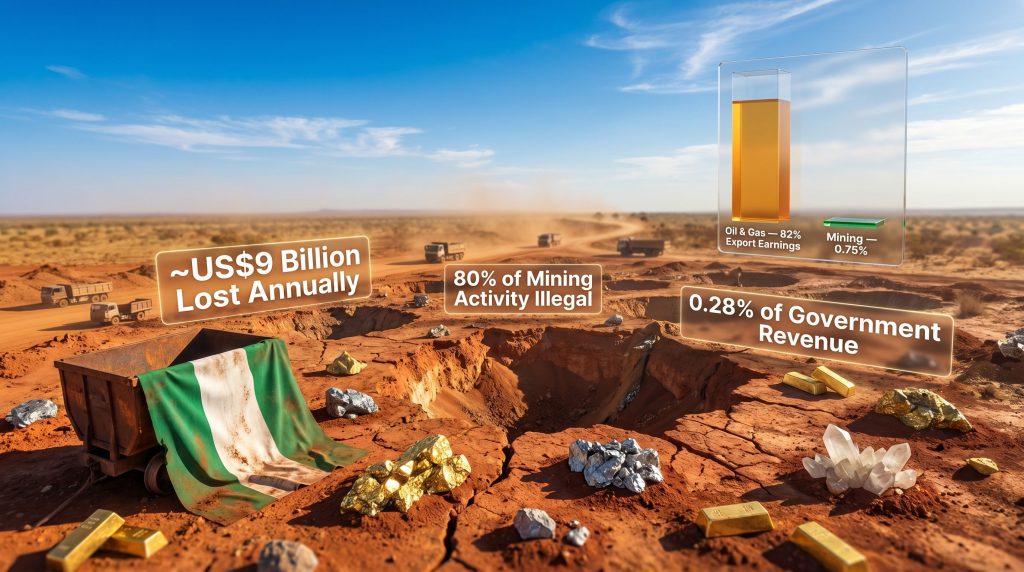
The scale of underperformance in Nigeria's mining sector becomes immediately apparent when set against the country's oil and gas economy. According to a joint report by the Nigeria Extractive Industries Transparency Initiative (NEITI) and the Africa Network for Environment and Economic Justice (ANEEJ), produced with UK government funding, the mining sector contributed just 0.72% of GDP, 0.28% of government revenue, and 0.75% of total export earnings in 2023.
| Indicator | Mining Sector | Oil and Gas Sector |
|---|---|---|
| Contribution to GDP | 0.72% | Dominant share |
| Share of Government Revenue | 0.28% | 29% |
| Share of Export Earnings | 0.75% | 82% |
| Estimated Annual Loss to Illicit Trade | ~US$9 billion | Not applicable |
These figures do not reflect a sector in its infancy. Nigeria has mined tin in Plateau State for over a century. Its gold deposits in the North-West have attracted artisanal miners for generations. The weakness is structural and entrenched, driven by a parallel economy of illegal mineral trade that systematically strips value from the sector before it ever reaches formal accounting. This mirrors the broader resource curse in Congo, where geological wealth consistently fails to translate into public benefit.
The Illicit Trade in Nigerian Minerals: A US$9 Billion Annual Haemorrhage
The NEITI/ANEEJ report estimates that Nigeria loses approximately US$9 billion annually through illegal extraction and smuggling across the solid minerals sector. To place this in perspective, the entire formal sector contributes a fraction of that figure to government revenue each year. The gap between what Nigeria's geology could deliver and what its treasury actually receives is not a minor inefficiency. It is a structural collapse of the value chain at almost every stage.
This failure matters beyond economics. Nigeria's Financial Intelligence Unit (NFIU) has formally classified illegal mining as an emerging threat to both national economic stability and security, elevating the issue into the domain of financial crime investigation rather than routine sector regulation.
Four Mechanisms Driving Illicit Financial Flows in Nigerian Mining
The NEITI/ANEEJ report identifies four primary mechanisms through which value is extracted illegally from Nigeria's mineral sector:
- Commercial manipulation: Mineral grades and weights are systematically understated at the point of informal sale, enabling buyers to acquire resources well below their true market value before any official measurement occurs.
- Unlicensed extraction: Across multiple states, particularly in conflict-affected regions of the North-West, mining activity operates entirely outside formal licensing frameworks, with no royalties, taxes, or compliance obligations attached.
- Institutional corruption: Regulatory systems governing licensing, documentation, and enforcement have been compromised, creating deliberate entry points for criminal networks to access formal channels with illegally extracted materials.
- Cross-border smuggling: Unregistered minerals are moved through established smuggling corridors that avoid formal export channels, ensuring no fiscal capture occurs at the point of departure from Nigeria.
What makes this architecture particularly durable is that each mechanism reinforces the others. Corrupt licensing enables illegal operators to acquire documentation. Smuggling networks provide the exit route. Furthermore, commercial manipulation ensures foreign buyers can purchase materials profitably while leaving minimal formal financial traces.
How Foreign Buyers Dominate Nigeria's Illegal Mineral Networks
Direct Mine-Site Procurement: Bypassing Every Formal Structure
One of the most operationally significant findings in the NEITI/ANEEJ report concerns the procurement behaviour of foreign buyers, particularly actors with Chinese connections. Rather than operating through licensed tin sheds, registered aggregators, or formal trading houses, these buyers have established direct procurement relationships at mine sites themselves.
This approach enables three compounding advantages for illegal trade:
- Grade and weight assessments are conducted informally before any official measurement, enabling systematic undervaluation.
- Payment arrangements remain outside the formal banking system, leaving no auditable financial trail.
- Transactions bypass licensed aggregators entirely, circumventing the formal documentation chain that would otherwise generate a taxable record.
The NEITI/ANEEJ report also highlights the role of actors from India and Lebanon in these networks, though the concentration of influence from Chinese-linked buyers is described as particularly pronounced in pricing and export channel control.
The Shell Company Problem: Concealment Within Nigerian Law
Foreign entities involved in illegal mineral trade have adopted a sophisticated concealment strategy by registering shell companies under Nigerian law and using local proxies to obtain licences and permits. This approach makes beneficial ownership opaque to regulators and creates significant money laundering exposure within the formal banking system by blending illicit mineral proceeds with legitimate business activity.
The use of local proxy structures to obscure foreign ownership represents one of the most difficult enforcement challenges in the sector, because the paper trail points to Nigerian nationals while the financial benefit flows offshore.
The May 2025 conviction of four Chinese nationals in Plateau State, each sentenced to 20 years imprisonment with full asset forfeiture, demonstrates that prosecution is procedurally achievable within Nigeria's legal system. However, watchdogs cited in the NEITI/ANEEJ report describe this outcome as an exception rather than evidence of systemic enforcement capacity.
Gold, Tin, and Lithium: The Three Minerals at the Centre of Nigeria's Illegal Trade Crisis
Gold: Where Banditry and Extraction Converge
Gold dominates the illegal mineral trade in quantitative terms. An estimated 80% of mining activity across North-West Nigeria operates outside formal legal frameworks, according to the NEITI/ANEEJ report. Illegal gold extraction intensified significantly between 2022 and 2024, tracking the expansion of banditry and terrorism across affected states.
A critical structural factor amplifying the problem is the absence of domestic gold refineries in Nigeria. Without refining infrastructure, extracted gold departs the country in raw or minimally processed form, ensuring that value-addition occurs entirely offshore. This creates a double extraction: the mineral leaves at undervalued grades, and the refining margin that could remain in Nigeria is captured elsewhere in the supply chain.
Tin: Plateau State's Compounding Crisis
Plateau State sits at the epicentre of Nigeria's tin crisis. Illegal tin mining has expanded rapidly over the past five years, bringing with it documented environmental destruction, widespread child labour, and an overlay of security threats. In February 2025, the Plateau State governor took the significant step of suspending all mining operations across the state, citing insecurity, environmental damage, and child labour as the primary drivers of the decision.
The suspension is itself a measure of how pervasive illegal activity has become. When a state government determines that suspending all mining is preferable to attempting selective enforcement, it signals the depth of penetration by illegal networks. Abandoned extraction pits now scar both rural and urban landscapes across the region.
Lithium: The Emerging Critical Mineral Vulnerability
Nigeria's lithium deposits represent a newer but rapidly growing target for unlicensed operators. The critical minerals demand surge driven by electric vehicle adoption and energy storage expansion has created strong price signals that are reaching even informal mining communities in Nigeria. Raids and arrests involving unlicensed miners, including foreign nationals, were recorded throughout 2024 and into 2025.
The lithium situation carries strategic implications beyond domestic governance. If Nigeria's lithium deposits become entrenched within illegal trade networks before formal sector development occurs, the country risks being locked out of the global lithium market at precisely the moment when Western and Asian economies are most eager to diversify sourcing.
| Mineral | Primary Region | Key Illegal Activity | Estimated Scale |
|---|---|---|---|
| Gold | North-West Nigeria | Bandit-controlled extraction | ~80% of activity illegal |
| Tin | Plateau State | Foreign buyer networks, child labour | Operations suspended Feb 2025 |
| Lithium | Multiple states | Unlicensed extraction, foreign nationals | Raids ongoing 2024-2025 |
When Illegal Mining Finances Armed Violence
The Zamfara Model: Five Years of Failed Prohibition
Nigeria's government imposed a mining ban on Zamfara State in 2019 as a direct response to the documented overlap between mineral extraction and armed group financing. A no-fly zone was subsequently added to restrict logistical access to mining zones. Both measures failed to dislodge criminal networks from operational control of mine sites.
Armed groups maintained continuous extraction throughout the prohibition period, using mineral revenues to fund weapons procurement, recruitment, and logistics. The ban was ultimately lifted in December 2024, representing an implicit policy acknowledgment that supply-side prohibition alone cannot break the financial relationship between illegal mining and armed violence when criminal networks have sufficient territorial control to operate regardless of legal status.
The self-reinforcing cycle that has developed in North-West Nigeria works as follows: mineral revenues fund armed groups, which then provide security for extraction sites, which enables continued production, which generates more revenue. Each iteration strengthens both the criminal enterprise and its capacity to resist enforcement.
The Zamfara experience is a cautionary study for policymakers who believe that mining bans can substitute for the broader governance reforms required to sever the link between mineral revenues and armed group financing.
The NEITI/ANEEJ report also flags a growing overlap between some Chinese-linked commercial interests and local conflict dynamics in North-West Nigeria, suggesting that foreign buyer networks may be actively integrated into the security architecture that surrounds illegal extraction operations rather than merely passive beneficiaries of it. These strategic mineral supply risks extend well beyond Nigeria's borders, with implications for global supply chain security.
The next major ASX story will hit our subscribers first
Nigeria's Enforcement Response: Scale, Limits, and Gaps
The Mining Marshals Initiative
Nigeria's government established a dedicated Mining Marshals enforcement unit in 2024 to address illegal extraction across priority mining regions. By mid-2025, the initiative had deployed 2,670 officers, resulting in 327 arrests and the recovery of 98 mining sites from illegal occupation.
These are meaningful operational numbers that demonstrate institutional commitment. However, set against the estimate that 80% of North-West Nigeria's mining activity operates illegally, the recovered sites represent a small fraction of the total illegal footprint. The sustainability of site recovery also remains uncertain, as the report does not confirm whether recovered sites have remained under legal control or been reoccupied by illegal operators.
Legislative Escalation: The Death Penalty Debate
Nigeria's regulatory response has extended into legislative debate. A Nigerian minister has publicly argued for the death penalty as a penalty for gold smuggling, reflecting the government's assessment that existing penalties are insufficient to deter well-resourced criminal networks. This remains a proposed escalation rather than enacted law, and its deterrence effectiveness against organised foreign buyer networks with established concealment infrastructure is debated.
Why Enforcement Alone Cannot Close the Gap
The structural argument against enforcement-only approaches is straightforward. Criminal networks involved in the illegal mineral trade in Nigeria have penetrated licensing systems, corrupted regulatory bodies, and established cross-border smuggling routes developed over years. Arrest operations and site recoveries address the visible symptoms of a system failure rather than the system failure itself. Consequently, illicit financial flows continue to grow even as enforcement activity increases.
The Social and Environmental Cost of Unchecked Illegal Mining
Beyond revenue losses, the illegal mineral trade in Nigeria carries substantial costs that do not appear in economic accounts:
- Abandoned pit networks across Plateau State and surrounding regions represent permanent landscape scarring and ongoing hazards to surrounding communities.
- Soil contamination, land subsidence, and water table disruption in extraction zones impose long-term agricultural and health costs on affected populations.
- Child labour exposure in artisanal mining communities represents both a human rights failure and an indicator of the absence of regulatory presence in these areas.
A particularly difficult policy tension exists in communities where artisanal mining represents the primary livelihood. Enforcement crackdowns without accompanying alternative economic pathways risk deepening poverty rather than resolving the structural conditions that draw communities into illegal supply chains in the first place.
What Genuine Reform Would Require
Comprehensive reform of Nigeria's mining sector to address the illegal mineral trade cannot rest on enforcement alone. Furthermore, the broader context of mining geopolitics in 2025 makes timely action even more critical. Five structural interventions are broadly identified as necessary:
- Transparent licensing systems with digitised, publicly accessible permit registers that eliminate the opacity enabling shell company structures.
- Domestic refinery investment, particularly for gold, to capture value-addition within Nigeria and reduce the incentive to export raw minerals through informal channels.
- Cross-border intelligence cooperation with regional neighbours to disrupt established smuggling corridors rather than simply displacing them.
- Community benefit frameworks that create formal pathways to legal operation for artisanal miners, reducing the economic dependency on illegal supply chains.
- Strengthened beneficial ownership disclosure requirements for all mining licence holders, making proxy structures legally untenable.
| Reform Pathway | Likely Outcome |
|---|---|
| Enforcement-only, no structural change | Criminal networks adapt; ~US$9B annual losses continue |
| Partial formalisation without community inclusion | Continued artisanal illegal activity; enforcement resistance |
| Comprehensive governance reform with foreign buyer regulation | Potential to unlock substantial annual sector contribution |
| Regional security cooperation without domestic reform | Smuggling routes shift rather than close |
The illegal mineral trade in Nigeria is not primarily a policing problem. It is a governance failure that has been systematically exploited by sophisticated networks operating across regulatory, commercial, and security dimensions simultaneously. The May 2025 Plateau State convictions prove that prosecution is possible. What remains unproven is whether Nigeria can build the institutional architecture to make those convictions routine rather than exceptional.
This article draws on reporting by Reuters (Isaac Anyaogu, Mining.com, May 15, 2026) and findings from the joint NEITI/ANEEJ report on illicit financial flows in Nigeria's mining sector. Figures relating to annual revenue losses and sector contribution are sourced from the NEITI/ANEEJ report as cited in that coverage. Forward-looking assessments regarding reform outcomes are illustrative scenarios and should not be construed as financial or investment advice.
Want to Capitalise on Major Mineral Discoveries Before the Broader Market Does?
While Nigeria's governance failures continue to lock billions in mineral wealth out of formal markets, compliant jurisdictions like Australia are producing significant discovery opportunities that reward early, informed investors — Discovery Alert's proprietary Discovery IQ model scans ASX announcements in real time, instantly converting complex mineral data into actionable investment insights, with historic discoveries such as those made by De Grey Mining and WA1 Resources illustrating the scale of returns that well-timed positioning can achieve. Explore what major mineral discoveries have historically delivered by visiting Discovery Alert's dedicated discoveries page, and begin your 14-day free trial today to ensure you are positioned ahead of the market.