August 24, 2026
The Geography of a Global Energy Chokepoint
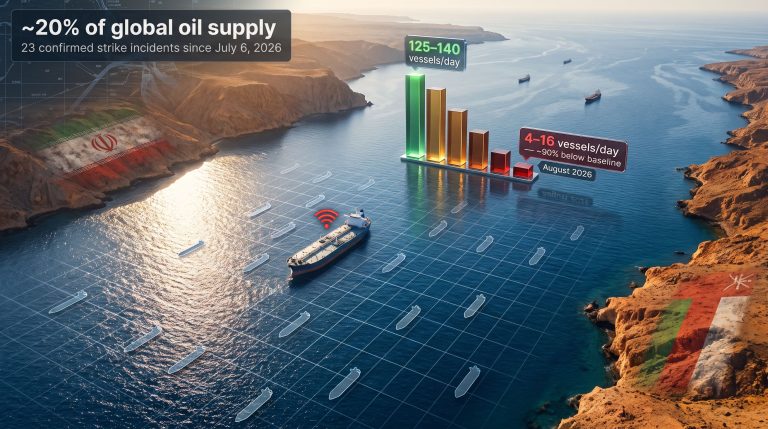
Every energy crisis in living memory has carried one common thread: the extraordinary fragility of the systems humanity depends upon to move oil from where it is extracted to where it is burned. No single point on the planet illustrates this fragility more starkly than a narrow strip of water separating the Arabian Peninsula from Iran, measuring roughly 33 kilometres at its tightest navigable passage. When that passage closes, the consequences are not regional. They are planetary.
The Strait of Hormuz shutdown and oil prices have become inseparable subjects in 2026, as a conflict between the United States and Iran that escalated in late February has severed access to approximately one-fifth of the world's total seaborne crude supply. What follows is not simply a story about rising fuel costs. It is a structural test of whether the modern global economy, built on assumptions of uninterrupted energy flow, can withstand the closure of its most critical artery.
When big ASX news breaks, our subscribers know first
Why the Strait of Hormuz Remains Irreplaceable to Global Oil Markets
The Physical Reality of the Chokepoint
The Strait of Hormuz sits at the mouth of the Persian Gulf, connecting the energy-rich waters of the Gulf to the Gulf of Oman and onward to international shipping lanes. At its narrowest navigable corridor, vessels must transit through lanes just a few nautical miles wide, with inbound and outbound traffic separated by minimal distance. This creates a mandatory transit bottleneck that no alternative architecture has yet been able to replicate at scale.
What makes the Strait uniquely dangerous as a supply vulnerability is not just its geographic narrowness, but the concentration of production behind it. Saudi Arabia, Iraq, Iran, Kuwait, the UAE, and Qatar collectively represent a substantial share of global proven oil reserves, and the overwhelming majority of their export capacity flows through this single corridor. The arithmetic is brutal: close the Strait, and you do not merely inconvenience the market. You remove a volume of supply that no combination of alternative routes, emergency reserves, or incremental production increases can rapidly restore.
Which Economies Face the Greatest Exposure?
The impact of the Strait of Hormuz shutdown and oil prices varies significantly by geography. Import-dependent Asian economies carry the heaviest structural burden, while North American producers find themselves in the paradoxical position of benefiting from elevated prices while facing logistical limitations on replacing Gulf volume.
| Country/Region | Hormuz Dependency | Primary Risk |
|---|---|---|
| Japan | Very High (~85% crude imports via Gulf) | Refinery utilisation collapse, LNG shortfalls |
| South Korea | Very High (~70% crude imports via Gulf) | Industrial energy cost inflation |
| India | High (~60% crude imports via Gulf) | Wholesale inflation, retailer subsidy losses |
| China | High (~40-45% crude imports via Gulf) | Tanker risk exposure, demand destruction risk |
| Europe | Moderate | LNG supply security, chemical feedstock costs |
| United States | Low-Moderate | Domestic production partially offsets exposure |
This table understates the cascading nature of the exposure. Furthermore, Japan and South Korea are not merely paying higher prices for crude they can otherwise source elsewhere. Their refinery systems are configured for Gulf crude grades, meaning that even if Atlantic Basin barrels become available, processing mismatches create additional operational friction. The Asian LNG supply pressures emerging from this crisis are compounding existing structural vulnerabilities across the region.
What Happens to Oil Prices When the Strait of Hormuz Shuts Down?
The Three-Phase Price Shock Mechanism
Oil market disruptions do not follow a single linear price trajectory. Energy economists identify three distinct phases of price response following a major supply disruption:
- Immediate speculative response (weeks one to two): Fear-driven forward contracting and positioning pushes prices sharply higher before any physical shortfall is confirmed by inventory data.
- Fundamental supply-demand rebalancing (weeks two through six): Inventory draws accelerate, strategic reserve releases begin, and voluntary demand moderation by large industrial consumers starts to emerge.
- Structural scarcity pricing (beyond six weeks): Actual inventory depletion and incipient rationing dynamics replace speculative premium as the dominant price driver. This phase is the most dangerous and the hardest to reverse quickly.
The current 2026 closure is progressing through the transition from phase two to phase three. Commercial inventory draws have accelerated, OECD stockpiles are approaching stress thresholds, and the structural price floor is rising with each passing week of closure. These oil market disruption risks are increasingly difficult to contain through conventional policy responses.
Historical Precedents and Their Limits
Previous Hormuz crises offer instructive but imperfect guidance. During the Iran-Iraq War tanker conflict of 1987 to 1988, crude prices remained elevated but were partially contained by Saudi Arabia's willingness to substantially increase production to compensate for disrupted Iranian and Iraqi exports. The 1990 to 1991 Gulf War spike toward $40 per barrel (nominal) reversed within three months as markets recognised that alternative supply existed and spare capacity was accessible.
The current situation diverges from these precedents in three critical ways:
- Spare production capacity is more constrained relative to the volume of disrupted supply
- Global commercial inventory buffers are already below their 10-year averages by an estimated 10 to 15%, providing less cushion than existed during the 2011 to 2012 Iranian sanctions episode
- Modern just-in-time supply chain practices mean that even brief disruptions create downstream industrial stress faster than historical supply systems did
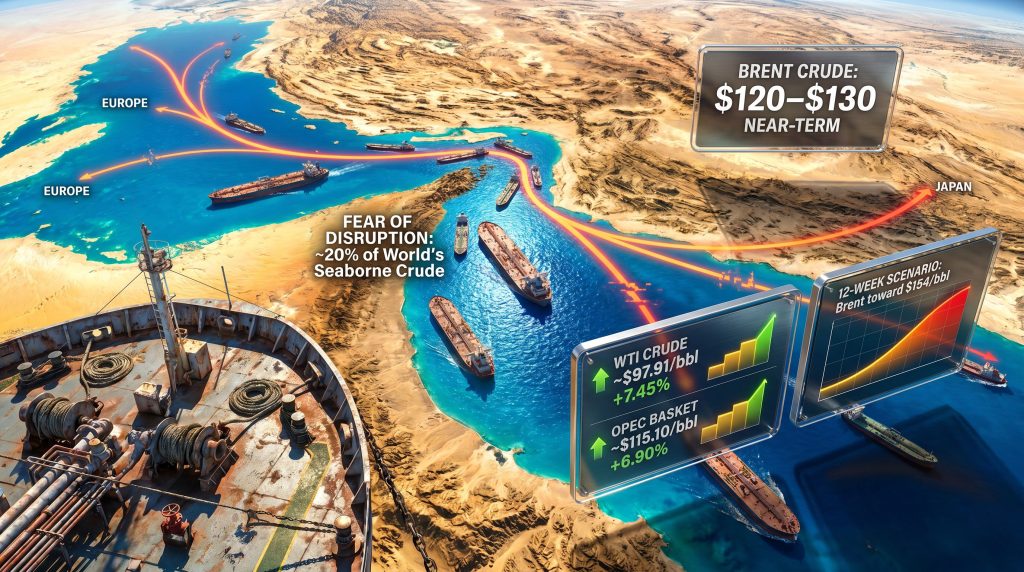
Major financial institutions have modelled escalating scenarios with notable specificity. JPMorgan has flagged that OECD commercial inventories could reach operational stress thresholds within weeks if the Strait remains closed. Bloomberg analysis has placed Brent crude in a $120 to $130 range under near-term conditions, with overshoot potential toward $150 if the blockade extends beyond 30 days, and a 12-week disruption scenario potentially pushing Brent toward $154 per barrel. These are not worst-case outliers. They reflect the mathematical consequence of removing roughly one-fifth of global seaborne crude supply from efficient market access. Disclaimer: Price forecasts represent analytical scenarios, not guaranteed outcomes. Actual prices are subject to geopolitical resolution, demand destruction, and policy responses that cannot be fully modelled in advance.
Current Market Pricing: The Week of May 15, 2026
Benchmark Performance During the Hormuz Disruption
According to data reported by Oilprice.com on May 15, 2026, crude markets posted one of their strongest weekly performances since the conflict began, with WTI crude oil July futures settling at $97.91 per barrel after a gain of $6.79, or 7.45%, across the week.
| Benchmark | Settlement Level | Weekly Change | Trading Range |
|---|---|---|---|
| WTI Crude (July Futures) | $97.91/bbl | +7.45% | $92.84 to $99.09 |
| Brent Crude | Approaching $107-$110 | ~+6% weekly | Multi-week high |
| OPEC Basket | $115.10/bbl | +6.90% | Multi-year high |
| Heating Oil | ~$4.00/gallon | +2.43% | Seasonal demand elevated |
| Gasoline | $3.640/gallon | +0.94% | Inventories declining |
The week's directional tone was set by multiple reinforcing signals: comments from U.S. officials indicating that ceasefire negotiations remained fragile, reports of ongoing tanker seizures and naval incidents, and inventory data confirming accelerating stockpile draws. Consequently, the result was a market that leaned aggressively toward the long side throughout the week, with each bearish headline creating only brief interruptions to the underlying upward trend. The crude oil price trends observed in the lead-up to this crisis had already signalled a fragile market susceptible to supply-side shocks.
Why OPEC+ Production Announcements Have Failed to Calm Markets
A key dynamic in the current Strait of Hormuz shutdown and oil prices environment is the production-accessibility disconnect: a situation where announced supply increases cannot deliver accessible barrels to market because the primary export corridor remains blocked. OPEC's market influence, however significant under normal conditions, has been severely curtailed by this logistical reality.
Barrels that cannot transit the Strait of Hormuz efficiently cannot relieve prompt market tightness, regardless of how much production is occurring at the wellhead. Markets price accessible supply, not announced production. Until those barrels can move to consuming regions, the gap between what is produced and what is deliverable continues to widen.
The Cape of Good Hope Detour: How Rerouting Tightens Prompt Supply
One of the least appreciated mechanisms amplifying the Strait of Hormuz shutdown and oil prices relationship is the logistical extension effect of rerouting crude tankers around southern Africa. As reported by the Guardian, the operational and commercial consequences of this rerouting are far more significant than many market observers initially anticipated.
Redirecting tankers via the Cape of Good Hope adds approximately 10 to 15 additional sailing days per voyage compared to the direct Hormuz route. This extended transit time does not reduce the total volume of crude oil in transit globally. It removes those barrels from the near-term accessible supply pool while they remain at sea, effectively tightening prompt market conditions even when total production volumes are unchanged.
This is sometimes called physical supply tightening through logistical extension, and it creates a paradox where global production statistics appear adequate while spot market conditions reflect genuine scarcity. Shipping costs have risen substantially as a consequence, adding cost pressure to every cargo that reroutes.
Global Inventory Drawdowns: Measuring the Buffer's Depletion
Strategic Petroleum Reserves vs. Commercial Stockpiles
Understanding the distinction between strategic petroleum reserves and commercial inventories is essential to gauging how much buffer the global system retains.
Strategic Petroleum Reserves (SPRs) are government-held emergency stockpiles, maintained by IEA member nations specifically for supply disruption scenarios. They are released through coordinated mechanisms and are designed for short-duration bridging, not sustained supply replacement.
Commercial inventories are the working stocks held by refiners, pipeline operators, and traders that enable day-to-day market function. When commercial inventories reach what analysts call operational minimums, the system loses its flexibility to absorb further disruptions or demand surges. At that point, rationing and allocation mechanisms begin regardless of strategic reserve levels.
The current disruption is drawing down both simultaneously, which is the critical distinction from previous episodes where SPR releases were sufficient to prevent commercial inventory stress.
What EIA Data Is Signalling
The most recent U.S. Energy Information Administration weekly inventory report delivered an unambiguously bearish supply signal to markets:
- Commercial crude inventories posted a larger-than-expected decline, exceeding analyst consensus forecasts
- Cushing, Oklahoma hub storage levels dropped sharply, reflecting tightening physical delivery conditions at the NYMEX WTI contract settlement point
- Gasoline inventories moved lower despite elevated refinery utilisation rates, indicating that demand is absorbing product as fast as it is being produced
- U.S. crude exports remained extremely strong, diverting domestic production into global markets rather than rebuilding domestic stockpiles
The Cushing drawdown carries particular significance for futures pricing. As the designated delivery point for NYMEX WTI futures contracts, declining Cushing storage creates direct upward pressure on front-month contracts as physical delivery scarcity premiums become embedded in settlement prices.
Bloomberg analysts have estimated that the cumulative effective supply loss already locked into global markets as a consequence of the ongoing Hormuz shutdown approaches one billion barrels. Strategic reserve releases, while providing some relief, have not been sufficient to fully offset this volume. IEA forecasts now project supply deficits widening through 2026 if the disruption persists.
Winners and Losers in the Hormuz Supply Shock
Unintended Beneficiaries: Non-Gulf Exporters Capture Market Share
Russia's Revenue Surge
The combination of elevated global crude prices and Russia's status as a non-Gulf producer has created a significant revenue windfall. Russia's oil revenues have increased by an estimated $6.3 billion as higher prices more than compensate for any production constraints the country faces. Non-Gulf exporters broadly are capturing premium pricing in markets previously served by Iranian and Gulf crude.
Brazil's Accelerating Role in Asia
Perhaps the most structurally significant trade flow development of the current crisis is the doubling of Brazil's crude oil exports to China. As Chinese refiners scramble to replace disrupted Gulf supply with Atlantic Basin alternatives, Brazil's deepwater pre-salt production has become a preferred substitute. This shift is fundamentally redrawing global crude trade flow maps in ways that may persist beyond the conflict's resolution.
U.S. Shale Producers: Price Beneficiary with Structural Constraints
American shale producers are benefiting from elevated prices but face genuine logistical constraints in scaling production fast enough to meaningfully replace Gulf volume. Refinery configuration mismatches, pipeline infrastructure limitations, and the time required to bring new drilling into production all restrict the pace of any shale supply response. As reported by Oilprice.com, U.S. production helps soften some of the damage but cannot fully replace missing Gulf exports in the near term. The broader oil price trade geopolitics at play are reshaping competitive dynamics across global energy markets.
Economies Under Severe Strain
India's Compounding Energy Crisis
India's economic exposure to the Strait of Hormuz shutdown and oil prices shock is among the most severe of any major economy, and the consequences are already measurable in macroeconomic data:
- Wholesale inflation has reached a 3.5-year high, with fuel costs surging approximately 25% according to Oilprice.com reporting
- Indian Prime Minister Modi ordered a 50% reduction in government motorcade sizes as a visible fuel conservation signal to the population
- State-owned fuel retailers are absorbing billions in losses because politically mandated retail price freezes prevent them from passing elevated crude costs through to consumers
- India-bound LPG tankers have been documented transiting the Strait in dark mode, with AIS transponders disabled to avoid conflict exposure, indicating acute desperation for supply
India's situation illustrates a tension common to import-dependent developing economies during supply shocks. Governments face simultaneous pressure to protect consumers from price pain through subsidies while fiscal constraints make those subsidies unsustainable at elevated crude prices.
Japan: Strategic Reserve Activation and Fuel Switching
Japan's refinery utilisation rate has dropped to approximately 73% as strategic oil stocks are drawn into the processing system to compensate for disrupted Gulf crude imports. Both Japan and South Korea have pivoted toward increased coal consumption to offset LNG supply disruptions, temporarily reversing years of energy transition progress. The IEA's reporting on Japan-bound tanker movements indicates that even friendly flag vessels are navigating under heightened operational risk protocols.
China: Cautious Navigation of the Crisis
China's response has been characteristically measured. Chinese tankers have been testing Hormuz passage under elevated risk conditions, with at least one documented transit attempt monitored by international shipping intelligence services. Despite some easing of domestic fuel export restrictions, China remains cautious about releasing substantial export volumes into global markets. Analysts project that Chinese gasoline consumption could contract by as much as 5.5% in 2026 if crude prices remain at current elevated levels, representing a meaningful demand destruction signal from the world's largest energy importer.
The next major ASX story will hit our subscribers first
Gulf Producers' Infrastructure Response
ADNOC's Bypass Pipeline Expansion
The most concrete infrastructure response to the current crisis from within the Gulf region has come from Abu Dhabi. Abu Dhabi National Oil Company has announced plans to double its Hormuz-bypass export pipeline capacity through a new pipeline project scheduled for completion in 2027. This expansion would increase throughput through the existing Habshan-Fujairah pipeline corridor, routing crude to the UAE's east coast port at Fujairah without transiting the Strait.
| Bypass Route | Operator | Current Capacity | 2027 Target | Key Limitation |
|---|---|---|---|---|
| Habshan-Fujairah Pipeline | ADNOC (UAE) | ~1.5 million bpd | ~3 million bpd | Covers UAE production only |
| East-West Pipeline (Petroline) | Saudi Aramco | ~5 million bpd | Unchanged | Exits to Red Sea, still subject to other chokepoints |
| Iraq-Turkey Pipeline | SOMO/Turkey | Reduced capacity | Uncertain | Operational disruptions limit reliability |
| Cape of Good Hope Rerouting | Global tanker fleet | Unlimited volume | Unlimited volume | Adds 10-15 days per voyage; tightens prompt supply |
The critical limitation of all existing bypass infrastructure is scope. Even at its expanded 2027 capacity, the Habshan-Fujairah pipeline serves only UAE-origin crude. Saudi Arabia's Petroline exits at the Red Sea port of Yanbu, which reduces but does not eliminate maritime risk exposure, as Red Sea shipping lanes carry their own security vulnerabilities. No single bypass option, or combination thereof, can replicate the volume that normally transits Hormuz. The full scale of global trade and energy disruption resulting from Hormuz closures is comprehensively documented by UNCTAD.
Qatar's Dark Mode LNG Operations
Qatar, the world's largest LNG exporter, has instructed vessels at its Ras Laffan industrial complex to operate with reduced transponder visibility during elevated-risk periods. This operational posture reflects the extraordinary sensitivity of LNG infrastructure to conflict proximity and the precautionary approach Qatar is taking to protect its export capacity.
Saudi Aramco: Balancing Revenue Pressure and Market Stability
Saudi Arabia faces a dual tension. Elevated crude prices improve Aramco's revenue per barrel, but extended disruption undermines the stability of the global economy that Saudi production depends upon for long-term demand. Aramco has been reported seeking to raise $10 billion through real estate asset monetisation, indicating that fiscal pressures exist even at current elevated price levels.
Technical Price Analysis: WTI Crude Oil
Key Support and Resistance Architecture
The weekly technical structure of WTI crude oil futures provides a systematic framework for understanding where prices are likely to find support and resistance as the Hormuz situation evolves:
| Price Level | Technical Significance |
|---|---|
| $110.93 | Next bullish objective above $103.78 breakout |
| $103.78 | Key resistance: breakout signals trend resumption |
| $97.04 | Upper bound of short-term retracement zone |
| $94.96 | Lower bound: sustained break shifts momentum bearish |
| $90.50 to $87.36 | Intermediate retracement support zone |
| $86.13 | Minor swing bottom: critical near-term floor |
| $79.52 to $73.80 | Long-term support zone |
| $66.84 | 52-week moving average: structural floor |
| $55.27 | Nearest main long-term bottom |
The main trend remains upward according to weekly swing chart and moving average analysis. Notably, despite significant volatility over the past two months, sellers have been unable to take out any significant structural bottoms, which reinforces the uptrend's technical integrity.
Bullish and Bearish Scenarios
For a bullish continuation:
- A sustained hold above $97.04 opens the path toward $103.78, then $110.93
- Continued Hormuz closure with accelerating inventory draws sustains the fundamental driver
- Any additional tanker seizures or naval escalation events create fresh buying catalysts
- Demand resilience in Asia despite elevated prices would confirm structural supply-side dominance
For a bearish reversal:
- A credible diplomatic breakthrough that confirms Hormuz shipping lane restoration
- Coordinated IEA strategic reserve releases that temporarily bridge physical supply gaps
- Demand destruction evidence accelerating sharply beyond current forecasts
- A sustained break below $94.96 targets $90.50 to $87.36; a collapse through $86.13 opens $79.52 to $73.80
The technical structure of WTI crude reveals something important about market psychology in the current environment. The 52-week moving average sits at approximately $66.84, and the nearest major structural bottom is at $55.27. These levels are not realistically under threat in the current supply environment, which means institutional traders have a well-defined and technically supported reason to treat every price dip as a buying opportunity. This is not blind optimism. It is a rational response to a market structure where every major support level has held under pressure. Even if a diplomatic resolution occurs, the technical analysis from Oilprice.com suggests the trading range would widen but the buy-the-dip bias would likely persist given residual geopolitical risk premium.
Macroeconomic Spillovers: Inflation, Central Banks, and Sector Stress
The Oil-Inflation Feedback Loop
Crude oil price increases transmit into consumer price indices with a lag of approximately four to eight weeks, meaning that the May 2026 elevated prices are expected to manifest most fully in June and July inflation readings. This delayed transmission is creating a layered policy challenge for central banks: they must respond to current data while anticipating future inflation pressure already baked into the forward supply chain.
The Federal Reserve's response to this dynamic is constrained. Restrictive monetary policy can dampen demand-side inflation, but it cannot create oil supply. Sustained high crude prices are therefore likely to keep inflation elevated even as the Fed maintains high interest rates, potentially creating a stagflationary environment in import-dependent economies.
Aviation Sector Under Pressure
Rising jet fuel costs represent one of the most visible consumer-facing consequences of the current crisis. Airline operators are facing sustained margin compression as jet fuel costs, which typically account for 20 to 30% of operating costs, have risen sharply in line with crude. This is creating upward pressure on ticket prices during what would otherwise be peak summer travel demand, threatening both airline profitability and broader consumer spending patterns.
Europe's Dual Energy Exposure
Europe faces compounding vulnerabilities from the Strait of Hormuz shutdown and oil prices environment. In addition to direct crude exposure, the continent's dependency on alternative energy sources is driving up procurement costs across multiple supply chains:
- Dependence on U.S. LNG is projected to surge as the continent reduces exposure to Gulf-linked supply chains, driving up LNG procurement costs and creating new dependencies
- European gas storage mandate relief is being sought by industry groups who argue that mandatory storage filling targets are uneconomical at elevated gas prices
- The chemicals sector faces sustained feedstock cost inflation, compressing margins across petrochemical production chains
- ADNOC Gas has separately announced a target of 80% recovery at Habshan by end-2026, which, if achieved, would partially alleviate European LNG supply concerns through UAE export channels
Scenario Modelling: Three Futures for the Strait of Hormuz
Scenario 1: Short Disruption (4 to 8 Weeks): Managed Stress
In this scenario, diplomatic progress produces a credible framework for Hormuz reopening within two months of the current date:
- Brent crude stabilises in the $110 to $120 range as the risk premium begins unwinding
- IEA member SPR releases cushion the inventory shortfall during the transition
- Demand destruction remains modest and predominantly voluntary
- Markets price the resolution but retain a residual geopolitical risk premium of $5 to $10 per barrel in forward curves
Scenario 2: Extended Disruption (12+ Weeks): Structural Supply Shock
This scenario reflects the trajectory if fighting continues without diplomatic resolution:
- Brent crude approaches $130 to $154 as Bloomberg's 12-week scenario modelling indicates
- OECD commercial inventories cross operational stress thresholds, triggering industrial allocation measures in the most exposed economies
- Demand destruction becomes involuntary as fuel rationing systems activate in Japan, South Korea, and India
- Inflation becomes entrenched across multiple economies; central bank policy divergence widens as some institutions prioritise growth preservation over inflation control
Scenario 3: Rapid Diplomatic Resolution
This scenario models a ceasefire and confirmed shipping lane restoration:
- WTI retraces toward $79 to $87 in the near term as the supply premium collapses
- Structural buy-the-dip support likely prevents a full collapse below $73 to $75
- A long-term geopolitical risk premium remains embedded in forward curves, reflecting the demonstrated vulnerability of the Hormuz corridor
- Non-Gulf exporters (Russia, Brazil, U.S. shale) retain some of the market share they captured during the disruption, permanently altering global crude trade flows
Frequently Asked Questions: Strait of Hormuz Shutdown and Oil Prices
What percentage of the world's oil passes through the Strait of Hormuz?
Approximately 20% of the world's total seaborne crude oil transits the Strait of Hormuz, making it the single most critical maritime chokepoint in the global energy system.
How high could oil prices go if the Strait of Hormuz stays closed?
Near-term analyst forecasts place Brent crude in the $120 to $130 range, with overshoot potential toward $150 to $154 under a 12-week or longer disruption scenario if emergency stockpile buffers are exhausted. These figures represent scenario modelling from major financial institutions and should not be treated as price guarantees.
Can the United States replace Hormuz oil with domestic shale production?
U.S. shale output can partially offset the price impact by adding domestic supply and sustaining strong export volumes. However, it cannot fully replace the volume of Gulf crude removed from global markets by a Hormuz shutdown. Refinery configuration mismatches, pipeline infrastructure limits, and drilling lead times all constrain the pace of any meaningful shale supply response.
How long can global strategic petroleum reserves sustain a Hormuz shutdown?
IEA member reserves provide meaningful but finite bridging capacity. Analysts estimate that full supply replacement via SPR releases is only sustainable for a limited number of weeks before commercial inventories begin crossing operational minimum thresholds, particularly at critical delivery hubs such as Cushing, Oklahoma.
What is ADNOC's Hormuz bypass pipeline and when will it be operational?
ADNOC's expanded Habshan-Fujairah pipeline is designed to double UAE bypass export capacity to approximately 3 million barrels per day and is currently scheduled for completion in 2027. Until that infrastructure comes online, the UAE retains partial exposure to any Hormuz disruption.
Which countries are most economically vulnerable to a Hormuz shutdown?
Japan, South Korea, and India face the highest economic vulnerability. India is already experiencing a 3.5-year high in wholesale inflation, with fuel costs approximately 25% higher than pre-disruption levels as a direct consequence of the current crisis.
The Long-Term Lesson: Diversification Is No Longer Optional
The Strait of Hormuz shutdown and oil prices crisis of 2026 is forcing a reckoning that energy policy communities have deferred for decades. The concentration of global crude transit through a single 33-kilometre passage was always a structural vulnerability. The current conflict has converted that theoretical vulnerability into an active economic crisis affecting consumers, businesses, governments, and central banks across every major economy.
The most durable consequence of this disruption will likely be accelerated investment in supply diversification infrastructure: bypass pipelines, LNG terminal expansion in non-Gulf locations, strategic reserve capacity increases, and trade flow diversification programmes. Brazil's emergence as a major China-bound crude supplier, Canada's 1 million barrel per day pipeline proposals, and ADNOC's bypass capacity expansion all reflect a global market working urgently to reduce its dependence on a single chokepoint.
Key structural takeaways from the current crisis include:
- The Hormuz closure has removed approximately one-fifth of global seaborne crude supply from efficient market access, with no rapid replacement mechanism available
- Commercial inventory draws are accelerating toward stress thresholds, with OECD stockpile levels under sustained pressure
- Brent crude faces a credible path to $130 to $154 under extended disruption scenarios
- WTI technical structure supports a buy-the-dip institutional bias above key structural support levels, with the 52-week moving average at $66.84 providing the ultimate structural floor
- Import-dependent economies, particularly India, Japan, and South Korea, face the most acute near-term economic damage
- Non-Gulf producers including Russia, Brazil, and U.S. shale operators are capturing market share and revenue windfalls that may persist beyond conflict resolution
When the Strait eventually reopens, prices will correct sharply. However, the geopolitical risk premium embedded in energy forward curves will not disappear. The world has been reminded, at considerable cost, that the assumption of uninterrupted Hormuz transit was never a guarantee. It was a wager that has now been called.
This article is intended for informational and educational purposes only. Nothing contained herein should be construed as financial, investment, or trading advice. Price forecasts and scenario projections cited reflect third-party analyst modelling and are inherently uncertain. Readers should conduct independent research and consult qualified financial advisers before making investment decisions.
Want to Profit From the Energy Crisis Reshaping Global Markets?
When geopolitical shocks like the Strait of Hormuz closure send commodity markets into upheaval, the investors who move first capture the greatest opportunities — and Discovery Alert's proprietary Discovery IQ model delivers real-time ASX mineral discovery alerts the moment they're announced, helping subscribers identify actionable opportunities in energy and commodity markets before the broader market reacts. Explore historic discoveries and the returns they generated, then begin your 14-day free trial to position yourself ahead of the next major market-moving event.