May 16, 2026
The Mechanics of a Market That Won't Panic
Commodity markets have a long history of overreacting to geopolitical shocks. From the oil embargo of 1973 to the Gulf War of 1990, the standard playbook has been fear first, fundamentals second. Prices spike on the headline, traders scramble to cover positions, and the narrative of scarcity takes hold faster than the scarcity itself. Yet something notably different has unfolded in the wake of the U.S.-Iran conflict of 2026, and understanding why requires moving beyond the surface-level observation that prices haven't gone high enough and into the deeper architecture of how modern oil markets actually absorb and price geopolitical disruption.
The question of why has oil not gone higher in the wake of the U.S.-Iran conflict is not simply one of inadequate market response. It is a question about the interaction between sentiment, buffers, buyer behaviour, and probabilistic thinking, all operating simultaneously under conditions of extreme uncertainty. Our crude oil volatility guide explores how these dynamics have played out across recent cycles.
When big ASX news breaks, our subscribers know first
From $60 to $126: Why the Starting Point Changes Everything
Before examining the ceiling, it is essential to understand the floor. Heading into Q1 2026, analyst consensus had Brent crude trading at approximately $60 per barrel or below. That baseline reflected a market shaped by elevated supply, tempered demand growth expectations, and no anticipation of a major military conflict reshaping Persian Gulf transit flows.
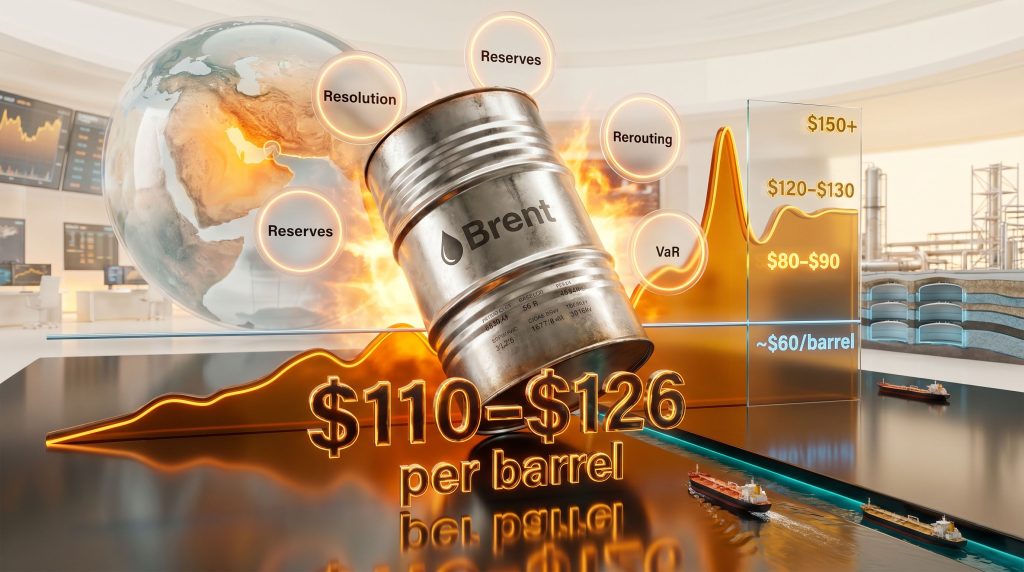
Against that starting point, the subsequent price trajectory tells a materially different story than the headline framing of a muted response suggests. Brent crude surged past $110 per barrel during the escalation phase and, at certain points, approached $126 per barrel, according to analysis from Alan Gelder, SVP Refining, Chemicals and Oil Markets at Wood Mackenzie. That represents a near-doubling of price from baseline expectations to peak levels recorded during the conflict period.
| Market Metric | Pre-Conflict Expectation | Post-Conflict Reality (May 2026) |
|---|---|---|
| Brent Crude Forecast (Q1 2026) | ~$60/barrel or lower | $110–$126+/barrel |
| Physical vs. Futures Premium | Aligned | Physical briefly surged above futures, then inverted |
| Strait of Hormuz Transit Status | Open and normal | Partially disrupted and blockaded |
| IEA Strategic Reserve Status | Largely intact | Actively being drawn down |
| Shadow Fleet Loading Activity | Ongoing | Sharply reduced volumes |
Framing the question as why oil hasn't gone higher obscures the fact that the market has already delivered one of its most dramatic price dislocations in decades. The more precise question is: given the scale of the supply disruption, why has the move been contained rather than catastrophic?
The Five Forces Containing Oil Price Escalation
The Physical-Futures Inversion Nobody Predicted
In normal supply shock conditions, physical crude prices rise sharply as buyers scramble to secure actual barrels, pulling futures prices upward in their wake. During the early phase of the U.S.-Iran conflict, this dynamic appeared to be playing out as expected, with physical premiums rallying strongly above futures.
What happened next confounded many market participants. Rather than futures trading up toward physical, the physical price traded down toward futures. Emily Ashford, Head of Energy Research at Standard Chartered Bank, observed that buyers appeared to be hoping for a rapid resolution to the Strait of Hormuz blockades and were reluctant to pay extraordinarily elevated prices for near-term cargoes. CNBC's coverage of the Iran war oil impact provides further context on how this buyer psychology developed during the escalation phase.
This buyer deferral behaviour is a critical and underappreciated mechanism. When institutional purchasers decline to chase prices higher because they believe tomorrow's price will be lower, they effectively remove the demand pressure needed to sustain physical premiums. The result is price softening, not because supply improved, but because near-term demand stepped back.
This process was amplified by the risk management behaviour of major trading firms and financial institutions. Extreme volatility increases what traders call Value at Risk (VaR), a statistical measure of potential losses across a portfolio over a defined time period. When VaR thresholds are breached, institutions are forced to reduce exposure, which means pulling back from aggressive buying even when supply fundamentals might otherwise justify it. Ashford noted that high volatility and the risk of a VaR shock contributed to purchase deferral, which in turn allowed prices to soften.
Strategic Reserves as a Multi-Month Shock Absorber
The coordinated release of strategic petroleum reserves by IEA and OECD member nations has functioned as a temporary but substantial buffer against the full price impact of the supply disruption. Gelder estimated the supply loss at approximately 10 million barrels per day, a figure that dwarfs historical precedents.
For context, consider how this disruption compares to major historical supply shocks:
| Historical Event | Estimated Supply Removed | Approximate Duration |
|---|---|---|
| 1973 Arab Oil Embargo | 4–5 million barrels/day | ~5 months |
| 1979 Iranian Revolution | 5–6 million barrels/day | ~12 months |
| 2022 Russia-Ukraine Conflict | ~2–3 million barrels/day | Ongoing (partial) |
| 2026 U.S.-Iran Conflict | ~10 million barrels/day | Ongoing |
The current disruption, if sustained, would be the largest single supply shock in post-World War II history, yet strategic reserve releases have temporarily masked its full market impact. This is precisely why Gelder noted that the crisis may have demonstrated that IEA and OECD stockholding can mitigate a material supply disruption for several months, potentially leading to more muted price responses to future geopolitical events. Furthermore, the OPEC market influence over production decisions continues to interact with these reserve dynamics in complex ways.
However, there is an important caveat that cannot be overstated.
The strategic reserve buffer is finite by definition. Onshore inventories in key market-clearing locations, including the United States, have not yet experienced sharp drawdowns because a separate mechanism has been absorbing supply: a global reduction in oil loaded on vessels, including sanctioned shadow fleet tankers. According to Gelder, that oil-on-water buffer is now largely consumed. Once it is exhausted, onshore draws will accelerate, and prices will need to rise high enough to destroy approximately 10 million barrels per day of demand to achieve market balance.
Freight Rate Dynamics and the Atlantic Basin Reroute
A less visible but commercially significant factor involves freight markets. As the conflict disrupted Persian Gulf flows, tanker operators repositioned vessels to move Atlantic Basin crude volumes eastward, partially compensating for lost supply from the Gulf region. This repositioning, while logistically complex, had the effect of reducing freight rate premiums as vessel supply in Atlantic corridors increased.
Falling freight rates directly compress the physical crude premium, since part of what buyers pay for a physical barrel includes the cost of transporting it to refinery intake. As freight costs fell, the physical-over-futures premium weakened, contributing to the broader price softening dynamic described by Ashford and Gelder.
The critical limitation here is capacity. Atlantic Basin rerouting has finite throughput, and if the Strait of Hormuz remains closed beyond a matter of weeks, the rerouting capacity will be exhausted, freight rates will re-escalate, and physical premiums will widen again.
The Ceasefire Effect and Media Attention Cycles
Market sentiment is not purely rational, and the behaviour of commodity prices often tracks news cycle intensity as much as underlying supply fundamentals. Gelder noted that the prevailing ceasefire has halted further damage to oil production infrastructure and that the conflict has progressively moved away from the forefront of media coverage.
This shift in attention has a measurable effect on commodity pricing. The fear premium, which represents the additional dollars per barrel markets assign simply to the possibility of disruption rather than its certainty, compresses when immediate conflict intensity subsides. As long as the ceasefire holds and the narrative of imminent resolution dominates market psychology, sentiment-driven pricing will reflect resolution expectations rather than disruption severity.
Intertemporal Substitution: The Economic Logic of Deferred Demand
Perhaps the most theoretically sophisticated explanation for why prices have not escalated further comes from Benjamin Zycher, Senior Fellow at the American Enterprise Institute. Zycher highlighted that oil is intertemporally substitutable, meaning it can be consumed in the current period or deferred to a future period. Because of this property, expectations about future prices are embedded in current market prices.
If the market collectively believes that the Strait of Hormuz will reopen within weeks and prices will subsequently decline, then current prices must reflect a probability-weighted average of the conflict-continuation scenario and the resolution scenario. The greater the market assigns probability to resolution, the more current prices are pulled toward the expected post-resolution equilibrium, regardless of present disruption severity. The broader oil price trade war impact analysis shows how similar probabilistic discounting has operated in other recent geopolitical contexts.
The Strait of Hormuz: The Variable That Overrides Everything Else
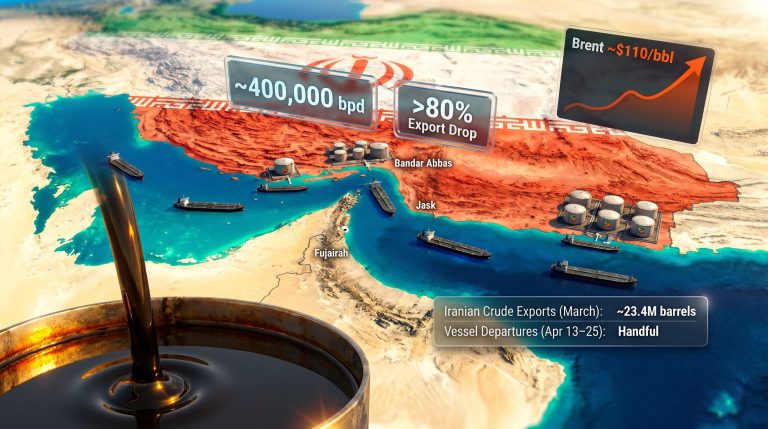
No analysis of why has oil not gone higher in the wake of the U.S.-Iran conflict can omit the central geographic variable. The Strait of Hormuz is a narrow maritime passage connecting the Persian Gulf to the Gulf of Oman, through which approximately 20% of global oil supply transits daily. There is no viable large-scale alternative routing for Persian Gulf producers. The Guardian's reporting on Hormuz disruption illustrates just how central this chokepoint has become to market anxiety.
The entire containment thesis rests on one assumption: that the Strait reopens within a matter of weeks. Current market pricing, according to Gelder, is overwhelmingly driven by this assumption rather than by a rigorous assessment of the supply loss itself.
| Scenario | Strait of Hormuz Status | Estimated Brent Price Trajectory |
|---|---|---|
| Base Case (Market Assumption) | Resumes transit within weeks | Gradual retreat toward $80–$90/barrel |
| Extended Disruption (2–3 months) | Partially restricted | Sustained $110–$130/barrel range |
| Prolonged Closure (6+ months) | Fully closed | Potential for $150+/barrel; demand destruction required |
| Full Resolution and Deal | Fully reopened | Rapid correction toward pre-conflict levels |
The demand destruction scenario deserves particular attention because it is frequently misunderstood. When supply is reduced by 10 million barrels per day and no substitution is possible, the market cannot achieve balance through supply-side adjustment alone. Prices must rise until demand falls by an equivalent volume. Historically, this requires very high prices sustained over sufficient duration to force meaningful consumption reductions across price-sensitive economies, particularly in Asia and emerging markets where fuel demand elasticity is relatively low.
Will Future Geopolitical Shocks Produce Smaller Oil Price Responses?
The current episode has generated genuine debate about whether the oil market's response mechanism has structurally changed. Gelder argued that the demonstrated effectiveness of IEA and OECD strategic stockholding coordination suggests future disruptions may produce more muted price responses, as markets now have stronger empirical evidence that coordinated reserve releases can bridge multi-month supply gaps.
Zycher offered a direct counterpoint. His position is that the magnitude of geopolitical risk determines the price response, and no structural change has occurred that would permanently dampen price sensitivity. The current episode's relatively contained outcome reflects the specific characteristics of this crisis, including the ceasefire, the market's resolution expectations, and the availability of buffer mechanisms, rather than any permanent alteration in how oil markets price geopolitical uncertainty. In addition, the broader geopolitical mining landscape illustrates how similar debates about structural versus situational risk play out across commodity sectors.
The debate ultimately hinges on a distinction between a situational containment and a structural one. If IEA coordination has genuinely demonstrated an expanded buffering capacity, future markets will price smaller risk premiums onto supply disruptions of comparable scale. If the containment reflects only crisis-specific factors, future disruptions of similar magnitude will produce similar or larger price responses depending on the presence or absence of equivalent buffers.
What Comes Next: Three Trajectories for Oil Markets
Scenario A: Rapid Resolution Within Four to Six Weeks
If the Strait of Hormuz resumes normal transit within the market's assumed timeline, strategic reserves will be replenished, the physical-futures spread will normalise, and Brent crude will likely retreat toward the $75–$90 per barrel range. The primary market lesson from this outcome would be that geopolitical risk premiums are transient and IEA coordination is effective.
Scenario B: Prolonged Partial Disruption Over Three to Six Months
If partial transit restrictions persist beyond the market's resolution assumption, onshore inventories will begin drawing down sharply as the oil-on-water buffer has already been substantially consumed. Freight rates will re-escalate as Atlantic Basin rerouting capacity is exhausted. Brent crude would likely sustain above $120 per barrel, with demand destruction beginning in the most price-sensitive markets. The market lesson here is that buffer mechanisms have finite capacity and sustained disruption requires demand-side adjustment. Furthermore, these commodity price impacts would extend well beyond oil into related energy and industrial commodity markets.
Scenario C: Full Closure and Escalation
A complete and sustained Strait of Hormuz closure represents the scenario in which the containment thesis fully breaks down. With no viable rerouting at scale and strategic reserves unable to substitute for 20% of global supply indefinitely, prices would need to rise high enough to reduce global oil demand by approximately 10 million barrels per day. Historical precedent suggests this requires prices well above $150 per barrel sustained over sufficient duration. Emergency demand-side policy responses would likely be activated across major consuming nations.
The next major ASX story will hit our subscribers first
The Critical Risk That Hasn't Fully Registered
The five factors containing oil prices, namely market belief in near-term resolution, strategic reserve releases, buyer deferral behaviour, vessel repositioning, and the ceasefire effect, are all temporary in nature. Each operates on a time horizon measured in weeks to months, not years.
What makes the current situation genuinely precarious is the sequential exhaustion of these buffers. The oil-on-water cushion is largely gone. Strategic reserves are being actively drawn down. Buyer deferral cannot continue indefinitely when refinery intake requirements create non-negotiable demand floors. Freight rerouting is approaching capacity constraints.
Standard Chartered's Ashford explicitly warned that the downward price adjustment observed in physical markets should be considered temporary. Once purchases can no longer be deferred, physical prices should rise again, potentially pulling futures higher with them in the pattern that markets initially expected but did not observe.
The answer to why has oil not gone higher in the wake of the U.S.-Iran conflict is therefore not that the market has permanently absorbed the shock. It is that the market has temporarily borrowed time from future price discovery using mechanisms that are each finite, each depleting, and each operating on the assumption that the Strait of Hormuz resolves on the timeline the market has priced in. If that assumption proves wrong, the containment story changes very rapidly.
This article is intended for informational purposes only and does not constitute financial or investment advice. Oil market conditions, geopolitical developments, and price trajectories are subject to rapid change. Readers should consult qualified financial professionals before making any investment decisions based on energy market analysis.
Want To Stay Ahead of the Next Major Commodity Disruption?
Discovery Alert's proprietary Discovery IQ model delivers real-time alerts on significant ASX mineral discoveries, instantly translating complex market data into actionable investment insights — so subscribers are positioned before the broader market reacts. Explore how historic mineral discoveries have generated substantial returns or start your 14-day free trial today to secure a market-leading advantage.