July 15, 2026
The Geopolitics of Oil Routing: How Chokepoint Risk Is Redrawing Asia's Crude Supply Map
Every major disruption to global oil flows eventually forces the same question onto refinery procurement desks: where does replacement supply come from, and how quickly can it arrive? The answer has historically defaulted to alternative Middle Eastern producers or West African exporters. However, a fundamental shift is now visible in the data, driven not by preference but by the compounding logic of geopolitical risk concentrated at a single maritime chokepoint.
Asian refiners buying US crude amid Strait of Hormuz tensions has reached levels not seen in at least three years, and the pricing behaviour of buyers reveals something more significant than routine supply diversification. Refiners across Japan, South Korea, Thailand, and Taiwan are absorbing double-digit per-barrel premiums to secure American crude. This signals that energy security calculus is now overriding short-term cost optimisation in ways that could reshape global crude trade flows well beyond this disruption cycle.
When big ASX news breaks, our subscribers know first
Understanding the Hormuz Dependency Problem
To appreciate why the current buying surge is so significant, it helps to understand just how concentrated Asia's crude import dependency has become around a single maritime corridor. The Strait of Hormuz, a narrow waterway separating Iran from Oman at its narrowest point of roughly 33 kilometres, functions as the arterial gateway for Persian Gulf crude exports heading to Asia-Pacific markets.
Approximately 70% of all crude oil destined for Asia-Pacific importing nations transits through this waterway, including the feedstock requirements of Japan's, South Korea's, Thailand's, and Taiwan's combined refining capacity. This is not merely a logistical dependency; it is a structural vulnerability embedded into the energy security pressures facing some of the world's largest economies.
"The Strait of Hormuz is unique among oil chokepoints because its closure would not simply disrupt one trade route among many. It would simultaneously threaten the feedstock security of the world's largest crude-importing region, with no immediately equivalent alternative routing option available at scale."
When conflict between the US and Iran escalated and began constraining Persian Gulf shipping lanes, the practical consequence for Asian refiners was not a gradual supply tightening but an acute procurement emergency requiring immediate market response.
The Scale of Asia's US Crude Buying Surge
What Does the Procurement Data Show?
The procurement data emerging from this disruption cycle is striking in both volume and velocity. According to trade sources cited by Reuters, the following transactions were confirmed for loading windows spanning July through August 2026:
| Buyer | Volume | Premium Paid | Loading Period |
|---|---|---|---|
| Two South Korean refiners (combined) | At least 5 million barrels of WTI | ~$11-$12/bbl over Dubai | July-August |
| Japan's Eneos | ~2 million barrels of WTI | Not disclosed | Comparable window |
| Thailand's PTT | ~1 million barrels of US crude | Not disclosed | Comparable window |
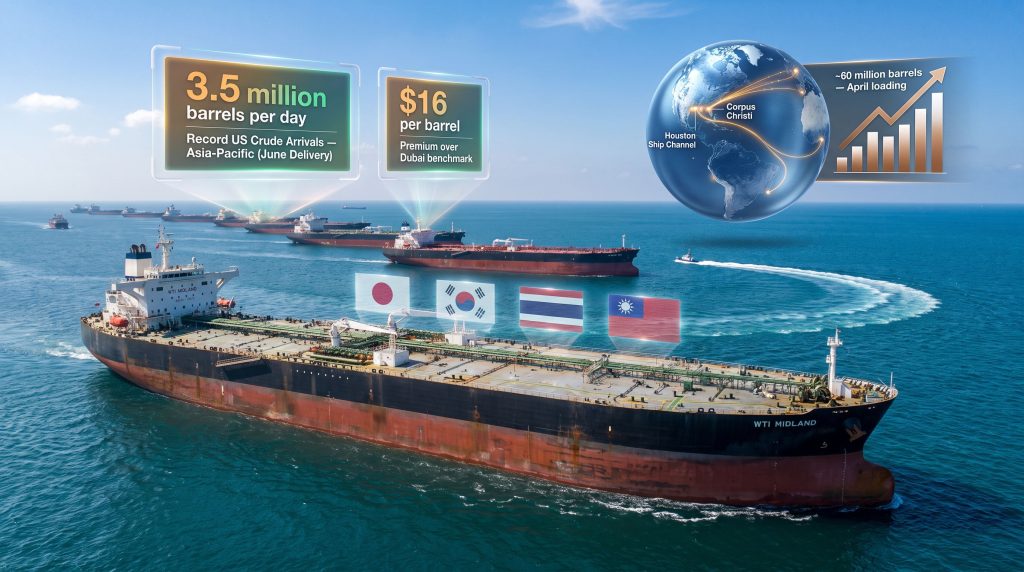
Beyond these confirmed spot transactions, broader shipping data points to an unprecedented near-term supply picture. Projected US crude arrivals into Asia-Pacific markets for June delivery are tracking toward a record 3.5 million barrels per day, compared to a previous record of approximately 2.5 million barrels per day. Furthermore, US crude booked for April loading reached approximately 60 million barrels, the highest single-month volume in at least three years.
Japan's April loading volumes alone reached at least 13 million barrels, itself a record monthly figure for that country. This concentration of buying activity in a compressed timeframe reflects not orderly portfolio diversification but a reactive scramble for supply security.
What Premium Tolerance Reveals About Refiner Psychology
Are Asian Buyers Making an Insurance Payment?
The pricing dimension of this buying wave deserves close analytical attention. Under normal market conditions, Asian refiners actively manage crude procurement costs against benchmark differentials. Paying double-digit per-barrel premiums for a lighter, sweeter grade that may not optimally suit their refinery configuration would ordinarily be commercially difficult to justify.
The current environment, however, is clearly not normal. South Korean refiners accepted premiums of approximately $11-$12 per barrel above the Dubai benchmark for WTI cargoes, while some transactions for WTI Midland cargoes were reportedly priced at premiums approaching $16 per barrel above Dubai. In addition, Taiwan's CPC Corporation paid approximately $12 per barrel above ICE Brent.
Compounding the pricing complexity, the Dubai benchmark itself surged to a historic high of $169.75 per barrel, creating a distorted reference environment. This is prompting some Asian buyers to migrate toward ICE Brent as their contractual pricing benchmark. This benchmark migration is itself a signal of structural change. When buyers begin renegotiating the measurement framework, it suggests they are preparing for a prolonged period of altered market conditions rather than a brief disruption episode.
"When energy buyers accept $16 per barrel premiums over their normal reference price, they are not making a trading decision. They are making an insurance payment against the risk of feedstock shortfall, and that distinction matters enormously for understanding how durable this procurement shift may prove to be."
Refinery Chemistry and the Light-Heavy Trade-Off
A dimension of this buying surge that receives insufficient analytical attention is the operational challenge it creates inside Asian refineries. The crude grades dominating current US export flows to Asia — primarily WTI Midland and West Texas Light — are classified as light, sweet crude with low sulphur content. Their API gravity and sulphur profiles are meaningfully different from the medium to heavy sour grades that dominate Persian Gulf exports, for which many Asian refineries have historically been optimised.
Refineries configured around heavier feedstocks must adjust several operational parameters to process lighter US barrels efficiently:
- Crude blending ratios must be recalibrated to manage distillation column behaviour across the lighter boiling range
- Hydrocracker utilisation typically decreases with lighter feedstocks, affecting the yield of middle distillates such as diesel and jet fuel
- Atmospheric distillation unit throughput may need adjustment to optimise light distillate recovery without overloading downstream processing units
- Residue upgrading units become underutilised when crude runs shift significantly lighter, affecting overall refinery economics
The fact that Asian refiners are absorbing both elevated price premiums and operational inefficiency simultaneously underscores just how significant perceived supply risk has become. The refinery-level cost of processing mismatched crude grades is real and measurable, yet procurement teams are accepting it as preferable to the alternative of inadequate feedstock supply. For context on broader oil market disruption dynamics, these operational trade-offs have been a recurring feature of major geopolitical shocks.
China's Absence: A Structurally Different Risk Calculus
Why Is China Not Participating in This Buying Wave?
One of the most analytically revealing aspects of the current US crude buying surge is which major Asian refining nation is notably absent from it. Chinese refiners, despite operating some of the world's largest and most sophisticated refining complexes, have not emerged as significant buyers of US crude during this disruption cycle.
The explanation lies in the intersection of trade policy and geopolitics rather than refinery economics. US-China trade tensions, combined with tariff structures that make American crude commercially unattractive relative to alternatives, have effectively removed China from the US spot market regardless of Hormuz disruption dynamics.
Chinese refiners are instead reinforcing supply arrangements through Russia, Central Asian producers via pipeline, and West African exporters where Chinese national oil companies hold equity stakes. This divergence creates an important asymmetry in the current disruption response. The nations most visibly pivoting toward US crude — Japan, South Korea, Thailand, Taiwan — are also those with existing strategic alignment with Washington, while China pursues an entirely separate diversification pathway.
The next major ASX story will hit our subscribers first
Three Scenarios for How This Trade Shift Could Evolve
The duration and structural permanence of this US crude buying surge depends heavily on how the underlying geopolitical disruption resolves. Three broadly defined scenarios frame the range of possible outcomes:
Scenario 1: Short-Term Tactical Hedge
Hormuz tensions de-escalate within weeks, shipping resumes at normal capacity, and Middle Eastern crude producers restore full delivery schedules to Asian buyers. US crude purchases taper back toward historical baseline levels, and the current buying wave is absorbed as an unusual but contained market episode.
Scenario 2: Extended Disruption, Accelerated Diversification
Conflict persists through Q3-Q4 2026, compelling Asian refiners to convert spot market US crude relationships into structured longer-term supply agreements. Refineries begin investing in configuration adjustments to process lighter American grades more efficiently, and formal crude import portfolio targets for non-Middle Eastern supply are revised upward.
Scenario 3: Permanent Realignment
Geopolitical risk is permanently repriced into Middle Eastern crude's attractiveness for Asian buyers. US crude establishes a sustained elevated share of Asian import portfolios, tanker routing infrastructure is expanded to support higher-volume US-to-Asia trade, and the current disruption is recognised in retrospect as the inflection point for a decade-long trade flow restructuring.
The recurrence of this buying pattern — first observed during the initial Hormuz disruptions in March and April 2025 and now repeating at larger volumes in July 2026 — suggests the market is moving progressively along this spectrum. Each disruption cycle reinforces procurement pathways, reduces friction in future buying responses, and builds institutional knowledge within Asian refiner trading operations for sourcing American crude at scale.
Infrastructure Enabling the US-to-Asia Crude Trade
Sustaining a step-change increase in US crude exports to Asia-Pacific markets requires more than willing buyers and sellers. The physical infrastructure supporting this trade is a genuine constraint that shapes how quickly and durably this reorientation can occur. Furthermore, broader oil price logistics factors amplify the challenge considerably during acute disruption periods.
Key infrastructure elements include:
- US Gulf Coast export terminals at Corpus Christi, Houston Ship Channel, and Beaumont, which collectively handle the majority of US crude export loading operations for Very Large Crude Carriers (VLCCs)
- VLCC routing options via the Panama Canal (transit-limited by vessel beam and draft specifications) or the longer Cape of Good Hope route, which adds approximately 10-15 days of transit time to Asian discharge ports
- Floating storage and transshipment hubs in Southeast Asian waters, particularly around Singapore and the Strait of Malacca, which provide cargo flexibility for regional distribution to secondary refining locations
- Cargo blending facilities at key regional terminals that allow lighter US crude to be blended with heavier grades before delivery to refineries with specific feedstock configuration requirements
A surge in Asian demand for US crude tests the throughput capacity of Gulf Coast export terminals, particularly during periods when domestic US crude production volumes are also elevated. Terminal scheduling constraints can introduce loading delays that partially offset the speed advantage of rapid procurement decisions.
The Strategic Dimension: US Crude as an Energy Security Instrument
Beyond immediate supply logistics, the current buying surge of Asian refiners buying US crude amid Strait of Hormuz tensions carries significant strategic dimensions that extend into energy policy and geopolitical relationships. The United States evolved from a net crude importer to a dominant global exporter following the lifting of the crude export ban in December 2015, and its export infrastructure has since matured into a system capable of responding to sudden large-volume demand from distant markets.
For Asian governments, increased procurement of US crude serves dual purposes. At the commercial level, it addresses immediate feedstock security. At the policy level, it reduces dependency on a single geopolitically volatile corridor in alignment with national energy resilience frameworks. Consequently, these geopolitical trade shifts are reinforcing bilateral trade linkages between the US and major Asian importers in ways that carry strategic weight well beyond energy markets alone.
For the broader US-Asia relationship, expanded crude export volumes to Japan, South Korea, and Thailand reinforce bilateral trade linkages and create energy interdependencies that carry their own strategic weight within Indo-Pacific security architecture. According to analysis from OilPrice.com, the pivot toward US supplies represents a meaningful structural shift rather than a temporary response.
The longer the Hormuz disruption persists, the more deeply these commercial and strategic motivations will become intertwined. Consequently, the more difficult it will become for Asian refiners to reverse course toward previous Middle Eastern supply dependency ratios, even if the geopolitical environment eventually normalises. The EIA's latest energy data further corroborates the scale of this shift, highlighting how Asian refiners buying US crude amid Strait of Hormuz tensions is already registering as a measurable structural change in global crude trade patterns.
Disclaimer: This article contains forward-looking analysis and scenario projections based on publicly available trade data and market reporting. The scenarios described represent analytical frameworks rather than confirmed outcomes. Readers should not treat this analysis as financial or investment advice. Oil market conditions can change rapidly, and actual trade flow outcomes may differ materially from any projections discussed.
Want to Stay Ahead of the Next Major Resource Discovery Driving These Geopolitical Shifts?
As global crude supply chains are redrawn and energy security becomes a defining investment theme, Discovery Alert's proprietary Discovery IQ model delivers real-time alerts on significant ASX mineral discoveries — instantly converting complex resource data into actionable investment opportunities for traders and long-term investors alike. Explore how historic discoveries have generated substantial market returns on Discovery Alert's dedicated discoveries page, and begin your 14-day free trial today to position yourself ahead of the market.