August 24, 2026
When Regulatory Enforcement Meets Industrial Survival: The Liberty Bell Bay Paradox
There is a particular tension that emerges when the machinery of corporate regulation collides with the fragility of strategic industrial infrastructure. Enforcement frameworks are built on principles of consistency and deterrence, yet the real-world application of those principles rarely unfolds in a vacuum. The story of ASIC drops case against Liberty Bell Bay smelter is not simply a legal footnote in Australia's corporate enforcement calendar. It is a case study in how regulators, administrators, and governments navigate competing obligations when the stakes extend far beyond a single balance sheet.
Understanding this situation requires stepping back from the immediate legal event and examining the deeper structural forces at work: a minerals sector undergoing strategic revaluation, a corporate governance framework under strain, and a workforce caught between insolvency law and industrial policy.
When big ASX news breaks, our subscribers know first
Liberty Bell Bay and the Strategic Weight of Domestic Smelting Capacity
Australia is among the world's largest exporters of manganese ore, yet for decades the country has exported the bulk of its mineral wealth in raw or lightly processed form, leaving higher-value downstream processing to offshore facilities. Against this backdrop, Liberty Bell Bay occupies a rare and structurally important position as the country's only manganese smelting operation.
Located in northern Tasmania, the facility converts manganese ore into processed alloy products used primarily in steel manufacturing. Manganese is a foundational input in steelmaking, improving hardness, tensile strength, and resistance to wear. Without manganese, modern structural steel as we know it simply could not be produced at scale. The element typically constitutes between 1% and 2% of finished steel by weight, but its absence renders the metallurgical process unworkable.
Beyond steel, manganese is attracting growing attention for its role in next-generation battery chemistry. Lithium manganese iron phosphate, known in the industry as LMFP, is an emerging cathode material for lithium-ion batteries that offers improved energy density over standard lithium iron phosphate formulations. Furthermore, it avoids the supply-chain vulnerabilities associated with cobalt and nickel. As battery manufacturers seek more abundant and geopolitically stable input materials, the critical minerals demand for manganese is intensifying.
The loss of Liberty Bell Bay's smelting capability would represent more than a regional economic setback. It would widen the gap between Australia's position as a major ore producer and its ambition to become a value-added critical minerals processor, at precisely the moment global supply chains are being restructured with that distinction in mind.
The facility's singularity in the Australian context means its closure would not simply reduce national processing capacity. It would eliminate it entirely, leaving Australia without any domestic manganese smelting capability in a period when the critical minerals strategy is attracting serious policy attention globally.
How GFG Alliance's Collapse Triggered the Administration Process
Liberty Bell Bay was owned by GFG Alliance, the sprawling industrial conglomerate controlled by British businessman Sanjeev Gupta. GFG Alliance built a significant Australian footprint across steel, aluminium, and energy assets, positioning itself as a revival force for struggling industrial facilities. When GFG Alliance's financial position deteriorated and the group ultimately collapsed, Liberty Bell Bay became collateral damage in a failure that had nothing to do with the smelter's operational performance or its market relevance.
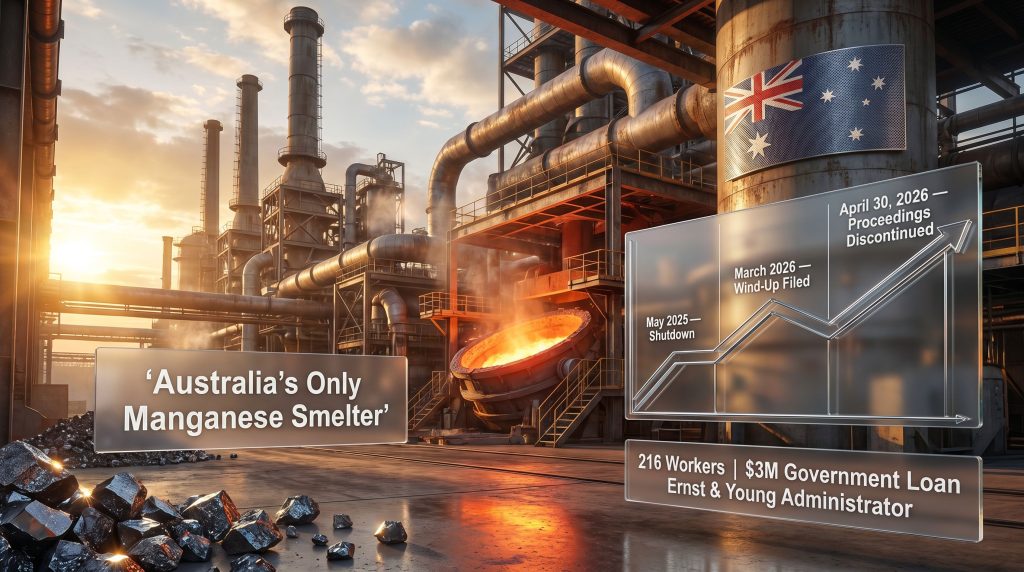
The plant ceased production in May 2025 following GFG Alliance's collapse. Rather than moving immediately to liquidation, the transition to care and maintenance mode preserved the physical integrity of the facility and kept 216 workers on payroll while administrators sought a buyer. This decision reflected a deliberate assessment that the asset retained going-concern value that would be destroyed by a rapid wind-down.
Ernst and Young was appointed as administrator, inheriting the task of managing a workforce, maintaining a complex industrial facility, and navigating an increasingly fraught regulatory environment, all simultaneously. However, as ASIC's court action against Liberty Bell Bay makes clear, the governance failures predated administration by several years.
The Five-Year Reporting Failure That Brought ASIC Into the Picture
Parallel to the operational shutdown, a separate compliance crisis was developing. ASIC alleged that GFG Alliance had failed to lodge annual financial reports for Liberty Bell Bay across five consecutive fiscal years, from 2021 through to 2025. This was not a minor administrative oversight. A multi-year failure to meet statutory reporting obligations represents a fundamental breakdown in the corporate transparency framework that Australian securities law is built upon.
Financial reporting requirements exist for a specific and critical purpose: they create the evidentiary record through which creditors, investors, regulators, and other stakeholders can assess the financial health and governance conduct of a company. When those reports are absent for half a decade, the informational architecture that underpins informed decision-making collapses entirely.
The following table outlines the key stages of ASIC's escalating enforcement response, drawing on confirmed information from the ABC News report of April 30, 2026:
| Enforcement Stage | Timing | Outcome |
|---|---|---|
| Five-year reporting gap identified | Fiscal years 2021 to 2025 | ASIC alleges systemic non-compliance |
| Wind-up application filed | March 2026 | NSW Supreme Court proceedings initiated |
| Agreement reached with administrator | April 29, 2026 | Discontinuation agreed, Supreme Court approved |
| Further hearings vacated | April 30, 2026 | Proceedings formally discontinued |
What "Just and Equitable" Winding Up Actually Means
ASIC pursued its enforcement action under the "just and equitable" ground for winding up a company, which is provided under Section 461(1)(k) of the Corporations Act 2001 (Cth). This is a distinctive legal pathway. Unlike insolvency-based liquidation, which is triggered when a company cannot pay its debts, a "just and equitable" wind-up is sought when the manner in which a company has been conducted makes it fundamentally unjust or impractical for it to continue operating in its current form.
Applying this ground to a company that failed to lodge financial reports for five years carries a clear regulatory logic. The absence of financial disclosures does not merely breach a procedural rule. It suggests a company operating outside the boundaries of acceptable corporate governance, in a manner that erodes the foundational transparency obligations that give the regulatory framework its meaning.
ASIC's decision to pursue the most serious available remedy, rather than civil penalties alone, communicated something important to the broader market: persistent, multi-year reporting non-compliance will not be treated as a minor administrative matter indefinitely.
This enforcement posture aligns with what regulators describe as deterrence signalling. The purpose is not merely to hold a single company accountable but to communicate to all entities within the regulatory perimeter that reporting obligations are non-negotiable, regardless of ownership complexity or financial distress. Indeed, these kinds of patterns often mirror the management red flags that experienced investors learn to identify early.
Why ASIC Dropped the Case: The Regulatory Logic Behind the Decision
The decision by ASIC to discontinue proceedings requires careful interpretation. It should not be read as a retreat from enforcement principles. The regulatory calculus changed fundamentally when Ernst and Young was appointed as administrator.
Voluntary administration under Part 5.3A of the Corporations Act 2001 (Cth) places an independently appointed professional in statutory control of a company's affairs. The administrator assumes responsibility for the entity's governance, financial reporting, and creditor communications. In practical terms, this means the governance deficit that ASIC was seeking to remedy through wind-up proceedings is now being addressed through an alternative, court-supervised mechanism.
Continuing to pursue wind-up proceedings against an entity already subject to independent administration creates a form of procedural redundancy. Both processes serve overlapping stakeholder protection objectives. Pursuing both simultaneously risks duplicating legal costs, creating conflicting judicial outcomes, and most critically, undermining the administrator's ability to run an efficient sale process.
The Commercial Impact of Unresolved Litigation on Sale Processes
For any prospective buyer conducting due diligence on Liberty Bell Bay, the existence of active wind-up proceedings would have represented a material uncertainty. Asset valuations become difficult to finalise when the legal status of the target entity is unresolved. Financing arrangements require clean legal titles. Deal structuring depends on regulatory certainty.
The administrator's confirmation that the discontinuation removes a potential obstacle to the sale process reflects a straightforward commercial reality: buyers do not acquire litigation risk voluntarily when alternatives exist. Consequently, this mirrors broader trends in asset sales and consolidation across the Australian minerals sector, where deal certainty is paramount.
Consider the competing pressures facing any interested buyer of Liberty Bell Bay:
- Active wind-up proceedings introduce liquidation risk that could extinguish asset value before a transaction closes
- Unresolved regulatory proceedings create indeterminate liability exposure
- Due diligence timelines extend when legal status is uncertain, increasing holding costs and deal fatigue
- Financing institutions typically require clean legal status before committing acquisition finance
ASIC's withdrawal removes each of these impediments simultaneously. The administrator's fiduciary duty to maximise creditor recoveries is directly served by creating the clearest possible pathway to a sale.
The Workforce Emergency and the Government's Response
While the legal proceedings were reaching resolution, a parallel crisis was unfolding on the ground in northern Tasmania. The 216-strong workforce that had been retained on full pay during the care and maintenance phase faced a sudden financial cliff when administrators announced that funding had run out to sustain payroll continuity.
Approximately 175 workers were told they would need to accept leave without pay or face redundancy. For a regional Tasmanian community, the loss of that income would have cascading effects well beyond the facility fence line.
The response from both levels of government was swift. A $3 million loan, split equally between the Tasmanian and Federal governments, was confirmed by Tasmanian Premier Jeremy Rockliff and Federal Industry Minister Tim Ayres. Prime Minister Anthony Albanese publicly affirmed that the governments were backing the workers, their families, and the surrounding community through the sale process.
The loan structure is significant in several respects:
| Element | Detail |
|---|---|
| Total loan amount | $3 million |
| Tasmanian government contribution | $1.5 million |
| Federal government contribution | $1.5 million |
| Recipient | Ernst and Young (administrator) |
| Purpose | Worker wage support during sale process |
| Coverage period | Approximately three weeks of wages |
The three-week coverage period is not incidental. It creates a defined and time-limited runway for the sale process, establishing urgency without abandoning the workforce. The structure communicates that government support has a finite scope and that a commercial resolution must be found within that window.
Regulatory Precedent and What the Dismissal Signals to the Market
One question that arises naturally from ASIC's decision to discontinue is whether it sets a precedent that other non-compliant entities can rely upon. The answer, on a careful reading of the circumstances, is clearly no.
ASIC did not abandon its enforcement objective. The original goal of ensuring that Liberty Bell Bay was subject to proper governance oversight and financial transparency is now being achieved through the administration process. An independent, court-supervised professional is now accountable for the entity's financial affairs and statutory compliance obligations. The mechanism has changed; the accountability principle has not.
It is also worth noting that the broader investigation into GFG Alliance's conduct across its Australian operations is unlikely to have concluded simply because ASIC drops case against Liberty Bell Bay smelter proceedings against one subsidiary have been discontinued. The reporting compliance failures that triggered this action were systemic, spanning five years and involving a group-wide pattern of non-disclosure.
A critical distinction for corporate governance practitioners: when a company enters administration, the statutory reporting obligations do not disappear. They transfer. The administrator assumes the compliance burden under court supervision, which is precisely why regulators can, in appropriate circumstances, allow their own parallel proceedings to be discontinued without abandoning their enforcement mandate.
The next major ASX story will hit our subscribers first
Frequently Asked Questions: Liberty Bell Bay, ASIC, and the Administration Process
What is the difference between administration and liquidation?
These two terms are frequently conflated but represent fundamentally different legal processes with different objectives.
- Administration is a temporary, remedial process managed by an independently appointed administrator. Its primary objective is to assess whether a company can be restructured or sold as a going concern, maximising returns to creditors while preserving employment where possible.
- Liquidation is a terminal process. A liquidator is appointed to wind up a company's affairs, sell its assets to repay creditors in order of legal priority, and ultimately deregister the company. The business ceases to exist.
Liberty Bell Bay is currently in administration. Liquidation remains a risk if no buyer is found within the available timeframe. For a deeper breakdown of how these processes affect asset value, project viability studies can provide further context on how going-concern assessments are structured.
What happens to workers if no buyer is found?
If the administration process concludes without a successful sale, the likely outcome is liquidation and workforce redundancy. Australian workers in this situation are protected by the Fair Entitlements Guarantee, a federal safety net that covers unpaid wages, annual leave, long service leave, and redundancy entitlements up to statutory caps when a company enters insolvency.
Is manganese classified as a critical mineral in Australia?
Manganese features in Australia's Critical Minerals Strategy as a mineral of strategic significance, owing to its essential role in steelmaking and its emerging relevance to battery technology supply chains. Australia is one of the world's leading producers of manganese ore by volume, which makes the absence of significant domestic processing capacity a notable gap in the value-chain story the country is seeking to build.
The Larger Stakes: Industrial Policy at a Critical Minerals Crossroads
The outcome of Liberty Bell Bay's sale process will be watched carefully by policymakers, industry groups, and investors assessing the viability of domestic critical minerals processing as a long-term industrial strategy.
A successful going-concern sale would demonstrate that strategic manufacturing assets can survive ownership collapse with the right combination of administration expertise, regulatory pragmatism, and targeted government support. It would also preserve something that cannot easily be rebuilt: the specialised workforce knowledge, operational infrastructure, and supply chain relationships that accumulate over decades of smelting operations.
If no buyer emerges and the facility moves to liquidation, Australia will have permanently lost its only domestic manganese smelting capability during a period when the global race to secure and process critical minerals is intensifying. The cost of that loss would extend well beyond the immediate community and workforce, representing a structural step backward for Australia's ambitions in the minerals processing sector.
The ASIC drops case against Liberty Bell Bay smelter episode is, in this sense, a stress test. It is testing whether Australia's regulatory frameworks, insolvency laws, and industrial policy settings are capable of working together, rather than against each other, when strategic assets face existential pressure. The ASIC case dismissal suggests that at least one part of that coordination challenge has been navigated successfully. Whether the broader outcome follows will depend on what happens next in the buyer search process.
Disclaimer: This article is intended for informational purposes only and does not constitute financial, legal, or investment advice. Information regarding administration outcomes, sale processes, and regulatory proceedings is subject to change. Readers should conduct their own research and consult qualified professionals before making any financial or investment decisions. References to government loan arrangements and workforce figures are sourced from ABC News reporting dated April 30, 2026.
Want to Stay Ahead of Significant ASX Mineral Discoveries as They Happen?
Discovery Alert's proprietary Discovery IQ model delivers real-time alerts on significant ASX mineral discoveries — including those in critical minerals like manganese — instantly translating complex data into actionable investment insights for both short-term traders and long-term investors. Explore how historic discoveries have generated substantial returns on Discovery Alert's dedicated discoveries page, and begin your 14-day free trial today to position yourself ahead of the broader market.