
June 15, 2026
Understanding Asset Valuation Challenges in Cyclical Commodity Markets
The mining industry operates within complex valuation frameworks where asset carrying values must align with long-term cash flow projections and market realities. When fundamental market conditions shift, mining companies face pressure to reassess their balance sheets through impairment reviews that can significantly impact shareholder value and strategic positioning. Furthermore, the Anglo De Beers impairment exemplifies these challenges as companies navigate evolving market dynamics.
Asset impairment triggers in mining operations reflect multiple converging factors beyond simple price volatility. These include sustained deterioration in commodity pricing, operational performance below historical norms, changes in resource grade quality, and shifts in geopolitical frameworks affecting asset accessibility. For diamond mining specifically, additional complexity arises from luxury market dynamics, consumer preference evolution, and competition from synthetic alternatives. Moreover, these factors intersect with broader industry evolution trends affecting the sector.
The distinction between temporary market corrections and structural demand shifts becomes critical in impairment assessments. Mining companies must evaluate whether current challenging conditions represent cyclical downturns warranting patience or fundamental market transformations requiring strategic repositioning. This evaluation directly influences carrying value calculations and future investment allocation decisions.
Impairment Recognition Framework for Mining Assets
Under International Financial Reporting Standards, mining companies must conduct impairment reviews when indicators suggest asset carrying values exceed recoverable amounts. These indicators include sustained price declines, reduced production guidance, negative operating cash flows, and significant changes in the economic environment affecting asset viability.
Key impairment assessment factors include:
• Discounted cash flow projections based on current and forward price assumptions
• Fair market valuations reflecting comparable recent transactions
• Assessment of asset utilisation rates and production capacity optimisation
• Evaluation of regulatory or ownership framework changes affecting operations
• Analysis of market structure evolution and competitive positioning
The Anglo De Beers impairment situation demonstrates how successive writedowns can accelerate when market conditions deteriorate faster than previous assumptions anticipated. Each impairment review establishes new baseline carrying values, creating compounding effects when subsequent reviews identify further deterioration.
When big ASX news breaks, our subscribers know first
Market Deterioration Patterns in Diamond Sector Performance
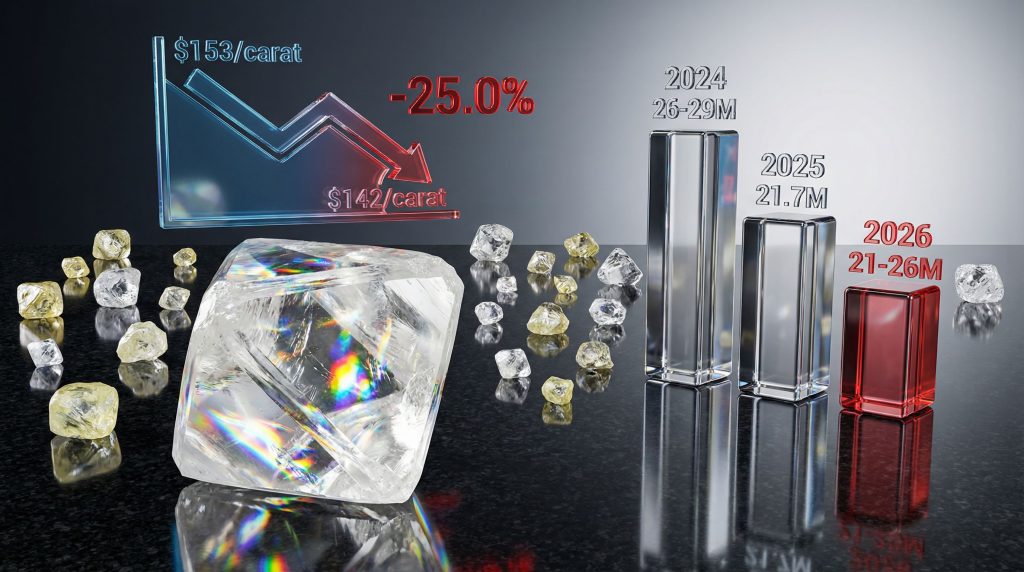
Diamond market conditions have experienced significant deterioration since 2024, with multiple indicators suggesting structural rather than cyclical challenges. De Beers reported average realised diamond pricing of $142 per carat in 2025, representing a 7% year-over-year decline from implied 2024 levels of approximately $153 per carat.
However, underlying market weakness appears more severe than headline pricing suggests. The rough diamond price index declined 12% in 2025, while inventory-adjusted pricing faced 25% year-over-year deterioration when accounting for below-cost sales of accumulated lower-value inventory. These challenging market conditions have implications for broader raw materials supply challenges across the mining sector.
Table: De Beers Market Performance Indicators (2024-2025)
| Metric | 2024 Performance | 2025 Performance | Change |
|---|---|---|---|
| Average Realised Price | $153/carat | $142/carat | -7.2% |
| Rough Price Index | Baseline | -12% decline | -12.0% |
| Inventory-Adjusted Index | Baseline | -25% decline | -25.0% |
| Q4 Effective Pricing | $118/carat | $97/carat | -18.0% |
Revenue and Volume Dynamics
De Beers' fourth quarter 2025 performance revealed concerning trends in volume-price relationships. The company sold 5.9 million carats generating $571 million in revenue, compared to 4.6 million carats producing $543 million in the prior year period.
Despite 28% higher unit sales volume, revenue increased only 5%, indicating the additional volume consisted primarily of promotional inventory clearance at substantially reduced margins. This pattern suggests deliberate stockpile reduction strategies aimed at converting static assets to cash flow, even at significant pricing sacrifices.
The divergence between average annual pricing ($142/carat) and fourth quarter effective pricing ($97/carat) demonstrates accelerating weakness during the most recent reporting period. This 31% gap indicates market conditions deteriorated substantially during late 2025, potentially justifying management's consideration of additional impairment recognition.
Market Structure Transformation
The diamond sector faces multiple structural headwinds that distinguish current challenges from historical cyclical downturns:
• Consumer preference evolution toward lab-grown alternatives offering comparable aesthetics at significantly lower prices
• Economic uncertainty reducing discretionary luxury spending in key geographic markets including the United States, Europe, and China
• Supply chain complexity affecting distribution networks and inventory management across the pipeline from mining to retail
• Investment sentiment shifts favouring technology and renewable energy sectors over traditional luxury commodity exposure
These factors create compounding pressures that traditional diamond marketing strategies have struggled to address effectively. The industry's historical reliance on artificial scarcity narratives faces challenges from both synthetic alternatives and changing consumer values prioritising sustainability and value transparency.
Financial Impact Analysis of Successive Asset Writedowns
The Anglo De Beers impairment represents one of the most significant mining asset writedown sequences in recent industry history. Anglo American has recognised cumulative impairments totalling $4.5 billion across 2024 and 2025, reducing the carrying value from an estimated original base of $11.6 billion to $4.1 billion currently.
Table: De Beers Impairment Progression
| Year | Impairment Amount | Carrying Value After | Percentage Reduction |
|---|---|---|---|
| 2024 | $1.6 billion | $7.6 billion | 17.4% |
| 2025 | $2.9 billion | $4.1 billion | 46.1% |
| 2026 | Under Review | TBD | Additional decline likely |
Accounting Framework Implications
Under IFRS 36 guidelines, each impairment review establishes new baseline carrying values for future assessments. This creates acceleration effects where successive impairments remove increasingly larger percentages of carrying value, reflecting deteriorating conditions that exceed previous assumptions.
The 2025 impairment of $2.9 billion represented 46.1% of the already-reduced 2024 carrying value, indicating market conditions worsened significantly faster than management's 2024 projections anticipated. This pattern suggests systematic underestimation of market structural challenges rather than temporary volatility management issues. Such dynamics reflect broader industry consolidation dynamics affecting the mining sector.
Anglo American's ownership share of cumulative impairments:
• Anglo American ownership stake: 85% of De Beers
• Anglo's share of $4.5 billion total impairments: $3.825 billion
• Impact on Anglo American's consolidated balance sheet and return on invested capital metrics
• Implications for dividend sustainability given negative EBITDA projections for De Beers operations
Comparative Industry Analysis
The De Beers impairment sequence parallels other major mining asset writedowns during commodity downturns, but exceeds typical patterns in both magnitude and timeline compression. Rio Tinto's approach to its Argyle Diamond Mine provides relevant context: rather than sustaining repeated impairments, Rio Tinto chose asset closure in November 2020 when diamond prices fell below operational viability thresholds.
Rio Tinto's Argyle closure followed diamond price deterioration from approximately $300 per carat in 2011 to $125 per carat by 2020. De Beers' current average realised pricing of $142 per carat suggests similar economic pressures, but Anglo American's strategy emphasises sale processes rather than operational closure.
This strategic difference reflects varying approaches to asset lifecycle management: immediate exit versus value preservation through ownership transition to potentially more operationally efficient or geographically advantaged buyers.
Strategic Portfolio Transformation in Modern Mining
Anglo American's pursuit of De Beers divestment forms part of a comprehensive portfolio transformation prioritising industrial metals over luxury commodities. The company completed its Amplats platinum unit demerger in June 2025 and finalised merger terms with Canada's Teck Resources, creating the combined Anglo-Teck entity.
This restructuring reflects mining industry trends favouring assets with predictable cash flow generation, ESG alignment with renewable energy transitions, and scalable production capacity meeting growing industrial demand. Diamond mining faces challenges in each category compared to battery metals and electrification-supporting commodities. Consequently, these changes align with broader copper and uranium investments gaining prominence in the sector.
Buyer Interest and Ownership Dynamics
Multiple potential buyers have emerged for Anglo American's 85% De Beers stake, creating competitive dynamics that may support valuation despite underlying market challenges:
Government Participants:
• Botswana Government (current 15% owner): Seeking majority control and expanded ownership
• Namibian Government: Expressed formal interest in shareholder participation
• Angola: Actively bidding for Anglo American's stake through government-backed consortium
Private Sector Interest:
• Consortium led by Gareth Penny, former De Beers Managing Director
• Management buyout structures leveraging industry expertise
• Strategic buyers potentially including other luxury goods companies
The involvement of multiple African governments reflects resource nationalism trends and desire for increased control over domestic mineral assets. These governments may accept different return thresholds than public company shareholders, potentially supporting higher valuation multiples despite current market challenges.
Capital Allocation Strategy Evolution
Anglo American's copper production guidance demonstrates management's differential confidence levels between commodity sectors:
Multi-Year Copper Guidance:
• 2026: 700,000-760,000 tonnes (reduced from 760,000-820,000 tonnes)
• 2027: 750,000-810,000 tonnes (new guidance)
• 2028: 790,000-850,000 tonnes (earliest forward guidance provided)
This multi-year copper guidance contrasts sharply with absent forward production guidance for De Beers, signaling management's conviction regarding copper market fundamentals versus diamond sector uncertainty. Furthermore, these positioning decisions reflect broader gold price forecast insights and commodity market dynamics.
Despite missing 2025 copper production targets at 695,000 tonnes (versus 690,000-750,000 tonne guidance), Anglo American maintained long-term expansion commitments. Goldman Sachs noted the Quellaveco operation missed targets by 10% due to lower-than-expected grades, yet management continued providing years-ahead production targets indicating resource base confidence.
Geopolitical Factors Influencing Diamond Asset Valuations
Diamond asset valuations face unique geopolitical complexities stemming from concentrated production geography, international trade regulations, and government ownership aspirations in resource-rich nations. These factors create additional valuation uncertainty beyond traditional commodity market dynamics.
African Government Participation Strategies
Botswana's current 15% De Beers ownership stake provides negotiating leverage for expanded control, given the country hosts De Beers' most significant mining operations. The Botswana government has stated objectives to take majority control, potentially through partnerships with private investors or direct acquisition of portions of Anglo American's stake.
Namibia's expression of shareholder interest reflects similar resource nationalism trends, though Namibian diamond operations represent smaller proportions of De Beers' overall production portfolio. Angola's active bidding participation suggests government-backed consortiums view diamond assets as strategic regardless of current market conditions.
These government involvement patterns create complex ownership structures that may support asset valuations through:
• Non-commercial buyer participation accepting different return thresholds than public market investors
• Operational synergies through closer government cooperation on regulatory and infrastructure issues
• Strategic asset control motivations extending beyond pure financial return optimisation
International Trade and Regulatory Considerations
Diamond assets face regulatory complexity through the Kimberley Process certification scheme and evolving sanctions frameworks affecting global trade flows. Recent industry discussions regarding Kimberley Process reform reflect ongoing challenges in maintaining certification credibility while accommodating political developments in producing regions.
Regulatory framework impacts include:
• Compliance costs for maintaining certification across multiple jurisdictions
• Market access restrictions in certain consuming regions based on origin verification requirements
• Currency fluctuation exposure across diverse producing and consuming markets
• Tariff uncertainty affecting pricing mechanisms in key markets including the United States and European Union
These regulatory considerations create operational complexity that mining companies must evaluate against potential returns when assessing long-term asset viability and ownership structures.
Investment Strategy Framework for Declining Commodity Sectors
Successful investment in declining commodity sectors requires differentiated approaches emphasising value extraction timing, operational efficiency optimisation, and strategic exit planning. Traditional buy-and-hold strategies prove inadequate when facing structural demand deterioration rather than cyclical downturns.
Value Extraction Methodologies
Operational Efficiency Focus:
Mining operations facing declining commodity prices must prioritise cost structure optimisation through technology implementation, production scheduling flexibility responding to market signals, and inventory management strategies minimising carrying costs. Capital expenditure discipline becomes critical for preserving cash flow during extended downturns.
De Beers' inventory clearance strategy during Q4 2025 demonstrates one approach: accepting below-cost pricing to convert static assets to cash flow, even at significant margin sacrifice. This strategy prevents further inventory accumulation costs while providing immediate liquidity, though at the expense of short-term profitability metrics.
Alternative operational strategies include:
• Production curtailment during extended low-price periods to preserve ore reserves for future higher-price environments
• High-grade ore prioritisation focusing on premium product segments maintaining better pricing resilience
• Cost base restructuring through workforce optimisation, contractor renegotiation, and facility consolidation
• Technology integration improving processing efficiency and reducing per-unit production costs
Strategic Exit Planning Considerations
Mining companies facing structural commodity challenges must develop comprehensive exit strategies addressing buyer identification, asset packaging optimisation, and timing relative to market cycles. Successful exits often require multi-year preparation rather than reactive market responses.
Asset packaging strategies:
• Geographic clustering grouping assets by region to attract government or local buyer interest
• Production stage optimisation timing sales during operational peak performance periods
• Management retention facilitating buyouts by experienced industry operators familiar with asset characteristics
• Infrastructure separation dividing mining rights from processing facilities to accommodate different buyer types
The De Beers sale process illustrates multiple buyer categories requiring different value propositions: government buyers prioritising resource control, management buyouts emphasising operational expertise, and strategic buyers seeking vertical integration opportunities.
Risk Management Frameworks
Financial Risk Mitigation:
Commodity price hedging strategies provide limited protection in structurally declining markets, as traditional hedging instruments assume eventual price recovery rather than permanent demand destruction. Alternative risk management approaches include:
• Operating leverage reduction minimising fixed cost commitments during uncertain periods
• Financial covenant management maintaining lending relationships through conservative debt structures
• Stakeholder communication preserving reputation value during challenging operational periods
• Regulatory compliance maintenance avoiding additional costs from enforcement actions during stressed periods
Market Psychology Considerations:
Investor sentiment toward declining commodity sectors often creates valuation disconnects between asset replacement costs and public market pricing. These disconnects create opportunities for contrarian investors willing to accept extended holding periods and operational challenges in exchange for potential asymmetric returns during recovery periods.
However, successful contrarian positioning requires accurate assessment of whether current challenges represent temporary demand destruction or permanent market structure changes. The diamond sector's synthetic competition and changing consumer preferences suggest structural rather than cyclical challenges, requiring more conservative recovery assumptions.
The next major ASX story will hit our subscribers first
Evaluation Framework for Diamond Sector Investment Opportunities
Diamond sector investment opportunities require specialised due diligence frameworks accounting for luxury market dynamics, geological asset characteristics, and evolving competitive landscapes including synthetic alternatives. Traditional mining investment models prove insufficient without adaptation for unique diamond market factors.
Due Diligence Requirements
Market Analysis Depth:
Long-term demand projections must account for generational preference shifts, with younger consumers demonstrating increased acceptance of lab-grown alternatives and greater emphasis on sustainability credentials. Traditional diamond marketing emphasising rarity and emotional significance faces challenges from transparency-focused consumer education.
Supply dynamics assessment requires evaluation of:
• New mine development pipelines including both traditional and alluvial operations
• Existing mine life extensions through deeper excavation or expanded processing capacity
• Synthetic production scaling and cost curve improvements affecting natural diamond positioning
• Inventory management practices across the pipeline from mining through retail distribution
Technology impact evaluation:
Laboratory-grown diamond production continues improving in quality, size range, and cost efficiency. Current synthetic production costs approximate $300-500 per carat for high-quality stones comparable to natural diamonds priced at $2,000-5,000 per carat. This 80-90% cost advantage creates fundamental competitive pressure requiring careful analysis of sustainable price premiums for natural stones.
Valuation Methodology Adaptation
Traditional mining valuation approaches require modification for diamond assets due to:
Discounted Cash Flow Complications:
• Price assumption uncertainty given structural market changes rather than cyclical volatility
• Production mix variations as different diamond quality categories face varying competitive pressures
• Terminal value challenges when assessing long-term viability against synthetic alternatives
• Discount rate adjustments reflecting higher uncertainty and reduced liquidity compared to industrial commodities
Asset-Based Valuation Considerations:
Geological reserve valuations must incorporate recovery rate assumptions, processing cost inflation, and market pricing differentiation by stone quality, size, and characteristics. Historical per-carat reserve valuations may overstate current asset values given changed market dynamics.
Comparable Transaction Analysis:
Recent diamond mining transactions provide limited guidance due to evolving market conditions and unique transaction structures. Government buyer participation, management buyout arrangements, and distressed sale circumstances create transaction multiples that may not reflect fair market valuations under normal conditions.
Investment Thesis Development
Contrarian Positioning Requirements:
Successful diamond sector investment requires contrarian positioning during market downturns, but must differentiate between temporary cyclical weakness and permanent structural decline. Current market conditions suggest structural challenges requiring conservative assumptions rather than historical recovery precedents.
Management Quality Assessment:
Operational excellence becomes critical during extended challenging periods. Management teams with demonstrated cost control capabilities, inventory optimisation experience, and stakeholder relationship management prove essential for preserving asset value during market downturns.
Strategic Buyer Identification:
Eventual exit planning requires early identification of potential strategic buyers including:
• Government entities seeking resource control
• Luxury goods companies pursuing vertical integration
• Private equity groups specialising in operational turnarounds
• Management teams with industry-specific expertise
Risk-Adjusted Return Expectations:
Diamond sector investments currently require significantly higher return thresholds to compensate for structural uncertainty, regulatory complexity, and limited liquidity compared to industrial mining assets. Conservative scenario modelling should assume extended challenging conditions rather than near-term recovery.
Future Outlook for Diamond Mining Operations
The diamond mining sector faces a complex transition period characterised by evolving consumer preferences, technological competition, and shifting investment priorities within the broader mining industry. Understanding potential recovery scenarios and their probability ranges proves essential for strategic planning and investment decision-making.
Industry Consolidation Trends
Market stress typically accelerates consolidation as stronger operators acquire distressed assets at attractive valuations. The diamond sector's current challenges create opportunities for:
Smaller Player Acquisition:
• Operational synergies through combined marketing, processing, and distribution capabilities
• Cost base optimisation eliminating redundant corporate overhead and administrative functions
• Geographic portfolio balancing reducing political risk through diversified production sources
• Technology sharing implementing best practices across expanded operational portfolios
Vertical Integration Strategies:
Some operators may pursue downstream integration controlling supply chains from mining through retail distribution. This approach provides greater margin capture opportunities but requires different skillsets and capital allocation compared to pure mining operations.
Government Ownership Expansion:
African government participation in diamond mining continues increasing as nations seek greater control over natural resource assets. This trend creates both opportunities and challenges for private operators depending on partnership structure and operational integration approaches.
Market Recovery Scenario Analysis
Potential Recovery Catalysts:
• Economic expansion driving luxury consumption growth in key markets including China, India, and the United States
• Marketing innovation successfully repositioning natural diamonds versus synthetic alternatives through authenticity, rarity, and heritage messaging
• Supply constraint development as marginal producers exit the market, reducing overall supply availability
• Jewellery industry evolution creating new product categories and consumption occasions supporting demand growth
Structural Challenge Persistence:
However, recovery scenarios must account for permanent market structure changes including:
• Synthetic diamond quality improvement and cost reduction continuing to pressure natural diamond pricing
• Consumer value consciousness prioritising transparency and sustainable practices over traditional luxury positioning
• Alternative investment preferences as younger demographics allocate discretionary spending toward experiences and technology rather than physical luxury goods
Investment Timeline Considerations
Short-Term Outlook (2026-2027):
Market challenges likely persist through the next 18-24 months as inventory clearance continues and consumer preference trends solidify. Companies with strong balance sheets and operational flexibility will be better positioned to weather extended challenging conditions.
Medium-Term Stabilisation (2028-2030):
Market stabilisation depends on successful demand recovery initiatives, supply side discipline, and resolution of current inventory overhangs. Government ownership transitions may provide stability through non-commercial buyer participation willing to accept different return thresholds.
Long-Term Positioning (2030+):
Long-term diamond sector positioning requires strategic patience and flexible exit optionality. Successful operators will likely focus on premium product segments, sustainable mining practices, and differentiated marketing approaches addressing evolving consumer values.
The Anglo De Beers impairment situation illustrates the complexity of navigating commodity sector transitions during periods of structural change. Whether current challenges represent temporary disruption or permanent market transformation will ultimately determine the success of various strategic approaches including divestment, operational optimisation, and ownership transition strategies.
Investment success in this environment requires careful risk assessment, conservative assumptions regarding recovery timing and magnitude, and maintaining flexibility to adapt strategies as market conditions evolve. The diamond sector's unique characteristics demand specialised expertise and patient capital rather than traditional mining investment approaches.
Are You Missing Out on the Next Major ASX Mineral Discovery?
While traditional commodities like diamonds face structural challenges, the ASX continues to deliver exceptional opportunities through significant mineral discoveries. Discovery Alert's proprietary Discovery IQ model instantly identifies these breakthrough announcements, transforming complex geological data into actionable investment insights that have historically generated substantial returns for early investors. Start your 14-day free trial today and discover why major mineral discoveries can create life-changing market opportunities for positioned investors.