May 15, 2026
The Structural Logic of Silver Streaming Before the Headlines
Understanding why the Lunar Royalties Fruta del Norte silver stream deal commands attention requires stepping back from the transaction itself and examining the mechanics that make silver streaming one of the most asymmetrically rewarding structures in resource finance. Before evaluating any single deal, investors benefit from grasping why the model exists, who it serves, and what conditions make a particular stream genuinely transformative versus merely large.
When big ASX news breaks, our subscribers know first
The Silver Streaming Model: A Structural Primer for Investors
How Silver Streams Differ From Royalties and Direct Mine Ownership
A silver stream is a financing arrangement in which a capital provider pays an upfront lump sum to a mining operator in exchange for the contractual right to purchase a fixed percentage of that mine's future silver output at a steep, predetermined discount to the prevailing spot price. The streamer does not own the mine, does not carry operating costs, and does not bear capital expenditure risk. Those obligations remain entirely with the operator.
This is materially different from a net smelter return (NSR) royalty, where the royalty holder receives a percentage of gross revenue or net smelter proceeds tied to all metals produced, without a fixed purchase price mechanism. It is equally distinct from a direct equity stake, which carries full exposure to operational performance, balance sheet risk, and management decisions.
The elegance of streaming lies in its risk architecture. Operators absorb cost inflation, grade variability, and logistical complexity. The streamer captures price upside with a structurally locked-in low cost base:
- Upfront capital flows to the operator at deal close
- The streamer purchases future production at a fraction of market price
- Price appreciation accrues entirely to the streamer's margin
- Operational risk remains with the mining company
Why By-Product Silver Streams Represent a Unique Asset Class
Silver's dual role as both a monetary and industrial metal means that by-product silver produced from gold mining occupies a curious position in mine economics. Primary gold operations rarely optimise their entire financial model around silver output, meaning that silver revenue is often treated as supplementary. Yet at scale, and especially in a rising silver price environment, that supplementary stream can generate hundreds of millions of dollars annually.
The scarcity of large-scale, life-of-mine silver streams on operating tier-1 assets is genuinely structural. These opportunities do not regularly come to market, and when they do, the number of capital providers capable of acting on them is extremely limited.
When a streamer purchases silver at roughly 10% of spot, the arithmetic is stark. At a silver spot price of $55 per ounce, the effective purchase cost is approximately $5.50 per ounce. Every dollar of upward price movement in silver translates almost directly into margin expansion for the streamer, with no corresponding cost increase. This creates the asymmetric return profile that distinguishes streaming from virtually every other form of mining finance.
Deal Anatomy: Breaking Down the $670 Million Fruta del Norte Transaction
Transaction Structure and Consideration
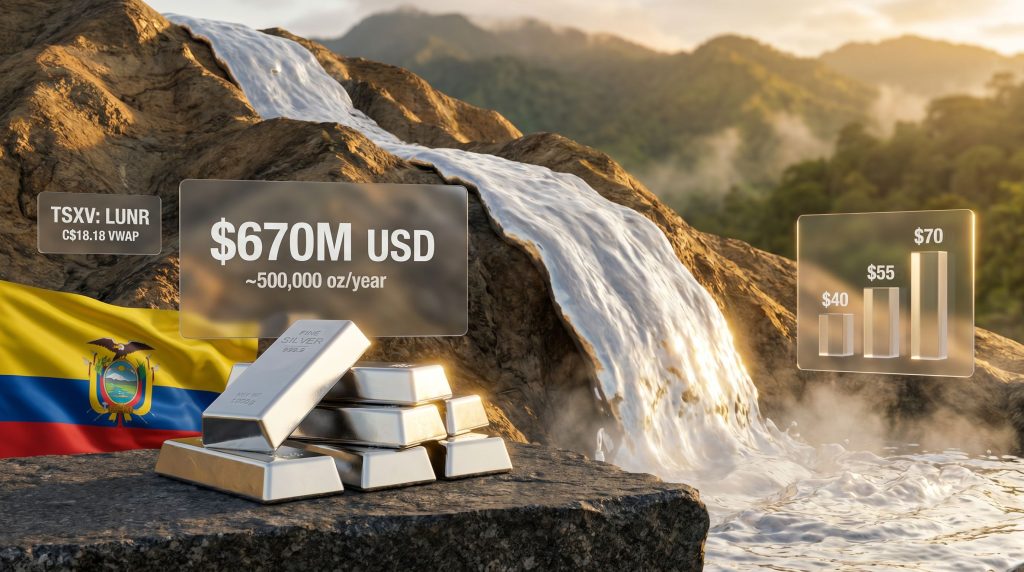
LunR Royalties (TSXV: LUNR) entered into an agreement to acquire a life-of-mine silver stream covering 100% of Fruta del Norte's payable silver production from Lundin Gold. The total consideration was structured as an all-equity transaction valued at USD $670 million, comprising approximately 50.5 million newly issued LunR shares priced on a 20-day volume-weighted average price (VWAP) of C$18.18, calculated as of February 20, 2026.
The stream's effective date was set at March 1, 2026, covering the full mining concession area of approximately 5,566 hectares, which includes five early-stage copper-gold-silver porphyry discoveries beyond the primary Fruta del Norte operation.
Key structural parameters of the deal:
- Stream coverage: 100% of payable silver production
- Purchase price: approximately 10% of prevailing spot silver price
- Consideration: equity only, no cash raised
- Effective date: March 1, 2026
- Shareholder vote: LunR shareholders meeting scheduled May 21, 2026
- TSXV approval: pending as a closing condition (targeted Q2 2026)
Production Economics and Projected Cash Flow
The financial logic of the stream is accessible to any investor willing to work through relatively straightforward arithmetic. Furthermore, Fruta del Norte produces approximately 500,000 ounces of silver annually as a by-product of its primary gold operations.
| Metric | Estimated Figure |
|---|---|
| Annual silver production | ~500,000 oz/year |
| Stream purchase price | ~10% of spot |
| Silver spot price (reference) | ~$55/oz |
| Effective purchase cost | ~$5.50/oz |
| Estimated annual stream cash flow | ~$25M USD/year |
| Implied payback period (reference price) | ~12–13 years |
At silver prices above the $55 reference level, which current market conditions suggest is conservative, the annual cash flow improves materially. One analytically useful feature of this deal is its transparency. With a single core asset, investors can directly stress-test return assumptions using any silver price scenario without needing to model a diversified multi-asset portfolio.
Staged Reduction Mechanism: What Step-Down Means for Investors
The stream does not maintain 100% coverage indefinitely. Once cumulative silver delivery thresholds are reached, the stream coverage steps down, reducing LunR's share of ongoing production. This is a standard mechanism in silver streaming agreements designed to rebalance value between operator and streamer over the long term.
Silver Price Sensitivity Table
| Silver Spot Price (USD/oz) | Effective Purchase Cost | Annual Revenue | Estimated Cash Flow | Implied Payback |
|---|---|---|---|---|
| $40/oz | ~$4.00/oz | ~$20M | ~$18M | ~37 years |
| $55/oz | ~$5.50/oz | ~$27.5M | ~$25M | ~27 years |
| $70/oz | ~$7.00/oz | ~$35M | ~$32M | ~21 years |
These figures are illustrative. Actual returns depend on step-down thresholds, mine life duration, and operational continuity at Fruta del Norte.
Any reserve growth or mine life extension at Fruta del Norte meaningfully extends the period during which full stream coverage applies, directly compressing the effective payback timeline. This creates a positive feedback loop between asset quality and streamer returns that does not exist in the same way for royalties with fixed expiry dates.
Fruta del Norte: Tier-1 Asset Profile
Why Mine Quality Matters in Stream Valuation
Not all silver streams are created equal. The quality of the underlying asset determines the reliability of production estimates, the longevity of cash flow, and the degree of confidence an investor can place in any return model. Fruta del Norte ranks among the highest-grade, lowest all-in sustaining cost (AISC) gold operations globally, a distinction that materially de-risks LunR's stream.
The mine's trajectory is well-documented:
| Milestone | Date |
|---|---|
| Asset acquisition by Lundin Gold | 2014 |
| Construction commencement | July 2017 |
| First gold pour | November 2019 |
| Commercial production declared | February 2020 |
| Silver stream effective date | March 1, 2026 |
Construction was completed and commercial production declared ahead of schedule, a meaningful indicator of operational competence. Gold production is projected at approximately 500,000 ounces annually over the next five to six years, with silver by-product output tracking at a similar rate.
Geographic and Jurisdictional Context: Operating in Ecuador
Ecuador presents a complex regulatory and political environment for large-scale mining. The Lundin family's track record in navigating non-traditional jurisdictions is widely regarded as a distinguishing capability. Taking Fruta del Norte from acquisition through construction and into commercial production in Ecuador is the kind of execution that most mining groups would consider prohibitively difficult.
Newmont holds approximately 30% of Lundin Gold's shares, positioning the world's largest gold producer as a significant approval stakeholder in any transaction involving Lundin Gold's assets. That alignment provides LunR with an additional layer of credibility regarding the deal's governance and commercial rationale.
For investors evaluating stream security, the combination of a producing asset, a proven operator, and a globally significant minority shareholder represents a risk profile that is unusually robust for a deal of this nature on a company of LunR's scale.
Corporate Profile: LunR Royalties and the Lundin Connection
LunR's Origins and Pre-Deal Asset Base
LunR Royalties was spun out from NGEx Minerals Ltd. and listed on the TSX Venture Exchange (TSXV: LUNR) at the very end of 2025. The company entered 2026 with a modest portfolio:
- A 1.00% NSR royalty on the Lunahuasi project in Argentina
- A 1.38% NSR royalty on the Los Helados project spanning Argentina and Chile
Neither royalty was generating meaningful cash flow at the time of listing. The Fruta del Norte silver stream is therefore transformative not merely in scale but in kind, converting LunR from an early-stage royalty holder into a cash-flow-generating streaming company in a single transaction.
The Related-Party Dynamic: Risks and Governance Considerations
The structural relationship between LunR and the Lundin family group is the most significant governance consideration in evaluating this deal. Lundin Gold, the counterparty to the transaction, is part of the same broader Lundin-affiliated corporate ecosystem. This makes the deal a related-party transaction under Canadian securities regulations, specifically governed by Multilateral Instrument 61-101 (MI 61-101).
Independent shareholder approval is required and has been scheduled for May 21, 2026. TSX Venture Exchange clearance is also a closing condition, with the transaction targeting completion in Q2 2026.
One structurally unusual feature of the deal is how Lundin Gold handles its incoming LunR shares. Rather than retaining them as a balance sheet asset, Lundin Gold intends to distribute those shares to its own shareholders as a dividend-in-kind. This mechanism effectively converts existing Lundin Gold shareholders into LunR shareholders directly, dispersing the share register broadly rather than concentrating cross-ownership.
This distribution approach avoids the governance complications of concentrated cross-ownership between related entities, but it does introduce a potentially less engaged initial shareholder base for LunR, many of whom may have had no prior intention of owning a junior royalty company.
Comparable Precedents: How Does This Deal Stack Up?
There are very few genuine comparables for a transaction of this scale and structure involving a company of LunR's size. The most instructive historical parallel is Franco-Nevada's foundational royalty on the Goldstrike asset, which gave that company the initial cash flow engine it used to fund decades of subsequent acquisitions and portfolio diversification.
| Transaction | Parties | Value | Structure |
|---|---|---|---|
| Fruta del Norte Silver Stream | LunR / Lundin Gold | $670M USD | Equity (shares) |
| I80 Gold Financing | I80 Gold / Franco-Nevada | $250M USD | Cash |
| UIS Tin Royalty | Evolve Royalties / Orion | $32.5M USD | Cash and equity |
The I80 Gold deal illustrates that even at $250 million in cash, the number of institutions globally capable of writing that cheque is extremely small. That LunR structured a life-of-mine silver stream worth $670 million without raising any cash at all is a structural achievement that very few junior royalty companies could replicate.
The Evolve Royalties acquisition of the UIS tin mine royalty in Namibia from Orion for $32.5 million, with Orion becoming a shareholder as part of the arrangement, illustrates the scale gap between precious and battery metal royalty deal flow. It also highlights the relative scarcity of royalty transactions in non-precious commodity categories.
Valuation Framework: How Should Investors Assess This Deal?
Implied Return Analysis: Building the Base Case
A simplified but structured approach to valuing the stream involves five sequential steps:
- Establish annual silver production volume at Fruta del Norte (~500,000 oz/year)
- Apply the stream purchase price (~10% of spot silver price)
- Model annual cash flow at multiple silver price scenarios ($40, $55, $70 per ounce)
- Calculate the implied payback period against the $670 million consideration
- Incorporate step-down provisions and realistic mine life assumptions
At reference silver prices of $55 per ounce, the stream generates approximately $25 million annually, implying a payback period of around 27 years on a simple undiscounted basis. At $70 per ounce silver, that payback compresses to roughly 21 years. Neither figure is aggressive, but both need to be evaluated against the mine life extension potential at Fruta del Norte, where reserve additions could materially extend the full-stream production period.
Was $670 Million the Right Price?
This is where the analysis becomes genuinely difficult. The scarcity of comparable large-scale, life-of-mine silver streams on tier-1 producing assets means that pricing benchmarks are nearly nonexistent. At roughly 12 to 13 times annual cash flow at reference silver prices, the deal is not inexpensive. However, it is defensible on asset quality grounds, and the all-equity structure eliminates the dilutive cash raises that would have been necessary to fund a transaction of this size in a conventional financing format.
The key risk is single-asset concentration. Until LunR completes additional royalty or stream acquisitions, its entire investment thesis rests on continuous, uninterrupted production at a single mine in a non-traditional jurisdiction. That concentration is simultaneously the source of the deal's analytical simplicity and its principal investor risk.
The next major ASX story will hit our subscribers first
Broader Market Context: Capital Flows in the Royalty Sector
Why Royalty Financing Remains Relevant in High-Liquidity Environments
One of the more counterintuitive features of the current environment is that royalty and streaming capital remains in demand even when conventional debt markets are relatively open. The persistence of streaming demand is partly structural: royalty capital offers operators a form of financing that does not dilute their gold or silver exposure in the way that equity raises do, while preserving operational upside. For operators who believe strongly in their mine's long-term potential, streaming remains the preferred non-dilutive option.
The number of institutions globally capable of writing a $250 million to $670 million royalty cheque remains extremely limited, creating a structural scarcity in deal supply that keeps pricing elevated and competition manageable for the largest players.
The Precious Metals Royalty Landscape: Concentration at the Top
Franco-Nevada's dominant deal-making capacity effectively sets a pricing floor that makes competition difficult for smaller royalty groups. When Franco-Nevada is willing to deploy $250 million in cash into an asset it considers undervalued, it signals a confidence level that smaller firms cannot easily replicate or challenge. For junior gold and silver royalty companies operating outside these top-tier relationships, access to tier-1 producing assets is, in practical terms, extraordinarily rare.
The Lunar Royalties Fruta del Norte silver stream transaction is notable precisely because it represents an exception to this rule, enabled by the Lundin family's unique network and the all-equity structure that made $670 million in capital deployment possible without a conventional cash raise. In addition, the broader context of gold M&A activity in 2025 illustrates how consolidation pressures are reshaping capital allocation across the entire precious metals sector.
Battery Metals Royalties: A Structural Contrast
The capital availability in gold and silver royalty markets stands in sharp contrast to persistent capital scarcity for copper, lithium, graphite, vanadium, and manganese royalty companies. Lithium prices have risen approximately 80% over the prior year, roughly comparable to gold's performance over the same period, yet investor capital has not followed the metal price recovery into the royalty space for these commodities.
Copper demand is projected to grow by approximately 50% over the next two decades, driven in part by artificial intelligence infrastructure buildout, a demand vector that was not part of any credible copper market forecast five years ago. Yet copper developer valuations and royalty company deal flow in the base and battery metals space remain subdued relative to their precious metal counterparts.
The battery metals investment landscape faces specific structural headwinds that the precious metals sector does not:
- Historically volatile and opaque pricing in lithium, graphite, and vanadium markets
- Immature supply chains that are still establishing transparent price discovery mechanisms
- Changing battery chemistries that create technology risk perception, particularly around cathode material preferences
- Frequently revised and often substantially higher-than-forecast capital expenditure requirements on development projects
The royalty model's core value proposition maps most naturally onto assets with long mine lives, stable pricing environments, and well-understood processing technology. Replicating that confidence in battery metal royalties requires demonstrating supply chain maturity and pricing transparency, conditions that are improving but not yet fully established across all relevant commodities.
Several high-profile battery metal project failures have contributed to investor caution. Capex estimates for certain large lithium projects have, in some cases, more than doubled from initial projections, and at least one major project backed by significant private equity capital has spent extended periods in receivership. These experiences have raised the due diligence bar for battery metal royalty deals considerably.
The Path to Maturity: Pricing Transparency as a Prerequisite
A fundamental precondition for investor confidence in any commodity royalty is the ability to determine what a commodity is actually worth. Five years ago, obtaining reliable pricing for several battery metals was genuinely difficult. The subsequent development of dedicated pricing platforms and market intelligence services for lithium, vanadium, graphite, and related metals represents meaningful structural progress, even if it has not yet translated into equivalent capital flows.
As supply chains mature and technology risk perceptions stabilise, the investment case for battery metal royalty companies is expected to strengthen. The entry of new retail and institutional capital into the gold mining space, attracted by gold's performance as a hard asset, may also serve as a gateway to broader royalty sector participation over time.
Strategic Outlook: What This Deal Signals for the Royalty Sector
LunR's Path Forward: From Single-Asset to Diversified Platform
The strategic ambition embedded in the Fruta del Norte silver stream acquisition mirrors a well-established playbook in royalty company development. The founding cash flow from a single high-quality asset funds the credibility, corporate infrastructure, and financial capacity to pursue subsequent acquisitions across a diversified portfolio. Franco-Nevada's early growth trajectory, anchored by a single transformative royalty, demonstrated how durable this model can be when the foundational asset is genuinely tier-one.
For LunR, execution risk in the near term centres on three factors:
- Maintaining single-asset concentration discipline while actively pursuing diversification
- Managing related-party governance scrutiny as the company grows and its shareholder base evolves
- Sustaining share price performance, which serves as the currency for any future all-equity or equity-component deal
Broader Implications for Silver Streaming as an Investment Category
The growing scarcity of large-scale, life-of-mine silver stream opportunities on operating tier-1 assets means that transactions like the Lunar Royalties Fruta del Norte silver stream may increasingly serve as pricing benchmarks for future deals. Consequently, silver supply deficits and rising industrial demand from solar panel manufacturing and electronics continue to reinforce silver's strategic relevance to royalty company portfolios.
The M&A angle is also worth noting. Battery metal royalty companies with undervalued portfolios may represent compelling acquisition targets for significantly larger companies seeking NAV enhancement, particularly where a small royalty company's asset base could add 12% to 15% to a much larger acquirer's net asset value. That dynamic, while currently underappreciated, is one that portfolio builders in the royalty space are actively tracking.
Furthermore, the gold-silver ratio remains an important analytical lens for investors evaluating the relative value of silver streaming assets, particularly as silver's industrial demand profile continues to diverge from gold's more purely monetary characteristics. Understanding these dynamics is central to any credible assessment of long-term stream valuation.
FAQ: Lunar Royalties Fruta del Norte Silver Stream
What is the Lunar Royalties Fruta del Norte silver stream deal?
LunR Royalties (TSXV: LUNR) agreed to acquire a life-of-mine silver stream on Lundin Gold's Fruta del Norte gold mine in Ecuador for USD $670 million, structured entirely as an equity transaction involving approximately 50.5 million newly issued LunR shares.
How much silver does Fruta del Norte produce annually?
Fruta del Norte produces approximately 500,000 ounces of silver per year as a by-product of its primary gold mining operations.
What price does LunR pay for silver under the stream?
LunR purchases 100% of Fruta del Norte's payable silver production at approximately 10% of the prevailing spot silver price, subject to step-down provisions after certain cumulative delivery thresholds are met.
Is this a related-party transaction?
Yes. LunR Royalties has a structural affiliation with the Lundin family group, which also controls Lundin Gold. The transaction is governed under Canadian securities regulations (MI 61-101) and requires independent shareholder approval, scheduled for May 21, 2026.
What happens to the LunR shares that Lundin Gold receives?
Rather than retaining the shares, Lundin Gold plans to distribute them to its own shareholders as a dividend-in-kind, effectively converting Lundin Gold shareholders into LunR shareholders.
When is the deal expected to close?
The transaction is targeted to close in Q2 2026, subject to TSX Venture Exchange approval and the LunR shareholder vote.
How does this deal compare to other royalty transactions?
In terms of deal size and all-equity structure for a small-cap royalty company, this transaction is without direct precedent. Comparable large-scale royalty deals such as Franco-Nevada's $250 million cash financing of I80 Gold were executed by significantly larger, more established royalty companies with considerably greater balance sheet capacity.
This article is for informational purposes only and does not constitute financial advice. All financial projections, payback estimates, and sensitivity analyses are illustrative in nature and subject to material uncertainty. Investors should conduct their own due diligence and consult a licensed financial adviser before making investment decisions. Past performance of comparable transactions is not indicative of future results.
Want to Spot the Next Major Mineral Discovery Before the Broader Market Does?
Discovery Alert's proprietary Discovery IQ model scans ASX announcements in real time, delivering instant alerts on significant mineral discoveries and turning complex data into actionable investment insights — explore historic discoveries and their returns to understand the potential, then begin your 14-day free trial at Discovery Alert to position yourself ahead of the market.