
May 15, 2026
When Commodity Cycles Meet Operational Transformation: Reading the PGM Recovery Through a Structural Lens
Few investment narratives in the mining sector are as difficult to decode as the turnaround story. When production volumes rise sharply, margins swing from deeply negative to positive, and a net loss narrows considerably, the instinct is to celebrate recovery. But experienced resource investors understand that not all recoveries are created equal. Some are commodity-price mirages that dissolve when the cycle turns. Others reflect genuine structural change at the operational level — changes that persist regardless of what happens to spot prices.
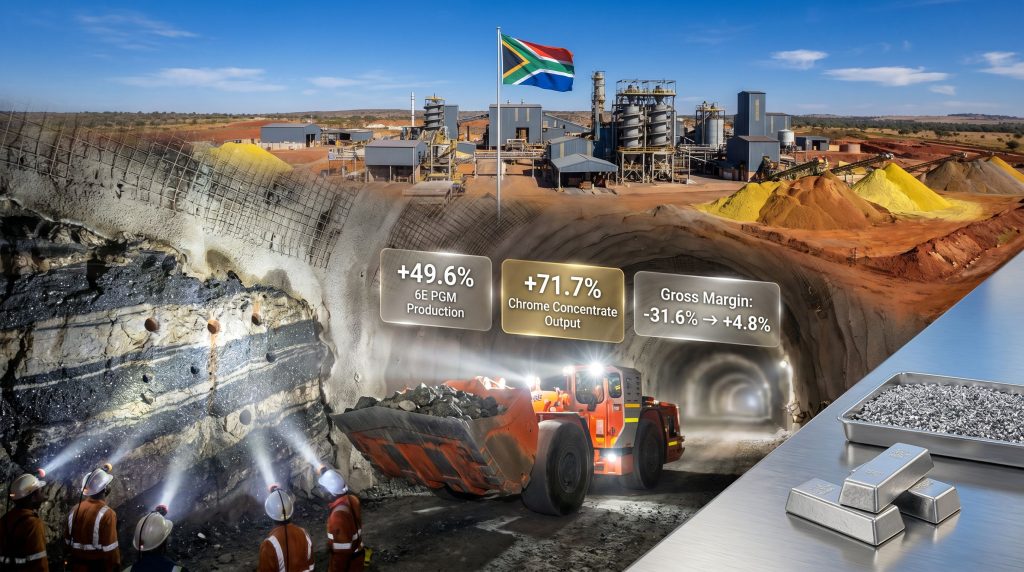
The Eastplats positive operating income at Crocodile River Mine, reported in Q1 2026 results from Eastern Platinum Limited, presents exactly this interpretive challenge. The headline figures are encouraging: 6E PGM output climbed 49.6% year-on-year, chrome concentrate volumes surged 71.7%, and mine operating income turned positive after a period of significant underperformance. Yet revenue actually declined by 6.8% to $13.8 million, and the company's own management acknowledged that monthly run-of-mine processing tonnages fell short of internal targets during the quarter.
Understanding what is actually happening at the Crocodile River Mine, and what it signals for the broader PGM sector, requires moving beyond the headline numbers.
When big ASX news breaks, our subscribers know first
The Geological Foundation: Why the UG2 Reef Changes Everything
The Bushveld Complex in South Africa's Limpopo and North West provinces is widely regarded as the most significant PGM-bearing geological formation on Earth, containing the overwhelming majority of the world's economically recoverable platinum, palladium, rhodium, and related metals. Within this formation, two primary ore horizons have historically driven production: the Merensky Reef and the Upper Group 2, or UG2, chromitite layer.
The UG2 reef carries a characteristic that makes it particularly valuable for operators like Eastplats: it is simultaneously rich in PGMs and in chrome. This dual-mineralogy creates a production dynamic that few other ore types can match. Every tonne milled through a correctly configured processing circuit can yield both a PGM concentrate stream and a chrome concentrate stream, effectively generating two separate revenue lines from a single mining operation.
For the Crocodile River Mine, the UG2 reef within the Zandfontein underground section represents a fundamentally different quality of feed material compared to the tailings retreatment approach the mine previously relied upon. Tailings operations process previously discarded material that has already been through a mill circuit, meaning residual grades are lower, variability is higher, and the metallurgical response is inherently less predictable. Underground RoM UG2 ore, by contrast, arrives at the processing plant as freshly broken primary rock, carrying its original grade profile.
This distinction has profound implications for cost structure. Lower-grade, variable tailings feed requires more processing energy per ounce recovered, delivers inconsistent plant throughput, and generates narrower margins at any given commodity price level. The completion of the Retreatment Project in early 2025 and the concurrent ramp-up of underground UG2 ore delivery therefore represent a genuine step-change in the mine's economic fundamentals — not simply an operational adjustment. Furthermore, understanding the broader PGM supply constraints affecting global markets helps contextualise why this operational shift carries such strategic weight.
Dissecting the Q1 2026 Numbers: The Apparent Contradiction Resolved
The most striking feature of Eastplats' first-quarter 2026 results is a combination that initially appears contradictory: revenue fell while margins improved dramatically. Understanding this requires looking at what changed on the cost side of the ledger rather than fixating on the revenue line.
| Financial Metric | Q1 2026 | Q1 2025 | Change |
|---|---|---|---|
| Total Revenue | $13.8 million | ~$14.8 million | -6.8% |
| Gross Margin | 4.8% | -31.6% | +36.4 percentage points |
| Mine Operating Income | Positive | Negative | +$5.4 million improvement |
| Net Loss (attributable) | $4.1 million | $6.9 million | Narrowed by $2.8 million |
| 6E PGM Production | 4,751 oz | 3,175 oz | +49.6% |
| Chrome Concentrate | 16,757 t | 9,761 t | +71.7% |
Source: Mining Weekly, May 15, 2026, citing Eastplats Q1 2026 results.
When a mining operation shifts from processing depleted tailings material to mining fresh primary ore from underground, production costs per unit tend to fall significantly once the underground infrastructure is established and ore delivery is consistent. The tailings retreatment model carries an inherent structural cost disadvantage: low grades require high processing volumes to generate the same ounce output, and the absence of chrome co-product revenue means the entire processing cost burden falls on PGM recovery alone.
With UG2 underground ore now feeding the Crocodile River processing circuit, chrome concentrate production in Q1 2026 reached 16,757 tonnes, compared to 9,761 tonnes in the same period of 2025. This 71.7% increase in chrome output represents a substantial co-product revenue contribution that directly reduces the effective per-ounce cost of PGM production. When chrome revenue offsets a portion of fixed processing costs, the economics of PGM recovery improve even if PGM volumes alone remain modest.
The gross margin swing from -31.6% to +4.8% across a single year — a movement of 36.4 percentage points — is consequently less a story about commodity prices and more a story about the elimination of a structurally loss-making processing model.
The shift from tailings retreatment to underground RoM ore is not merely an operational adjustment. It represents a fundamental repositioning of the Crocodile River Mine's long-term cost structure and revenue quality, and the Q1 2026 margin data reflects exactly that repositioning.
The Revenue Concentration Question: Impala Platinum's Dominant Role
One of the more nuanced risk factors embedded in Eastplats' current operating model is its revenue concentration. In Q1 2026, approximately 81% of total revenue was derived from PGM concentrate sales to Impala Platinum under existing offtake arrangements, according to Mining Weekly's May 2026 reporting.
This structure is common among junior and mid-tier PGM producers during production ramp-up phases. Offtake agreements provide revenue certainty by guaranteeing a buyer for concentrate output, eliminating the need for the producing company to independently market and sell its PGM material into spot or refined markets. For a company still scaling underground operations, this certainty has genuine operational value.
However, the concentration risk is equally real. With four-fifths of revenue tied to a single purchaser, the terms of the offtake relationship — including pricing formulas, volume commitments, and contract renewal conditions — become central to the mine's financial trajectory. As Crocodile River production scales, diversifying revenue exposure would logically reduce this single-counterparty dependency.
The chrome concentrate stream, which is sold separately from the PGM offtake, provides a degree of natural diversification. Chrome concentrate typically accesses different buyers and different pricing benchmarks compared to PGM concentrate, meaning that Eastplats' chrome revenue provides a partial natural hedge against Impala Platinum concentration risk.
PGM Price Recovery: How Significant Is the Macro Tailwind?
Any honest assessment of the Eastplats positive operating income at Crocodile River Mine must account for the extraordinary price environment that characterised the platinum group metals market in early 2026. The Minerals Council South Africa's March 2026 data, cited in Mining Weekly, revealed year-on-year price movements of exceptional magnitude:
| Metal | March 2026 Price | Year-on-Year Change |
|---|---|---|
| Platinum | $2,054/oz | +109.6% |
| Rhodium | $11,285/oz | +105.7% |
| Palladium | $1,556/oz | +62.4% |
Source: Minerals Council South Africa, cited in Mining Weekly, May 15, 2026.
These are not incremental price movements. The platinum and palladium dynamics driving these extraordinary year-on-year gains reflect a combination of supply tightness and recovering industrial demand that has transformed the economics of PGM production across the Bushveld Complex. The critical question for investors evaluating Eastplats' recovery narrative is how much of the margin improvement reflects durable operational change versus temporary commodity price support.
The margin recovery data provides a partial answer. Even with dramatically higher PGM prices amplifying revenue per ounce, total revenue still fell by 6.8% in Q1 2026. This suggests that production volumes during the quarter were insufficient to fully capture the price tailwind, reinforcing the view that operational improvements — particularly the underground ore transition — were the primary driver of the mine operating income turnaround rather than commodity prices alone.
Independently, Johnson Matthey's May 2026 analysis, reported by Mining Weekly, noted that platinum is projected to remain in deficit through 2026, while palladium and rhodium may record surpluses. This supply-demand divergence within the 6E basket has important implications for how Eastplats' per-ounce revenue will evolve as its production mix develops.
South Africa's Broader PGM Sector Recovery: Sector-Wide Context
Eastplats' operational improvement is occurring against a backdrop of broad-based recovery across South Africa's PGM mining sector. According to Minerals Council South Africa data published on May 15, 2026, national PGM production in March 2026 was 10.5% higher than in March 2025, reflecting improved operational stability and recovering end-market demand across the industry.
PGMs represented the single largest contributor to South Africa's total mineral sales of R242 billion in the first quarter of 2026, a figure that underscores the group metals' outsized importance to the country's mineral export economy. The Minerals Council characterised the sharp increase in mineral sales earnings as demonstrating the sector's capacity to support broader economic growth, provided that supportive policy and regulatory frameworks remain in place.
However, it is important to note that this policy commentary from the Minerals Council reflects the organisation's advocacy position and refers to sector-wide conditions rather than any project-specific support or approval status for individual operations. The South Africa mining trends of recent years provide essential context for understanding just how significant this sector-wide recovery actually is.
South African PGM producers of all sizes have benefited from the simultaneous improvement in prices, operational stability, and demand recovery. For smaller operators like Eastplats, the sector-wide tailwind is supportive but does not substitute for the operational work required to consistently achieve production targets.
The next major ASX story will hit our subscribers first
The Processing Tonnage Gap: Where the Recovery Story Gets Complicated
Despite the encouraging headline metrics, Eastplats' management acknowledged a persistent operational challenge in its Q1 2026 disclosures. CEO Wanjin Yang acknowledged in May 2026 that monthly RoM processing tonnages at Crocodile River Mine were below internal targets during Q1 2026, with the company stating its intent to focus on operational efficiencies to improve both PGM and chrome production going forward.
This admission matters for several reasons. In underground UG2 mining, ore delivery to the surface processing plant depends on a cascade of interconnected operational activities:
- Stope development must advance at a sufficient rate to maintain active ore faces
- Ore loading and underground transport must move broken material efficiently to ore passes
- Surface stockpile management must buffer variability in underground delivery rates
- Processing plant feed rates must remain consistent to achieve nameplate capacity utilisation
When any link in this chain underperforms, the result is processing plant underutilisation, which means fixed costs are spread across fewer tonnes processed, driving up unit operating costs. The fact that Q1 2026 delivered positive mine operating income despite below-target tonnages suggests the per-tonne economics of underground RoM UG2 ore are materially better than those of the tailings retreatment model they replaced. Nevertheless, it also indicates that full financial potential has not yet been captured.
Achieving consistent monthly tonnage targets would be the single most impactful operational lever available to Eastplats for improving Q2 2026 and full-year financial outcomes. The chrome co-product economics would amplify this improvement: higher throughput volumes generate proportionally more chrome concentrate, which in turn reduces effective PGM production costs per ounce.
How Underground UG2 Mining Works: From Stope to Sale
For investors less familiar with PGM mining mechanics, understanding the production process clarifies why tonnage consistency is so critical and where operational risk concentrates.
-
Underground development: Mining crews advance tunnels and stopes through the UG2 chromitite layer at Zandfontein, drilling and blasting to break ore from the reef face in a narrow-reef environment typical of Bushveld Complex operations.
-
Ore transport to surface: Broken ore is loaded underground and transported via ore passes, conveyors, or haul trucks to surface stockpiles, where it forms the ROM pad ahead of crushing.
-
Primary crushing and milling: Surface ore handling facilities crush and mill the UG2 ore to the particle size required for downstream separation, with consistent feed grade being critical for stable metallurgical performance.
-
Chrome and PGM separation: The UG2 ore's chrome-rich mineralogy allows dense media separation and spiral concentrator circuits to recover chrome concentrate as a separate product stream, while flotation circuits recover PGM-bearing sulphide minerals into a separate PGM concentrate.
-
Offtake and delivery: PGM concentrate is dispatched to Impala Platinum under the offtake agreement, with smelting and refining responsibilities passing to Impala post-delivery. Chrome concentrate is marketed and sold separately. Revenue recognition for each stream occurs at distinct points in the delivery cycle, which can create quarterly timing variability.
Dual-Exchange Listing: Capital Access and Currency Dynamics
Eastplats' corporate structure adds a layer of financial complexity worth understanding in the context of its recovery trajectory. The company is incorporated in Canada with a primary listing on the Toronto Stock Exchange and a secondary listing on the Johannesburg Stock Exchange. All financial reporting is conducted in US dollars, while the vast majority of operating costs are incurred in South African rand.
This creates a natural structural characteristic that operates in Eastplats' favour during periods of rand weakness against the US dollar. When the rand depreciates relative to the greenback, rand-denominated operating costs translate into fewer US dollars in the financial statements, while PGM revenues — priced in US dollars at international benchmarks — remain largely unaffected on the revenue side. The result is an implicit cost hedge that benefits the company's reported margins during periods of currency weakness.
The TSX primary listing provides access to North American institutional capital, including resource-focused funds with mandates to invest in mining companies listed on Canadian exchanges. The JSE secondary listing, furthermore, maintains visibility with South African institutional investors and demonstrates ongoing engagement with the domestic regulatory and stakeholder environment where the mine operates. This mirrors a broader pattern of supply-driven metals recovery observed across multiple commodity segments in recent years.
Key Indicators to Watch: What Q2 2026 Will Reveal
The most informative data points for assessing whether the Eastplats positive operating income at Crocodile River Mine represents a sustainable trend will emerge from Q2 2026 operational and financial disclosures. Investors should focus on the following variables:
- Monthly RoM processing tonnage trends: whether management's focus on operational efficiency has translated into measurable improvements against internal targets
- Chrome concentrate production volumes: continued growth in this stream would confirm improved underground ore delivery rates
- Gross margin trajectory: whether the 4.8% Q1 2026 gross margin expands further as tonnage consistency improves
- Net loss reduction: the pace at which attributable net losses narrow toward breakeven as production scales
- 6E PGM ounce output: whether the 49.6% year-on-year growth rate in Q1 2026 is maintained or accelerated in subsequent quarters
In addition, tracking how commodity prices and miner performance interact across the broader sector will help investors contextualise Eastplats' individual results within the wider PGM industry recovery.
This article is intended for informational purposes only and does not constitute financial advice. Forecasts, projections, and analysis relating to production targets, commodity prices, and financial performance involve inherent uncertainty. Past performance does not guarantee future results. Investors should conduct independent due diligence before making investment decisions relating to any mining company.
Frequently Asked Questions: Eastplats and the Crocodile River Mine
What drove Eastplats to achieve positive operating income at Crocodile River Mine in Q1 2026?
The return to positive mine operating income was primarily the result of transitioning from tailings retreatment feed to run-of-mine UG2 ore from the Zandfontein underground section, which improved cost efficiency, combined with a significant increase in both 6E PGM and chrome concentrate production volumes. The gross margin swing from -31.6% to +4.8% reflects this structural cost improvement rather than commodity prices alone.
What is the UG2 chromitite reef and why does it matter for Eastplats?
The Upper Group 2 chromitite layer is one of the primary PGM-bearing horizons within the Bushveld Complex, characterised by elevated chrome content alongside economically significant concentrations of platinum, palladium, rhodium, and other PGMs. For Crocodile River Mine, the UG2 reef at Zandfontein generates dual revenue streams from a single mining operation: PGM concentrate sold to Impala Platinum and chrome concentrate sold separately, improving the economics of every tonne mined.
Why did Eastplats' total revenue fall despite stronger production volumes?
Revenue declined by 6.8% to $13.8 million in Q1 2026 despite significant production volume growth. This apparent contradiction reflects the transition period from the legacy retreatment operation to the underground UG2 model, combined with below-target monthly processing tonnages acknowledged by management. The positive margin outcome despite lower revenue demonstrates that the new operating model is delivering superior unit economics even before full production ramp-up is achieved.
How significant is Impala Platinum's role in Eastplats' revenue base?
Impala Platinum accounted for approximately 81% of Eastplats' Q1 2026 revenue through a PGM concentrate offtake agreement. This concentration provides revenue predictability during the production ramp-up phase but also creates dependency risk if offtake terms change or if production growth outpaces the existing agreement's commercial scope.
What were South African PGM market conditions like during Q1 2026?
The first quarter of 2026 was characterised by extraordinary PGM price recovery. Minerals Council South Africa data for March 2026 showed platinum at $2,054/oz (up 109.6% year-on-year), rhodium at $11,285/oz (up 105.7%), and palladium at $1,556/oz (up 62.4%). National PGM production also grew 10.5% in March 2026 versus March 2025, with PGMs representing the largest contributor to South Africa's R242 billion in total mineral sales during the quarter.
Want to Identify the Next Major Mineral Discovery Before the Broader Market Does?
Discovery Alert's proprietary Discovery IQ model delivers real-time alerts on significant ASX mineral discoveries, transforming complex geological and production data into clear, actionable investment insights for both short-term traders and long-term investors. Explore historic examples of exceptional discovery returns and begin a 14-day free trial to secure a genuine market-leading advantage.