May 15, 2026
The Geopolitical Architecture Behind India's Gulf Energy Strategy
Few bilateral energy relationships in Asia carry as much strategic weight as the one developing between India and the United Arab Emirates. While transactional oil trade has historically defined how the world thinks about Gulf-India energy flows, something more structurally significant has been taking shape over the past several years. The PM Modi UAE visit India UAE energy partnership has quietly evolved into one of the most diversified, multi-domain bilateral frameworks in the entire Indo-Pacific region, spanning hydrocarbon security, clean energy deployment, maritime infrastructure, and now artificial intelligence.
Understanding why this matters requires stepping back from the headline agreements and examining the underlying energy security architecture that makes this partnership not just useful, but strategically indispensable for both nations.
When big ASX news breaks, our subscribers know first
Why West Asia Instability Is Reshaping India's Supply Chain Calculus
Global energy markets have always been sensitive to geopolitical turbulence in the Gulf region, but the nature of that sensitivity has grown more acute in recent years. The Strait of Hormuz, through which an estimated 20% of globally traded oil transits annually according to the U.S. Energy Information Administration, remains one of the most consequential maritime chokepoints on earth. Any sustained disruption to this corridor does not merely affect oil prices; it triggers cascading effects across refining capacity, LPG availability, and industrial fuel supply chains for energy-importing economies.
India's exposure to this risk is particularly acute. As the world's third-largest oil importer, India sources approximately 60% of its total crude oil requirements from Gulf states. The arithmetic of this dependency is straightforward: when regional instability elevates supply chain risk, India feels it faster and more severely than most comparable economies. It is against this backdrop that the PM Modi UAE visit India UAE energy partnership, cemented in May 2026, must be understood — not as a diplomatic courtesy call, but as a structural response to a structural vulnerability.
The UAE occupies a position within this calculus that no other Gulf state can replicate. Its combination of production capacity, geographic proximity to India's western coastline ports, established trade infrastructure, and growing role in clean energy investment creates a partner profile that is genuinely difficult to substitute. Furthermore, the broader geopolitical mining landscape across the Indo-Pacific continues to reinforce why diversified, bilateral energy arrangements carry increasing strategic value.
India's Energy Import Profile at a Glance
| Metric | Data Point |
|---|---|
| India's global oil import ranking | 3rd largest globally |
| Share of crude imports from Gulf region | Approximately 60% of total |
| India's strategic petroleum reserve coverage | Approximately 9 to 10 days of consumption |
| IEA recommended strategic reserve benchmark | 90 days of consumption |
| UAE investment commitment (May 2026 visit) | USD 5 billion |
The gap between India's current 9 to 10 days of strategic reserve coverage and the IEA's recommended 90-day benchmark is not a minor administrative shortfall. It represents a structural vulnerability that has real consequences during supply disruptions, price shocks, or maritime security incidents. Closing that gap has become a national energy security priority, and the ISPRL-ADNOC collaboration formalised during the PM Modi UAE visit is the most direct mechanism India has yet deployed to accelerate that process.
What the PM Modi UAE Visit Actually Produced
The outcomes of PM Modi's Abu Dhabi visit span five distinct domains, each carrying its own strategic logic. Taken together, they represent a qualitative shift in the India UAE energy partnership rather than incremental additions to an existing framework. For broader context on how India structures its hydrocarbon imports, India's LNG import tax structure provides useful background on the policy frameworks shaping these decisions.
Strategic Petroleum Reserves: The ISPRL-ADNOC Collaboration
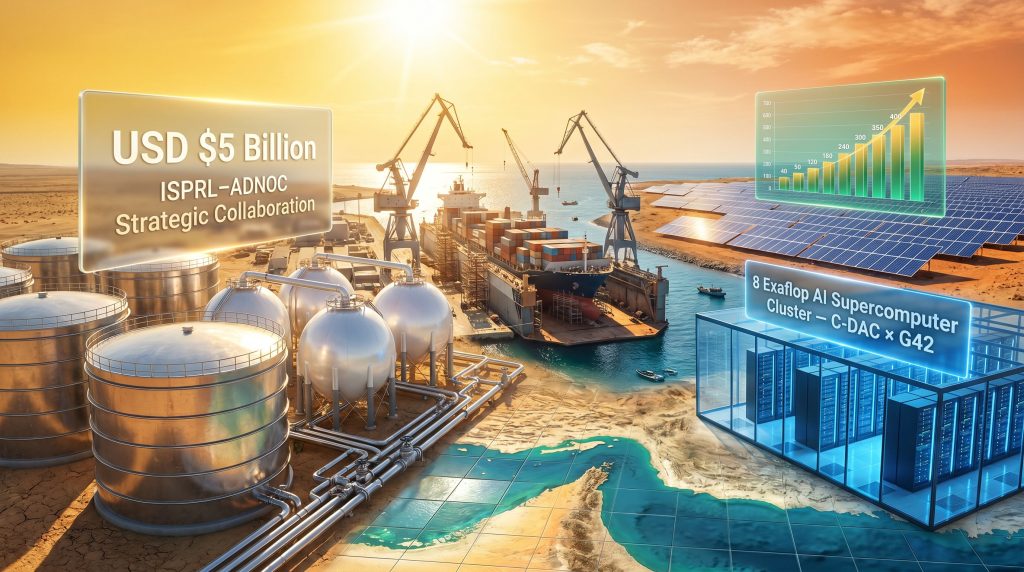
The agreement between Indian Strategic Petroleum Reserves Limited and Abu Dhabi National Oil Company is arguably the most strategically significant outcome of the visit. ISPRL currently operates underground storage facilities at Visakhapatnam, Mangaluru, and Padur, with an aggregate capacity of approximately 5.3 million metric tons. The ADNOC collaboration creates a pathway for expanding this capacity while simultaneously enabling joint development of LNG and LPG storage facilities on Indian soil.
What makes this arrangement structurally novel is the model it establishes. A foreign national oil company holding participation interests in Indian strategic energy infrastructure creates a shared stake in the stability and security of India's energy supply system. ADNOC's long-term commercial interests become directly aligned with India's energy security outcomes, which is precisely the kind of structural interdependence that transforms bilateral relationships from transactional to strategic.
"India's strategic reserve coverage currently stands at roughly one-tenth of the IEA's recommended 90-day benchmark. The ISPRL-ADNOC agreement represents the most substantive step yet taken toward closing that gap through international partnership rather than unilateral capital deployment."
LPG Supply Stability: More Than a Commodity Agreement
The dedicated LPG supply collaboration agreement addresses a dimension of India's energy security that receives less international attention than crude oil but carries enormous domestic significance. India's LPG demand has grown at approximately 4 to 5% compounded annually over the past five years, driven substantially by government-sponsored clean cooking fuel programmes that have extended access to hundreds of millions of households previously reliant on biomass.
This demand growth creates supply chain pressure that long-term bilateral supply agreements are specifically designed to absorb. Understanding LPG pricing benchmarks helps contextualise why predictable supply arrangements matter so significantly for India's domestic fuel policy. By formalising predictable LPG supply arrangements with one of its most geographically proximate Gulf suppliers, India gains insulation against spot market price volatility during periods of elevated regional risk.
Maritime Infrastructure and the Vadinar Ship Repair Cluster
The agreement to establish a ship repair cluster at Vadinar port in Gujarat carries both economic and strategic dimensions. On the economic side, it advances the Make in India initiative by developing domestic maritime industrial capabilities that currently depend heavily on foreign facilities. On the strategic side, Vadinar's location on India's northwest coast, in proximity to Indian Navy operational zones, gives the cluster indirect value for naval logistics and maintenance capacity.
A parallel skill development agreement targets the workforce pipeline required to make the cluster operational at scale, recognising that physical infrastructure without trained personnel is strategically inert.
The 8 Exaflop Supercomputer: Technology Diplomacy at the Frontier
Perhaps the most forward-looking agreement to emerge from the PM Modi UAE visit India UAE energy partnership is the technology collaboration between India's Centre for Development of Advanced Computing and UAE-based company G42, to jointly establish an 8 Exaflop supercomputer cluster. To contextualise this figure: one exaflop represents one quintillion floating-point operations per second. An 8 Exaflop system would represent an increase of roughly 1,000 times over India's existing PARAM Siddhi-AI infrastructure, which operates at approximately 6.8 Petaflops.
The applications of this computational capacity span multiple strategic domains:
- Energy grid optimisation and smart power distribution modelling
- Large-scale climate and weather prediction systems
- AI model training for India's national AI Mission objectives
- Defence applications including cryptographic systems and strategic simulation
- Drug discovery and large-scale genomic research
This agreement signals that the partnership has expanded well beyond hydrocarbons into what might be called technology sovereignty collaboration, where both nations build shared infrastructure that reduces dependence on third-party computational supply chains.
How the India-UAE Partnership Compares Across the Gulf
Situating the India UAE energy partnership within the broader context of India's Gulf relationships reveals why the UAE occupies a qualitatively different position from other bilateral energy partners.
| Partner Nation | Primary Energy Supply | Strategic Reserves Pact | Clean Energy Collaboration | Technology Dimension |
|---|---|---|---|---|
| UAE | Crude oil, LPG, LNG | Yes, ISPRL-ADNOC | Masdar solar and green hydrogen | 8 Exaflop supercomputer cluster |
| Saudi Arabia | Crude oil (largest single supplier) | Limited framework | Emerging discussions | Minimal |
| Qatar | LNG (dominant supplier) | No formal pact | Limited | Limited |
| Kuwait | Crude oil | No formal pact | Minimal | Minimal |
The UAE's differentiation is not merely quantitative. It spans the full energy value chain from upstream hydrocarbon supply to downstream clean energy deployment, while simultaneously extending into defence, maritime logistics, and advanced technology. No other Gulf partner currently occupies all of these dimensions simultaneously in the India relationship.
The Clean Energy Dimension: Masdar and What It Signals
UAE-backed clean energy developer Masdar has committed to large-scale renewable energy deployment in Rajasthan, one of India's highest solar irradiance states and a natural anchor for utility-scale solar development. This positions the UAE not as a transitional fossil fuel partner being slowly replaced by renewable alternatives, but as an active participant in India's 500 GW renewable energy target by 2030. In addition, the broader clean energy transition underway across the region is creating new investment corridors that complement exactly this kind of bilateral arrangement.
Potential future collaboration areas within the clean energy dimension include:
- Green hydrogen production leveraging India's renewable generation capacity alongside UAE distribution and export networks
- Offshore wind development in Indian coastal zones where wind resources are commercially viable
- Battery storage integration to manage intermittency in India's expanding solar and wind portfolio
- Grid interconnection frameworks as a long-term infrastructure ambition
What makes this clean energy engagement strategically sophisticated is that it does not conflict with the hydrocarbon partnership. India's energy transition will unfold over multiple decades. Fossil fuel demand will remain elevated through the 2030s even under ambitious transition scenarios. The UAE's dual positioning as both a hydrocarbon producer and a substantial clean energy investor creates a partnership architecture that remains relevant and commercially aligned across multiple energy transition timelines simultaneously. Consequently, critical minerals demand tied to battery storage and grid infrastructure will increasingly shape the investment priorities embedded within this relationship.
What the USD 5 Billion Investment Commitment Represents
The UAE's commitment of USD 5 billion in investment during the PM Modi UAE visit is not an isolated financial pledge. It is a confidence signal embedded in a longer commercial relationship. The UAE is already among India's top sources of foreign direct investment, with cumulative flows exceeding USD 20 billion over the preceding decade. The India-UAE Comprehensive Economic Partnership Agreement, established in 2022, significantly elevated bilateral trade volumes and created the institutional framework within which this latest investment commitment sits.
The 5 billion dollar figure is expected to generate employment across infrastructure, energy, technology, and manufacturing sectors. More importantly for long-term strategic purposes, it signals that the UAE views India's economic trajectory with sufficient confidence to deploy capital at scale across a multi-year horizon.
"The 2022 Comprehensive Economic Partnership Agreement between India and the UAE created an institutional foundation that transformed bilateral trade from commodity-led exchanges into a broader economic architecture. The May 2026 investment commitment represents the capital-deployment phase of that structural evolution."
The next major ASX story will hit our subscribers first
Scenario Analysis: Forces That Could Accelerate or Complicate This Partnership
No bilateral energy partnership operates in a static environment. Several scenarios could meaningfully alter the trajectory of the partnership in either direction.
Scenario 1: Strait of Hormuz Disruption
If maritime conflict restricts Hormuz transit capacity, the ISPRL-ADNOC strategic reserves pact transitions from a medium-term infrastructure project to an immediately operational buffer mechanism. India's ability to draw on jointly managed reserve capacity could absorb short-term supply shortfalls without triggering severe domestic fuel price shocks. This scenario also accelerates demand for the Vadinar ship repair cluster as India expands its naval logistics footprint in western coastal waters.
Scenario 2: India's Renewable Buildout Exceeds Current Targets
If India's solar and wind deployment significantly outpaces its 500 GW by 2030 target, petroleum demand could plateau earlier than current projections suggest. Under this scenario, the partnership's strategic centre of gravity shifts progressively toward Masdar's clean energy investments, green hydrogen infrastructure, and technology collaboration. The 8 Exaflop supercomputer cluster becomes increasingly central as a symbol and instrument of the relationship.
Scenario 3: Broader Gulf Geopolitical Realignment
The UAE maintains diplomatic relationships with a diverse set of global partners, including both Western nations and regional powers. Shifts in UAE foreign policy priorities could introduce uncertainty into long-term supply commitments. India's strategic petroleum reserve expansion, particularly through the ISPRL-ADNOC model, functions as a direct structural hedge against this scenario by building domestic buffer capacity that reduces real-time dependency on uninterrupted supply flows.
The Broader Strategic Significance for Asian Energy Architecture
The India UAE energy partnership, as it has developed through and beyond the May 2026 visit, offers a model for what sophisticated South-South energy diplomacy looks like in a multipolar world. It balances fossil fuel security with clean energy investment. It combines commodity supply agreements with infrastructure development and technology co-investment. Furthermore, it builds structural interdependence that gives both nations genuine long-term incentives to maintain and deepen the relationship.
For global energy markets, the evolution of this bilateral corridor carries implications beyond its immediate participants. As India continues its trajectory toward becoming one of the world's largest economies, the partnerships it chooses to anchor its energy security architecture will shape regional energy flows, investment patterns, and geopolitical alignments for decades ahead. The UAE, through its combination of hydrocarbon capacity, clean energy ambition, and technology investment reach, has positioned itself as India's most comprehensively aligned Gulf energy partner. For a closer look at how this partnership has been discussed in broader media coverage, this overview of PM Modi's UAE engagements offers useful context on the diplomatic significance of the visit.
Disclaimer: This article contains forward-looking analysis, scenario projections, and investment-related observations drawn from publicly reported information and sector research. It does not constitute financial advice. Readers should conduct their own due diligence before making decisions based on geopolitical or energy market assessments.
Want to Capitalise on the Resource Opportunities Emerging From Global Energy Shifts?
As geopolitical realignments reshape energy supply chains and critical minerals demand accelerates, Discovery Alert's proprietary Discovery IQ model delivers real-time alerts on significant ASX mineral discoveries — transforming complex market signals into actionable investment insights. Explore why historic mineral discoveries have generated substantial returns for investors, and begin your 14-day free trial today to position yourself ahead of the market.