May 15, 2026
The Eastern Mediterranean's Forgotten Frontier: Syria's Offshore Energy Awakening
Syria offshore oil and gas exploration has historically followed a predictable pattern: geopolitical disruption suppresses activity, regional discoveries in adjacent waters validate geological prospectivity, and international capital eventually returns when conditions stabilise. The Eastern Mediterranean has followed this script almost perfectly over the past two decades. While Israeli, Cypriot, and Lebanese waters drew billions in exploration investment following transformative deepwater gas discoveries, Syria's offshore acreage sat largely untouched, locked out of the global energy investment cycle by conflict, sanctions, and institutional collapse. That dynamic is now shifting in ways that carry significant implications for regional energy geopolitics, upstream investment strategy, and Syria's own post-conflict reconstruction trajectory.
When big ASX news breaks, our subscribers know first
Why the Levant Basin Makes Syria's Offshore Waters Geologically Credible
The Levantine Basin is not a speculative geological concept. It is a proven hydrocarbon system that has already delivered commercially significant gas accumulations across multiple national jurisdictions in the Eastern Mediterranean. The basin's stratigraphic architecture, characterised by thick Mesozoic carbonate reservoirs overlain by Miocene-age Messinian salt sequences that function as sealing formations, has proven effective at trapping hydrocarbons at scale in adjacent offshore areas.
Geological systems do not recognise national boundaries. The same source rocks, migration pathways, and trapping geometries that enabled commercial discoveries in Israeli and Cypriot waters extend, in principle, across the broader basin. This is the technical foundation underpinning international interest in Syria offshore oil and gas exploration, and it is why the entry of major energy companies into Syrian waters is viewed by industry observers as geologically rational rather than purely speculative.
That said, geological continuity does not guarantee commercial viability. Basin-wide prospectivity must be validated at the individual block level through seismic interpretation, well drilling, and reservoir characterisation. Syria's offshore acreage remains, as of mid-2026, entirely undrilled in the deepwater sense, meaning that while regional analogues provide a credible technical basis for exploration, the specific resource potential of Syrian blocks is unconfirmed.
How Conflict Suppressed Syria's Offshore Potential
Prior to the outbreak of civil conflict in 2011, Syria maintained an active upstream petroleum sector with international company participation. According to Risk Intelligence's analysis of Syria's oil and gas sector, TotalEnergies maintained a partnership with the Syrian Petroleum Company spanning from 1988 to 2011, representing more than two decades of engagement before the deteriorating security environment forced a withdrawal. The conflict that followed did not merely pause exploration activity; it dismantled the institutional, regulatory, and physical infrastructure required to attract and support international investment.
For over a decade, Syria's offshore acreage effectively dropped off the global exploration map. International sanctions regimes imposed by the United States and the European Union created substantial legal barriers for Western companies considering investment in Syrian energy assets. Those sanctions have historically constrained not only direct investment but also the provision of technical services, financial transactions, and equipment supply to Syrian counterparties, making even preliminary engagement commercially and legally complex for major international oil companies.
The post-2024 shift in Syria's political landscape has, however, opened the question of whether those barriers can be navigated, reduced, or removed in ways that enable structured upstream investment to proceed.
What Is Syria's Offshore Block 3 and Why Does It Matter?
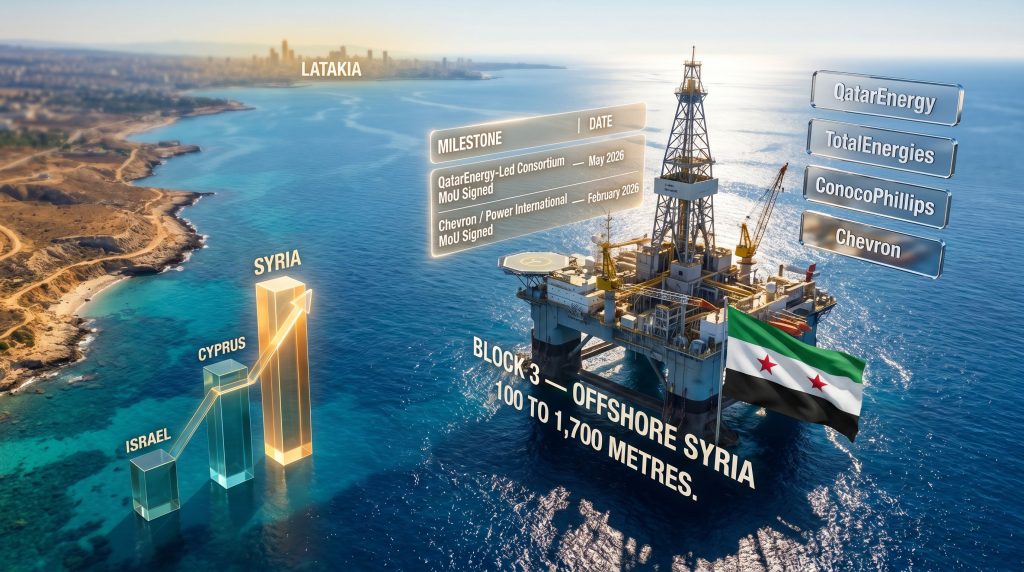
Block 3 represents the most concrete expression of Syria's offshore exploration ambitions to date. Located in the Levantine Basin in the Eastern Mediterranean, the block sits offshore the Syrian city of Latakia and encompasses a water depth range spanning from approximately 100 to 1,700 metres. This range is operationally significant because it straddles the boundary between conventional shelf-depth drilling and technically demanding deepwater operations.
The shallower portions of the block, those in the 100 to 500 metre range, are accessible using conventional jackup and semi-submersible drilling equipment of the type commonly deployed across the Mediterranean. The deeper sections, approaching 1,700 metres, require specialised deepwater drillships and subsea completion technologies that represent substantially higher capital expenditure and operational complexity.
The table below summarises the key parameters associated with Block 3 as confirmed by publicly available reporting from Arab News, dated May 12, 2026:
| Parameter | Detail |
|---|---|
| Block Name | Block 3 (Offshore Syria) |
| Location | Levantine Basin, Eastern Mediterranean |
| Coastal Reference Point | Off Latakia, Syria |
| Water Depth Range | 100 to 1,700 metres |
| Exploration Stage | Technical review / MoU phase (as of May 2026) |
| Lead Operator Consortium | QatarEnergy, TotalEnergies, ConocoPhillips |
| State Partner | Syrian Petroleum Company (SPC) |
| Agreement Type | Technical and commercial assessment framework |
The classification of this project as Syria's first deepwater exploration initiative is itself a meaningful milestone. Deepwater development requires not only technical capability but also regulatory frameworks, environmental assessment protocols, and emergency response infrastructure that the Syrian system must now build or rebuild in parallel with the exploration effort itself.
The Two Consortium Tracks Taking Shape Simultaneously
One of the more strategically interesting dimensions of Syria's offshore re-engagement is that it has attracted not one but two separate international consortium arrangements operating along parallel tracks. This structure suggests that competitive interest in Syrian Mediterranean acreage extends beyond a single group of companies, which is an early positive signal for the country's broader upstream investment appeal.
Consortium One: QatarEnergy, TotalEnergies, and ConocoPhillips
The first and most recently announced consortium formalised its position in May 2026, when QatarEnergy, TotalEnergies, and ConocoPhillips signed a technical and commercial assessment framework with the Syrian Petroleum Company. The agreement was executed at QatarEnergy's headquarters in the presence of Saad Sherida Al-Kaabi, Qatar's Minister of State for Energy Affairs and President and CEO of QatarEnergy.
Al-Kaabi characterised the agreement as consistent with QatarEnergy's broader international upstream expansion strategy, framing the Syrian engagement as part of a global portfolio approach to business development rather than a country-specific strategic bet. Furthermore, TotalEnergies' cooperation agreement on offshore exploration signals meaningful institutional commitment from one of Europe's largest energy majors.
TotalEnergies' participation carries particular historical weight. The French energy major maintained an active partnership with the Syrian Petroleum Company from 1988 to 2011, a period spanning more than two decades. That prior institutional relationship means TotalEnergies brings not just technical capability but also accumulated knowledge of Syrian regulatory norms, operational conditions, and subsurface data from the pre-conflict era. Julien Pouget, TotalEnergies' Senior Vice President for MENA Exploration and Production, noted that the company welcomed the opportunity to reestablish cooperation with SPC, building on that long-standing prior relationship.
Consortium Two: Chevron and Power International Holding
The second consortium track predates the QatarEnergy arrangement by several months. In February 2026, the Syrian Petroleum Company signed a Memorandum of Understanding with Chevron International and Power International Holding at the People's Palace in Damascus. The agreement was signed by SPC CEO Yusuf Qablawi, Frank Mount (Head of Corporate Business Development at Chevron), and Erik Keskula (CEO of Power International Holding).
As of May 2026, SPC had received formal notification from Chevron indicating readiness to proceed with development of a selected offshore block, suggesting the Chevron-led arrangement is somewhat further along its implementation pathway than the QatarEnergy consortium, which remains in the technical assessment phase.
The table below compares the two tracks side by side:
| Feature | QatarEnergy-Led Consortium | Chevron-Led Consortium |
|---|---|---|
| Agreement Date | May 2026 | February 2026 |
| Partners | QatarEnergy, TotalEnergies, ConocoPhillips | Chevron International, Power International Holding |
| Agreement Type | Technical review and commercial framework | MoU for exploration and drilling |
| Current Status | Assessment phase | Moving toward implementation |
| Signing Location | QatarEnergy HQ | People's Palace, Damascus |
| State Counterpart | Syrian Petroleum Company | Syrian Petroleum Company |
What the Syrian Petroleum Company's Mandate Actually Requires
The Syrian Petroleum Company functions as the sovereign institutional anchor for all upstream petroleum activity in Syria. Under the MoU framework signed with the QatarEnergy consortium, SPC's articulated expectations are specific: the international partners are required to conduct the necessary technical studies, develop a detailed work program, and draft an exploration contract that would formalise the transition from assessment to active exploration.
This phased approach, moving from technical study to work program to exploration contract to drilling, reflects standard international upstream contracting practice. However, the pace at which each phase can be completed depends heavily on factors outside the consortium's direct control, including the stability of Syria's regulatory environment, the resolution of applicable sanctions questions, and SPC's own institutional capacity to engage meaningfully with technically complex work programs.
SPC's stated objective of expanding cooperation with major international companies to access advanced expertise and modern technologies is consistent with a knowledge transfer model, where the primary near-term benefit of international engagement is capability building rather than immediate revenue generation.
The Risk Architecture Around Syria's Offshore Ambitions
Any objective analysis of Syria offshore oil and gas exploration must engage seriously with the risk landscape. The opportunity, while geologically credible, sits within one of the more complex risk environments in global upstream investment. Moreover, the geopolitical landscape for metals and mining in 2025 provides useful context for understanding how political instability shapes resource investment decisions more broadly.
| Risk Category | Key Considerations |
|---|---|
| Geopolitical | Regional instability, ongoing conflict proximity, territorial maritime boundary uncertainties |
| Sanctions Exposure | US and EU sanctions frameworks historically constrained Western company engagement in Syrian energy |
| Technical | Deepwater drilling complexity in the 1,000-1,700 metre range requires specialised infrastructure |
| Commercial | No confirmed reserves; extended lead time from MoU to potential production |
| Regulatory | Post-conflict legal and fiscal framework for upstream investment remains nascent |
| Operational | Workforce capacity gaps, limited supply chain access, damaged port and logistics infrastructure |
The sanctions dimension deserves particular attention. Both the United States and the European Union have historically maintained broad sanctions regimes targeting Syrian government entities and the energy sector. While the post-2024 political transition in Syria has prompted some reassessment of sanctions policy by Western governments, the legal status of energy sector investment remains a complex and evolving question for companies domiciled in sanctions-applying jurisdictions.
Critical Framing: The presence of Chevron, a major American oil company, in the February 2026 MoU suggests that some degree of sanctions navigation or licensing accommodation has occurred or is anticipated, though the precise legal basis for that engagement has not been publicly detailed. Investors and analysts should treat this as an open question requiring legal due diligence rather than a resolved issue.
The next major ASX story will hit our subscribers first
Why International Majors Are Willing to Enter Now
The logic of early-mover positioning in frontier basins is well understood in upstream investment strategy. Companies willing to accept higher political risk at the assessment and exploration stage, before reserves are confirmed and competition intensifies, can negotiate substantially more favourable fiscal and commercial terms than late entrants who arrive after exploration de-risking has already occurred.
For QatarEnergy, the Syria engagement fits within a pattern of aggressive international upstream portfolio expansion that has seen the company enter exploration acreage across Africa, South America, and Asia over the past several years. Syria represents another frontier position in a diversified global exploration portfolio. In addition, the oil price movements shaped by trade war dynamics are influencing how major energy companies evaluate risk-adjusted returns in frontier markets.
For TotalEnergies, the re-entry into Syria carries the additional benefit of historical institutional knowledge. Two decades of operational presence in Syrian upstream, prior to 2011, means the company retains subsurface data, regulatory familiarity, and relationship capital that new entrants lack. That institutional memory is a genuine competitive advantage in the technical assessment phase.
The broader economic context also matters. Arab News reporting from May 2026 notes concurrent UAE interest in investing in Syrian free zones, suggesting that Gulf state capital is flowing into multiple dimensions of Syria's reconstruction economy simultaneously. Offshore energy investment is, consequently, one component of a larger capital inflow picture.
The Pathway from MoU to Commercial Production
Understanding the realistic development timeline for Syria's offshore sector requires clarity about how far the current agreements actually are from commercial production. MoUs and technical assessment frameworks are the earliest possible stage of an upstream development process that, in deepwater frontier environments, typically spans a decade or more from initial seismic acquisition to first production.
The sequential steps required are as follows:
- Technical Studies Phase – Seismic data acquisition or reprocessing, geological modelling, and basin-level analysis to define drill targets
- Work Program Development – Defining specific drilling targets, capital commitment schedules, and operational timelines
- Exploration Contract Drafting – Establishing the legal and fiscal terms governing the relationship between SPC and international partners
- Regulatory Approvals – Securing the necessary governmental endorsements and navigating applicable international legal frameworks, including any sanctions-related licensing
- Exploratory Drilling – First well campaigns designed to test geological hypotheses and identify potential accumulations
- Reserve Confirmation – Independent resource assessment based on drilling results, including pressure testing, sampling, and formation evaluation
- Field Development Planning – Engineering design for production facilities, pipelines, and export infrastructure for confirmed commercial discoveries
- Commercial Production – First hydrocarbons delivered to market
In deepwater frontier basins globally, the elapsed time from step one to step eight typically ranges from eight to fifteen years, depending on the complexity of reservoir development, infrastructure requirements, and regulatory environments. Syria's additional layers of post-conflict reconstruction complexity are likely to extend rather than compress this timeline. Furthermore, understanding crude oil price factors in 2025 helps contextualise why energy companies are willing to accept such extended timelines in exchange for early-mover positioning.
Three Scenarios for Syria's Offshore Future
The trajectory of Syria offshore oil and gas exploration is genuinely uncertain, and responsible analysis requires acknowledging a range of possible outcomes rather than projecting a single pathway.
-
Optimistic Case: Seismic reprocessing and new acquisition confirm Levant Basin geological continuity into Syrian Block 3; exploratory drilling begins between 2027 and 2028; a commercial discovery triggers field development planning; offshore gas production reaches domestic consumers within a decade, materially addressing Syria's chronic electricity deficit.
-
Base Case: Technical studies proceed through 2026 and 2027 but reserve confirmation is delayed by drilling complexity or logistical constraints; commercial production timelines extend beyond 2035; the offshore sector provides a long-term investment signal without near-term revenue impact.
-
Downside Case: Unresolved sanctions complications or renewed geopolitical instability stall investment activity; MoUs lapse without progression to formal exploration contracts; international partners redirect capital to lower-risk frontier opportunities elsewhere.
These scenarios represent analytical projections based on publicly available information and historical upstream development patterns. They do not constitute investment advice, and actual outcomes may differ materially from any scenario described above.
Frequently Asked Questions: Syria's Offshore Oil and Gas Sector
What is Syria's offshore Block 3?
Block 3 is an offshore exploration area located in the Levantine Basin of the Eastern Mediterranean, situated off the Syrian coastal city of Latakia. It encompasses water depths ranging from 100 to 1,700 metres and is the subject of a technical and commercial assessment agreement signed between the Syrian Petroleum Company and a consortium comprising QatarEnergy, TotalEnergies, and ConocoPhillips in May 2026.
Which international companies have signed agreements for Syria's offshore exploration?
Two separate consortium arrangements have been formalised. The QatarEnergy-led consortium, including TotalEnergies and ConocoPhillips, signed a technical assessment framework in May 2026. A separate MoU between Chevron International, Power International Holding, and SPC was signed in February 2026.
What is the Levant Basin and why is it significant?
The Levant Basin is a sedimentary basin underlying the Eastern Mediterranean Sea that has proven hydrocarbon prospectivity, demonstrated by commercially significant gas discoveries in Israeli and Cypriot waters. Its geological continuity across national maritime boundaries provides a technical basis for expecting similar resource potential in Syrian offshore areas, though this remains unconfirmed by drilling.
Are these agreements production contracts or preliminary studies?
Both arrangements are Memoranda of Understanding or assessment frameworks, representing the earliest contractual stage of an upstream development process. No production contracts, exploration licences, or drilling commitments have been publicly confirmed as of May 2026.
When could Syria begin actual offshore drilling?
No drilling timeline has been publicly confirmed. Based on industry benchmarks for deepwater frontier exploration, exploratory drilling would realistically require completion of seismic studies and work program development first, suggesting a minimum timeline of two to three years from the current assessment phase before first wells could be drilled, subject to regulatory and logistical factors.
How does Syria's offshore potential compare to nearby countries like Israel and Cyprus?
Syria's offshore acreage shares the same basin-level geological system that underpins producing fields in adjacent exclusive economic zones. However, Syria's blocks are undrilled in the deepwater context, meaning resource potential remains speculative. The regional analogy provides geological credibility but not commercial certainty. In addition, the effect of trade wars on oil markets continues to shape how regional energy producers position themselves for long-term investment.
What role does the Syrian Petroleum Company play?
SPC functions as the sovereign state counterparty in all upstream petroleum agreements in Syria. Under the current MoU frameworks, SPC's role is to facilitate technical studies, develop work programs, and ultimately negotiate exploration contracts with international partners. It also serves as the primary vehicle for knowledge transfer and institutional capacity building.
How have sanctions affected Syria's energy sector development?
US and EU sanctions frameworks have historically created substantial legal barriers to energy sector investment in Syria, constraining Western company participation and limiting access to technical services, financial systems, and equipment. The economic impact of tariff and trade war developments adds a further layer of complexity when evaluating the sanctions outlook for Syria's upstream sector. The precise current status of applicable sanctions in relation to the announced exploration agreements has not been publicly clarified and represents a material risk factor for the sector's development timeline.
Want to Track the Next Major Mineral Discovery Before the Broader Market Does?
Syria's offshore re-emergence is a compelling reminder that transformative resource discoveries can surface in the most unexpected frontiers — and that timing is everything for investors. Discovery Alert's proprietary Discovery IQ model delivers real-time alerts on significant ASX mineral discoveries, instantly translating complex geological data into actionable investment insights, so subscribers are positioned ahead of the market the moment a major discovery is announced — explore Discovery Alert's dedicated discoveries page to see the historic returns that early discovery investors have achieved, and begin your 14-day free trial today.