May 19, 2026
The investment landscape for ASX 200 mining shares buy hold sell decisions has become increasingly complex as investors navigate volatile commodity markets and evolving global demand patterns. Recent market turbulence has highlighted the critical importance of systematic evaluation frameworks when assessing mining sector opportunities, particularly as traditional sector correlations break down during periods of geopolitical uncertainty.
Furthermore, the amplified volatility witnessed across resources companies during recent conflicts demonstrates that iron ore price trends and broader commodity dynamics require sophisticated analytical approaches rather than simplistic trading decisions.
Investment Framework Development for Mining Portfolio Construction
Modern portfolio theory suggests that successful mining investment requires systematic framework development rather than reactive stock picking. The volatility witnessed across ASX 200 mining shares during recent geopolitical tensions demonstrates the critical importance of structured allocation strategies that can withstand market turbulence while capturing long-term commodity cycle opportunities.
Professional fund managers typically employ multi-tiered risk frameworks when constructing mining exposure, recognising that commodity investments exhibit distinct behavioural patterns compared to traditional equity sectors. The recent performance data illustrates this principle clearly: while the S&P/ASX 200 Index declined 8.9% following the Iran conflict escalation, the S&P/ASX 200 Materials Index experienced a more severe 18.7% decline, highlighting the amplified volatility inherent in resources sector exposure.
Strategic Asset Allocation Methodology
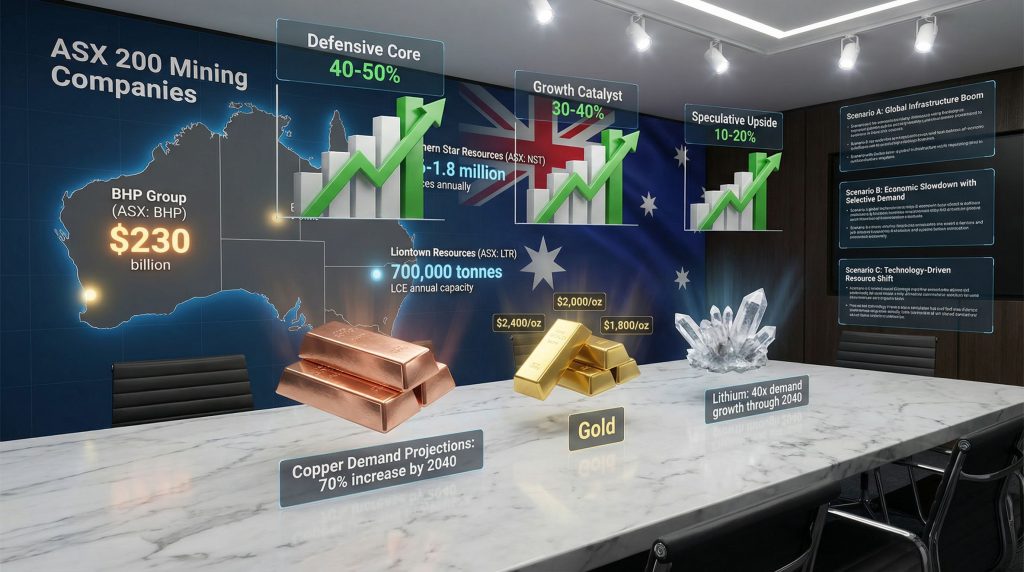
Institutional investors commonly structure mining portfolios using three distinct risk categories, each serving specific portfolio objectives. Additionally, understanding how tariffs impact markets becomes essential for developing comprehensive investment strategy components that can weather various economic scenarios.
Core Holdings (40-50% of mining allocation):
- Large-cap diversified miners with established cash flow generation
- Geographic and commodity diversification reduces single-point-of-failure risk
- Defensive characteristics during market downturns
- Dividend sustainability through commodity cycles
Growth Catalyst Positions (30-40% of mining allocation):
- Mid-cap producers with operational leverage to commodity price movements
- Project development pipeline providing expansion optionality
- Established production base reducing development risk
- Active management opportunities during volatility
Speculative Growth Allocation (10-20% of mining allocation):
- Development-stage companies with high-conviction commodity exposure
- Significant leverage to commodity price appreciation
- Higher volatility requiring smaller position sizes
- Merger and acquisition potential providing exit opportunities
Correlation Analysis and Risk Management
Understanding commodity price correlations forms the foundation of effective mining portfolio construction. Historical analysis reveals that different mining subsectors exhibit varying correlation patterns during different market regimes:
| Commodity Relationship | Economic Expansion | Economic Contraction | Inflation Periods |
|---|---|---|---|
| Gold vs. Base Metals | Negative correlation | Positive correlation | Mixed correlation |
| Iron Ore vs. Copper | High positive | Moderate positive | Variable |
| Lithium vs. Traditional Metals | Low correlation | Negative correlation | Positive correlation |
This correlation structure explains why Northern Star Resources experienced a 42% decline despite gold's traditional safe-haven status, as the 16% gold price fall coincided with broader materials sector weakness, demonstrating that correlation patterns can break down during extreme market stress.
When big ASX news breaks, our subscribers know first
Tier 1: Defensive Foundation Holdings Analysis
BHP Group Strategic Positioning
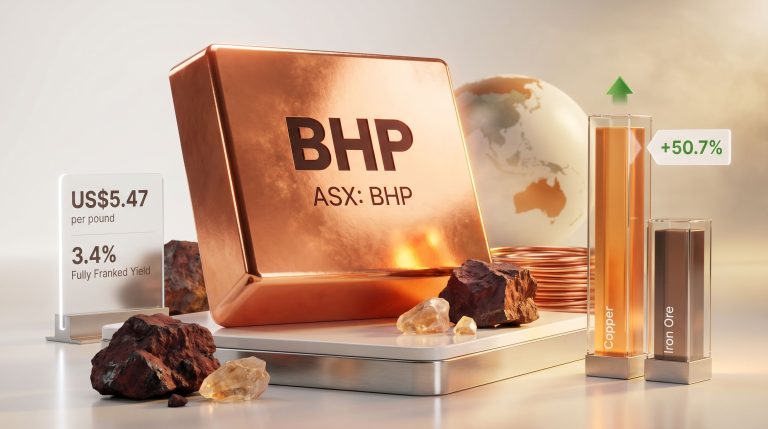
BHP Group represents the archetypal defensive mining holding, offering investors exposure to multiple commodity cycles through its diversified asset portfolio. The company's recent performance data provides insight into how even defensive positions can experience significant volatility during market stress periods.
Recent Performance Metrics:
- Share price: $48.52 AUD (March 24, 2026 close)
- Single-day gain: 3.0% recovery suggesting stabilisation
- Twelve-month performance: 23% gains demonstrate underlying strength
- Peak decline: 17% from February 28 highs during conflict period
- Record high achievement: $59.39 on March 3, 2026
The 18.4% decline from the March peak to current levels illustrates that even diversified majors remain susceptible to broad-based commodity sell-offs. However, the 23% twelve-month gain provides context for the recent weakness, suggesting profit-taking behaviour rather than fundamental deterioration.
Analyst Assessment Framework:
UBS maintains a Hold rating with a $52 price target, implying modest 7% upside from current levels. This conservative outlook reflects several key considerations including iron ore price sensitivity and Chinese demand patterns. Consequently, the copper supply forecast becomes crucial for evaluating BHP's diversification benefits across multiple commodities.
Operational Leverage and Market Position
BHP's commodity diversification strategy provides natural hedging during different economic scenarios. Copper exposure benefits from electrification trends and infrastructure development, while iron ore generates significant cash flows during global construction cycles. This diversification proved valuable during the recent market stress, as the company's 17% decline compared favourably to the broader materials index 18.7% fall.
Investment Rationale Validation:
- Market capitalisation exceeding $230 billion ensures institutional liquidity
- Geographic diversification across Australia, Chile, and North America
- Technology integration improving operational efficiency
- ESG compliance positioning for institutional capital allocation
Tier 2: Growth Catalyst Investment Analysis
Northern Star Resources Operational Assessment
Northern Star Resources exemplifies the growth catalyst category, offering direct leverage to gold price movements through established production operations. Recent performance demonstrates both the opportunities and risks inherent in single-commodity exposure.
Performance Analysis:
- Current price: $17.57 AUD (March 24, 2026)
- Daily recovery: 2.1% suggesting potential stabilisation
- Twelve-month performance: -2% indicating sideways trading before recent decline
- Conflict-period decline: 42% representing severe oversold conditions
The 42% decline significantly exceeded both the gold price fall (16%) and broader materials sector weakness (18.7%), indicating company-specific factors beyond commodity price movements. This performance divergence often occurs when operational guidance revisions coincide with commodity price weakness, creating amplified selling pressure.
Operational Metrics Framework:
- Annual production capacity: 1.6-1.8 million ounces
- All-in sustaining costs: $1,400-1,500 per ounce
- Reserve life: 12+ years providing longevity
- Geographic concentration: Western Australia regulatory stability
Analyst Revision Patterns
Ord Minnett's recent target revision illustrates how analysts adjust valuations during operational transitions. The broker reduced its twelve-month target from $29.70 to $23.70 (a 20% decrease) while maintaining its Buy rating, suggesting conviction in the underlying business despite near-term challenges.
Target Revision Analysis:
- Previous target: $29.70 AUD
- Revised target: $23.70 AUD
- Reduction magnitude: 20.2%
- Implied upside: 34.8% from current price
- Rating maintenance: Buy recommendation retained
This revision pattern typically occurs when analysts maintain long-term conviction while acknowledging near-term operational headwinds. The substantial implied upside (34.8%) suggests the analyst views current pricing as disconnected from fundamental value.
What Gold Price Scenarios Mean for Margins?
Northern Star's cost structure creates distinct profit scenarios based on gold price environments:
Scenario Analysis:
- Gold at $2,400/oz: Operating margins of $900-1,000 per ounce
- Gold at $2,000/oz: Operating margins of $500-600 per ounce
- Gold at $1,800/oz: Operating margins of $300-400 per ounce
The 16% gold price decline mentioned in market reports suggests movement toward the compressed margin territory, explaining the severity of the share price reaction. When operating leverage works in reverse, small commodity price declines translate into disproportionate margin compression.
Tier 3: Speculative Growth Positioning
Liontown Resources Development Analysis
Liontown Resources represents pure-play lithium exposure through its Kathleen Valley development project, offering investors direct participation in battery metal demand growth. Recent performance demonstrates the resilience of lithium-focused investments during broader market stress.
Performance Resilience:
- Current price: $1.55 AUD (March 24, 2026)
- Daily performance: +6.5% indicating strong relative performance
- Conflict-period decline: -9.3% significantly outperforming materials sector
- Twelve-month gains: +138% demonstrating strong fundamental momentum
Liontown's relative outperformance during the recent sell-off (9.3% decline versus 18.7% for materials index) reflects the structural differentiation between lithium and traditional mining commodities. Battery metal demand drivers remain largely disconnected from cyclical economic patterns affecting iron ore and copper.
Project Development Metrics:
- Kathleen Valley capacity: 700,000 tonnes LCE annually
- Capital expenditure: $545 million for Phase 1 development
- Production timeline: 2024-2026 ramp-up period
- Offtake security: 75% of initial production pre-sold
Lithium Market Dynamics
Lithium commodity price resilience during March 2026 (declining only 3.6% over 30 days) contrasts sharply with traditional metals weakness, highlighting structural demand drivers supporting battery metal pricing. This resilience stems from several factors:
- Electric vehicle adoption acceleration continuing despite economic uncertainty
- Battery production capacity expansions proceeding as planned
- Limited new supply additions maintaining market balance
- Energy storage deployment supporting baseline demand
Moreover, Australia's strategic positioning in global supply chains becomes increasingly important, particularly as the critical minerals reserve gains prominence in national security discussions.
Market Position Evaluation:
- Lithium carbonate pricing: $15,000-25,000 per tonne range provides strong margins
- Battery demand growth: 25-30% annually through 2030
- Supply chain integration: Direct relationships with end-users
- ESG compliance: Renewable energy integration planned for operations
How Do Analyst Ratings Reflect Risk-Reward Balance?
Tony Locantro from Alto Capital recently assigned a Sell rating to Liontown shares, providing important perspective on valuation concerns despite strong operational progress. His analysis highlights several key considerations for speculative positions:
"The company demonstrated strong operational advancement during its first half 2026 results, with production increases and revenue growth from expanding concentrate shipments. However, current valuation levels may reflect significant future growth assumptions, creating limited upside potential relative to execution risks."
Risk Assessment Framework:
- Earnings development stage creates forecasting uncertainty
- Capital-intensive ramp-up phase increasing execution risk
- Share price appreciation may have captured much of the project value
- Risk-reward balance suggesting profit-taking opportunities
Market Cycle Positioning and Risk Management
Geopolitical Risk Premium Integration
Recent geopolitical tensions have created distinct risk premiums across different mining subsectors, requiring dynamic portfolio adjustment strategies. The variation in sector performance during the Iran conflict period illustrates how different commodities respond to supply chain disruption concerns:
Sector Performance During Crisis:
- Energy minerals: Limited decline due to supply security concerns
- Base metals: Moderate decline reflecting demand uncertainty
- Precious metals: Mixed performance based on safe-haven demand versus industrial usage
- Battery metals: Outperformance due to structural demand trends
Currency and Macroeconomic Sensitivity
Australian dollar strength significantly impacts mining company competitiveness, particularly for companies with high local cost structures. Recent AUD performance affects different miners differently:
- Export-focused miners: Currency strength reduces AUD-denominated revenues
- Domestic cost structures: Higher AUD increases relative cost burdens
- USD-priced commodities: Natural hedging provides some protection
- Capital expenditure: AUD strength reduces equipment import costs
Technical Analysis Integration
Professional portfolio managers increasingly integrate technical analysis with fundamental research to optimise entry and exit timing. Recent price action provides several technical insights:
Support and Resistance Analysis:
- BHP: Testing support around $45-47 range with potential for bounce
- NST: Oversold conditions may create technical buying opportunity
- LTR: Consolidation pattern between $1.30-1.70 suggests range-bound trading
Volume patterns during the recent sell-off indicate institutional profit-taking rather than fundamental repositioning, suggesting potential stabilisation as selling pressure exhausts.
Long-Term Structural Investment Themes
Energy Transition Commodity Demand
The transition toward renewable energy systems creates unprecedented demand growth for specific mining commodities, fundamentally altering traditional supply-demand dynamics:
Critical Mineral Projections:
- Copper demand: 70% increase by 2040 driven by electrification
- Lithium requirements: 40-fold expansion through 2040 for battery production
- Rare earth elements: 3-7 times current demand by 2030 for renewable energy systems
- Nickel consumption: Doubling through 2030 for battery cathode production
These demand projections suggest structural supply deficits across multiple commodities, supporting long-term investment themes despite short-term volatility.
Technology Integration and Operational Efficiency
Mining companies increasingly adopt advanced technologies to improve operational efficiency and reduce environmental impact. These technological advances create competitive advantages for early adopters:
Operational Technology Trends:
- Autonomous equipment adoption reducing labour costs and improving safety
- Artificial intelligence optimisation improving ore grade prediction and processing efficiency
- Remote operations capabilities reducing operational risk and cost structures
- Predictive maintenance systems minimising unplanned downtime
Companies successfully implementing these technologies typically achieve lower cost structures and improved operational reliability, creating sustainable competitive advantages.
ESG Integration and Sustainable Mining
Environmental, social, and governance considerations increasingly influence mining investment decisions, both from regulatory compliance and capital access perspectives:
ESG Implementation Requirements:
- Carbon emission reduction targets requiring operational changes
- Water usage optimisation and tailings management improvements
- Community engagement programmes ensuring social licence to operate
- Biodiversity offset programmes addressing environmental impact
Mining companies with strong ESG credentials typically access capital at lower costs and face fewer regulatory obstacles, creating valuation premiums for ESG leaders.
The next major ASX story will hit our subscribers first
Portfolio Implementation Strategy
Systematic Implementation Framework
Successful mining portfolio implementation requires systematic approach incorporating both fundamental analysis and market timing considerations:
Phase 1: Foundation Development (Months 1-3)
- Establish core positions during market weakness
- Dollar-cost average into defensive holdings to reduce timing risk
- Monitor commodity price trends and economic leading indicators
- Assess company-specific guidance and operational updates
Phase 2: Tactical Enhancement (Months 3-9)
- Add growth-oriented positions during sector oversold conditions
- Implement sector rotation based on commodity cycle positioning
- Monitor earnings revisions and analyst recommendation changes
- Evaluate merger and acquisition opportunities and arbitrage situations
Phase 3: Portfolio Optimisation (Months 9-12)
- Harvest gains from significantly outperforming positions
- Rebalance commodity exposure based on cycle analysis
- Assess portfolio correlation patterns and adjust allocation
- Plan tax-efficient portfolio transitions for following year
Performance Monitoring Framework
Regular portfolio monitoring requires systematic evaluation across multiple dimensions:
Quarterly Assessment Metrics:
- Production guidance achievement rates versus company forecasts
- All-in sustaining cost trends relative to commodity price movements
- Reserve replacement ratios ensuring asset longevity
- ESG compliance scores and regulatory developments
- Relative performance versus sector benchmarks and commodity indices
Annual Strategic Review:
- Commodity cycle positioning analysis and forward-looking adjustments
- Geographic exposure optimisation considering political and regulatory risks
- Technology adoption progress assessment and competitive position evaluation
- Capital allocation efficiency analysis including dividend sustainability
- Portfolio stress testing under various economic scenarios
Risk Management Integration
Effective mining portfolio management requires comprehensive risk management addressing multiple sources of volatility:
Diversification Strategy:
- Commodity exposure across different demand drivers (infrastructure, technology, defence)
- Geographic distribution reducing single-country regulatory risk
- Development stage diversification balancing current income with growth potential
- Market capitalisation ranges providing liquidity options during stress periods
Dynamic Hedging Approaches:
- Natural commodity hedging through correlation-based position sizing
- Currency exposure management for international operations
- Volatility management through options strategies during high-uncertainty periods
- Sector rotation timing based on economic cycle analysis
For additional market perspectives, investors can reference ASX 200 mining analysis and current sector performance data to inform their decision-making processes.
Investment Advisory Note: Mining sector investments carry inherent volatility and commodity price risks that may not be suitable for all investors. Portfolio allocation should reflect individual risk tolerance, investment timeline, and diversification objectives. Regular portfolio review and professional financial advice are recommended for optimal outcomes.
This comprehensive framework provides investors with structured approaches to ASX 200 mining shares buy hold sell allocation that extend beyond simple recommendations. Instead, it emphasises systematic portfolio construction, risk management integration, and long-term value creation through disciplined exposure to Australia's resources sector. The recent market volatility demonstrates the importance of maintaining strategic perspective while implementing tactical adjustments based on evolving market conditions and company-specific developments.
Ready to Capitalise on the Next Major ASX Mining Discovery?
Discovery Alert's proprietary Discovery IQ model delivers real-time alerts on significant ASX mineral discoveries, instantly empowering subscribers to identify actionable opportunities ahead of the broader market. Understand why historic discoveries can generate substantial returns by exploring major mineral finds and their market impact, then begin your 14-day free trial to position yourself ahead of the market.