June 15, 2026
The Commodity Cycle That's Reshaping Australian Equity Markets
Few investment themes in modern market history have demonstrated the kind of violent, cyclical momentum that lithium has delivered across multiple boom-and-bust sequences. The mineral sits at the intersection of electrification, geopolitical competition, and industrial transformation, making it unlike virtually any other commodity in the global supply chain. For investors navigating the ASX in 2026, understanding what has driven the extraordinary recovery in ASX lithium shares requires stepping back from the noise of daily price movements and examining the structural forces underneath.
Australia is not merely a participant in the global lithium story, it is central to it. The country accounts for the world's largest share of spodumene production, the hard-rock lithium mineral that underpins battery supply chains from Shanghai to Stuttgart. This geological endowment, concentrated heavily in Western Australia's Pilbara and Goldfields regions, has positioned the ASX as one of the most direct equity markets through which investors can access lithium exposure.
When big ASX news breaks, our subscribers know first
What Spodumene Actually Is, and Why It Matters More Than Most Investors Realise
The Technical Reality Behind Australia's Lithium Dominance
Before examining share performance, it helps to understand what Australian miners are actually selling. Understanding spodumene lithium extraction is essential, as it is not refined lithium but rather a partially processed mineral product, typically graded at around 6% lithium oxide (Li₂O) content, that is exported primarily to China for downstream refining into battery-grade lithium hydroxide or lithium carbonate.
This two-stage supply chain dynamic creates a nuanced pricing structure that many retail investors misunderstand. The lithium carbonate price, which recovered approximately 140% over the past year, represents the downstream refined product benchmark. The spodumene concentrate price, quoted per dry metric tonne (dmt), is what most Australian producers actually realise as revenue. These two figures do not always move in lockstep, and the spread between them reflects refining margins, Chinese downstream capacity utilisation, and shipping costs.
Understanding the difference between spodumene concentrate pricing and lithium carbonate pricing is fundamental to accurately interpreting the financial results of ASX-listed lithium producers. Conflating the two can lead to significant misreading of margin dynamics.
Why Hard-Rock Lithium Has Structural Advantages Over Brine Operations
Australian hard-rock deposits, particularly those in Western Australia, carry several geological advantages over the brine-based lithium operations concentrated in South America's Lithium Triangle. Processing timelines for spodumene are faster than evaporation-dependent brine ponds, which can take 12 to 18 months to yield usable lithium. Hard-rock operations also tend to deliver more consistent product grades with lower impurity profiles, a quality characteristic that battery manufacturers increasingly value as cell chemistry becomes more sophisticated.
This geological reality is a less commonly understood factor in why Australian producers have attracted premium valuations relative to some international peers during commodity recoveries. Furthermore, the direct lithium extraction technology emerging in the sector may further reshape how lithium is processed and valued across different deposit types.
From Price Collapse to Recovery: The 2023 to 2026 Lithium Cycle
Understanding What Caused the Crash Before Celebrating the Rebound
The extraordinary returns generated by ASX lithium shares over the past 12 months cannot be assessed in isolation from what preceded them. The lithium market downturn between mid-2022 and late 2024 saw lithium carbonate prices fall by more than 85% from their peak, driven by a combination of accelerated supply additions from African hard-rock projects, slower-than-expected EV adoption in key Western markets, and significant destocking across Chinese battery supply chains.
This compression phase destroyed enormous amounts of shareholder value. Companies that had traded at stratospheric multiples during the 2021 to 2022 bull market saw their share prices eviscerated. The psychological damage was severe, and many retail investors exited the sector entirely, often near the bottom of the cycle.
The recovery that has since materialised reflects several converging forces:
- Curtailed production from high-cost operations that became uneconomic during the price trough
- Sustained growth in global EV sales, particularly in China, Europe, and increasingly in the United States
- Grid-scale battery storage deployment accelerating as a demand pillar independent of automotive demand
- Supply-side discipline reducing the rate of new project sanctioning globally
Key Macro Indicators Investors Should Monitor
| Indicator | Relevance to ASX Lithium Shares |
|---|---|
| Lithium carbonate spot price | Direct earnings impact on producing companies |
| Spodumene concentrate price (6% Li₂O) | Actual revenue benchmark for Australian exporters |
| Global EV sales growth rate | Primary forward demand signal |
| Chinese battery manufacturing output | Largest downstream demand driver globally |
| Australian spodumene export volumes | Supply-side production indicator |
| AUD/USD exchange rate | Affects realised revenue translation for ASX producers |
How ASX Lithium Shares Are Structured: A Risk-Tiered Framework
Not All Lithium Exposure Is Created Equal
One of the most persistent mistakes investors make when approaching ASX lithium shares is treating the sector as homogeneous. In reality, the universe spans three fundamentally different risk and return profiles, each requiring a different analytical framework.
Allocating capital to ASX lithium shares without distinguishing between producing companies, advanced developers, and early-stage explorers is equivalent to treating a blue-chip bank and a pre-revenue fintech startup as equivalent investment propositions.
Tier 1: Established Producers
- Generating revenue and EBITDA from active mining operations
- Earnings directly correlated to spodumene and lithium price movements
- Typically ASX 200 constituents with producing assets in Western Australia
- Lower operational risk, but limited exploration upside
Tier 2: Advanced Developers
- Projects in construction, commissioning, or early production ramp-up phases
- Execution risk remains a key variable; capital expenditure management is critical
- Valuation driven primarily by project milestones, feasibility studies, and offtake agreements
- Higher potential returns than producers if development targets are achieved
Tier 3: Explorers and Early-Stage Companies
- No production revenue; reliant on equity markets for funding
- Significant upside potential if resource estimates expand or projects advance to development
- Highly sensitive to broad market sentiment and lithium price direction
- Appropriate only for investors with high risk tolerance and long time horizons
Which ASX 200 Lithium Shares Have Outperformed the Market?
A 12-Month Performance Analysis Against the Benchmark
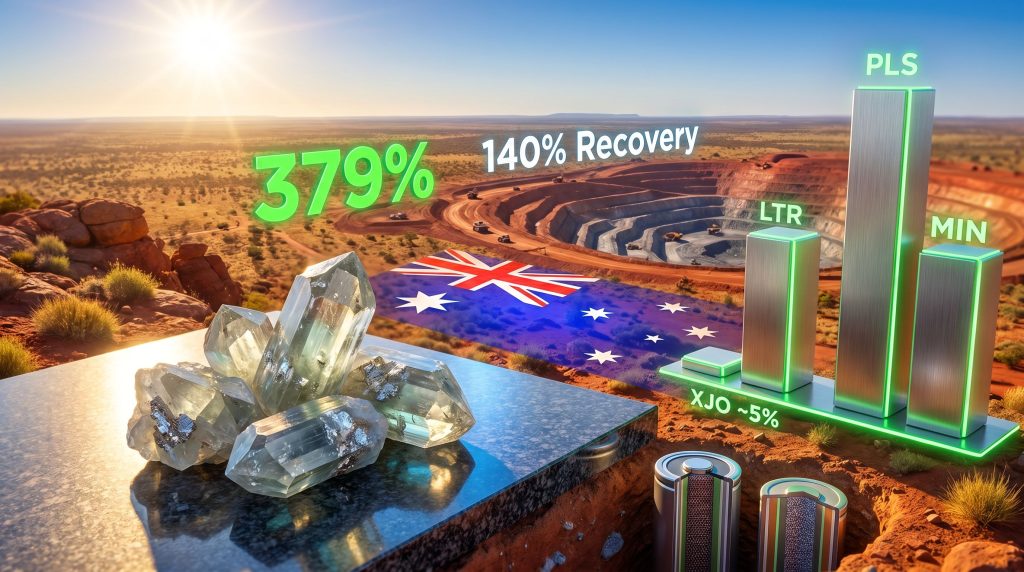
The S&P/ASX 200 Index (ASX: XJO) delivered approximately 5% total return over the past 12 months, a respectable but unremarkable result in historical context. Against that backdrop, the three largest ASX 200 mining companies with significant lithium exposure have generated returns that dwarf the benchmark by an extraordinary margin.
| Company | ASX Code | Approximate 12-Month Return | Primary Lithium Asset |
|---|---|---|---|
| Pilbara Minerals (PLS Group) | PLS | ~379% | Pilgangoora, Western Australia |
| Liontown Resources | LTR | ~210% | Kathleen Valley, Western Australia |
| Mineral Resources | MIN | ~207% | Diversified lithium and iron ore |
| ASX 200 Index (XJO) | — | ~5% | — |
To contextualise the scale of PLS Group's outperformance: shares were available at approximately $1.35 twelve months prior to the time of writing. At a price of $6.47, a $5,000 position would have grown to approximately $23,963, representing a near five-fold return within a single financial year. This is the kind of return that commodity cycles can produce at their inflection points, but it is equally the kind of return profile that comes packaged with commensurately high downside risk during the contraction phase.
Past performance is not indicative of future returns. These figures are illustrative and should not be interpreted as forecasts or investment recommendations.
Deep Dive: What Separates the Top Performers?
PLS Group (ASX: PLS): The Pure-Play Benchmark
Pilgangoora, operated by PLS Group, is one of the world's largest hard-rock lithium deposits by both resource size and annual production capacity. The project's scale creates meaningful cost advantages through economies of operation, a critical attribute during commodity price troughs when smaller, higher-cost operations are forced into curtailment or closure.
PLS Group's half-year financial results for FY2026 demonstrated the leverage that a recovering lithium price creates for low-cost producers:
- First-half revenue increased 47% year-on-year to $624 million
- Underlying EBITDA surged 241% to $253 million in H1 FY2026
- EBITDA margins expanded dramatically, from 17% in H1 FY2025 to 41% in H1 FY2026
This margin expansion from 17% to 41% is particularly instructive. It illustrates how, for a large-scale low-cost producer, a moderate improvement in the commodity price can generate a disproportionately large improvement in profitability, since fixed operating costs are spread across a higher-value revenue base.
Liontown Resources (ASX: LTR): The Development-to-Production Story
Liontown stock performance has been one of the more closely watched stories in the sector, as the Kathleen Valley project in Western Australia represents one of the most significant new lithium operations to achieve commercial production in recent years. Transitioning from a development-stage company to an operating producer is among the most capital-intensive and execution-risk-laden journeys in the resource sector, and Liontown has navigated it during a period of commodity price recovery.
Key H1 FY2026 metrics from Liontown include:
- Lithium production grew 70% year-on-year, reaching 192,514 dry metric tonnes (dmt)
- Revenue for the six months to 31 December increased 107% to $207.5 million
The 107% revenue increase reflects both volume growth from production ramp-up and price improvement, a dual tailwind that development-stage companies transitioning to production can capture in a way that established producers with fixed output capacity cannot.
Mineral Resources (ASX: MIN): The Diversified Commodity Operator
Mineral Resources occupies a structurally distinct position among ASX lithium shares due to its dual exposure to both lithium and iron ore through its Onslow Iron operations. This diversification is not merely a marketing characterisation, it has material financial implications for how the company performs across different points in the commodity cycle.
MIN's H1 FY2026 results represented a record half-year performance:
- EBITDA reached $1.2 billion for the half-year period
- Revenue hit a record $3.1 billion, driven by contributions from both lithium and Onslow Iron
Comparing Business Model Structures
| Feature | Pure-Play Lithium (e.g., PLS, LTR) | Diversified Miner (e.g., MIN) |
|---|---|---|
| Earnings sensitivity to lithium price | Very high | Moderate |
| Revenue diversification | Low | High |
| Leverage to lithium upside | Maximum | Partial |
| Downside protection | Limited | Greater |
| Complexity of valuation analysis | Lower | Higher |
For investors who want maximum exposure to a lithium bull cycle, pure-play operators offer the greatest leverage. For those who prioritise capital preservation through commodity downturns, diversified operators provide a structural earnings buffer.
The next major ASX story will hit our subscribers first
Beyond the ASX 200: Other ASX Lithium Shares Worth Monitoring
Emerging Players and Mid-Tier Operators
IGO Limited (ASX: IGO)
IGO provides a distinctive entry point into the lithium space through its joint venture interest in Tianqi Lithium Energy Australia (TLEA), which holds a stake in the Greenbushes lithium operation. Greenbushes is widely regarded as one of the highest-grade hard-rock lithium mines on the planet, with ore grades significantly above the industry average. Higher ore grades translate directly into lower processing costs per unit of lithium recovered, a structural competitive advantage that becomes most visible during periods of price pressure.
Elevra Lithium (ASX: ELV)
Formed through the merger of Piedmont Lithium and Sayona Mining, Elevra Lithium represents a newer pure-play production story with assets spanning both North America and Australia. The company carries a higher risk profile relative to established ASX 200 producers but offers meaningful upside exposure if production targets across its asset portfolio are achieved on schedule.
Core Lithium (ASX: CXO)
Core Lithium's Finniss Lithium Operation in the Northern Territory is notable for its proximity to Darwin Port export infrastructure, a logistical advantage relative to landlocked deposit locations. Production status and any restart or expansion timelines remain key variables for investors tracking this company.
How Should Investors Evaluate ASX Lithium Shares? A Practical Framework
Five Analytical Dimensions for Assessing Lithium Equity Risk
-
Production Status — Is the company generating lithium revenue today, or is it operating as a pre-production enterprise funded by equity raises?
-
Cost Position — What is the all-in sustaining cost (AISC) per tonne of spodumene concentrate, and what margin does it generate at prevailing lithium prices?
-
Balance Sheet Strength — Does the company maintain sufficient cash reserves and manageable debt levels to sustain operations through commodity price downturns without requiring dilutive capital raises?
-
Asset Quality — What is the grade, resource scale, and remaining mine life of the underlying lithium deposit? Higher-grade deposits with longer mine lives command valuation premiums.
-
Offtake and Customer Relationships — Are there binding sales agreements with major battery manufacturers or chemical processors, and on what pricing terms?
Key Financial Metrics to Track for ASX Lithium Producers
| Metric | Why It Matters |
|---|---|
| EBITDA margin | Measures operational efficiency relative to prevailing lithium prices |
| Revenue growth (year-on-year) | Reflects combined volume growth and price improvement |
| Net debt to EBITDA ratio | Quantifies financial leverage and balance sheet vulnerability |
| Realised lithium price (per dmt) | Shows actual price achieved relative to benchmark spot prices |
| Production volume (dmt) | Tracks operational scale and quarterly growth trajectory |
The Risk Landscape: What Investors Must Not Ignore
A Balanced Risk Assessment for Resource Sector Participants
The same commodity price leverage that produced returns of 207% to 379% over 12 months is structurally identical to the mechanism that erased comparable amounts of value during the 2023 to 2024 lithium price correction. Investors who entered the sector in late 2022 at peak valuations experienced severe drawdowns before the subsequent recovery. This cycle will repeat in some form, though its timing and magnitude are inherently unpredictable.
The historical pattern of lithium markets suggests that extraordinary price recoveries tend to attract new supply investment, which eventually moderates the price again. The speed of this cycle in lithium has historically been faster than in traditional bulk commodities, partly because project construction timelines are shorter than in iron ore or copper.
Primary risk factors for ASX lithium share investors:
-
Commodity price volatility: Lithium prices remain highly cyclical, with Chinese demand conditions, new supply additions from Africa and South America, and potential battery chemistry substitution all capable of materially shifting the supply-demand balance
-
Execution risk: Development-stage companies face construction delays, commissioning challenges, and cost overruns that can consume capital and delay the revenue generation timeline
-
Battery chemistry substitution: A less commonly discussed risk is the growing adoption of lithium iron phosphate (LFP) battery chemistry, which uses less lithium per kilowatt-hour than nickel-manganese-cobalt (NMC) formulations, potentially moderating the per-vehicle lithium demand intensity over time
-
Currency risk: Most ASX lithium producers sell into USD-denominated markets while reporting in Australian dollars; AUD/USD fluctuations directly affect realised revenue even when commodity prices are stable
-
Geopolitical and regulatory risk: Permitting timelines, environmental approvals, and export policy changes in Australia, or processing policy shifts in China, can materially affect project economics and market access
Frequently Asked Questions: ASX Lithium Shares
What are ASX lithium shares?
ASX lithium shares are equities listed on the Australian Securities Exchange that derive a material portion of their revenue or future value from lithium mining, processing, or development activities. They range from large-cap producers in the ASX 200 to small-cap explorers with no current production revenue.
Why does Australia produce so much lithium?
Australia's geological endowment of spodumene-bearing pegmatite formations, concentrated primarily in Western Australia, makes it the world's largest producer of hard-rock lithium. Established mining infrastructure, a stable regulatory environment, and geographic proximity to Asian battery manufacturing supply chains reinforce this structural advantage.
What is the difference between lithium carbonate and spodumene concentrate?
Spodumene concentrate is the partially processed mineral product that Australian miners export, typically graded at around 6% Li₂O. Lithium carbonate and lithium hydroxide are the refined forms produced from spodumene, predominantly in China, and used directly in battery manufacturing. Australian producers' revenues are tied to spodumene pricing, not lithium carbonate pricing, which is why the two figures can diverge significantly.
Are ASX lithium shares appropriate for long-term investors?
Lithium shares can form part of a long-term portfolio if investors understand commodity cycle dynamics, size positions appropriately relative to total portfolio value, and maintain realistic expectations about drawdown risk during price troughs. Diversified exposure through a multi-commodity miner or a sector ETF may reduce single-stock concentration risk for investors with lower risk tolerance.
What drove the 140% recovery in lithium carbonate prices?
The recovery reflects a confluence of supply-side curtailments from high-cost operations that became uneconomic during the trough, continued strong EV sales growth particularly in China, accelerating grid-scale battery storage deployment, and reduced rates of new project sanctioning during the period of price weakness. The global lithium market dynamics, furthermore, suggest that demand from emerging economies is adding a new structural dimension to this recovery narrative.
The Outlook: Structural Tailwinds and Near-Term Considerations
Long-Term Demand Drivers Supporting the Investment Thesis
The structural case for lithium demand growth through 2030 and beyond rests on several pillars that extend beyond the near-term commodity cycle:
- Global EV fleet expansion continues to require growing volumes of battery-grade lithium, with projections across multiple research organisations pointing to demand growth compounding at double-digit annual rates through the decade
- Grid-scale energy storage represents an increasingly significant and EV-independent demand source, as electricity networks integrate higher proportions of intermittent renewable generation
- Supply chain localisation initiatives in the United States, Europe, and Japan are creating new demand pathways for Australian lithium exports that bypass traditional Chinese processing routes
- The overall trajectory of battery technology remains weighted toward lithium-ion chemistry variants for the foreseeable future, despite ongoing research into alternative chemistries
Near-Term Variables That Could Influence Share Performance
- The trajectory of both spodumene concentrate and lithium carbonate spot prices through the remainder of 2026
- Chinese economic conditions and downstream battery manufacturing capacity utilisation rates
- New supply additions from African hard-rock projects and South American brine operations entering the market
- Quarterly production reports and half-year financial results from ASX-listed producers, which can trigger significant short-term share price volatility
- Currency movements in the AUD/USD pair, which affect the Australian dollar revenue realised from USD-denominated commodity sales
This article contains general information only and does not constitute financial advice. Investing in ASX lithium shares involves significant risk, including the potential for total loss of capital. Past performance is not indicative of future results. Readers should consider their own financial circumstances and consult a qualified financial adviser before making investment decisions.
Readers seeking additional perspectives on ASX lithium shares and the broader critical minerals investment landscape may find value in exploring ASX lithium stock listings for a comprehensive overview of companies in the sector, as well as market commentary available at The Motley Fool Australia, which regularly publishes analysis on ASX resource sector developments.
Want to Be First When the Next Major ASX Lithium Discovery Hits the Market?
Discovery Alert's proprietary Discovery IQ model scans ASX announcements in real time, instantly identifying significant mineral discoveries across lithium and more than 30 other commodities — delivering actionable alerts before the broader market has time to react. Explore Discovery Alert's dedicated discoveries page to see how historic ASX mineral discoveries have generated extraordinary returns, and begin your 14-day free trial today to position yourself ahead of the next major find.