June 15, 2026
Price Discovery at an Inflection Point: How Benchmark Specifications Shape the Lithium Market
Commodity price benchmarks are only as reliable as the assumptions embedded within their specifications. When those assumptions drift out of alignment with commercial reality, the consequences ripple through every contract, every procurement decision, and every financial instrument tied to the assessed price. In the lithium market, that drift has been building quietly for several years, and the Fastmarkets lithium price methodology changes taking effect on September 1, 2026 represent a significant corrective response to market conditions that have materially changed since the original specifications were designed.
Understanding why these changes matter requires looking beneath the headline figures to examine how benchmark prices are actually constructed, what happens when specifications fail to keep pace with evolving trading practices, and how the distinctions between qualified and unqualified battery-grade material have become one of the most commercially consequential technical questions in the global energy transition supply chain.
When big ASX news breaks, our subscribers know first
The Role of Price Reporting Agencies in the Lithium Supply Chain
How Benchmark Prices Function as Market Infrastructure
Price reporting agencies occupy a structurally unique position in commodity markets. Unlike exchanges, they do not facilitate transactions directly. Unlike financial data providers, their assessments are designed to reflect physical trade rather than derivatives positioning. Their function is closer to that of an independent auditor of market value, aggregating information from multiple counterparties to produce a consensus price that no single participant controls.
Fastmarkets operates as a leading cross-commodity price reporting agency across agriculture, forest products, and metals and mining, with the battery raw materials market representing one of its most rapidly evolving coverage areas. For lithium specifically, the benchmark assessments it publishes underpin procurement negotiations across the electric vehicle, stationary energy storage, and consumer electronics sectors globally.
The credibility of any benchmark depends on three reinforcing pillars:
- Specification precision: the physical description of the commodity being assessed must match the material that actually changes hands in commercial transactions
- Data collection transparency: market participants must be able to understand how the assessment is constructed and what information is included or excluded
- Alignment with commercial reality: payment terms, logistics assumptions, and quality thresholds must reflect how the market actually operates, not how it operated when the benchmark was originally designed
When all three pillars hold firm, a benchmark functions as trusted infrastructure. When one begins to erode, distortions compound over time.
What Makes a Lithium Assessment Commercially Bankable?
The practical test of a benchmark's utility is whether buyers and sellers are willing to index long-term contracts to it. For a lithium price assessment to serve this function effectively, it must consistently track the actual cost of securing battery-ready, production-grade supply.
A benchmark that inadvertently incorporates pricing data from material that does not meet battery manufacturers' technical requirements will systematically understate the true cost of qualified supply. Over time, this creates a wedge between the indexed contract price and the actual market clearing price for usable material, eroding trust in the benchmark and reducing its utility for contract indexation.
Key Principle: A benchmark price is only as reliable as the specification it is built upon. When trading practices evolve faster than the methodology documents governing them, systematic price divergence becomes inevitable.
What Is Driving the Fastmarkets Lithium Price Methodology Changes Effective September 2026?
The Divergence Between Assessed Prices and Commercial Reality
The immediate catalyst for the September 2026 revision was an observed increase in reports of unqualified lithium hydroxide trading at a significant discount to the broader market. Fastmarkets has confirmed this explicitly, noting that unqualified material represents a growing share of reported transactions, and that its presence in the assessed price universe was creating downward pressure on benchmarks designed to reflect qualified, battery-grade supply.
This distinction between qualified and unqualified material is not merely semantic. Qualification is a formal process by which battery manufacturers test and approve a specific material from a specific producer for use in their cathode production processes. Furthermore, material that has not completed this process may have the correct chemistry on paper but lacks the documented performance validation that battery manufacturers require. Unqualified material therefore trades at a discount precisely because it is not immediately deployable in battery manufacturing applications.
When both qualified and unqualified material are captured under the same benchmark specification, the resulting assessed price represents neither category accurately. It understates the cost of genuinely production-ready supply and overstates the value of material that requires further qualification steps before it can be used. These dynamics compound existing lithium oversupply challenges that have already placed significant pressure on producers across the supply chain.
The Consultation Process and Market Feedback
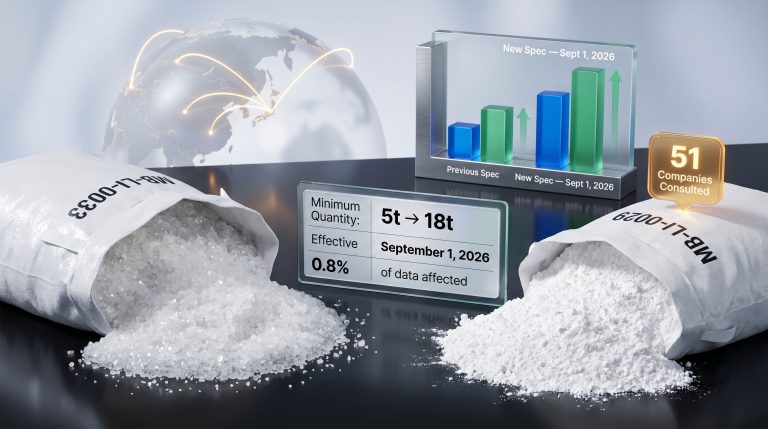
Fastmarkets conducted an extensive consultation process before finalising the September 2026 changes, gathering feedback from more than 50 companies across the lithium supply chain. The majority of respondents supported a tighter specification, reflecting broad recognition across the industry that the existing framework was no longer fit for purpose in current market conditions.
The consultation process itself reflects best practice in benchmark governance. By soliciting structured feedback before implementing material changes, Fastmarkets ensures that the revised methodology has practical legitimacy across the supply chain, not just technical correctness on paper. It is also worth noting that the consultation period for the related CJK lithium methodology proposal was extended in May 2026 when initial feedback was insufficient, demonstrating that Fastmarkets applies procedural discipline even when this slows implementation.
As an independent benchmark provider, Fastmarkets has made clear that its role is price-agnostic. The objective of any specification change is to more accurately reflect where the market is genuinely trading, not to influence the direction of the assessed price.
A Technical Breakdown of the September 2026 Specification Changes
Battery-Grade Lithium Hydroxide: Specification Parameters Before and After
| Specification Parameter | Previous Standard | Revised Standard (Effective Sept 1, 2026) |
|---|---|---|
| Quality descriptor | Powder, accepted by buyer for battery use | Non-clumping, non-agglomerated coarse powder, widely qualified by buyers in destination country; D50 particle size 200-700 μm |
| Payment terms | Not specified | 30-day terms (ddp Europe, ddp US/Canada); telegraphic transfer (exw domestic China) |
| Minimum quantity (exw China) | 5 tonnes | 30 tonnes |
| Delivery timing (ddp Europe, US/Canada) | Within 30 days | Within 60 days |
| Shelf life | Not specified | Delivered within 6 months of production or reprocessing date (big bags); airtight bags or drums considered for normalisation |
Battery-Grade Lithium Carbonate: Specification Parameters Before and After
| Specification Parameter | Previous Standard | Revised Standard (Effective Sept 1, 2026) |
|---|---|---|
| Quality descriptor | Powder, accepted by buyer for battery use | Powder, widely qualified by buyers in destination country for battery use |
| Payment terms | Not specified | 30-day terms (ddp Europe, ddp US/Canada); telegraphic transfer (exw domestic China) |
| Minimum quantity (exw China) | 5 tonnes | 30 tonnes |
| Delivery timing (ddp Europe, US/Canada) | Within 30 days | Within 60 days |
| Shelf life | Not specified | Delivered within 9 months of production or reprocessing date (big bags); airtight bags or drums considered for normalisation |
The Particle Size Definition: Why D50 Between 200 and 700 μm Is Technically Significant
The introduction of a defined particle size range for lithium hydroxide coarse powder is one of the most technically substantive elements of the revision. Particle morphology directly influences how hydroxide material performs in cathode manufacturing, affecting mixing consistency, sintering behaviour, and ultimately the electrochemical performance of the finished cathode material.
Previously, the term "coarse powder" lacked a measurable definition, creating ambiguity that allowed a range of physical forms to qualify under the specification. By anchoring the definition to a D50 particle size between 200 μm and 700 μm, Fastmarkets has introduced a reproducible, objectively measurable standard that removes interpretive flexibility from what had previously been a loosely defined quality parameter.
It is worth noting that a clarification was issued in May 2026 confirming that both MB-LI-0033 and MB-LI-0040 are assessed as coarse powder, establishing consistency across the domestic China and CJK assessments ahead of the September revision.
Understanding the Shelf Life Differentiation Between Hydroxide and Carbonate
The six-month shelf life requirement for lithium hydroxide versus nine months for lithium carbonate reflects fundamental differences in the chemical stability of the two compounds under storage conditions.
Lithium hydroxide monohydrate is hygroscopic and chemically reactive with atmospheric carbon dioxide. Exposure to humidity causes moisture absorption, while CO2 exposure progressively converts lithium hydroxide to lithium carbonate through a surface carbonation reaction. Both processes degrade the material's performance characteristics in battery applications and may necessitate reprocessing before use, adding cost and time to the supply chain.
Lithium carbonate, by contrast, is chemically more stable under typical storage conditions. Its lower reactivity with atmospheric gases means that properly packaged carbonate material retains its specification characteristics for a longer period, justifying the extended nine-month shelf life window. For a deeper understanding of the lithium carbonate supply dynamics that inform these considerations, the broader market context is worth examining alongside the technical specification detail.
The specification that big bag storage is the primary reference point, with airtight bags and drums considered for normalisation, reflects the dominant packaging practices in intercontinental lithium trade. Big bags, while convenient for large-volume shipments, offer less protection against atmospheric exposure than sealed drums or airtight flexible packaging, making the shelf life clock more operationally significant.
The Six Fastmarkets Assessments Directly Impacted
Lithium Hydroxide Assessments
The following three price codes are affected by the hydroxide specification changes:
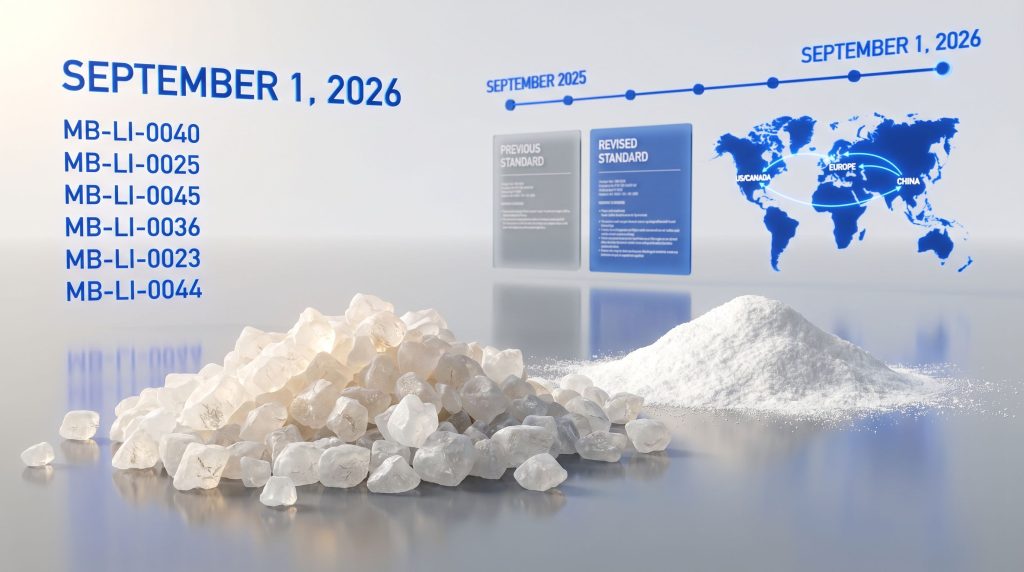
- MB-LI-0040: Lithium hydroxide monohydrate LiOH.H2O, 56.5% LiOH min, battery grade, spot price range, exw domestic China, yuan per tonne
- MB-LI-0025: Lithium hydroxide monohydrate LiOH.H2O, 56.5% LiOH min, battery grade, spot price, ddp Europe, $ per kg
- MB-LI-0045: Lithium hydroxide monohydrate LiOH.H2O, 56.5% LiOH min, battery grade, spot price, ddp US and Canada, $ per kg
Lithium Carbonate Assessments
The following three price codes are affected by the carbonate specification changes:
- MB-LI-0036: Lithium carbonate 99.5% Li2CO3 min, battery grade, spot price range, exw domestic China, yuan per tonne
- MB-LI-0023: Lithium carbonate 99.5% Li2CO3 min, battery grade, spot price, ddp Europe, $ per kg
- MB-LI-0044: Lithium carbonate 99.5% Li2CO3 min, battery grade, spot price, ddp US and Canada, $ per kg
How Normalisation Works for Non-Conforming Data
Pricing data submitted for material that falls outside the revised specifications will be subject to normalisation adjustments before being considered in the assessment. This applies to non-qualified material, alternative payment terms, and delivery windows outside the base specification.
The normalisation framework preserves data breadth while protecting benchmark integrity. Rather than excluding all non-conforming transactions, Fastmarkets applies adjustments to bring the data into alignment with the base specification, maintaining a wider information set while ensuring the headline benchmark reflects the specified quality tier.
Normalisation in Practice: If a transaction involves fine powder with a D50 below 200 μm traded on 60-day payment terms, Fastmarkets would apply appropriate differentials to normalise this data point before considering its inclusion in the assessed price range. Data that cannot be reliably normalised may be excluded entirely from the assessment.
Geographic and Logistical Rationale Behind the Revised Delivery Windows
Why 60-Day Delivery Windows Reflect Intercontinental Trade Reality
The extension of the delivery timing specification from 30 to 60 days for ddp Europe and ddp US/Canada assessments addresses one of the most practically significant misalignments in the previous methodology. Ocean freight from major Chinese lithium processing hubs to European and North American discharge ports routinely requires 25 to 45 days of transit time alone, before accounting for port handling, customs clearance, and inland freight to the delivery destination.
A 30-day specification was effectively incompatible with intercontinental delivery terms for Chinese-origin material, meaning that transactions with commercially standard lead times were either excluded from the assessment or required normalisation adjustments that added complexity to the data collection process. The revised 60-day window brings the specification into alignment with commercial lead times that are standard practice rather than exceptional in global lithium trade.
The Minimum Quantity Shift: From 5 Tonnes to 30 Tonnes for Domestic China Assessments
The increase in minimum quantity for exw domestic China assessments from 5 tonnes to 30 tonnes reflects a similarly practical recognition of what constitutes a commercially representative transaction in the current market.
A 5-tonne minimum is characteristic of sampling orders, trial purchases, or small-lot specialty transactions rather than the volume increments that define the bulk of the spot market. Including such small transactions in a benchmark assessment designed to reflect mainstream commercial pricing risks introducing noise from non-representative trades. Raising the threshold to 30 tonnes filters the data set toward transactions of a scale consistent with production-level procurement, producing a more representative benchmark price for the mainstream market.
The next major ASX story will hit our subscribers first
How Fastmarkets Classifies and Implements Methodology Changes
Material Versus Immaterial Changes: Why the Distinction Matters for Benchmark Governance
Fastmarkets applies a structured governance framework to methodology changes, distinguishing between material changes capable of fundamentally altering the published price level and immaterial changes that refine operational processes without affecting price outcomes. The September 2026 revision has been classified as a material change, triggering the full consultation and notification process, including publication of the proposed specification, implementation rationale, and timetable with adequate advance notice for market participants to adjust.
This classification framework is not merely procedural. In an environment where lithium benchmark prices are increasingly referenced in financial derivatives, long-term supply agreements, and investment-grade project financing, the reliability of the change management process is as commercially important as the content of any individual change. Participants can review the full suite of lithium prices and assessments published by Fastmarkets to contextualise how benchmark levels have evolved alongside these governance developments.
Low-Liquidity Assessment Periods and Broader Market Fundamentals
During periods of reduced trading activity, Fastmarkets may draw on broader market fundamentals to supplement transaction-based data in producing its assessments. Relevant considerations under such conditions include:
- Inventory levels at conversion facilities and warehouses
- Operating rates at major lithium hydroxide and carbonate producers
- Export volumes from key production regions
- Feedstock value movements at the spodumene concentrate level, including dynamics along the spodumene-to-lithium salts chain
- Relative pricing across comparable assessments and geographic delivery terms
This approach prevents benchmark prices from becoming artificially static during thin trading periods while maintaining the methodological transparency that market participants require to trust the assessment process.
Implications Across the Lithium Supply Chain
What the Changes Mean for Producers and Miners
For lithium producers, the revised specifications introduce several practical considerations:
- Suppliers whose hydroxide output does not meet the coarse powder particle size range (D50: 200-700 μm) may find their product subject to normalisation adjustments rather than being included at face value in the benchmark assessment
- The 30-tonne minimum quantity change for domestic China assessments means that small-volume spot sales will carry reduced weight in benchmark influence
- Shelf life requirements create new documentation obligations, particularly for producers shipping material across long intercontinental supply chains where transit time consumes a meaningful portion of the allowable storage window
What the Changes Mean for Battery Manufacturers and Cathode Producers
For battery manufacturers and cathode producers, the revised specification represents a meaningful improvement in benchmark utility:
- The shift from material accepted by any individual buyer to material widely qualified by buyers in the destination country raises the quality bar to a level more consistent with production-scale procurement requirements
- Benchmarks that more accurately reflect the cost of securing qualified, production-ready supply provide a more reliable foundation for contract indexation and procurement budgeting
- The particle size definition (D50: 200-700 μm) provides a technically precise anchor that aligns the benchmark with the physical form most commonly processed in NMC and LFP cathode manufacturing
What the Changes Mean for Traders and Financial Participants
For trading desks and financial market participants, the specification changes carry specific operational implications:
- The introduction of 30-day payment terms as a standard specification element standardises the financing cost embedded in benchmark prices, reducing ambiguity when comparing transactions conducted on different credit terms
- Derivative contracts referencing Fastmarkets lithium benchmarks, including the CJK lithium hydroxide derivative traded on CME Group, will be subject to a one-time differential adjustment when the September 1, 2026 methodology change becomes effective
- Participants holding positions indexed to the pre-revision methodology should review exposure to the transition differential and assess whether position adjustments are warranted ahead of the implementation date
Fastmarkets Lithium Methodology: A Timeline of Key Developments
| Date | Methodology Event |
|---|---|
| September 2025 | Updated methodology document published |
| May 13, 2026 | Launch of NCM cathode black powder payables, CIF China |
| May 15, 2026 | Consultation period extended for CJK lithium methodology proposal following insufficient initial feedback |
| May 2026 | Clarification issued confirming MB-LI-0033 and MB-LI-0040 assessed as coarse powder |
| June 15, 2026 | Specification change notice published for global suite of battery-grade lithium assessments |
| September 1, 2026 | Revised methodology becomes effective across all six impacted price codes |
What the Broader Evolution of Lithium Benchmarking Signals About Market Maturity
From Specialty Chemical to Institutionalised Commodity
The increasing granularity of Fastmarkets' lithium specifications — covering particle morphology, shelf life windows, payment terms, and minimum commercial quantities — reflects a broader transition in how lithium functions as a commodity. Early-stage commodity markets tolerate loose specifications because trading volumes are low, participants are few, and the infrastructure for more sophisticated benchmarking does not yet exist.
As a market deepens, however, looser specifications become a liability rather than a convenience. The emergence of financial derivatives referencing lithium prices, the proliferation of long-term supply contracts indexed to third-party benchmarks, and the growing participation of institutional capital in the lithium sector have all raised the stakes for specification precision. The consultation process involving more than 50 supply chain companies signals that the lithium market now has sufficient stakeholder depth to support rigorous benchmark governance.
The Intersection of Benchmark Integrity and Supply Chain Strategy
As lithium supply chains become embedded in broader energy security and industrial policy frameworks across the United States, European Union, and Asia-Pacific region, the accuracy of benchmark prices acquires significance beyond purely commercial considerations. Offtake agreements, project financing structures, and long-term procurement frameworks increasingly reference third-party benchmark prices as their pricing foundation.
In addition, innovations such as direct lithium extraction are reshaping where and how production-grade material enters the supply chain, further reinforcing the need for benchmark specifications that can accommodate an evolving supply landscape. The Fastmarkets lithium price methodology changes taking effect on September 1, 2026 represent a substantive step toward ensuring that foundation remains robust as the market continues to scale.
Readers seeking the primary source documentation for Fastmarkets' lithium price methodology and specification updates can access the full suite of methodology documents at fastmarkets.com/methodology.
This article is intended for informational purposes only and does not constitute financial, investment, or procurement advice. Methodology details referenced are sourced from Fastmarkets' June 15, 2026 pricing notice. Market participants should refer directly to Fastmarkets' official methodology documentation for definitive specification guidance.
Want to Stay Ahead of the Next Major Lithium Discovery on the ASX?
While benchmark specifications shape how lithium is priced across global supply chains, the real wealth-creation moments in this sector often arrive with a single ASX announcement — and timing is everything. Discovery Alert's proprietary Discovery IQ model scans ASX announcements in real time, instantly identifying significant mineral discoveries and translating complex data into actionable opportunities, much as historic finds by De Grey Mining and WA1 Resources demonstrated. Explore Discovery Alert's dedicated discoveries page to understand the scale of returns major mineral discoveries can generate, and begin your 14-day free trial to ensure you're positioned ahead of the market.