June 12, 2026
Market Structure Analysis for ASX Lithium Stocks Investment Positioning
The Australian lithium landscape operates through a tiered structure where companies occupy distinct risk-return profiles based on their operational status and market positioning. This stratification creates specific investment opportunities that respond differently to global price movements and supply chain disruptions.
Production Stage Classification and Investment Risk Profiles
Investment success in ASX lithium stocks requires understanding how different company categories respond to market conditions. The sector's structure creates natural hedging opportunities for diversified portfolios, particularly when considering Australia lithium tax breaks that support domestic operations.
| Category | Market Cap Range | Operational Status | Revenue Stability | Cycle Sensitivity |
|---|---|---|---|---|
| Tier 1 Producers | $8B+ | Cash flow positive operations | High predictability | Lower volatility |
| Development Stage | $2-8B | Construction or ramp-up phase | Revenue emerging | Moderate sensitivity |
| Exploration Projects | <$2B | Resource definition stage | No revenue streams | Extreme volatility |
Geographic and Logistical Advantages of Australian Producers
Australian lithium operations benefit from proximity to Asian processing hubs, creating cost advantages that become pronounced during margin compression cycles. Western Australian ports handle approximately 60% of global spodumene concentrate exports, providing established shipping infrastructure that reduces logistical bottlenecks compared to emerging producer regions.
Furthermore, the regulatory environment in Australia offers stability compared to jurisdictions where mining permits face frequent revisions or export restrictions. This operational certainty translates into premium valuations during market stress periods when investors prioritise jurisdictional safety over pure cost metrics.
When big ASX news breaks, our subscribers know first
Global Price Discovery Mechanisms and Their Impact on Australian Producers
Lithium pricing operates through multiple mechanisms that create arbitrage opportunities and timing signals for ASX lithium stocks investors. The Guangzhou Futures Exchange (GFEX) has emerged as the primary price discovery venue for lithium carbonate, with daily trading volumes exceeding spot market transactions by substantial margins.
However, understanding these price mechanisms requires examining the broader critical minerals strategy that shapes global supply chains and investment flows.
Supply Chain Disruption Patterns and Market Response
Recent supply disruptions demonstrate how quickly market dynamics can shift from oversupply to deficit conditions. The suspension of operations at CATL's Jianxiawo mine removed approximately 40,000 tonnes of annual lithium carbonate equivalent from Chinese domestic production. Zimbabwe's export ban eliminated an estimated 200,000 tonnes of spodumene concentrate from global markets, representing roughly 7% of projected 2026 supply.
Consequently, China's regulatory actions in Jiangxi province resulted in the revocation of 27 mining permits, targeting smaller lepidolite operations that collectively contributed meaningful supply volumes. These regulatory changes reflect environmental compliance priorities rather than market manipulation, suggesting the supply removals carry structural rather than cyclical characteristics.
Price Volatility and Production Cost Dynamics
Australian spodumene operations typically achieve cash costs between $300-500 per tonne of concentrate, positioning them in the lower quartile of the global cost curve. This cost advantage provides downside protection during price corrections while maximising operating leverage during recovery phases.
In addition, the relationship between spot pricing and long-term contract structures creates timing opportunities for investors. Producers with significant exposure to quarterly pricing mechanisms capture price movements more rapidly than those locked into annual negotiations, though this exposure cuts both directions during volatile periods.
Leading ASX Lithium Stocks Analysis and Strategic Positioning
Investment selection within the Australian lithium sector requires evaluating operational metrics, balance sheet strength, and strategic positioning across different market conditions. For companies seeking to expand their market presence, understanding various ASX capital raising methods becomes crucial for accessing growth capital.
Tier 1 Producer Investment Characteristics
Pilbara Minerals (ASX: PLS) – Scale Leadership Strategy
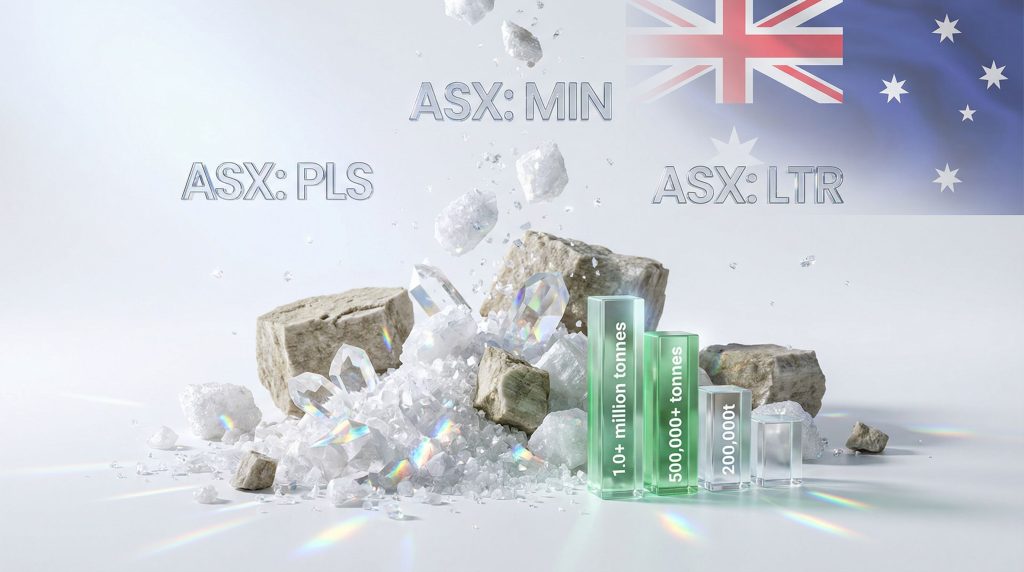
Pilbara's Pilgangoora operation maintains annual production capacity exceeding 1.0 million tonnes of spodumene concentrate, establishing it as the world's largest independent hard-rock lithium producer. The company's cash position consistently exceeds $1 billion through commodity cycles, providing operational flexibility and acquisition capacity during market downturns.
Moreover, the P1000 expansion project targets 1.2 million tonnes annual capacity, with modular construction allowing responsive scaling based on market conditions. Unit cash costs below $400 per tonne provide substantial margins even during price correction phases.
Mineral Resources (ASX: MIN) – Diversified Business Model Buffer
Mineral Resources operates the Mount Marion lithium operation through a joint venture with Ganfeng Lithium, while maintaining diversified revenue streams through mining services and iron ore operations. This business model reduces lithium price sensitivity compared to pure-play producers.
Furthermore, the company's disciplined capital allocation approach prioritises cash returns over production growth, creating value during both expansion and contraction cycles.
Mid-Tier Development Companies Growth Assessment
Liontown Resources (ASX: LTR) – Production Ramp Execution
Liontown's Kathleen Valley mine achieved commercial production in 2024, with current operations targeting 500,000 tonnes annual spodumene capacity. The transition from construction to operational cash flow represents a fundamental shift in the company's investment profile.
For instance, underground development phases extend mine life beyond the initial open-pit extraction, though capital requirements for this expansion create financing considerations that impact share dilution potential.
Core Lithium (ASX: CXO) – Restart Scenario Analysis
Core Lithium suspended operations at its Finniss project in late 2024 due to lithium price weakness, creating a restart scenario dependent on sustained price recovery. The company's Northern Territory location provides different regulatory and logistical dynamics compared to Western Australian operations.
| Company | Current Status | Target Capacity | Capital Requirements | Restart Timeline |
|---|---|---|---|---|
| LTR | Production ramp | 500,000+ tonnes | Moderate expansion needs | Operational |
| CXO | Suspended operations | 200,000 tonnes | Significant restart costs | 2026+ potential |
Risk Assessment Framework for ASX Lithium Stocks
Comprehensive risk evaluation encompasses operational challenges, market dynamics, and external factors that create both downside protection and upside limitations for lithium investments. This evaluation becomes particularly important for junior mining exploration companies with limited operating history.
Operational Risk Categories and Mitigation Strategies
Production ramp risks remain significant for development-stage companies, with technical challenges frequently delaying achievement of nameplate capacity. Metallurgical complexity in processing different ore types can impact recovery rates and concentrate quality, affecting pricing realisations.
However, infrastructure constraints create bottlenecks during high-demand periods, though Australian operations benefit from established port facilities and transport networks. Environmental compliance requirements continue expanding, with water usage and tailings management receiving increased regulatory scrutiny.
Additionally, grade variability within ore bodies affects processing costs and recovery rates, with some operations experiencing significant variance between mine plan projections and actual extraction results. This geological risk requires careful evaluation of resource confidence levels and mining method suitability.
Market Risk Dynamics and External Dependencies
Demand concentration in Chinese battery manufacturing creates single-point-of-failure risks for the entire sector. Despite battery industry growth, alternative cathode chemistries including lithium iron phosphate (LFP) require lower lithium content per unit of battery capacity compared to nickel-rich formulations.
Nevertheless, geopolitical tensions between Australia and China periodically create trade policy uncertainty, though lithium's strategic importance has generally protected it from tariff disputes. Currency exposure to AUD/USD fluctuations affects revenue conversion for Australian producers selling in US dollar markets.
Consequently, technology substitution risks include solid-state battery development and sodium-ion alternatives, though commercial deployment timelines remain uncertain and lithium demand continues growing in absolute terms despite market share evolution.
Strategic Portfolio Construction for Lithium Cycle Positioning
Investment timing within lithium cycles requires understanding both technical indicators and fundamental supply-demand dynamics that drive sustainable price recovery versus temporary corrections. For deeper market analysis, global lithium insights provide valuable perspective on international trends affecting Australian producers.
Cycle Timing Recognition and Investment Triggers
Supply deficit emergence typically precedes price recovery by 6-12 months as inventory drawdowns accelerate before spot pricing responds. Consumer stockpile levels returning to historical ranges of 30-45 days forward consumption indicate demand normalisation rather than speculative accumulation.
Furthermore, capital discipline maintenance among producers provides the strongest signal for sustainable recovery. Previous cycles ended when producers announced aggressive expansion programs during peak pricing, flooding markets with new supply. Current producer restraint suggests different cycle dynamics.
In addition, merger and acquisition activity acceleration often coincides with cycle inflection points as strategic acquirers recognise value opportunities before public market pricing adjusts. Chinese buyer interest in Australian assets particularly signals long-term supply security priorities.
Risk-Adjusted Portfolio Allocation Framework
Core Holdings Strategy (60-70% allocation)
- Focus on established producers generating consistent cash flows
- Emphasis on lowest quartile cost positions providing cycle protection
- Preference for companies with diversified business models reducing lithium price dependency
- Balance sheet strength enabling operation through extended downturns
Growth Allocation Strategy (20-30% allocation)
- Near-production development projects with clear construction pathways
- Strategic partnerships or binding offtake agreements reducing market risk
- Established mining jurisdiction locations minimising regulatory uncertainty
- Management teams with proven operational track records
Speculative Positioning (5-10% allocation)
- Early-stage exploration projects with significant resource potential
- Technology-focused companies developing innovative processing methods
- Position sizing appropriate for total loss scenarios
- Focus on unique geological settings or strategic locations
External Factors Shaping ASX Lithium Stocks Performance Outlook
Macro-economic conditions and policy developments create the operating framework within which Australian lithium companies execute their strategies and generate returns for investors. Understanding these broader market conditions becomes easier through resources like top lithium shares which provide regular market updates.
Government Policy Impact and Regulatory Framework Evolution
Australia's Critical Minerals Strategy provides policy support for domestic value-addition though processing facility development, though direct financial assistance remains limited compared to jurisdictions like Canada or the United States. Foreign Investment Review Board (FIRB) oversight of strategic asset transactions creates approval uncertainty for major deals while protecting national interests.
However, environmental regulations continue evolving with stricter standards for mine approvals and ongoing operations. Water usage restrictions in Western Australia particularly affect lithium operations requiring significant processing water for concentration plants.
Moreover, tax policy discussions include potential changes to mining taxation structures, though current royalty rates remain competitive internationally. Resource rent tax proposals periodically emerge during commodity price peaks but lack sustained political support.
Global Demand Driver Assessment and Sustainability
Electric vehicle adoption rates vary significantly across geographic markets, with China leading penetration rates above 35% while other major markets remain below 15%. This divergence creates different demand growth trajectories that affect global lithium consumption patterns.
Furthermore, grid-scale energy storage deployment accelerates as renewable energy integration requires buffering capacity, though these applications typically utilise lower-cost battery chemistries that may reduce lithium intensity per unit of storage capacity.
Additionally, consumer electronics provide steady baseline demand growth of 3-5% annually, though this mature market offers limited upside compared to transportation electrification trends. For comprehensive market analysis, tracking lithium market performance provides insights into sector momentum.
Investment Framework Summary: ASX lithium stocks require portfolio construction balancing established cash-generating producers for stability, development-stage companies for growth exposure, and selective speculative positions for asymmetric upside potential, with position sizing reflecting individual risk tolerance and market cycle timing considerations.
The next major ASX story will hit our subscribers first
Strategic Investment Framework for Long-Term Value Creation
Successful navigation of the Australian lithium sector demands understanding both cyclical timing and structural competitive advantages that enable companies to generate sustainable returns across different market environments.
Cash-generating assets provide the foundation for lithium sector exposure, offering dividend potential and balance sheet strength during market stress periods. These companies typically maintain operational flexibility to adjust production rates based on pricing conditions while preserving long-term asset value.
Consequently, diversification across development stages reduces portfolio volatility while capturing different return profiles. Early-production companies offer operational leverage to price recovery, while exploration projects provide exposure to resource expansion and discovery value creation.
Furthermore, currency hedging considerations become important for significant portfolio allocations, as Australian dollar strength can offset commodity price gains for domestic investors. Some producers offer natural hedging through cost structures denominated in Australian dollars while revenues price in US dollars.
Key Investment Principles for ASX Lithium Stocks:
- Prioritise companies with proven operational capabilities and strong balance sheets
- Maintain exposure across the development spectrum based on risk tolerance
- Monitor supply-demand fundamentals for cycle timing optimisation
- Consider jurisdictional stability as a key selection criterion
- Evaluate management track records in commodity cycle navigation
The window for acquiring quality ASX lithium stocks at attractive valuations continues narrowing as structural supply constraints become apparent and demand growth accelerates across multiple end markets. Investors focusing on operational excellence, financial strength, and strategic positioning will likely capture the most sustainable returns as this critical materials sector matures.
Ready to capitalise on the next major lithium discovery?
Discovery Alert instantly alerts investors to significant ASX mineral discoveries using its proprietary Discovery IQ model, turning complex mineral data into actionable insights for lithium and other critical minerals sectors. Begin your 14-day free trial today and position yourself ahead of the market with real-time alerts that can identify emerging opportunities before they reach mainstream attention.