May 11, 2026
When Oil Markets and Fiscal Policy Collide: What It Means for Australian Equities
Few market environments test investor composure quite like the convergence of geopolitical energy shocks and large-scale domestic fiscal uncertainty arriving simultaneously. The ASX market open budget and oil prices have become the defining twin pressures for participants in Australian equity markets at the start of the trading week beginning May 11, 2026. Two structurally distinct forces are compressing risk appetite from opposite directions: a crude oil price surge driven by the renewed breakdown of U.S.-Iran diplomatic efforts, and the imminent delivery of what commentators are calling one of the most significant federal budgets Australia has seen in many years.
Understanding how these forces interact, and which sectors absorb the most pressure, requires more than surface-level market observation. It demands an appreciation of Australia's unique economic architecture and its particular vulnerability to energy price volatility, global supply chain disruption, and fiscal policy shifts.
When big ASX news breaks, our subscribers know first
The ASX 200 Enters Budget Week Under Compounding Pressure
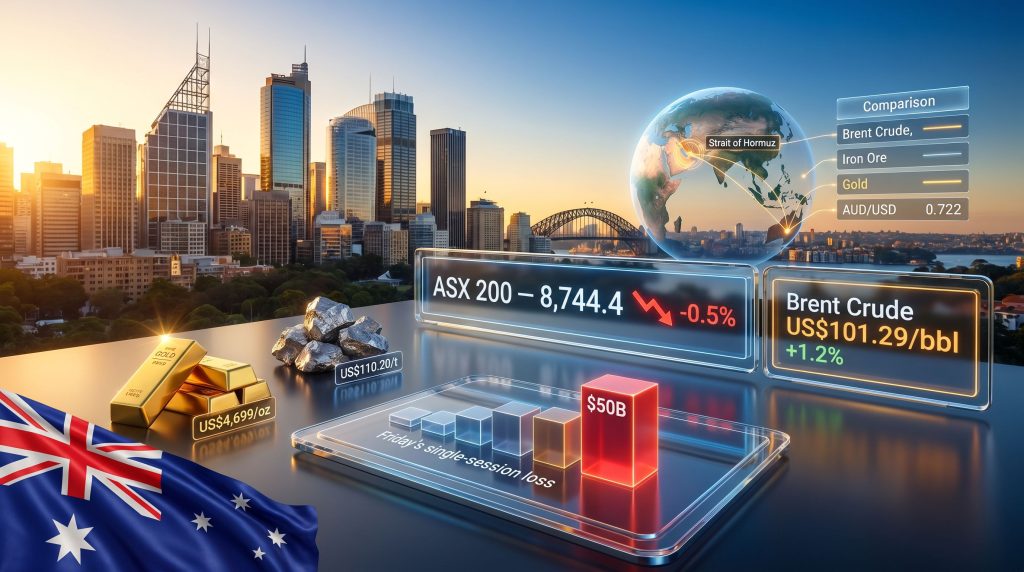
The ASX 200 closed Friday's session at 8,744.4 points, having shed approximately $50 billion in market capitalisation across a single trading day. That level of single-session value destruction is notable by any historical standard, and Monday's futures positioning was pointing toward a further decline of approximately -0.5% at the open, suggesting that whatever drove Friday's selloff had not resolved itself over the weekend.
What makes this opening particularly layered is the simultaneous nature of the pressures. The ASX market open budget and oil prices are not simply reacting to one catalyst in isolation. Investor caution is being amplified by the knowledge that Tuesday evening brings a major fiscal announcement, meaning market participants are reluctant to build fresh positions until the budget's sector-specific implications become clear. For broader context, the Australian share market performance heading into this week had already shown signs of structural strain well before geopolitical escalation intensified.
Why Wall Street's Record-Setting Run Isn't Lifting Australian Stocks
The disconnect between U.S. equity performance and ASX movement this week is a study in structural composition. Wall Street has been driven higher primarily by technology sector momentum, a category of companies largely insulated from oil price shocks, currency fluctuations, and commodity cost inflation. By contrast, the ASX 200's weighting is tilted heavily toward materials, energy, and financials sectors, all of which carry significant direct exposure to the variables currently under stress.
This dynamic is not unique to the current week. Periods in which U.S. equity gains are narrow and technology-concentrated have historically failed to translate into broad-based global equity strength. London's FTSE and Tokyo's Nikkei are both pointing lower, confirming that the softness extends across commodity-exposed and internationally oriented markets beyond Australia's own exchange.
The divergence between tech-led U.S. gains and commodity-weighted markets like Australia's illustrates a recurring structural pattern: when the engine of Wall Street growth is software and semiconductors rather than energy, infrastructure, or industrial output, the positive momentum rarely migrates to exchanges built around physical resource extraction.
Furthermore, the ASX commodity pressure that has characterised much of 2025 and into 2026 has left the index structurally exposed to precisely the kind of dual-force environment now taking shape.
Oil Above US$100: Why Australia Bears a Disproportionate Burden
Brent Crude opened Monday's session at US$101.29 per barrel, representing a +1.2% gain from Friday's close. This follows a week in which crude prices had shed nearly -7% on optimism around peace negotiations, only for those hopes to collapse as U.S.-Iran hostilities resumed in full. According to live ASX market updates from the ABC, the resumption of conflict caught many investors off guard after the brief diplomatic window appeared to be making progress.
For context, earlier in the current conflict cycle during late April 2026, crude benchmarks had surged to the US$124 to US$126 per barrel range. While prices have moderated from those peaks, the resumption of hostilities means the downside scenario for energy costs has materially narrowed. The recent oil price rally dynamics from earlier in 2025 established a pattern where geopolitical disruption and policy uncertainty compound each other's effect on crude benchmarks.
The Strait of Hormuz and Australia's Structural Vulnerability
The geographic chokepoint at the centre of this risk is the Strait of Hormuz, the narrow passage through which a substantial portion of the world's seaborne oil and liquefied natural gas transits. Any disruption to shipping through this corridor carries asymmetric consequences for different economies depending on their energy trade dependencies.
For the United States, which has expanded its domestic production significantly over the past decade and achieved net exporter status in crude oil terms, the Strait's disruption creates market volatility and financial exposure, but not the same degree of direct supply vulnerability. For Australia, the calculus is considerably different.
| Risk Dimension | United States | Australia |
|---|---|---|
| Domestic oil production status | Net exporter | Moderate domestic production; net importer of refined fuels |
| Strait of Hormuz supply exposure | Indirect | Direct (LNG and fuel import routes transit nearby) |
| Energy cost transmission to mining and transport | Lower relative impact | Higher, given operational fuel intensity |
| Currency response to oil shocks | USD often strengthens | AUD typically weakens under risk-off conditions |
| Inflation feedback from oil spikes | Partially absorbed domestically | More directly transmitted through import prices |
Australia's mining and resources sector, which forms the backbone of the ASX's market capitalisation, is heavily fuel-dependent. Diesel consumption in open-cut mining operations is substantial, and every meaningful increase in crude prices feeds directly into operating cost structures. When oil sustains above the US$100 per barrel level, the margin compression effect across mining companies becomes a tangible earnings risk rather than a theoretical concern.
Oil Price Timeline: The Volatility Pattern in 2026
| Period | Price Level | Driving Factor |
|---|---|---|
| Late April 2026 | US$124 to US$126 per barrel | Fears of ceasefire collapse and supply disruption |
| Prior week to May 11 | Fell approximately -7% | Peace negotiation optimism |
| Monday, May 11, 2026 | US$101.29, +1.2% | Resumption of full-scale U.S.-Iran hostilities |
| Historical reference: 2008 GFC peak | Approximately US$145 per barrel | Global demand surge preceding financial crisis |
Note: The 2008 crude oil peak is cited here for historical reference. Brent crude reached approximately US$145 per barrel in July 2008, representing the highest benchmark level prior to the current conflict cycle.
The 2026-27 Federal Budget: Fiscal Scale Meets Market Uncertainty
Treasurer Jim Chalmers is scheduled to deliver the 2026-27 Federal Budget on Tuesday evening, and the event carries unusual weight for a mid-term fiscal announcement. Three structural pillars have been identified as the framework underpinning the budget: tax reform, savings and productivity measures, and strategic investment initiatives. Prime Minister Albanese has described the budget's central objective in terms of making Australia more equitable, language that financial markets typically interpret as signalling redistributive mechanics with implications for corporate settings, consumer disposable income, and sector-specific investment flows.
What complicates the budget's reception in financial markets this particular week is the oil price backdrop. With Brent crude above US$100 per barrel, the Treasury's inflation assumptions face upward revision pressure. If energy cost inflation proves stickier than pre-budget modelling assumed, it constrains the fiscal space available for stimulus measures and creates the risk that announced spending commitments generate more inflationary pressure than the government intended.
How Key ASX Sectors Map to Budget Sensitivity
| Sector | Nature of Budget Exposure | Directional Risk |
|---|---|---|
| Energy | Fuel subsidy settings, carbon policy framework adjustments | Mixed; depends on subsidy structure |
| Consumer Staples | Cost-of-living relief provisions affecting household spending | Broadly positive for demand |
| Financials | Tax reform implications for lending structures and returns | Neutral to mixed |
| Resources and Mining | Investment incentive provisions, infrastructure spending tied to export capacity | Potentially positive |
| Healthcare | GLP-1 pharmaceutical policy signals, healthcare spending commitments | Watch closely |
Analyst consensus estimates had previously projected ASX earnings growth of 13% to 18% for calendar 2026, tapering to approximately 9% for 2027. Both figures are subject to downward revision risk if energy cost inflation persists at current levels and feeds through into operating cost structures across the resources, transport, and manufacturing sectors.
Budget week creates a particular form of market paralysis: investors who might otherwise be positioned to take advantage of depressed valuations hold back, unwilling to commit capital until the fiscal framework clarifies which sectors receive tailwinds and which face new headwinds.
Monday's Commodity Snapshot: Reading the Signals
Beyond oil, the broader commodity complex at Monday's open provides a nuanced picture for ASX participants to interpret.
| Commodity | Price | Session Movement |
|---|---|---|
| Brent Crude Oil | US$101.29 per barrel | +1.2% |
| Iron Ore (Singapore) | US$110.20 per tonne | -0.5% |
| Gold | US$4,699 per ounce | Broadly flat |
| U.S. Natural Gas Futures | US$2.75 per gigajoule | -0.4% |
| AUD/USD Exchange Rate | US$0.722 | Watching |
Iron Ore's Relative Stability: A Hidden Support
Iron ore's -0.5% decline to US$110.20 per tonne in Singapore represents something more significant than the number suggests in isolation. In the context of broader commodity volatility and energy market stress, iron ore's modest pullback reflects an underlying demand environment that has not materially deteriorated. Monitoring iron ore price trends through this period is essential, as seasonal restocking cycles following Chinese New Year have historically provided price floor support, and supply-side dynamics continue to favour Australian producers at current price levels.
For major ASX-listed iron ore producers, the critical question is not the day-to-day price movement but whether the US$110 level holds through a period of broader market stress. At that price point, production margins for low-cost Pilbara operators remain healthy, providing earnings resilience even as other cost pressures build.
Gold's Flat Performance: What the Market Is Telling You
Gold trading at approximately US$4,699 per ounce and remaining broadly unchanged is a signal worth examining carefully. In a conventional geopolitical risk scenario, escalating military hostilities between major powers typically trigger gold buying as investors seek safe-haven protection. The fact that gold is not spiking materially suggests one of two dynamics: either oil is absorbing the primary geopolitical risk premium at present, or institutional investors are not yet convinced that the current escalation represents a prolonged, unresolvable conflict.
This is not the same as saying geopolitical risk has been discounted. It means the market's current read is that the conflict's severity, while significant, falls within a range of manageable scenarios. That assessment could change rapidly if shipping disruptions in the Strait of Hormuz escalate. Indeed, central bank gold demand has been a persistent underlying support for prices throughout 2025 and into 2026, which may help explain why gold has not retreated more sharply despite the absence of a safe-haven spike.
The Australian Dollar's Dual Role
At US$0.722, the Australian dollar sits in territory that partially offsets commodity price softness for export-oriented companies by boosting the AUD value of USD-denominated revenues. However, the same risk-off conditions driving commodity pressure also weigh on the AUD, creating a currency environment that offers partial but not complete earnings protection for Australian resource exporters.
ASX Stocks Under the Spotlight: What Investors Are Watching
Several company-specific developments are shaping Monday's early trading beyond the macro backdrop.
| Company | Development | Potential Market Read |
|---|---|---|
| Macquarie Group (ASX: MQG) | Full-year profit up 30% to $4.85 billion | Positive; commodities volatility a revenue tailwind |
| Coles Group (ASX: COL) | Targeting GLP-1 weight-loss drug product category with home-brand offerings | Consumer health strategy pivot with budget-watch implications |
| Lynas Rare Earths (ASX: LYC) | Earnings report due Monday morning | Critical minerals sector bellwether |
| Elevra Lithium (ASX: ELV) | Agreed to sell Ewoyaa Lithium Project in Ghana to Zhejiang Huayou Cobalt for approximately US$71 million | Lithium sector M&A activity; China's strategic acquisition of African lithium assets |
| Lodestar Minerals (ASX: LSR) | Five new copper and gold targets identified at Aguila following IP and MT surveys | Exploration-stage interest; copper demand narrative |
| News Corp (ASX: NWS) | Macquarie assigns Outperform rating with a $46.25 price target | Broker-driven attention |
Macquarie's 30% Profit Surge: The Volatility Paradox
Macquarie Group's $4.85 billion full-year profit, representing a 30% year-on-year increase, is one of the more instructive data points of this particular market open. The primary driver was the bank's Commodities and Global Markets division, a business unit that generates revenue from trading activity, risk management products, and market facilitation across commodity markets.
This result illustrates a counterintuitive dynamic that experienced market participants understand well: for diversified financial institutions with sophisticated commodities operations, heightened market volatility is not uniformly negative. Wider price swings, greater uncertainty, and increased hedging demand all feed into higher trading revenues. While oil price volatility pressures ASX companies that consume energy, it simultaneously creates revenue opportunities for those positioned to facilitate risk transfer across those same markets.
Elevra Lithium's Ewoyaa Divestment: A Lithium Sector Signal
The announcement that Elevra Lithium has agreed to sell its interest in the Ewoyaa Lithium Project in Ghana to China's Zhejiang Huayou Cobalt for approximately US$71 million is worth contextualising within the broader lithium sector landscape. Zhejiang Huayou Cobalt is one of China's most significant battery materials processors, and its acquisition of direct project interests in African lithium deposits represents a continuation of Chinese industrial policy focused on securing upstream raw material supply chains for the electric vehicle and battery storage sectors.
For ASX-listed lithium developers, this transaction serves as a reference point for project valuation and as evidence that Chinese strategic buyers remain active at the project acquisition level despite near-term lithium price softness. The willingness to deploy US$71 million for a development-stage African lithium project signals ongoing conviction in long-term demand trajectories even when spot prices are not at peak levels.
Coles and GLP-1 Drugs: A Consumer Shift With Wider Implications
Coles Group's decision to target GLP-1 weight-loss drug users with aligned home-brand product offerings represents more than a retail marketing decision. GLP-1 receptor agonists, originally developed for type 2 diabetes management and increasingly prescribed for weight management, have been shown in clinical studies to alter food consumption patterns, including changes in appetite, portion preference, and product category selection. Coles' strategic pivot acknowledges that a growing cohort of Australian consumers may be shifting their grocery purchasing behaviour in response to these medications.
If Tuesday's federal budget includes pharmaceutical policy provisions related to weight management medications, including potential listing or subsidy frameworks, Coles' proactive positioning becomes directly relevant to investor assessments of the company's medium-term earnings trajectory.
The next major ASX story will hit our subscribers first
The Oil-Inflation-Rate Feedback Loop: A Structural Risk Framework
For investors trying to understand why oil prices matter so profoundly to the ASX beyond direct sector exposure, the following transmission mechanism explains the chain of consequences:
- Geopolitical conflict disrupts Middle East oil supply routes or creates a credible threat of disruption
- Brent Crude rises above US$100 per barrel, elevating energy costs globally
- Australian import fuel costs increase, flowing directly into domestic CPI calculations
- Elevated inflation constrains the Reserve Bank of Australia's capacity to cut interest rates
- A higher-for-longer rate environment increases discount rates applied to future earnings
- Higher discount rates compress equity valuations, particularly in growth and rate-sensitive sectors
- The ASX faces simultaneous pressure from both the cost side of corporate earnings and the valuation side through rate mechanics
This feedback loop explains why the ASX market open budget and oil prices carry amplified significance for Australian equities compared to markets with greater domestic energy independence. Reporting from Small Caps similarly notes that the market's sharp weakening this week is directly tied to the resumption of war hostilities compounding pre-existing fiscal uncertainty.
Scenario Framework for the Week Ahead
| Scenario | Oil Price Range | ASX Likely Direction | Budget Interaction |
|---|---|---|---|
| Diplomatic de-escalation | US$75 to US$85 per barrel | Moderate recovery possible | Inflation relief creates fiscal flexibility |
| Sustained conflict, no supply disruption | US$100 to US$115 per barrel | Continued sideways to lower pressure | Subsidy pressure, CPI risk to upside |
| Active Strait disruption | US$120 per barrel and above | Material drawdown risk | Emergency fiscal response scenarios activated |
FAQ: ASX Market Open, Budget Week, and Oil Prices
What is causing Monday's ASX decline?
The ASX is tracking approximately -0.5% lower at Monday's open, driven by the resumption of U.S.-Iran hostilities pushing Brent Crude back above US$101 per barrel, compounding the $50 billion market capitalisation loss recorded on Friday. Investor caution ahead of Tuesday's federal budget announcement is further suppressing risk appetite and limiting buying interest.
Why does Australian oil exposure differ from the United States?
Australia is a net importer of refined petroleum products despite having domestic crude oil production. Energy costs transmit directly into the operating cost structures of mining, logistics, and manufacturing, sectors that represent a far greater proportion of the ASX than they do of U.S. indices. Additionally, the AUD typically weakens under risk-off conditions that accompany oil spikes, amplifying rather than cushioning the domestic impact.
What should investors focus on in the federal budget?
Key areas to monitor include:
- Energy subsidy provisions and their interaction with current fuel cost inflation
- Any corporate or individual tax reform affecting ASX company earnings
- Infrastructure spending tied to resource sector demand
- Pharmaceutical policy signals relevant to healthcare and consumer staples companies
Why is Wall Street rising while the ASX falls?
U.S. equity gains are concentrated in technology stocks, which benefit from artificial intelligence investment cycles and are largely insulated from commodity cost pressures. The ASX's heavier weighting toward resources, energy, and financials creates structural exposure to oil price volatility that technology-heavy indices do not share.
What does flat gold pricing signal about current market conditions?
Gold holding at approximately US$4,699 per ounce without significant upward movement suggests that while geopolitical risk is elevated, institutional investors are not yet treating the current conflict as a tail-risk scenario warranting aggressive safe-haven allocation. Oil is consequently the primary vehicle through which geopolitical risk premium is being expressed in financial markets.
Key Variables to Monitor Through Budget Week
The coming days will be defined by how several critical variables evolve in parallel:
- U.S.-Iran diplomatic developments and any confirmation of Strait of Hormuz shipping disruption
- Brent Crude's trajectory relative to the psychologically significant US$100 per barrel threshold
- RBA rate guidance and any commentary linking energy inflation to monetary policy expectations
- Treasurer Chalmers' Tuesday evening budget delivery, with focus on energy, tax reform, and investment provisions
- Lynas Rare Earths earnings result as a signal for the broader critical minerals sector
- Macquarie Group's market response to its confirmed $4.85 billion profit announcement
- Elevra Lithium's Ewoyaa transaction completion and what it signals for ASX lithium project valuations
The week ahead is genuinely consequential for the direction of Australian equities. The ASX market open budget and oil prices represent an intersection of energy market geopolitics and domestic fiscal policy that creates an environment where disciplined scenario thinking matters more than momentum-chasing. Understanding structural market dynamics, furthermore, provides clearer guidance than short-term price action alone for investors seeking to navigate this period with confidence.
The information presented in this article is for educational and informational purposes only and does not constitute financial or investment advice. All prices, market data, and commodity figures referenced reflect conditions as reported at the time of writing. Readers should conduct their own independent research and consult a licensed financial adviser before making any investment decisions. Past market performance is not indicative of future results.
Want to Stay Ahead of ASX Mineral Discoveries Amid Market Volatility?
When energy shocks and fiscal uncertainty compress risk appetite across the ASX, identifying transformative mineral discoveries before the broader market becomes a critical strategic advantage — Discovery Alert's proprietary Discovery IQ model delivers real-time alerts on significant ASX mineral discoveries, instantly converting complex data across more than 30 commodities into clear, actionable insights. Explore how historic discoveries have generated substantial returns by visiting Discovery Alert's dedicated discoveries page, and begin your 14-day free trial today to position yourself ahead of the market.