
May 11, 2026
When a Coal Giant Starts Shrinking Before Anyone Calls Time
Across the global resources sector, the most consequential mine closures rarely begin with a formal announcement. They begin with a production curve that quietly bends downward, a regulatory environment that gradually tightens, and a political clock that starts running faster than anyone expected. By the time formal closure talks are initiated, the economic logic has usually already shifted beneath the surface.
That is precisely the dynamic now unfolding around one of South America's most significant coal operations, where output has contracted sharply, a government mandate is narrowing the policy window, and the operator has yet to publicly articulate its position. The Cerrejon coal mine closure talks represent one of the most structurally complex sovereign-corporate negotiations in the current global energy transition cycle, and understanding what is actually at stake requires looking well beyond the headline numbers.
When big ASX news breaks, our subscribers know first
The Scale of What Is Being Discussed
A Mining Operation Built for a Different Era
Situated in Colombia's La Guajira province along the country's northern Caribbean coastline, the Cerrejon operation is not simply a mine. It is an integrated industrial corridor. The complex includes one of the world's largest open-pit coal excavation zones, a dedicated 150-kilometre railway line purpose-built to move coal from the interior to the coast, and a Caribbean export port designed to service bulk commodity carriers serving international markets.
Glencore, which became the sole owner of Cerrejon after acquiring the remaining ownership stakes from BHP and Anglo American in 2021, operates the mine under a concession agreement scheduled to expire in 2034. That date, once viewed as a comfortable operational horizon, is now at the centre of an accelerating political and commercial dispute.
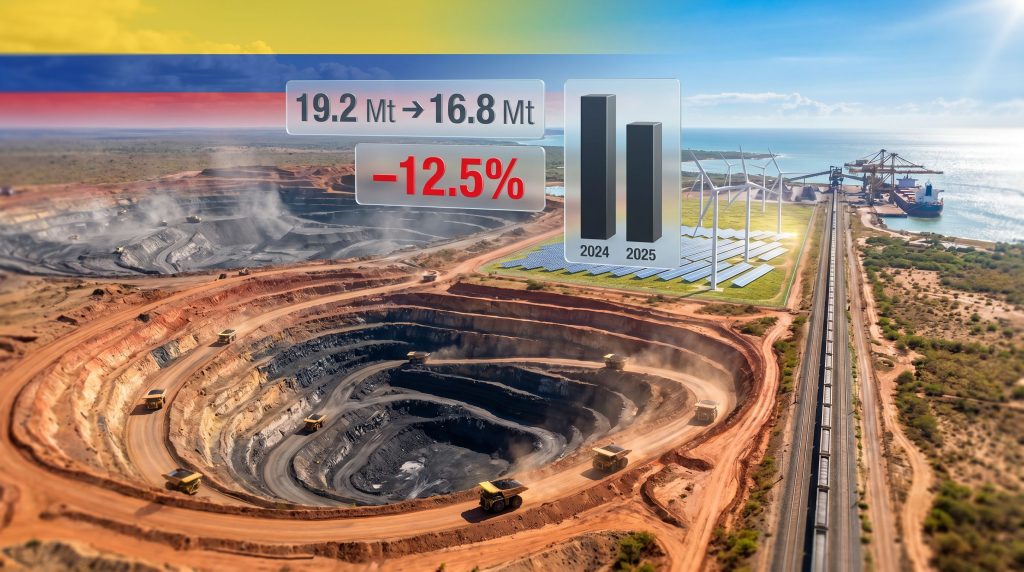
The mine's production figures tell an important part of the story:
| Year | Production (Million Tonnes) | Year-on-Year Change |
|---|---|---|
| 2024 | 19.2 Mt | – |
| 2025 | 16.8 Mt | -12.5% |
A contraction of approximately 2.4 million tonnes in a single year is not a minor operational fluctuation. It represents a structural shift in the mine's output trajectory, one that analysts would typically examine alongside capital expenditure trends, workforce levels, and equipment maintenance cycles to determine whether the decline is recoverable or entrenched.
Understanding the Open-Pit Model and Its Closure Complexity
Open-pit coal mining at Cerrejon's scale involves a fundamentally different closure calculus compared to underground operations. As the pit expands over time, the volume of overburden requiring removal per tonne of coal extracted typically increases, raising unit costs and compressing margins. This dynamic, known in mining economics as the strip ratio, tends to worsen as a mine ages, making the economic case for early closure progressively more compelling even before political factors enter the equation.
The infrastructure footprint compounds the complexity further. Decommissioning a 150-kilometre dedicated railway line and a purpose-built export port facility involves significant mine reclamation challenges, community transition arrangements, and asset disposal decisions that cannot be executed quickly or cheaply. Any negotiated closure framework must account for these realities from the outset.
Colombia's Policy Architecture and the Urgency Behind the Talks
A Government With a Narrowing Window
President Gustavo Petro's administration has structured its energy transition agenda around a clear policy instrument: prohibiting the signing of new exploration contracts for hydrocarbons and coal-based minerals. The intent is to redirect Colombia's resource economy toward clean and renewable energy sources, with the La Guajira region specifically identified as a priority zone for this transition given its substantial renewable energy potential.
What makes the timing of the Cerrejon coal mine closure talks particularly significant is the political calendar. Petro's four-year presidential term concludes in August 2026, creating a compressed window of roughly three months from the date of the government's formal closure request to lock in any substantive negotiating framework before a potential change in administration could reset the policy direction entirely.
This is not a minor procedural consideration. A succeeding administration with different priorities could shelve the closure dialogue indefinitely, allowing the concession to run its remaining course to 2034 without the transition commitments the current government is seeking. The sense of urgency embedded in Minister of Mines and Energy Edwin Palma's public statements reflects this structural constraint.
The Three-Pillar Framework for Closure Discussions
The Colombian Ministry of Mines and Energy has outlined a structured approach to what it wants closure negotiations to address. Rather than framing the discussion purely as an exit from coal, the government has positioned it around three interconnected commitments:
- Clean energy infrastructure investment in La Guajira, leveraging the region's renewable resource base
- Workforce retraining and skills development programmes for Cerrejon's direct and indirect workforce
- New economic ventures oriented toward sustainable industries capable of generating long-term regional employment
This three-pillar structure reflects a sophisticated understanding of why just transition frameworks fail in practice: they often focus on decommissioning the old economy without adequately specifying what replaces it. The government's insistence on embedding transition commitments within the closure discussion itself, rather than treating them as a separate downstream consideration, is analytically significant.
Palma's public framing made clear that the Colombian government does not view the remaining concession years as an automatic entitlement to continued operations at current scale. The position establishes that the time remaining until 2034 should be treated as a transition window rather than a production guarantee.
Glencore's Position: Reading the Silence
Corporate Silence in a Sovereign Context
As of May 2026, Glencore and Cerrejon's operational management had not issued any public response to the Colombian government's formal request for closure discussions, declining to comment when approached by media outlets covering the story.
In sovereign concession disputes, corporate silence typically serves one of several strategic functions. It may reflect an internal legal and commercial review process, where management is assessing its contractual rights and obligations before taking a public position. It may represent a deliberate negotiating tactic designed to avoid anchoring to an early position. Or it may signal genuine uncertainty about how to balance the competing pressures of asset value protection, sovereign relationship management, and broader portfolio strategy.
Glencore's broader coal strategy provides important context here. The company has faced sustained pressure from institutional investors and climate advocacy groups regarding its coal assets, whilst simultaneously arguing that managed decline of coal operations is preferable to rapid divestment that transfers assets to less scrupulous operators. How Cerrejon fits within that framework, particularly given its declining production trajectory, is a question Glencore will ultimately need to answer publicly.
The Israel Export Dispute: A Precedent That Reshapes the Negotiating Landscape
In July 2025, President Petro publicly stated his intention to unilaterally amend Glencore's concession contract if Cerrejon coal continued to be shipped to Israel. Glencore subsequently complied with the government's demand and halted those exports.
This episode carries implications that extend well beyond the specific trade route involved. It established, in practical terms, that the Petro administration was prepared to use concession modification as an active policy instrument rather than a last resort. For Glencore's legal and commercial teams, this precedent materially changes the risk calculus:
- Sovereign intervention risk at Cerrejon is no longer theoretical; it has been demonstrated
- The company's compliance in 2025 may have implicitly validated the government's authority to impose such conditions
- Any legal challenge to future unilateral actions would need to contend with the precedent established by the company's own earlier compliance
- International arbitration proceedings, if pursued, would unfold in a context where Glencore had already accommodated one unilateral government intervention
The Israel export dispute matters not because of its direct commercial significance, but because it functionally tested and confirmed the outer boundaries of what the Petro administration was willing to do. Closure talks now take place in the shadow of that demonstrated willingness.
A Multi-Party Negotiation With Divergent Interests
Mapping the Stakeholder Landscape
The Cerrejon coal mine closure talks involve a constellation of parties whose interests align on some dimensions and diverge sharply on others. Understanding this landscape is essential to assessing what a viable negotiated outcome might look like.
| Stakeholder | Primary Concern | Negotiating Priority |
|---|---|---|
| Colombian Ministry of Mines & Energy | Energy transition alignment | Accelerated closure timeline |
| La Guajira Provincial Authorities | Regional economic continuity | Just transition investment commitments |
| Local and Indigenous Communities | Livelihoods and social infrastructure | Workforce retraining and new economic alternatives |
| Glencore (Operator) | Asset value recovery and legal certainty | Concession term protection until 2034 |
| Labour Unions | Worker employment security | Transition support packages and job guarantees |
| Global Coal Markets | Supply continuity | Production volume stability |
The La Guajira Dimension
La Guajira occupies a particular position in this negotiation that no party can afford to underestimate. The region is home to the Wayuu indigenous people, one of Colombia's largest indigenous communities, whose relationship with large-scale mining operations at Cerrejon has historically been contentious, involving disputes over water access, land rights, and environmental impacts documented by international human rights organisations.
Under Colombian law, extractive projects affecting indigenous territories are subject to prior consultation requirements that carry genuine legal weight. Any closure framework that attempts to bypass community-level dialogue risks legal challenge, delays, and reputational damage for all parties involved. The government's explicit inclusion of community representatives in the proposed dialogue structure reflects both a legal obligation and a political necessity.
The economic stakes for the region are substantial. Royalty payments from Cerrejon have historically represented a significant component of La Guajira's provincial fiscal base, and the mine's direct and indirect employment footprint has shaped the regional labour market for decades. Furthermore, transitioning away from that economic anchor requires credible, funded alternatives — not aspirational policy statements. The broader commodity prices and mining performance dynamics make this transition even more urgent to get right.
Three Scenarios for How This Resolves
Scenario 1: Negotiated Early Closure Before August 2026
This outcome requires Glencore to enter formal dialogue and reach a framework agreement with the Colombian government before Petro's term concludes. Such an agreement would likely involve financial compensation for early concession termination, a phased production wind-down schedule, binding investment commitments for clean energy and workforce transition in La Guajira, and regulatory cooperation from the government in return.
The window for this scenario is narrow. Meaningful progress on a multi-party negotiation of this complexity within roughly three months represents an ambitious timeline, even under favourable conditions.
Scenario 2: Concession Runs to Natural Expiry in 2034
If negotiations stall or a new administration reverses the current policy direction, Cerrejon could continue operating under its existing concession terms until 2034. This outcome preserves Glencore's contractual rights but leaves the company exposed to continued sovereign intervention risk of the kind demonstrated in the 2025 Israel export dispute.
It also means operating an asset on a declining production curve, with the infrastructure decommissioning obligations still ultimately triggered at concession end. The economic case for this scenario weakens as the production trajectory continues downward and as clean energy alternatives in La Guajira advance independently of any negotiated framework.
Scenario 3: Unilateral Government Action
Should negotiations break down entirely before August 2026, the government retains the option of unilateral concession modification, as it signalled its willingness to deploy in 2025. This pathway carries the highest risk for both parties:
- Glencore would almost certainly pursue international arbitration, likely under investor-state dispute settlement mechanisms embedded in bilateral investment treaties
- Colombia would face reputational consequences in the broader foreign direct investment community
- The litigation timeline would likely extend years beyond the current political cycle, creating prolonged uncertainty for the region
This scenario is the least likely to produce outcomes that serve any party's core interests, yet it remains a credible possibility if the pressure of Petro's term deadline generates a policy action before a negotiated framework can be established.
The next major ASX story will hit our subscribers first
The Bigger Picture: Cerrejon as a Just Transition Case Study
Global Context for Mine Closures in Developing Economies
The Cerrejon situation is unfolding within a broader global pattern where coal-producing developing economies are being asked to transition away from fossil fuel revenues whilst managing the social and fiscal consequences of that shift. The South Africa mining decline offers a cautionary parallel, with Indonesia and Poland each navigating versions of this challenge with varying degrees of international financial support and domestic political consensus.
What distinguishes the Cerrejon case is the combination of scale, the integrated infrastructure footprint, and the compressed political timeline. Multilateral financing institutions including the World Bank and regional development banks have developed structured just transition financing mechanisms in recent years, but accessing these typically requires detailed planning frameworks that take time to develop and negotiate.
La Guajira's Renewable Energy Potential
An often underappreciated dimension of this situation is the renewable energy resource quality of La Guajira itself. The region has been identified as one of Latin America's most promising wind and solar zones, with consistently strong resource measurements that have attracted the attention of independent power developers. The energy transition in mining more broadly is accelerating this shift, as rising critical minerals demand reshapes investment priorities across the sector.
The strategic logic of repurposing elements of Cerrejon's existing infrastructure corridor for clean energy logistics has been raised in policy circles. A 150-kilometre railway and an operational Caribbean port represent infrastructure assets with potential alternative uses in a renewable energy supply chain context, whether for transporting wind turbine components, supporting offshore renewable projects, or facilitating hydrogen export in a longer-term scenario.
Whether this potential is realised depends on the quality of the transition framework negotiated, the availability of financing, and the political continuity of Colombia's energy transition agenda beyond August 2026. Reporting from energy analysts suggests the renewable opportunity in La Guajira is substantial enough to underpin credible alternative economic development — provided the political will and financing align.
Key Signals Worth Monitoring
Forward Indicators for the Closure Process
For anyone tracking the progression of the Cerrejon coal mine closure talks, the following developments carry the most analytical weight:
- Glencore's formal response to the government's dialogue request, which will clarify whether the company intends to engage constructively or contest the process
- The August 2026 presidential transition, which represents the single most consequential variable for whether the current closure framework survives or is abandoned
- Labour union positions, whose engagement with any proposed transition package will determine whether workforce concerns become a facilitating or blocking factor
- La Guajira renewable energy pipeline progress, including permitting and financing milestones that would strengthen the economic case for transition investment
- Any signals of legal action preparation by Glencore, which would indicate the company is positioning for arbitration rather than negotiation
The three months between the government's formal request in May 2026 and the end of Petro's term represent the period of highest pressure and highest consequence for the outcome of these discussions. What is negotiated, or not negotiated, within that window will shape La Guajira's economic trajectory and Glencore's Colombian exposure for years beyond the current political cycle.
Disclaimer: This article is intended for informational purposes only and does not constitute financial or investment advice. Projections, scenarios, and forward-looking assessments reflect analytical interpretation of available public information and are subject to change. Readers should consult qualified professional advisers before making investment decisions based on information contained herein.
Want to Spot the Next Major Mineral Discovery Before the Market Does?
While sovereign transitions reshape legacy coal assets like Cerrejon, Discovery Alert's proprietary Discovery IQ model scans ASX announcements in real time, instantly alerting subscribers to significant new mineral discoveries — from critical minerals powering the energy transition to emerging commodities reshaping global supply chains. Explore historic discoveries and their exceptional returns, then begin your 14-day free trial to gain a genuine market-leading edge.