August 6, 2026
When Sector Rotation Meets Resource Strength: Reading the ASX Open Correctly
Global equity markets rarely move in unison, and the days when a single overnight signal cleanly dictates the following morning's open are increasingly rare. What matters more to sophisticated investors is which parts of a market are moving, and why those movements carry different implications depending on the composition of the index receiving the signal. This distinction becomes especially relevant when interpreting an ASX market open modest slide on mixed US reporting overnight, where the surface-level read of a lower open conceals a considerably more nuanced picture beneath.
When big ASX news breaks, our subscribers know first
Understanding the Cross-Pacific Signal Transmission Mechanism
The pathway from Wall Street's close to the ASX's open is not a simple relay. It operates through ASX SPI (Share Price Index) futures, which trade during Australian hours and price in overnight U.S. developments before the physical market opens. Institutional desks monitor these futures as the primary leading indicator of opening direction, adjusting positions accordingly.
What makes the overnight session on August 5, 2026 (U.S. time) particularly instructive is the divergence between benchmark indices rather than a uniform decline. Furthermore, ASX market performance in recent periods has demonstrated how index composition shapes the transmission of offshore signals.
| Index | Close Level | Session Move | Primary Driver |
|---|---|---|---|
| Dow Jones Industrial Average | 54,349 | Record High | Strong blue-chip earnings reports |
| S&P 500 | 7,724 | -0.2% | Mixed corporate earnings, AI uncertainty |
| Nasdaq Composite | 26,363 | -0.8% | AI sector reporting concerns |
When the Dow closes at a record high while the Nasdaq falls 0.8%, the signal is not macro deterioration. It is sector rotation, specifically a rotation away from growth and technology names toward value and industrials. This distinction matters enormously for the ASX, where the materials and energy sectors carry far greater index weight than technology.
Investor Framework: Uniform selloffs across U.S. benchmarks signal genuine risk-off conditions and typically produce sharper ASX declines. Divergent sessions, where value leads and growth lags, tend to produce range-bound or modestly lower ASX opens with pronounced sector-level dispersion rather than index-level collapse.
The Strength Behind the Slide: Why the ASX's Starting Position Matters
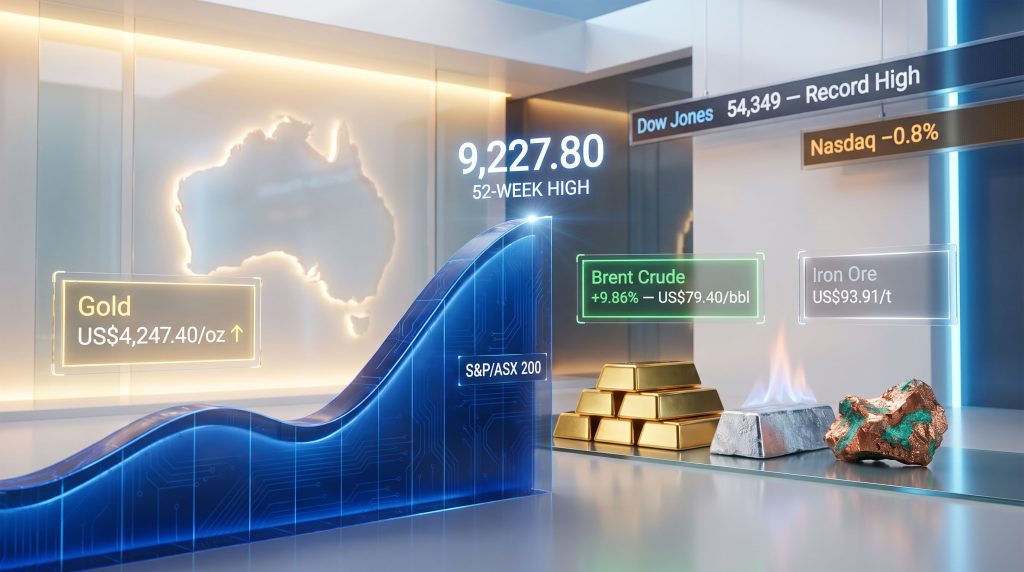
Context is everything when interpreting a lower open. The S&P/ASX 200 closed the prior session at 9,227.80, representing a 52-week high and a gain of 82.00 points (+0.90%) on August 5, 2026. A modest pullback from this level is statistically unremarkable and is consistent with the normal behaviour of indices that have extended to new highs.
Technically, 52-week high closes are associated with two competing dynamics. On one hand, momentum traders interpret them as confirmation of trend continuation. On the other hand, they attract short-term profit-taking from investors who entered earlier in the cycle. The net effect is often a session or two of consolidation before the trend reasserts, assuming underlying fundamentals remain intact.
Crucially, the commodity signals underpinning the ASX's resource-heavy composition were broadly constructive heading into the open:
- Iron ore price trends showed a gain of +0.22% to US$93.91 per tonne, providing stable support for major diversified miners
- Gold held at US$4,247.40 per ounce, sustaining the elevated price environment that has been driving significant earnings upgrades across ASX gold producers
- Brent Crude surged +9.86% to US$79.40 per barrel, a substantial single-session move driven by positive signals around potential Strait of Hormuz developments
- U.S. Natural Gas Futures slipped -1.91% to US$2.6699/MMBtu, introducing a mild headwind for LNG-exposed names
- The Australian Dollar was buying US$0.7056, a relatively firm reading that, while positive for import costs, can modestly compress the AUD-equivalent earnings of resource exporters
Metals Resilience in the Face of Geopolitical Disruption
The broader macro backdrop shaping commodity markets in mid-2026 has been dominated by the question of how deeply the Middle East conflict disrupted global metals supply chains. Wood Mackenzie's mid-year metals sector review provided a detailed quantitative answer, and the findings were more constructive than many anticipated.
Peter Schmitz, Director of Global Markets Research at Wood Mackenzie, noted that the metals sector had absorbed a substantial geopolitical shock with considerably more composure than most forecasts had predicted. The most striking data point was in aluminium: at the peak of market concern, the disruption was expected to generate a supply deficit of between 2.5 and 3.0 million tonnes. The revised mid-year estimate reduced that figure to approximately 900,000 tonnes, a downward revision of roughly 70%.
| Metric | Initial Disruption Estimate | Revised Mid-Year Estimate |
|---|---|---|
| Aluminium Supply Deficit | 2.5-3.0 million tonnes | ~900,000 tonnes |
| Direct Reduced Iron Output Affected | ~32% of global production | Stable (minor share of total steel) |
| Copper Market Position | Deficit anticipated | Slight surplus |
Schmitz was careful, however, to frame the reduced deficit not as an all-clear signal but as a deferral of consequences. His assessment highlighted that inventories were continuing to deplete, cost pressures were accumulating gradually, investment decisions were being deferred across the sector, and demand was reorienting away from China in ways that may not yet be fully reflected in pricing.
Key Insight: A 900,000-tonne aluminium deficit and a slight copper surplus are not comfortable figures. They are simply less alarming than the worst-case scenarios that were being modelled earlier in the year. The underlying structural vulnerabilities remain live concerns for medium-term supply.
The Hidden Risk: Deferred Capital Investment
One of the less-discussed consequences of geopolitical disruption in commodity markets is the chilling effect on capital allocation decisions. When operating environments become uncertain, mining companies and their financiers delay final investment decisions on new projects and expansion programmes. This deferred capex does not disappear from the supply equation; it simply shifts the timeline of future production additions, creating the conditions for tighter markets in subsequent years.
For ASX investors with exposure to copper market trends and aluminium developers, this dynamic provides a structural medium-term price floor that complements the near-term deficit figures. Projects that are well-advanced in permitting and development are positioned to benefit disproportionately when the investment cycle eventually restarts.
The Ichthys LNG Prosecution: A Turning Point for Australian Regulatory Risk
Away from commodity markets, one of the most significant developments for Australian energy investors involves regulatory action rather than price movements. The Northern Territory Environmental Protection Agency (NT EPA) has initiated formal prosecution proceedings against the Inpex-operated Ichthys LNG project, centred on the systematic under-reporting of benzene and toluene emissions across a five-year period from 2019 to 2024.
The sequence of events leading to prosecution followed a self-disclosure pathway. In October 2025, Inpex informed the NT EPA of significant emission reporting failures at the Ichthys facility. Under the facility's operating licence, annual reporting of total air emissions in tonnes is a mandatory condition. The NT EPA's investigation, which followed the self-disclosure, subsequently escalated to formal prosecution.
What the Ichthys Case Signals to the Broader LNG Sector
The prosecution's significance extends well beyond the specific compliance failure at Ichthys. The NT EPA has explicitly framed its regulatory response as part of a broader suite of actions, including a recommendation to strengthen licence terms and conditions across all LNG facilities operating in Darwin Harbour. The scope of this recommendation signals a shift in the enforcement posture of Australian environmental regulators.
In addition, Australia's resource and energy exports face compounding pressures as regulatory frameworks tighten. Several implications follow for investors in LNG-exposed ASX equities:
- Compliance cost escalation: Strengthened licence conditions typically translate into higher monitoring, reporting, and potentially abatement costs for operators
- Licence condition uncertainty: Facilities operating under existing licences may face revised conditions that alter operational parameters
- Reputational risk premium: Prosecution proceedings against a major LNG facility introduce a reputational dimension that can affect capital market perceptions of sector risk
- Sector-wide review risk: The NT EPA's framing of its response as sector-wide rather than facility-specific suggests that other operators may face similar scrutiny
Regulatory Risk Note: The Ichthys prosecution does not represent an isolated compliance incident. The NT EPA's decision to use it as the basis for a broader Darwin Harbour LNG licence review indicates a systemic shift in how Australian environmental authorities are approaching hydrocarbon emissions monitoring. Investors should treat NT EPA announcements as a leading indicator of sector-wide compliance risk going forward.
Junior and Mid-Tier Exploration: The Critical Minerals Pipeline Stays Active
While macro forces and regulatory developments dominate the broader conversation, the operational activity among ASX-listed junior resource companies provides an important read on sector-level confidence. Despite the uncertain global backdrop, exploration pipelines remain active across the critical minerals space.
| Company (ASX Code) | Activity | Commodity Focus |
|---|---|---|
| Chilwa Minerals (CHW) | Shallow mineralisation confirmed at Mpyupyu West | Base metals |
| Black Bear Minerals (BKB) | Rising silver grades from historic core, Shafter project, Texas | Silver |
| Somerset Minerals (SMM) | High-grade copper-silver discovery at Talisker | Copper/Silver |
| Kaoko Metals (KAO) | Drilling commenced at Chalkos | Base metals |
| Panther Metals (PNT) | Multiple nickel-copper targets defined at Red Flag | Nickel/Copper |
Somerset Minerals' Talisker discovery warrants particular attention from a geological standpoint. Intercepts of up to 46.3% copper and 214 g/t silver represent discovery-grade results that are exceptionally rare in the current exploration environment. For context, copper grades above 5% are generally considered high-grade in modern open-cut operations; a 46.3% copper intercept indicates either a very high-grade vein system or a massive sulphide lens, both of which carry significant resource upgrade potential if the system proves continuous at depth.
The concentration of copper, silver, and nickel targets across these active campaigns reflects a deliberate alignment by ASX junior operators with the commodity suite most directly linked to the global energy transition. Battery cathode materials, electrical wiring systems, and industrial electrification all depend heavily on copper availability, and the market is increasingly rewarding high-grade discovery results with positive re-ratings. Monitoring the gold price outlook alongside base metals performance remains essential for investors calibrating exposure across the resource sector.
BHP's Infrastructure Commitment as a Bellwether Signal
Monadelphous Group (ASX: MND) securing a major construction contract at BHP's Nelson's Point facility is a tier-one signal worth noting. When Australia's largest mining company commits fresh capital to infrastructure at established operations, it communicates a forward-looking confidence in long-term commodity demand that carries more analytical weight than any single quarterly pricing data point. BHP's capital allocation decisions are among the most closely watched in the sector precisely because they reflect the view of an operator with the deepest intelligence on long-cycle demand fundamentals.
The next major ASX story will hit our subscribers first
Positioning Across Different Investor Timeframes
The conditions heading into the August 6 open create different implications depending on investment horizon and risk appetite.
For short-term traders, the directionless early session typical of a mixed U.S. lead creates opportunity in sector divergence rather than index-level positioning. Energy names responding to Brent's +9.86% overnight gain may outperform while Nasdaq-correlated technology and AI-adjacent names absorb the growth sector's weakness. Intraday volatility tends to be elevated in these conditions as competing narratives resolve.
For medium-term investors, the commodity picture provides durable support. The gold price outlook above US$4,247/oz sustains a structurally favourable earnings environment for ASX gold producers. Iron ore at US$93.91/tonne is consistent with healthy operating margins for major diversified miners. Furthermore, the Wood Mackenzie aluminium deficit, while revised lower, still confirms supply tightness that underpins base metal price floors through the remainder of the year.
For long-term investors, the themes worth monitoring extend beyond daily price movements:
- The energy transition metals pipeline, where copper and nickel discovery activity signals continued operator confidence in structural demand
- The evolving LNG regulatory environment, where the Ichthys prosecution may prove to be an early marker of a broader compliance environment shift
- The AI sector earnings cycle, where Nasdaq volatility driven by reporting concerns could periodically introduce risk-off episodes that compress global equity sentiment
- Deferred mining capex across the sector, which is building the conditions for medium-term supply constraints in several key metals
Consequently, understanding the layered dynamics behind a seemingly straightforward lower open — from the mechanics of cross-Pacific signal transmission through to the resource and energy exports landscape — is what separates reactive trading from informed, structured portfolio decision-making.
Disclaimer: This article is provided for informational purposes only and does not constitute financial advice. All market data referenced reflects conditions as of August 6, 2026 (AEST). Commodity prices, index levels, and corporate developments are subject to rapid change. Readers should conduct their own research and consult a qualified financial adviser before making any investment decisions. Forward-looking statements and forecasts involve inherent uncertainty and should not be relied upon as predictions of future outcomes.
Want to Identify the Next High-Grade Discovery Before the Broader Market Does?
Somerset Minerals' extraordinary Talisker intercepts — up to 46.3% copper and 214 g/t silver — illustrate precisely why being first to a significant ASX mineral discovery can be transformative, and Discovery Alert's proprietary Discovery IQ model delivers real-time alerts the moment announcements like these hit the ASX, turning complex geological data into clear, actionable insights across more than 30 commodities. Explore historic examples of major discovery returns and begin your 14-day free trial today to ensure you're positioned ahead of the market when the next exceptional result emerges.