August 3, 2026
When Commodity Strength Fails to Lift Share Prices: A July 2026 Autopsy
There is a persistent myth in resources investing that strong commodity prices automatically translate into strong miner share prices. July 2026 dismantled that assumption with considerable force. Across the three largest iron ore-focused miners listed on the ASX, a month that featured copper trading at historically elevated levels and iron ore holding a steady floor still produced results that ranged from modest underperformance to outright decline. Understanding why requires looking well beyond spot prices.
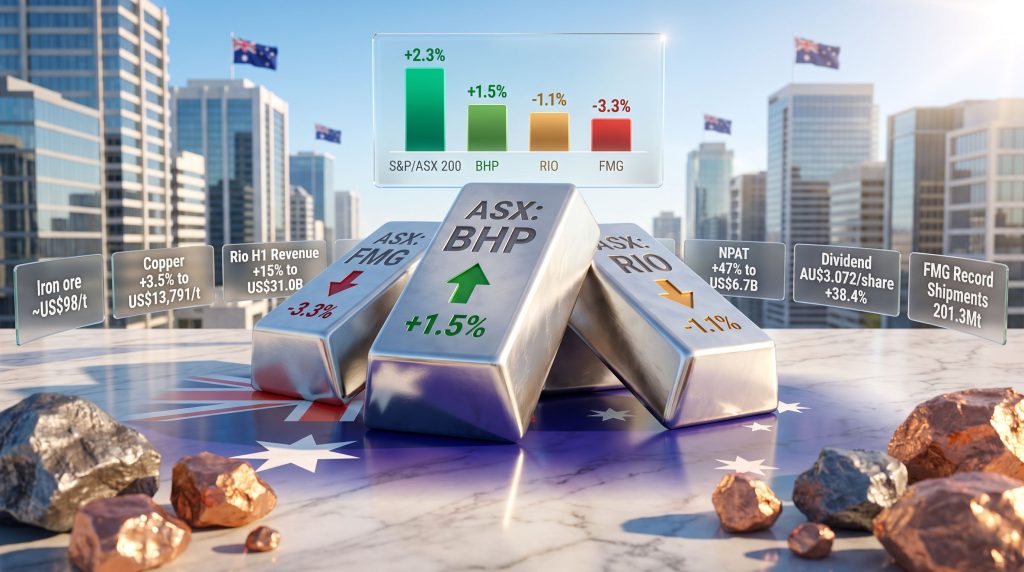
Rio Tinto, Fortescue and BHP shares in July collectively failed to match the S&P/ASX 200 Index's 2.3% monthly gain, despite each company reporting results during the period. The reasons differ meaningfully between the three, and those differences reveal important structural dynamics about how large-cap mining equities are actually priced by institutional markets.
When big ASX news breaks, our subscribers know first
The Benchmark Divergence: Where Did Each Miner Land?
A straightforward comparison of July's outcomes illustrates just how wide the performance gap was across the group and relative to the broader index.
| Metric | July 2026 Performance |
|---|---|
| S&P/ASX 200 Index (XJO) | +2.3% |
| BHP Group (ASX: BHP) | +1.5% |
| Rio Tinto (ASX: RIO) | -1.1% |
| Fortescue (ASX: FMG) | -3.3% |
BHP was the only one of the three to finish the month in positive territory, closing at $60.31 after opening July from $59.40. Rio Tinto moved from $172.51 to $170.57, a decline of 1.1%. Fortescue fell from approximately $19.12 to $18.51, representing the weakest monthly outcome at -3.3%.
What unified all three was underperformance against a broader market that benefited from sector rotation into financials, healthcare, and technology during the same period. Mining's relative weakness was not a story of catastrophic fundamentals, but rather a story of market pricing being pulled in multiple directions simultaneously. For further context on how Rio Tinto, Fortescue and BHP shares stacked up, the June 2026 period provides a useful preceding benchmark.
Iron Ore vs. Copper: The Commodity Divergence That Defined the Month
Iron ore, which remains the dominant revenue driver for all three miners, traded in a relatively contained band around US$98 per tonne throughout July. That stability, while arguably reassuring, provided no incremental catalyst for re-rating. The iron ore demand outlook remains closely tied to Chinese steel output, which continues to face headwinds from the country's property sector restructuring.
Copper told an entirely different story. The red metal climbed 3.5% across the month, closing at approximately US$13,791 per tonne according to Bloomberg data. That divergence matters enormously when assessing how the market valued each miner's commodity mix. Furthermore, the copper supply crunch unfolding across global markets added a structural dimension to the metal's price strength.
Copper's continued strength reflects cumulative demand from energy transition infrastructure buildout, including grid upgrades, electric vehicle manufacturing supply chains, and utility-scale battery storage projects. Iron ore, by contrast, remains tightly coupled to Chinese steel output, which has been constrained by ongoing property sector restructuring.
This commodity split created a clear hierarchy of perceived earnings quality. Miners with meaningful copper exposure attracted more favourable investor sentiment, while those dependent almost entirely on iron ore faced headwinds tied to China demand uncertainty.
Understanding Grade Decline at the Mine Level: The Escondida Factor
One aspect of copper mining that is often underappreciated by generalist investors is the concept of ore grade decline. As open-pit copper mines mature, the average grade of copper per tonne of rock extracted typically decreases over time, even as total material mined may increase. This means that producing the same quantity of copper requires processing progressively larger volumes of ore, increasing unit costs.
At BHP's Escondida mine in Chile, the world's largest copper-producing operation by volume, forecast grade decline was explicitly cited as the primary reason for reduced FY2027 copper production guidance. This is not an operational failure but a geological reality built into the mine's life-of-asset plan. Understanding this distinction is critical for investors assessing whether a production shortfall reflects poor management or simply the physics of a maturing ore body.
BHP Shares in July 2026: Strong Current Results, Softer Forward Picture
BHP's June quarter update, released on 16 July, captured both sides of the miner's current position with notable clarity.
FY2026 Production Summary
- Full-year copper output reached 1.95 million tonnes, a 3% year-on-year decline
- Q4 alone contributed 491,900 tonnes of copper, up 3% quarter on quarter
- The average realised copper price surged 35% to US$5.74 per pound in FY2026, more than offsetting the volume reduction
- Iron ore production totalled 264.7 million tonnes for the full year, a 1% improvement on FY2025
On any standalone reading, these are robust numbers. A 35% lift in realised copper pricing represents a significant windfall, and iron ore volumes trending modestly higher shows operational resilience in the Pilbara.
Yet BHP shares fell 2.3% on 16 July, the day of the quarterly release. The market's focus shifted immediately to FY2027 guidance, which projected copper output of 1.65 million to 1.8 million tonnes and iron ore of 260 million to 272 million tonnes. The copper guidance represents a material step-down from FY2026 levels, and that forward signal dominated the near-term price reaction.
This dynamic illustrates one of the more counterintuitive aspects of resources investing: institutional capital often prices miners on a forward basis rather than on trailing results. A record realised price in the year just completed can be entirely overshadowed by volume guidance suggesting lower output in the year ahead.
Rio Tinto Shares in July 2026: Volatility, Recovery, and Earnings Quality
Rio Tinto's July experience was more turbulent than its modest -1.1% monthly outcome suggests. The share price fell sharply in the first two weeks before recovering aggressively on the back of a standout earnings release.
The Early-Month Selloff
- Rio Tinto opened July at approximately A$173.07
- By 8 July, the price had declined to around A$163.85, a drop of roughly 5.3% in less than two weeks
- Single-session declines of -1.77% on 7 July and -2.55% on 8 July reflected broad sector-wide selling rather than company-specific concerns
- A Berenberg analyst upgrade near the end of the month contributed to a recovery of approximately 3%
H1 2026 Results: A Catalyst That Shifted Market Sentiment
When Rio Tinto reported its half-year results on 29 July, the numbers were materially stronger than consensus expectations across every major financial metric.
| Financial Metric | H1 2026 Result | Year-on-Year Change |
|---|---|---|
| Revenue | US$31.0 billion | +15% |
| Underlying EBITDA | US$14.8 billion | +28% |
| Profit After Tax (attributable) | US$6.7 billion | +47% |
| Interim Dividend | AU$3.072 per share | +38.4% |
The 47% jump in attributable profit combined with a 38.4% increase in the interim fully franked dividend represented one of the more compelling earnings releases from any ASX large-cap in the reporting period. Rio Tinto shares surged 3.7% on 29 July alone, partially recovering the ground lost in early trading weeks.
Importantly, Rio Tinto's copper and lithium portfolio was highlighted as a key driver of the earnings uplift. This reinforces the structural thesis that diversification away from iron ore dependency is increasingly being rewarded by equity markets, not merely in theory but in observed earnings outcomes.
What the Dividend Signal Means for Long-Term Investors
A 38.4% increase in the interim dividend warrants particular attention from income-oriented investors. Dividend growth of that magnitude is not routine for a miner of Rio Tinto's scale, and it signals management confidence in the sustainability of current cash generation. For investors focused on total return, the franking benefits attached to Australian-domiciled distributions add a meaningful layer of after-tax value.
Fortescue Shares in July 2026: A Record Obscured by a Major Write-Down
Fortescue's July experience illustrates a concept known in financial analysis as earnings quality deterioration, where headline operational achievements are undermined by balance sheet charges that prompt investors to reassess project economics.
Record Iron Ore Shipments: The Positive Foundation
- Total iron ore shipments reached an all-time record of 201.3 million tonnes in FY2026, up 1% year on year
- FY2027 shipment guidance was issued in the range of 197 million to 207 million tonnes
- The guidance range implies reasonable volume continuity, with no significant production cliff
The Iron Bridge Impairment: Why Non-Cash Charges Still Matter
The dominant event for Fortescue in July was the announcement of a US$750 million pre-tax non-cash impairment charge on its Iron Bridge magnetite project, disclosed on 31 July. The carrying value reassessment reflected a revised ramp-up schedule and a recalibration of production scenarios relative to the project's nameplate capacity of 22 million tonnes per annum.
Fortescue shares fell 1.9% on 31 July in direct response.
A common misconception among newer investors is that non-cash charges are inconsequential because they do not reduce operating cash flow. However, that reasoning misses several important implications:
- Capital allocation credibility is affected when a project requires a material impairment, raising questions about original investment assumptions
- Future earnings may be lower than previously modelled if the impairment reflects structurally reduced production expectations
- Investor confidence in management's ability to execute complex project ramp-ups can erode, particularly when the affected asset involves technically demanding ore processing
Iron Bridge is a magnetite project, which involves a fundamentally different processing pathway than Fortescue's traditional hematite operations. Magnetite ore requires significantly more energy-intensive beneficiation, including grinding and magnetic separation, to upgrade the ore to a saleable high-grade concentrate. This technical complexity helps explain why ramp-up timelines for magnetite projects are historically more challenging to execute than for direct-shipping hematite operations. In addition, understanding the iron ore types involved helps investors contextualise these processing cost differences.
Competing Catalysts During July
| Catalyst | Direction | Approximate Impact |
|---|---|---|
| Record FY2026 iron ore shipments (201.3Mt) | Positive | Short-term sentiment support |
| Reports of China restricting certain iron ore shipments | Negative | Investor risk-off pressure |
| Iron Bridge US$750M pre-tax impairment charge | Negative | -1.9% on announcement day |
| FY2027 shipment guidance broadly in line with expectations | Neutral | Limited incremental market reaction |
The next major ASX story will hit our subscribers first
Cross-Miner Scorecard: FY2026 at a Glance
| Metric | BHP (ASX: BHP) | Rio Tinto (ASX: RIO) | Fortescue (ASX: FMG) |
|---|---|---|---|
| July 2026 Share Price Change | +1.5% | -1.1% | -3.3% |
| Iron Ore Production/Shipments FY2026 | 264.7Mt (production) | Not separately disclosed in July update | 201.3Mt (record shipments) |
| Copper Production FY2026 | 1.95Mt | Copper/lithium key H1 earnings driver | Not a primary revenue driver |
| Standout Financial Result | Realised copper price +35% YoY | Revenue +15%, EBITDA +28%, NPAT +47% | Record shipment volume |
| FY2027 Volume Guidance | Cu: 1.65-1.80Mt; Fe: 260-272Mt | Not separately detailed in July reporting | Fe shipments: 197-207Mt |
| Key Negative Event | Escondida grade decline in FY2027 guidance | Early-month broad sector selloff | US$750M Iron Bridge impairment |
| Dividend Action | Not declared in July update | AU$3.072/share interim (+38.4%) | Not declared in July update |
What July Reveals About the Structural Positioning of Each Miner
The Pure-Play Iron Ore Risk Premium
Fortescue's near-exclusive dependence on iron ore exposes it more directly to fluctuations in Chinese steel demand than its peers. With China's property sector continuing to restructure, the traditional demand driver for steel, and therefore iron ore, faces a period of subdued growth expectations. Miners with commodity diversification into copper, aluminium, or lithium carry a structural buffer against this concentration risk.
Guidance Sensitivity as a Market Pricing Mechanism
BHP's July experience demonstrates that institutional investors apply a forward multiple to mining equities, not a trailing one. When FY2027 copper guidance fell below FY2026 actuals, the market treated this as a reduction in the asset's expected value stream, regardless of how strong the current-year numbers were. Consequently, this is a critical insight for investors who rely solely on reported production and pricing to assess fair value.
Earnings Quality and Its Durability
Rio Tinto's combination of revenue growth, margin expansion, profit uplift, and dividend increase represented the highest earnings quality outcome of the three miners in July. Unlike a volume record achieved against a flat or declining price, or a nominal profit figure obscured by write-downs, Rio Tinto's result demonstrated broad-based financial improvement across multiple metrics simultaneously. Analysts tracking ASX mining stocks have noted this divergence in earnings quality as a key differentiator heading into the second half of 2026.
Frequently Asked Questions
Which ASX mining share performed best in July 2026?
BHP Group (ASX: BHP) was the strongest performer of the three, closing July up 1.5%, though it still trailed the broader ASX 200's 2.3% monthly gain.
Why did Rio Tinto shares fall in early July despite strong earnings?
The early-month decline of approximately 5.3% between 1 July and 8 July reflected sector-wide selling pressure rather than company-specific concerns. The strong H1 2026 earnings released on 29 July, including a 47% profit increase and a 38.4% higher interim dividend, drove a partial recovery that limited the full-month decline to -1.1%.
What caused Fortescue shares to underperform in July 2026?
Two primary factors weighed on Fortescue: reports of China restricting access to certain iron ore shipments during the month, and a US$750 million pre-tax non-cash impairment on the Iron Bridge magnetite project announced on 31 July. Despite recording all-time high iron ore shipments of 201.3 million tonnes in FY2026, these negatives dominated the market's assessment.
What is a magnetite project and why is Iron Bridge's impairment significant?
Magnetite is a lower-grade iron ore type requiring intensive processing to produce a high-grade concentrate, unlike hematite which can often be shipped directly after basic crushing. The US$750 million impairment signals a meaningful revision to Iron Bridge's expected production ramp-up, introducing uncertainty about the project's long-term economics and Fortescue's capital allocation strategy in the higher-complexity magnetite segment. For investors keen on interpreting drill results and project data more broadly, understanding ore type distinctions is an essential first step.
How did commodity prices affect ASX mining shares in July 2026?
Iron ore held relatively steady around US$98 per tonne, providing limited upside catalyst. Copper rose 3.5% to US$13,791 per tonne, benefiting miners with copper exposure. Rio Tinto's H1 2026 earnings explicitly attributed a portion of its earnings strength to copper and lithium performance, reinforcing the market's preference for commodity-diversified miners in the current cycle.
Key Takeaways for Investors
- Commodity mix is increasingly a re-rating variable: The gap between copper-exposed and pure-play iron ore miners is widening in terms of market valuation and earnings quality perception
- Forward guidance dominates short-term price reactions: BHP's July decline on results day, despite strong FY2026 actuals, confirms that institutional investors price on future output expectations, not trailing performance
- Non-cash impairments carry reputational weight beyond their accounting treatment: Fortescue's Iron Bridge charge raises legitimate questions about project execution in technically demanding ore types
- Earnings quality, not volume records, drives durable re-ratings: Rio Tinto's multi-metric improvement, capped by a substantial dividend increase, demonstrated the most sustainable positive catalyst of the three miners during the month
- Ore grade geology is a fundamental investment variable: Understanding grade decline at operations like Escondida helps investors distinguish between manageable geological inevitabilities and operational underperformance
This article contains general information only and does not constitute financial advice. Past performance is not indicative of future results. Investors should consider their own circumstances and seek independent financial advice before making investment decisions. Share prices and commodity data referenced reflect July 2026 trading conditions.
Want to Identify the Next Major ASX Mineral Discovery Before the Broader Market?
Discovery Alert's proprietary Discovery IQ model delivers real-time alerts on significant ASX mineral discoveries, transforming complex geological and commodity data into actionable investment insights for both short-term traders and long-term investors — explore historic examples of exceptional discovery returns to understand what early positioning can mean for a portfolio, then begin your 14-day free trial at Discovery Alert to secure a market-leading edge.