August 23, 2026
The Hidden Architecture of Oil's Risk Premium and Why It Can Vanish Overnight
Most retail investors think of oil prices as a reflection of how much crude is being pumped out of the ground versus how much the world consumes. That view captures perhaps half the picture. The other half is psychological, geopolitical, and deeply embedded in how professional traders price risk that has not yet materialised. Understanding this second dimension is what separates investors who get caught in sharp oil reversals from those who anticipate them.
When crude oil drops over 4% in a single session, as it did during Asian trading hours on Monday, August 4, 2026, the move is rarely about barrels. It is about fear leaving the market all at once.
When big ASX news breaks, our subscribers know first
What the 4% Drop in Oil Actually Reveals About Market Structure
The mechanics behind oil drops after Trump calls off planned strike on Iran are best understood through the lens of risk premium architecture, not supply fundamentals. In the months leading up to the announcement, crude oil price trends had been reflecting what traders call a geopolitical risk premium — an invisible surcharge added to the market price to compensate for the possibility that conflict could disrupt physical supply.
This premium is not calculated on a spreadsheet. It is the aggregate judgment of thousands of traders, algorithms, and institutional desks assessing the probability that a given geopolitical threat will translate into actual barrels being removed from the market. When that probability is perceived to fall sharply, the premium unwinds, sometimes in minutes.
Geopolitical risk premiums are structurally fragile because they are built on perception rather than physical reality. A single headline can dissolve what took weeks to accumulate.
The figures from that Monday session were unambiguous:
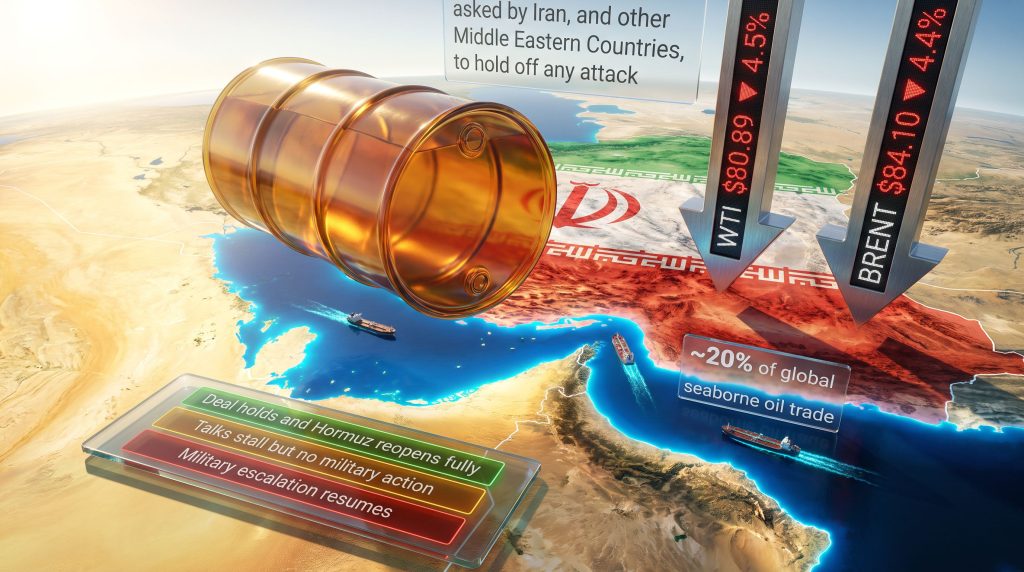
- West Texas Intermediate (WTI) crude for September delivery fell 4.5% to $80.89 per barrel
- Brent crude for October delivery declined 4.4% to $84.10 per barrel
- Both benchmarks moved in near-lockstep, confirming the driver was geopolitical rather than supply-specific
- The selloff concentrated during Asia-Pacific trading hours, when algorithmic systems reacted fastest to the overnight headline
The near-identical percentage decline across both benchmarks is itself informative. Brent and WTI can diverge significantly when the driver is domestic U.S. production or inventory data. When they move together at this magnitude, the cause is almost always a global risk event — in this case, the announcement by U.S. President Donald Trump that a planned military strike on Iran had been suspended.
The Strait of Hormuz: Why One Waterway Holds Global Energy Hostage
To understand why the potential for U.S. military action against Iran moves oil prices so dramatically, it is essential to understand the geography of global crude supply chains. The Strait of Hormuz is not merely a strategic concern. It is the single most consequential maritime chokepoint in the world energy system.
| Metric | Data Point |
|---|---|
| Share of global seaborne oil trade | Approximately 20% |
| Estimated daily volume transiting | 17 to 21 million barrels |
| Key exporting nations dependent on transit | Saudi Arabia, UAE, Kuwait, Iraq, Iran |
| Narrowest navigable shipping lane width | Approximately 3.2 kilometres per lane |
Any credible military escalation involving Iran immediately raises the spectre of Hormuz disruption. Even a partial closure or harassment campaign targeting tanker traffic through the strait would remove millions of barrels per day from global supply — the kind of disruption that would send Brent to levels not seen since the post-pandemic supply crunch.
Trump's proposed diplomatic framework, shared via Truth Social rather than through formal State Department channels, explicitly included the complete reopening of the Strait of Hormuz as a core condition. That detail alone confirmed to markets that Hormuz access had been a live pricing variable in the preceding weeks.
The U.S.-Iran conflict that preceded this announcement reportedly began on February 28, 2026, and in the months that followed, diplomatic progress stalled repeatedly. By early August, current crude prices had been absorbing elevated risk premiums throughout that entire period. The sudden de-escalation announcement therefore represented a compression of accumulated fear, not just a reaction to a single day's news.
Reading the Diplomatic Signal: Why Iran's Response Created a Two-Sided Risk
One of the most important analytical distinctions in geopolitical oil trading is between a de-escalation announcement and a confirmed agreement. These are fundamentally different things, and markets have historically learned the hard way when they treat the former as the latter.
In this instance, Iran's official response provided significant grounds for caution. Rather than confirming any framework, Iran's acting defence minister characterised Trump's statements as a component of what state media described as a psychological and cognitive warfare campaign. Separately, Fars International, the news agency affiliated with the Islamic Revolutionary Guard Corps, publicly described Trump's outlined demands as aspirational rather than agreed, signalling that no binding deal was in place.
This divergence between Washington's optimism and Tehran's scepticism creates what traders call an asymmetric risk profile:
- If the framework holds and Hormuz access is guaranteed, the war premium is fully removed and prices could extend lower
- If talks stall without military resumption, a partial uncertainty premium re-enters crude pricing
- If escalation resumes, oil could recover the entire lost premium and potentially exceed prior highs
What a Credible Iran Deal Would Actually Require
For the diplomatic framework to be taken seriously by energy markets, analysts and policy observers would generally expect to see the following elements in place:
- Verified Hormuz access commitments, backed by international maritime law or a neutral monitoring body with enforcement capability
- Concrete nuclear programme limitations with International Atomic Energy Agency inspection protocols
- Phased sanctions relief tied to verifiable Iranian compliance milestones rather than upfront concessions
- Multilateral endorsement from regional stakeholders including Saudi Arabia, the UAE, and major European powers with treaty credibility
None of these elements were confirmed in the initial announcement, which helps explain why, even as prices fell sharply, sophisticated market participants were already stress-testing the downside of a deal reversal.
Scenario Analysis: Three Paths Forward for Crude Pricing
The near-term trajectory for oil prices following this kind of geopolitically-driven move depends almost entirely on which of three scenarios plays out:
| Scenario | Probability Assessment | Likely Oil Price Direction |
|---|---|---|
| Deal holds and Hormuz reopens fully | Low to moderate, given unverified details | Sustained downward pressure; war premium fully removed |
| Talks stall but no military action | Moderate probability | Partial price recovery; uncertainty premium re-enters |
| Military escalation resumes | Lower but non-trivial probability | Sharp spike; Brent likely retests or exceeds prior highs |
Historical precedent is instructive here. In prior cycles of U.S.-Iran diplomatic engagement, crude markets have consistently shown a pattern of sharp initial declines on de-escalation headlines, followed by partial reversals as deal specifics proved elusive or negotiations collapsed. Furthermore, markets have developed what analysts describe as a credibility discount mechanism — a built-in scepticism applied to unverified geopolitical announcements, particularly those communicated through informal channels.
What the Move Means Across the Broader Economy
A 4% to 4.5% single-session decline in benchmark crude is not just a number on a trading screen. It cascades through the economy in ways that are both immediate and delayed:
- Energy producers face immediate margin compression, particularly high-cost producers operating close to breakeven thresholds at current price levels
- Refiners and downstream retailers benefit from lower feedstock costs, with wholesale fuel price adjustments typically filtering through within days
- Headline inflation metrics in energy-importing economies are sensitive to sustained crude declines at this magnitude, with effects appearing in CPI readings within one to two monthly reporting cycles
- Energy equity indices typically track crude direction in the same session, meaning a 4%+ oil drop can meaningfully drag on energy sector ETFs and individual producer stocks
- Emerging market economies that are net oil importers, including several large Asian economies, experience an effective terms-of-trade improvement when crude falls sharply
Why Algorithmic Trading Amplifies Geopolitical Oil Moves
A dimension that receives insufficient attention in mainstream coverage is the role that algorithmic and systematic trading plays in amplifying geopolitical oil price moves. Modern crude markets are dominated by quantitative strategies that scan news feeds, social media platforms, and satellite data in real time.
When a high-profile geopolitical headline breaks — particularly one involving the word Iran and the phrase strike cancelled — pre-programmed sell signals can trigger within seconds across hundreds of trading systems simultaneously. This dynamic means that the initial price reaction to a geopolitical event often overshoots the fundamental justification.
The 4.5% WTI decline may have incorporated both genuine reassessment of supply risk and algorithm-driven momentum that exaggerated the move beyond what a purely fundamental analysis would support.
For tactical investors, this overshoot dynamic creates potential mean-reversion opportunities, but only for those who have rigorously assessed the credibility of the underlying geopolitical development.
The next major ASX story will hit our subscribers first
Key Variables Traders Are Monitoring
Beyond the immediate Iran diplomacy question, several macro and market-specific variables will shape how crude prices evolve in the weeks ahead. The broader context of geopolitical tensions reshaping global trade adds further complexity to an already volatile pricing environment. Consequently, traders are closely watching:
- Iran's formal diplomatic response through verifiable official government channels, not just media affiliates
- U.S. military posture in the Persian Gulf, including carrier group positioning and any changes to regional force levels
- OPEC market influence on production decisions, which could either absorb or amplify the geopolitical price move depending on whether the group chooses to offset the risk premium removal with output adjustments
- Global demand signals from China and Europe, which determine how much supply disruption the market can absorb before prices spike
- U.S. dollar strength, given that oil is priced in dollars, any significant currency movements interact with and can partially offset commodity price shifts
- Strategic Petroleum Reserve activity, particularly any signals from the U.S. Department of Energy about potential releases or drawdowns
In addition, the broader context of trade war oil markets dynamics continues to influence how quickly these variables translate into price movement.
Frequently Asked Questions
Why did oil prices fall when the planned strike was cancelled?
Military threats against Iran introduce the possibility that the Strait of Hormuz could be disrupted, removing millions of barrels per day from global supply. When that threat is perceived to diminish, the risk premium built into crude prices unwinds rapidly, pushing prices lower even though no physical supply change has occurred.
How significant is a 4%+ single-session oil price move?
During periods of geopolitical calm, crude oil averages daily moves of less than 1%. A 4% to 4.5% single-session decline is considered a high-volatility event and typically signals a major reassessment of risk rather than a routine supply-demand adjustment.
Is the Iran diplomatic framework confirmed?
Based on available reporting at the time of the announcement, Iran's government responded cautiously, with affiliated media outlets publicly dismissing the terms outlined by Trump as aspirational rather than agreed. No multilateral agreement had been formally announced.
Could oil prices recover if negotiations collapse?
Yes. Historical patterns in U.S.-Iran diplomatic cycles consistently show partial or full price recoveries when de-escalation narratives fail to materialise into binding agreements. The speed and magnitude of any recovery would depend on whether military action resumed or talks simply stalled.
What does this mean for fuel prices at the pump?
A sustained crude decline of this magnitude can reduce wholesale fuel costs within days, with retail price adjustments typically following within one to three weeks, depending on local market structure, refinery margins, and distributor pricing practices.
This article is intended for informational purposes only and does not constitute financial or investment advice. Oil price forecasts and geopolitical scenario assessments involve inherent uncertainty and should not be relied upon as the basis for investment decisions. Past market behaviour during similar geopolitical events does not guarantee future outcomes.
Want to Stay Ahead of Major Commodity Discoveries Driving Market Moves?
While geopolitical events can shift oil prices dramatically overnight, significant mineral discoveries on the ASX offer a different kind of opportunity — and Discovery Alert's proprietary Discovery IQ model delivers real-time alerts the moment these discoveries are announced, turning complex data across 30+ commodities into clear, actionable insights. Explore historic discovery returns to understand how major finds have generated substantial market returns, and begin your 14-day free trial today to position yourself ahead of the broader market.