May 18, 2026
The Australian mining sector stands at a pivotal crossroads as global economic forces reshape commodity markets throughout 2026. Traditional investment frameworks face unprecedented challenges from simultaneously accelerating energy transition demands, persistent inflationary pressures, and evolving geopolitical tensions that continue restructuring international supply chains. Professional investors increasingly recognise that conventional mining stock analysis requires enhanced sophistication to navigate the complex interplay between macro-economic shifts, technological disruption, and regulatory evolution across the resource sector.
Multiple scenario pathways emerge when analysing ASX mining stocks 2026 investment opportunities. Each trajectory presents distinct risk-reward profiles depending on how global infrastructure investment cycles, central bank monetary policies, and energy transition timelines converge over the next twelve months. Understanding these interconnected dynamics becomes essential for constructing resilient mining portfolios capable of generating sustainable returns regardless of which economic scenario ultimately materialises.
Commodity Market Dynamics Reshaping Investment Strategies
The fundamental drivers supporting commodity demand continue evolving beyond traditional economic growth models. Infrastructure investment programs across developing economies maintain momentum, yet the composition of metal demand increasingly reflects electrification and renewable energy deployment rather than conventional construction patterns. This structural shift creates opportunities for mining companies positioned within critical minerals energy transition supply chains while potentially challenging traditional industrial metal producers.
Gold market dynamics demonstrate this complexity effectively. Central bank diversification strategies continue supporting gold prices record highs as monetary authorities seek alternatives to traditional reserve currencies. Technical analysis suggests potential price ranges reflecting this institutional demand, though specific projections require careful verification against established market research from organisations like the World Gold Council and London Bullion Market Association.
Key Market Indicators Investors Should Monitor:
• Central bank gold purchase volumes published quarterly by official sector institutions
• Energy transition mineral demand forecasts from the International Energy Agency
• Infrastructure spending commitments across Asia-Pacific developing economies
• Supply chain disruption frequency affecting mining equipment and materials costs
Battery mineral markets exhibit particularly volatile characteristics as production capacity expansion attempts to match accelerating electric vehicle and renewable energy storage demand. Furthermore, battery‐grade lithium trends indicate that lithium, nickel, and copper markets experience periodic oversupply conditions followed by rapid demand surges, creating timing challenges for investment decision-making.
When big ASX news breaks, our subscribers know first
Performance Analysis of Leading ASX Mining Positions
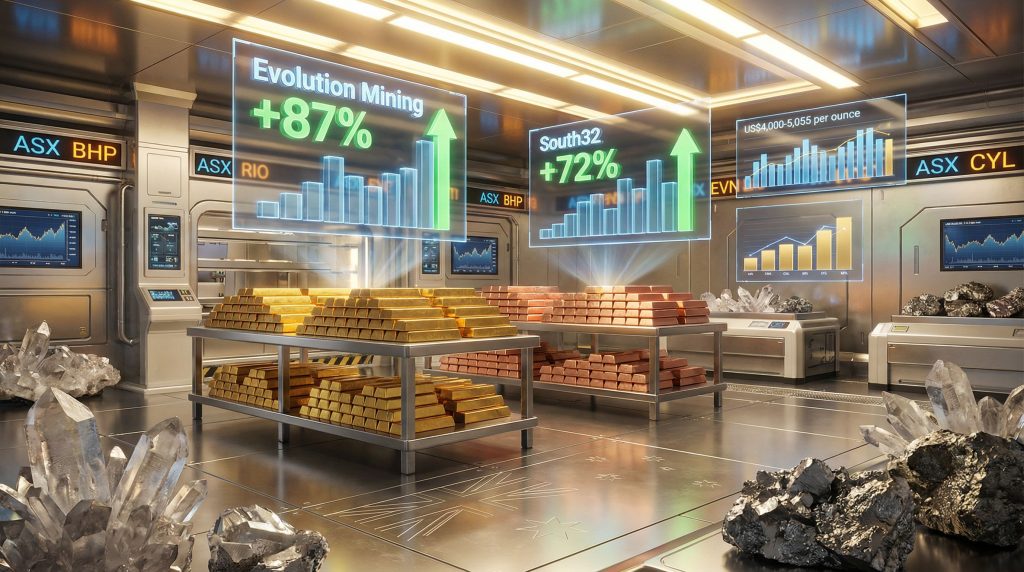
Evolution Mining represents a compelling case study in operational discipline within the gold mining subsector. The company achieved remarkable 87% gains over six months through December 2025, driven primarily by effective cost control measures and production target achievement across its diversified Australian operations spanning New South Wales, Queensland, and Western Australia.
With a market capitalisation reaching AU$36 billion, Evolution Mining demonstrates how focused operational strategies can capitalise on elevated gold prices while maintaining exposure to copper through by-product revenue streams. The company's emphasis on debt reduction and disciplined capital expenditure provides financial flexibility during commodity price volatility periods.
However, market sentiment regarding future performance appears increasingly cautious. Broker consensus establishes an average price target of $14.05, suggesting potential downside risk of approximately 16.7% from recent trading levels. This valuation compression reflects concerns about sustainability of current commodity price levels and potential margin pressure from operational cost inflation.
South32 offers an alternative approach through commodity diversification across aluminium, alumina, manganese, nickel, copper, zinc, lead, and silver operations. The company's 72% six-month performance gain demonstrates how balanced exposure across multiple metal types can smooth earnings volatility while capturing upside from selective commodity strength.
| Performance Metric | Evolution Mining (EVN) | South32 (S32) |
|---|---|---|
| Market Cap | AU$36 billion | ASX 200 constituent |
| 6-Month Gains | +87% | +72% |
| YTD Performance | +34% | +29% |
| Broker Target | $14.05 (16.7% downside) | $4.83 (6% upside) |
| Primary Focus | Gold production + copper | Diversified base metals |
The diversification strategy proves particularly valuable during periods of selective commodity weakness. When aluminium markets soften, nickel or copper strength can offset earnings impacts, providing more stable cash flow generation compared to single-commodity producers.
Risk Assessment Framework for Mining Investments
Operational risk evaluation requires systematic analysis of cost structure sustainability, reserve quality, and management execution capabilities. In addition, the most successful ASX mining stocks 2026 demonstrate consistent ability to maintain production costs below industry benchmarks while extending reserve life through exploration or acquisition activities.
Critical Financial Health Indicators:
• Debt-to-EBITDA ratios remaining below 1.5x during commodity downturns
• Free cash flow generation consistency across quarterly reporting periods
• Capital allocation discipline preventing excessive expansion spending relative to cash generation
• Dividend sustainability through commodity cycle volatility
Energy cost inflation presents ongoing challenges across the mining sector, though specific percentage increases vary significantly by geographic region and energy source mix. Companies with access to renewable energy sources or long-term power purchase agreements demonstrate competitive advantages over operators dependent on volatile fossil fuel pricing.
Labor market constraints continue affecting production scheduling across Australian mining operations. Skilled workforce shortages drive wage inflation while potentially delaying project development timelines. Mining companies with established training programs and competitive compensation packages maintain operational advantages during labour market tightness.
Strategic Portfolio Construction Approaches
Effective mining portfolio construction requires balancing exposure across commodity types, company sizes, and development stages. Large-cap diversified miners provide stability and dividend income, while mid-cap specialists offer growth potential through project development or resource expansion. Consequently, implementing sound investment strategy components becomes crucial for portfolio success.
Tier 1 Diversified Holdings should comprise 40-50% of mining allocations:
BHP Group (ASX: BHP) maintains market capitalisation exceeding AU$232 billion with balanced exposure across iron ore, copper, nickel, and petroleum operations. The company's scale economies and integrated operational model provide earnings stability while copper expansion projects position for energy transition demand growth.
Rio Tinto (ASX: RIO) offers complementary exposure through iron ore dominance combined with aluminium, copper, and diamond operations. The company's technological innovation initiatives and Pilbara expansion projects support long-term competitive positioning within global iron ore markets.
Mid-Cap Growth Opportunities merit 30-40% portfolio weighting:
These positions should target companies with market capitalisations between AU$1-10 billion demonstrating specialised commodity expertise, strategic partnership potential, and regional operational advantages. The key selection criteria involve evaluating management track records, project pipeline quality, and balance sheet strength sufficient to fund development activities. For instance, many top ASX copper stocks demonstrate these characteristics effectively.
Small-Cap Exploration Exposure requires careful position sizing at 10-20% maximum:
Early-stage companies like Catalyst Metals (ASX: CYL), which achieved 108% twelve-month returns through its Plutonic gold mine and Bendigo exploration projects, demonstrate both the opportunity and risk characteristics of exploration-focused investments. Single-asset dependence creates significant execution risk, requiring diversification across multiple small-cap positions.
Technology Integration Transforming Operational Efficiency
Automation and digitalisation initiatives increasingly separate industry leaders from underperformers. Companies successfully implementing autonomous vehicle deployment, predictive maintenance systems, and real-time monitoring capabilities achieve measurable cost reductions while improving safety performance metrics. Moreover, automation technology advancements continue revolutionising operational efficiency across the sector.
The initial capital requirements for technology adoption create competitive barriers benefiting established operators with strong balance sheets. Early adopters develop operational advantages that compound over time, making technology investment capability an important evaluation criterion for long-term mining investments.
Sustainable Mining Practice Implementation:
• Renewable energy adoption reducing operational cost structures
• Water recycling systems improving resource utilisation efficiency
• Waste minimisation technologies enhancing environmental compliance
• Carbon capture implementation addressing emission reduction requirements
Environmental technology integration requires substantial capital investment but generates long-term operational cost savings while ensuring regulatory compliance. Mining companies demonstrating leadership in sustainability practices increasingly access premium market pricing and preferred financing terms.
Regulatory Evolution Impacting Sector Dynamics
Environmental regulations continue evolving across Australian jurisdictions, creating compliance costs while potentially limiting expansion opportunities. Carbon emission reduction requirements, water usage restrictions, and biodiversity protection measures affect operational planning and capital expenditure priorities.
Social licence considerations require ongoing community engagement and indigenous land rights negotiations, potentially extending project development timelines. Companies with established stakeholder relationships and proven community engagement track records maintain advantages in securing operational approvals.
Tax Policy Implications affecting profitability include:
• State government royalty rate adjustments varying by commodity and jurisdiction
• Federal tax policy changes influencing effective corporate tax rates
• International tax coordination affecting multinational transfer pricing
• Carbon tax implementation creating additional operational cost structures
Resource rent taxation policies continue evolving as governments seek to capture greater shares of mining industry profitability during commodity price upturns. Understanding jurisdiction-specific tax frameworks becomes essential for accurate investment return calculations.
The next major ASX story will hit our subscribers first
Market Timing Considerations for Mining Sector Entry
Cyclical analysis suggests different positioning strategies depending on perceived commodity cycle stages. Early cycle positioning favours companies with development projects approaching production, while late cycle protection emphasises defensive characteristics including low-cost operations and strong balance sheets.
Technical analysis integration provides additional timing insights through momentum indicators, volume confirmation patterns, and support-resistance level identification. However, fundamental analysis overlay remains essential for understanding earnings revision trends and valuation metrics relative to historical trading ranges.
Investment Timing Framework:
- Early Cycle: Focus on development-stage assets with expansion optionality
- Mid Cycle: Prioritise cash-generative operations with sustainable dividend policies
- Late Cycle: Emphasise defensive positioning with geographic diversification
The current market environment exhibits characteristics of mid-to-late cycle positioning, with established producers achieving strong recent performance while forward-looking valuations suggest more modest return expectations. This dynamic requires careful security selection emphasising quality characteristics over momentum-driven investment decisions.
Forward-Looking Investment Considerations
Global infrastructure investment cycles continue supporting base metals demand, particularly in developing Asian economies implementing large-scale transportation and energy projects. However, the pace of demand growth increasingly depends on economic policy implementation and financing availability across emerging markets.
Energy transition timeline uncertainty creates both opportunities and risks for battery mineral producers. Accelerated electric vehicle adoption and renewable energy deployment could exceed current demand forecasts, while technological alternatives or recycling improvements might reduce raw material requirements. Analysts studying ASX mining stocks entering production provide valuable insights into upcoming supply dynamics.
Long-term Portfolio Monitoring Requirements:
• Quarterly financial results analysis and peer performance comparisons
• Commodity price trend monitoring through forward curve analysis
• Operational metrics tracking including production costs and output volumes
• Management guidance assessment and historical execution track record evaluation
Successful mining sector investment requires ongoing attention to these dynamic factors while maintaining disciplined rebalancing triggers based on significant commodity price movements, company-specific operational developments, regulatory environment shifts, and broader macroeconomic condition changes affecting resource demand patterns.
The ASX mining stocks 2026 investment landscape demands sophisticated analysis combining traditional financial metrics with forward-looking scenario planning. Companies demonstrating operational excellence, strategic positioning within energy transition supply chains, and financial discipline provide the strongest foundation for navigating the complex dynamics shaping Australia's resource sector throughout the remainder of this pivotal year.
Risk Disclaimer: This analysis contains forward-looking statements and investment considerations that involve inherent uncertainties. Commodity prices, operational performance, and regulatory environments can change rapidly, affecting investment returns significantly. Past performance does not guarantee future results. Investors should conduct independent research and consider professional financial advice before making investment decisions. All financial figures and performance data should be verified through official company announcements and regulatory filings before investment consideration.
Looking to Capitalise on ASX Mining Opportunities in 2026?
Discovery Alert's proprietary Discovery IQ model delivers real-time notifications on significant mineral discoveries across the ASX, empowering subscribers to identify actionable trading opportunities ahead of the broader market. Explore why major mineral discoveries can lead to substantial market returns through historic examples, and begin your 14-day free trial today to position yourself advantageously in this dynamic sector.