May 18, 2026
The Industrial Crossroads: Unpacking Port Pirie Smelter Government Funding
The global race to control critical minerals processing has exposed a fault line running directly beneath some of the world's most advanced economies. For decades, Western nations offshored their smelting and refining capacity in pursuit of lower production costs, rarely pausing to consider what would happen when geopolitical conditions shifted. That calculation is now being revisited at enormous expense, and few places illustrate the dilemma more starkly than Port Pirie smelter government funding — a debate playing out at a 135-year-old smelting complex on the upper Spencer Gulf in regional South Australia.
When big ASX news breaks, our subscribers know first
What Port Pirie Actually Represents in Australia's Industrial Architecture
Port Pirie's smelter is not simply a lead and zinc processing facility. It is one of the world's largest multi-metals smelting complexes, a designation that reflects both its scale and its versatility. Operations commenced there in 1889, and the facility has survived multiple commodity cycles, ownership changes, and technological transformations across more than a century of continuous production.
The plant is operated by Nyrstar, a subsidiary of Trafigura, one of the world's largest privately held commodities trading companies. Beyond its primary lead and zinc streams, Port Pirie's multi-metals architecture gives it the physical and chemical infrastructure to process a range of co-produced metals, including antimony and bismuth, both of which have attracted significant strategic attention in recent years.
The facility sits within a regional city of approximately 17,000 people located around two and a half hours north of Adelaide. It directly employs roughly 800 workers, with substantial flow-on employment throughout the local economy. A companion zinc smelter in Hobart employs a further 500 people, and Nyrstar's Australian operations are effectively treated as a linked industrial system when assessing the funding question.
"The irreversibility of smelting infrastructure is frequently underestimated. A century of accumulated permitting history, skilled workforce development, and specialised metallurgical knowledge cannot be reconstructed within a policy cycle. Once gone, these assets are almost certainly gone permanently."
The Funding Timeline: From Emergency Rescue to Structural Negotiation
Understanding the Port Pirie smelter government funding debate requires separating two distinct phases of intervention.
Phase One: The August 2025 Transitionary Package
In August 2025, the Australian, South Australian, and Tasmanian governments jointly committed a transitionary support package of $135 million for Nyrstar's Australian operations. This package had several specific objectives:
- Maintaining operational continuity at both Port Pirie and Hobart during a period of severe financial stress
- Funding maintenance and capital works to prevent physical deterioration of irreplaceable infrastructure
- Commissioning feasibility studies for antimony and bismuth production at Port Pirie
- Supporting engineering assessments for germanium and indium extraction potential at the Hobart zinc smelter
- Reducing workforce uncertainty while commercial transition planning proceeded
The South Australian government's component of this package was reported at $112.5 million, reflecting the state's disproportionate exposure given Port Pirie's location and economic significance to the region.
Phase Two: The May 2026 Negotiation
By May 2026, the initial package had expired, triggering a fresh round of funding discussions. This transition from a defined rescue package to an open-ended negotiation is analytically significant. It signals a shift from crisis management toward something more structurally embedded, raising precisely the policy questions that economic commentators have been pressing governments to address.
| Funding Event | Timing | Amount | Parties |
|---|---|---|---|
| Transitionary support package | August 2025 | $135 million | Federal, SA and Tasmanian governments |
| SA component of above | August 2025 | $112.5 million | South Australian Government |
| Renewed funding negotiations | May 2026 | Unconfirmed | Federal and state governments |
Australia's $5 Billion De Facto Industrial Policy
Port Pirie does not exist in isolation. When mapped against the full landscape of Australian smelting and processing interventions since early 2025, a pattern emerges that goes well beyond reactive crisis management. Furthermore, the broader smelter bailout debate unfolding across Queensland and South Australia reveals just how systemic this challenge has become.
| Asset | State | Committed Support | Date | Primary Rationale |
|---|---|---|---|---|
| Whyalla Steelworks | South Australia | $2.4 billion + $200 million+ additional | February 2025 | Sovereign steel; Future Made in Australia |
| Glencore Mt Isa Copper Smelter and Townsville Refinery | Queensland | $600 million | October 2025 | Copper supply chain; critical minerals |
| Rio Tinto Boyne Island Aluminium Smelter | Queensland | $2 billion | March 2026 | Aluminium sovereignty; energy costs |
| Tomago Aluminium Smelter | New South Wales | Committed, quantum unconfirmed | December 2025 | High energy cost relief |
| Nyrstar Port Pirie and Hobart | SA and Tasmania | $135 million + ongoing | August 2025 onward | Lead, zinc, critical minerals transition |
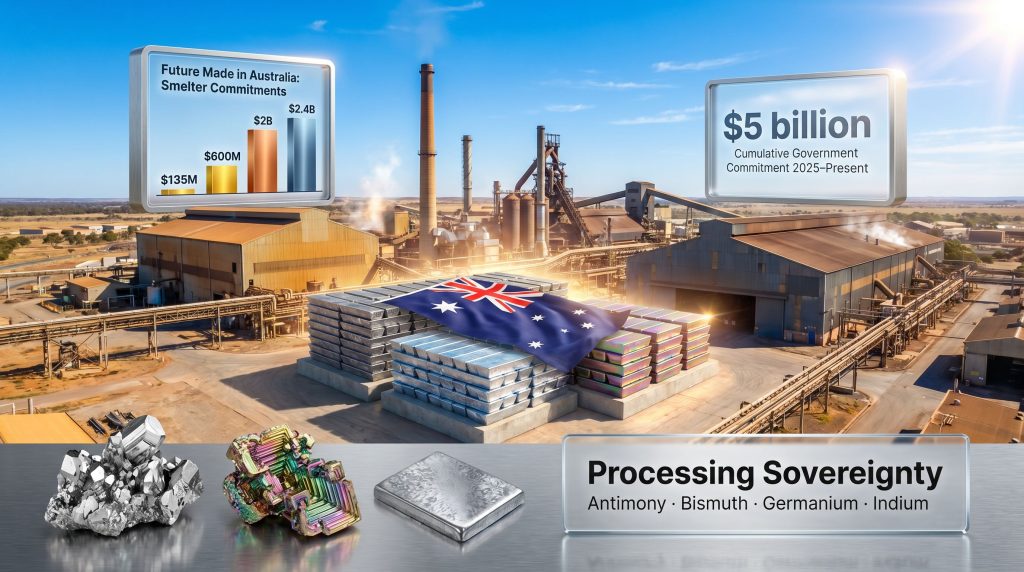
The cumulative commitment across these assets has exceeded $5 billion since early 2025, representing one of the largest concentrated periods of industrial intervention in Australian history. Each decision has been framed through the lens of Australia's Future Made in Australia policy agenda, which emphasises sovereign industrial capability and supply chain resilience. Critically, however, no single overarching strategic framework formally coordinates these interventions, meaning the policy is being constructed asset by asset rather than from a coherent industrial plan.
The Trafigura Paradox and What It Reveals About Sovereign Premiums
One of the most analytically challenging dimensions of the Port Pirie smelter government funding debate is the ownership context. Nyrstar's parent company, Trafigura, reported a profit of approximately USD $2.7 billion (around AUD $3.7 billion) in its most recent financial year. The Port Pirie smelter, meanwhile, has been losing tens of millions of dollars each month.
This disparity is not unusual in global commodities. Large diversified traders frequently hold processing assets that generate losses at the asset level while their overall portfolio remains profitable. The rational commercial response for a profit-maximising multinational is to exit uneconomic processing exposure unless the risk-return equation is altered by external factors, such as government co-investment.
South Australian Premier Peter Malinauskas captured the commercial logic directly, observing that Trafigura's profitability is a function of disciplined commercial decision-making about what is economically viable and what is not. His conclusion was equally direct: if Australia wants domestic smelting capability, governments must be prepared to invest in it.
This framing introduces the concept of the sovereign premium — the additional value that governments assign to industrial assets beyond their purely commercial returns. A smelting complex that generates negative cash flow for a private operator may still generate substantial positive value for a national economy through employment, supply chain security, and strategic optionality. The central policy question is how large that premium genuinely is, and whether public investment is the most efficient mechanism for capturing it.
"The Trafigura profitability figure should not be read as evidence that the company is withholding support cynically. It reflects a rational corporate calculation that differs structurally from a government's broader calculus. Public policy must bridge that gap deliberately rather than treating it as evidence of bad faith."
China's Role: Market Distortion, Export Restrictions, and Strategic Timing
The financial losses at Port Pirie are not primarily the result of poor management or operational inefficiency. They reflect a structural dynamic in global metals markets where Chinese state-subsidised smelting operations have driven processing margins to levels that unsubsidised Western facilities cannot sustain commercially.
This distinction between cyclical market weakness and structural market distortion is central to evaluating the policy case for intervention. A facility struggling through a temporary commodity downturn may not justify public support. However, a facility rendered uneconomic by deliberate foreign state subsidisation presents a qualitatively different policy argument.
China's dominance across multiple metals processing chains is well documented, but several specific developments have sharpened the strategic case for Port Pirie in recent months. Consequently, critical minerals security has become one of the defining industrial policy challenges facing Australia and its allies:
- In late 2024, China imposed export restrictions on antimony, creating immediate supply disruptions for US and allied industrial and defence supply chains
- Antimony's concentration risk was already elevated, with China controlling the substantial majority of global refined antimony supply prior to those restrictions
- The export halt exposed the fragility of defence supply chains that had not developed alternative sourcing, accelerating demand for Western processing alternatives
- Port Pirie's existing multi-metals infrastructure positions it as one of very few near-term alternatives to Chinese antimony supply that does not require greenfield construction
In addition, China's bismuth export controls have further reinforced the case for Port Pirie's multi-metals capability, given that bismuth is already identified as a feasibility study target at the site. The timing of China's antimony restrictions is worth examining carefully. Whether by strategic design or coincidence, the restrictions created exactly the conditions that strengthen the commercial and policy case for facilities like Port Pirie to pivot toward antimony production.
The next major ASX story will hit our subscribers first
The Antimony Opportunity: Defence Applications and the US Export Market
Antimony occupies an unusual position in the critical minerals landscape. It is not a glamour commodity in the way that lithium or cobalt have become, yet its applications span multiple defence-critical and industrial sectors. The antimony supply risks facing allied nations are now well documented, and Port Pirie's potential as a processing hub has moved from peripheral to central in policy discussions:
- Ammunition and military hardware: Antimony trioxide is used in hardening lead for ammunition and in various explosive compounds
- Flame retardants: Antimony compounds are among the most effective flame retardant synergists used in textiles, plastics, and electronics manufacturing
- Night-vision technology: Antimony is a component in infrared detector materials used in military optical systems
- Battery systems: Antimony is used in lead-acid battery grid alloys and is being assessed for next-generation sodium-ion battery applications
Critically, antimony and Port Pirie were specifically referenced in discussions between Australian and US leadership as part of a formal bilateral critical minerals partnership. This inclusion is not incidental. It reflects US recognition that its defence industrial base carries unacceptable single-source exposure to Chinese antimony supply, and that Australian processing capacity represents a credible mitigation pathway. Furthermore, strategic antimony financing mechanisms are already being deployed across allied nations to accelerate exactly this kind of supply chain diversification.
The feasibility studies currently underway at Port Pirie are assessing whether the facility's existing metallurgical infrastructure can be upgraded to produce antimony at commercially meaningful scale. If viable, US defence procurement could serve as an anchor customer, fundamentally changing the revenue profile of the facility beyond its traditional lead and zinc streams.
The Broader Critical Minerals Pipeline
| Mineral | Processing Site | Primary Applications | Strategic Significance |
|---|---|---|---|
| Antimony | Port Pirie | Defence, batteries, flame retardants | High; US export market identified |
| Bismuth | Port Pirie | Pharmaceuticals, electronics, metallurgy | Moderate; growing demand trajectory |
| Germanium | Hobart | Semiconductors, fibre optics, defence optics | Very High; China export-controlled |
| Indium | Hobart | Solar cells, flat panel displays, semiconductors | High; highly concentrated global supply |
Germanium deserves particular attention. China has also imposed export controls on germanium, a semiconductor-critical metal with significant defence applications in infrared optics. The Hobart zinc smelter processes zinc concentrates that carry germanium as a trace component, and extraction technology exists to recover it commercially. If feasibility studies confirm economic viability, Hobart could become one of a small number of non-Chinese germanium sources available to allied nations.
Evaluating the Policy Case: Four Analytical Lenses
Former Productivity Commission chair Michael Brennan has publicly articulated the inherent difficulty of these decisions, noting that taxpayer support packages tend to emerge from crisis conditions rather than well-developed strategic frameworks, and that genuine value-for-money assessment is genuinely difficult to achieve in such circumstances. His caution about governments perpetually propping up industrial assets carries particular weight given the automotive industry precedent.
A structured evaluation across four analytical dimensions yields the following assessment:
1. Sovereign Capability
Port Pirie scores high on irreversibility. The facility represents 135 years of accumulated industrial infrastructure, environmental permitting, and metallurgical expertise. Reconstruction from scratch would take decades and cost multiples of current support requirements, assuming it were even possible given the complexity of modern environmental approval processes.
2. Market Failure
The market failure argument is substantiated rather than merely asserted. Chinese state subsidisation of competing smelting operations constitutes a documented form of market distortion that falls outside the normal parameters of commercial competition. This distinguishes Port Pirie's situation from a facility simply losing ground to more efficient competitors.
3. Transition Pathway
This is the most uncertain dimension. The critical minerals pivot is plausible but unproven. Feasibility studies were still ongoing as of mid-2026, and technical risks around antimony production upgrade remain to be resolved. A credible commercial pathway exists in theory; whether it exists in practice will depend on engineering outcomes, contract negotiations, and commodity market conditions.
4. Opportunity Cost
This dimension requires honest engagement with alternatives. The capital committed to Port Pirie and its peers could theoretically fund new greenfield critical minerals processing infrastructure, direct equity stakes in critical minerals mining, or other strategic industrial investments. That comparison has not been formally made public, which weakens the policy accountability framework around these decisions.
The Automotive Industry Warning and Why This Time May Be Different
The Holden precedent looms over every Australian industrial subsidy debate. Successive governments provided escalating support to the automotive sector through the 2000s and into the early 2010s. When the Abbott government declined to increase subsidies in 2013, Holden's Australian operations became commercially untenable, and the company exited manufacturing entirely by 2017.
Applied to Port Pirie, the automotive comparison is instructive but not perfectly analogous. The critical difference is strategic context. Australian automotive manufacturing was not positioned within a geopolitical supply chain security framework. Port Pirie, by contrast, is being evaluated as critical infrastructure within a bilateral defence and supply chain security relationship with the United States.
That distinction does not eliminate the risk of perpetual assistance dependency, but it does change the nature of the commercial opportunity that government co-investment is meant to unlock. The question is whether the transition from subsidy to strategic commercial partnership is achievable within a defined timeframe, or whether the critical minerals pivot is optimistic reframing of an unresolvable structural problem.
Scenario Pathways: Three Futures for Port Pirie by 2030
Scenario A: Critical Minerals Transformation
Feasibility studies confirm commercial viability for antimony and bismuth at Port Pirie. US defence procurement contracts provide anchor revenue. Government co-investment transitions from operational subsidy to strategic capital partnership, and Port Pirie emerges as a regional critical minerals processing hub with declining dependence on public support.
Scenario B: Extended Managed Continuity
The critical minerals pivot faces technical or commercial obstacles that delay commercial independence. Government continues rolling support packages to preserve employment and strategic optionality. The facility remains viable but dependent, with cumulative public expenditure escalating without a clear endpoint. This is the Holden pathway applied to metals processing.
Scenario C: Structured Partial Preservation
Full smelter operations cannot be commercially justified even with targeted support. Governments negotiate an orderly restructure that preserves critical minerals processing capability at reduced scale while managing workforce transition. Selected capabilities, particularly antimony processing, are maintained with targeted investment while legacy lead and zinc operations are wound down.
Disclaimer: The scenario projections above are analytical frameworks for policy evaluation purposes. They do not constitute investment advice or financial forecasts. Outcomes will depend on commercial negotiations, feasibility study results, commodity market conditions, and geopolitical developments that cannot be predicted with certainty.
Frequently Asked Questions: Port Pirie Smelter Government Funding
Why is the Port Pirie smelter receiving government funding?
The facility is experiencing severe financial losses attributed to international competition from state-subsidised foreign smelting operations that have structurally suppressed global metals processing margins. Governments have intervened to preserve sovereign processing capability, protect approximately 800 direct jobs in a regionally dependent community, and maintain the facility's potential to produce strategically important critical minerals including antimony and bismuth.
How much has the government committed to Port Pirie smelter support?
An initial transitionary support package of $135 million was agreed in August 2025 by the Australian, South Australian, and Tasmanian governments. This package expired by May 2026, triggering active negotiations for further support. The quantum of renewed funding had not been publicly confirmed as of mid-2026.
Who owns the Port Pirie smelter?
The facility is operated by Nyrstar, a subsidiary of global commodities trading company Trafigura, which reported a profit of approximately USD $2.7 billion (AUD $3.7 billion) in its most recent financial year.
What critical minerals could Port Pirie produce?
Feasibility studies are assessing antimony and bismuth production at Port Pirie, and germanium and indium extraction potential at the Hobart zinc smelter. Antimony has attracted the most strategic attention given its defence applications and China's export restrictions imposed in late 2024.
What is the risk if Port Pirie closes permanently?
Closure would eliminate approximately 800 direct jobs in a community of 17,000 people and remove processing infrastructure that required 135 years to develop. From a strategic standpoint, it would increase Australia's and its allies' dependence on Chinese-controlled critical minerals supply chains at precisely the moment when geopolitical conditions are driving demand for alternative sources.
Want to Stay Ahead of the Next Major Mineral Discovery?
Discovery Alert's proprietary Discovery IQ model delivers real-time alerts on significant ASX mineral discoveries — including opportunities across critical minerals such as antimony, bismuth, and germanium — instantly empowering subscribers to identify actionable opportunities ahead of the broader market. Explore Discovery Alert's dedicated discoveries page to understand why historic mineral discoveries have generated substantial returns, and begin your 14-day free trial today to position yourself at the forefront of Australia's critical minerals future.