July 15, 2026
When Three Macro Forces Align: Understanding the ASX's Most Powerful Rally Conditions
Global equity markets rarely move in a straight line, and the forces that drive a single trading session are seldom as simple as one headline suggests. The most decisive intraday moves tend to occur when multiple independent catalysts converge simultaneously, each reinforcing the other in ways that no single factor could achieve alone. Wednesday, July 15, 2026 delivered precisely this kind of session for Australian investors, with ASX today US bank earnings and CPI data boost Aussie mood along with BHP in a textbook display of cross-market transmission.
Understanding why these sessions unfold the way they do, and what they signal beyond the day's price action, is where the real analytical value lies.
When big ASX news breaks, our subscribers know first
The Session at a Glance: Three Catalysts, One Direction
Before examining the mechanics, a high-level summary of the day's key data points establishes the scope of the move:
| Metric | Detail |
|---|---|
| Session Tone | Strongly bullish into midday, gains paring post-lunch |
| Primary Catalyst | Cooler-than-expected US CPI + strong US bank earnings |
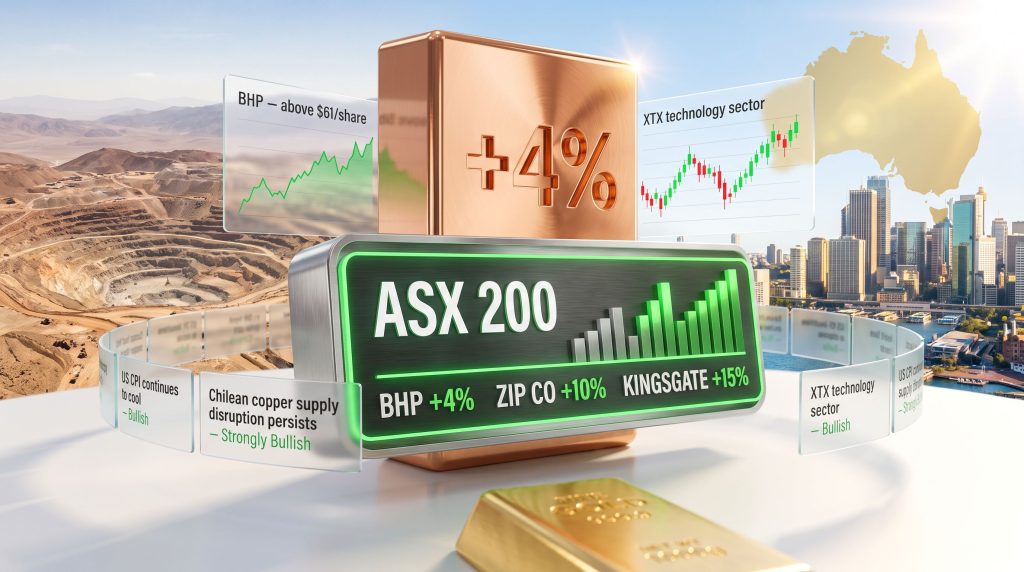
| Largest Large-Cap Mover | BHP: +4% intraday, above $61/share |
| Technology Sector (XTX Index) | +1% intraday; -3% week-to-date |
| Notable Mid-Cap Performer | Zip Co: approximately +10% midday |
| Top Session Gainer | Kingsgate Consolidated: +15%+ |
| Industrial Standout | Southern Cross Electrical: approximately +6% (175% one-year return) |
The three forces at work were distinct in origin but deeply interconnected in effect: a softer-than-expected US Consumer Price Index reading, a robust US bank earnings season, and a commodity-driven surge in BHP shares underpinned by a more than 4% weekly rise in copper prices.
How US Inflation Data Travels Across the Pacific
The Rate Expectations Transmission Mechanism
The pathway from a US CPI print to ASX price action is well-worn but frequently misunderstood in its speed and scale. When US inflation data comes in below consensus estimates, bond markets immediately reprice the probability of Federal Reserve interest rate cuts. Lower expected rates reduce the appeal of holding US dollars in interest-bearing instruments, which tends to weaken the greenback. A softer US dollar then has a powerful knock-on effect: commodity prices, which are globally denominated in dollars, become cheaper for non-US buyers, stimulating demand expectations and supporting prices.
For Australian investors, this chain reaction matters enormously. The ASX market performance is heavily weighted toward resources and financials, two sectors acutely sensitive to both the US dollar and global risk appetite.
When US CPI data prints below expectations, it raises the probability of Federal Reserve interest rate cuts, which weakens the US dollar, boosts commodity prices, and improves global risk sentiment. All of these forces tend to push the ASX 200 higher, particularly across materials, financials, and technology sectors.
The Historical Precedent: Why Context Matters
This is not a new phenomenon. In January 2025, unexpectedly slowing US core inflation drove a synchronised rally across both Wall Street and ASX-listed equities, as investors rapidly repriced rate-cut timelines. The contrast with earlier episodes is instructive: when US monthly CPI printed at a hotter-than-expected +0.4% in prior months, rate-cut hopes were dashed and the ASX fell in sympathy. The July 15 session sits on the opposite end of that spectrum, which is precisely what amplified the market's response.
The critical distinction for investors is understanding the threshold at which an inflation reading shifts from merely in-line to genuinely market-moving. A result that beats consensus by a few basis points often produces noise; however, a reading that challenges the prevailing rate narrative produces genuine repricing across asset classes simultaneously.
US Bank Earnings and the Global Financial Health Signal
Why Wall Street Bank Results Matter to Sydney Traders
Major US bank earnings function as something far more significant than corporate scorecards. They serve as a real-time proxy for the health of the global financial system. When institutions of that scale report earnings that exceed analyst expectations, the implicit message to global markets is that credit conditions remain sound, loan books are performing, and the economic cycle has not deteriorated as feared.
This confidence signal travels fast. Reduced perceptions of global credit risk directly lift sentiment toward financial sector equities worldwide, including those listed in Australia. Furthermore, there is solid historical precedent for this: according to recent market analysis, strong US bank results preceded a notable gap-up open on the ASX in early 2025, a structural pattern that repeated itself on July 15, 2026.
Sector-Specific Ripple Effects Across the ASX
The downstream effects of US bank earnings strength played out across multiple ASX sectors simultaneously:
- Buy-Now-Pay-Later (BNPL): Zip Co's approximately 10% intraday surge is a high-beta expression of improved US financial sector sentiment. BNPL companies are particularly sensitive to credit cycle optimism because their business models depend on accessible consumer credit conditions and investor willingness to price in growth.
- Technology: The XTX technology index gained approximately 1% intraday, though the sector remained down roughly 3% across the week. This fragile intraday recovery reflects how tech stocks can benefit from rate-cut optimism while remaining vulnerable to the broader weekly sentiment backdrop.
- Materials: Improved US financial conditions reduce the cost of capital for global mining investment, which indirectly supports long-term commodity demand expectations by making large capital projects more economically viable.
BHP's +4% Surge: Unpacking a Multi-Layered Commodity Story
Index Weight and Price Mechanics
BHP's capacity to single-handedly drag the ASX 200 higher is a function of its enormous index weighting within the materials sector. When a stock of this scale moves 4% in a single session, the index-level effect is disproportionate to what any mid-cap or small-cap equivalent could produce. The intraday move carried BHP back above the $61 per share mark, bringing it meaningfully closer to the record high range in the mid-$60s.
| BHP Price Level | Context |
|---|---|
| Session High | Above $61/share |
| Recent Record High Range | Mid-$60s |
| Approximate Distance to Record | $3-$5/share |
| Weekly Copper Price Movement | +4%+ |
The Copper Catalyst: Supply Disruption Meets Demand Optimism
Copper's more than 4% weekly price increase heading into July 15 was driven by a dual dynamic that commodity analysts describe as particularly powerful: simultaneous demand-side optimism and supply-side disruption. The growing copper supply crunch has been a persistent theme for market watchers throughout this period.
On the demand side, improved US macro sentiment following the CPI data raised expectations for continued industrial and infrastructure activity. On the supply side, extreme weather conditions in Chile created credible threats to mine output across multiple producing operations. The Chile copper outlook cannot be overstated: the country accounts for roughly 27% of global copper mine production, making it the world's dominant single-country supplier. Any credible disruption to Chilean output triggers immediate speculative positioning in copper futures markets.
This combination of factors created conditions where traders were actively building positions anticipating further copper price upside, with some speculative interest betting on a sustained price premium above current levels.
Rio Tinto's Cost Innovation: A Benchmark Worth Understanding
Rio Tinto's reported reduction of copper mining costs by more than 40% through gold by-product credits on the same session introduced an important competitive dimension to the copper narrative. This figure refers to the practice of polymetallic mining, where a primary metal like copper is extracted alongside economically significant by-products such as gold or molybdenum. The revenue generated from selling these by-products is applied against total production costs, reducing the reported cash cost per pound of copper produced.
This cost accounting approach, known in the industry as by-product credit methodology, can dramatically alter the apparent economics of a copper mine and reshape competitive positioning across the sector. When major producers achieve dramatic cost reductions through this mechanism, it raises the bar for what constitutes a viable copper development project and concentrates supply advantages among diversified miners already operating polymetallic deposits.
Why the Afternoon Fade Matters as Much as the Morning Rally
The Chinese GDP Headwind
The partial paring of gains after midday trading on July 15 was attributed in part to Chinese GDP data that missed market expectations. This dynamic illustrates a fundamental structural tension embedded in the ASX's current positioning: the same commodities that rallied on US macro optimism are ultimately consumed in large volumes by China. When Chinese economic output disappoints, demand-side assumptions underpinning commodity prices are brought into question.
The asymmetric nature of this response is notable. Chinese data disappointments tend to temper commodity-driven ASX rallies rather than fully reverse them, because supply-side disruptions such as Chilean weather events can sustain price premiums independent of demand trajectories. However, sustained Chinese economic weakness would eventually erode the demand assumptions that justify elevated copper valuations.
Institutional Profit-Taking as a Market Signal
The afternoon drift also reflects standard institutional behaviour following offshore-driven gap-up sessions. When a market opens strongly on offshore catalysts and continues rising through the morning, algorithmic and active fund managers frequently begin trimming positions into strength, locking in gains before the next potential risk event. The fact that gains pared rather than reversed entirely is actually a constructive signal, suggesting that underlying conviction in the session's catalysts remained intact despite the softening.
The next major ASX story will hit our subscribers first
Sector-by-Sector Performance: What Each Move Is Telling Investors
Gold Sector: Kingsgate's Operational Restart
Kingsgate Consolidated's more than 15% single-session gain stands out as a reminder of how powerfully operational news can move junior and mid-cap miners. The restart of operations at the Chatree Gold Mine's Plant 1 in Thailand returned the company to a nameplate processing capacity of 4 million tonnes per annum. For gold mining companies where production interruptions have weighed on investor confidence, credible evidence of operational normalisation can produce outsized share price responses. In addition, the relationship between gold price and miners remains a key dynamic as the market rapidly reassigns a production-based valuation multiple.
Industrial Dark Horse: Southern Cross Electrical
Southern Cross Electrical's approximately 6% single-session gain, on top of a 175% one-year return, represents one of the more instructive stories of this session. Industrial stocks with genuine exposure to infrastructure and construction pipelines can compound quietly over extended periods, often beneath the coverage threshold of major research desks. A 175% annual return in an industrial stock suggests sustained earnings growth or contract momentum rather than speculative re-rating, making it a qualitatively different type of outperformance compared to resource-driven moves.
How to Read a Triple-Catalyst Session: Risk and Opportunity Framework
Multi-driver rallies like July 15 carry important strategic implications beyond the day's price action. The following scenario table captures the key variables investors should monitor in the sessions ahead:
| Scenario | ASX Materials Implication | ASX Financials Implication |
|---|---|---|
| US CPI continues to cool | Bullish: USD weakness supports commodity prices | Bullish: rate-cut expectations lift growth sentiment |
| Chinese GDP stabilises | Strongly bullish: demand-side recovery confirmed | Neutral to positive |
| Chilean copper disruption persists | Strongly bullish for copper-exposed stocks | Neutral |
| US CPI reverses higher | Bearish: USD strengthens, commodities fall | Bearish: rate-cut hopes recede |
| Chilean supply disruption resolves | Bearish for speculative copper positioning | Neutral |
The key risks worth monitoring post-session include:
- Chinese economic trajectory – ongoing GDP weakness would cap commodity demand assumptions over the medium term
- US inflation reversals – a single soft CPI print does not confirm a disinflation trend, and subsequent hotter readings could rapidly unwind rate-cut expectations
- Copper supply restoration – if Chilean weather events resolve quickly, speculative long positions in copper futures could unwind with meaningful speed
- BHP's proximity to record highs – technical resistance near the mid-$60s range may limit near-term upside even when fundamental support is present
Broad-based rallies driven by multiple independent positive inputs tend to demonstrate stronger follow-through than single-catalyst moves. However, investors must distinguish between structural tailwinds and episodic catalysts. One soft inflation print and one quarter of bank earnings do not, on their own, confirm a new macro regime.
Key Takeaways for Australian Investors
The July 15 session encapsulates several durable lessons about how the ASX functions in a globally integrated market environment. Consequently, the Australian share market performance narrative is shaped by forces extending well beyond domestic policy, reinforcing why global macro literacy is essential for local investors.
- Macro transmission speed is accelerating – offshore data releases now reshape ASX sentiment within hours, not days, compressing the window for repositioning
- BHP remains the ASX's most powerful single-stock sentiment amplifier in the materials sector, with its proximity to record highs making copper price movements a critical variable for index-level performance
- By-product credit economics at major miners like Rio Tinto are reshaping the copper cost curve in ways that have meaningful implications for which projects and companies can compete profitably at various price points
- Supply-demand tensions in copper are operating in opposite directions simultaneously, with Chilean weather disruption and Chinese demand uncertainty pulling the price in competing directions
- Broad sector participation across industrials, gold, BNPL, and materials suggests genuine risk-on sentiment rather than concentrated or speculative buying in a single pocket of the market. For further context on index-level moves, live ASX 200 data provides useful real-time reference points for tracking intraday momentum shifts
Furthermore, ASX today US bank earnings and CPI data boost Aussie mood along with BHP serves as a useful case study in how global macro events translate into local equity outcomes, reminding investors that domestic decisions are rarely made in isolation from international developments.
The material in this article is for informational purposes only and does not constitute investment advice. Readers are encouraged to conduct independent research and consult a qualified financial adviser before making any investment decisions. Forward-looking statements and scenario analyses involve uncertainty and should not be interpreted as guarantees of future market performance.
Want to Stay Ahead of the Next Major ASX Mineral Discovery?
While macro forces like US CPI data and copper price surges drive broad ASX momentum, the most asymmetric returns often emerge from significant mineral discoveries — and Discovery Alert's proprietary Discovery IQ model delivers real-time alerts the moment these opportunities are announced on the ASX, transforming complex geological and commodity data into actionable insights for investors at every experience level. Explore how historic discoveries have generated extraordinary returns and begin your 14-day free trial today to position yourself ahead of the broader market.