July 15, 2026
The Hidden Mechanics Behind Cross-Commodity Energy Signals
Most investors track commodity prices in isolation, but seasoned energy market participants know that crude oil movements frequently telegraph sentiment shifts across the entire energy complex, including sectors that have no direct operational link to oil. The relationship between Brent crude and ASX-listed coal equities is one of the more nuanced cross-commodity dynamics in Australian equity markets, and understanding its mechanics is essential for anyone analysing the current Australian coal stocks uptick as Brent crude returns to US$85/bbl.
This is not a simple cause-and-effect relationship. It operates through two distinct channels simultaneously: a real-world cost substitution mechanism and a market psychology loop that can move stock prices well before any physical demand shift materialises. Conflating the two is one of the most common analytical errors retail investors make when positioning in ASX energy names.
When big ASX news breaks, our subscribers know first
How Oil Prices Create a Ripple Effect Through Coal Equities
The cost substitution channel works as follows. Diesel fuel, which is a refined product derived from crude oil, is a critical input across industrial operations ranging from mining and logistics to backup power generation. When crude oil price trends shift sharply upward, the landed cost of diesel increases across virtually every industrial sector in every market that imports crude. At a certain price threshold, operators who have access to coal-fired energy infrastructure begin running comparative cost analyses, and in many Asian and emerging market economies, coal-fired generation becomes the more economical choice.
The psychological channel is distinct and arguably more powerful in the short term. When oil spikes, equity market participants immediately begin re-pricing coal stocks based on expected future coal demand, not confirmed demand. This front-running behaviour is well-documented in commodity-linked equities and creates situations where ASX coal producers can gain 4% to 9% in a single week on sentiment alone, without a single additional tonne of coal being contracted.
"The oil-coal correlation in equity markets is partly a reflection of investor behaviour rather than fundamental supply and demand. Markets tend to price in anticipated substitution effects before they actually occur, which means the equity move often overshoots the underlying physical market signal."
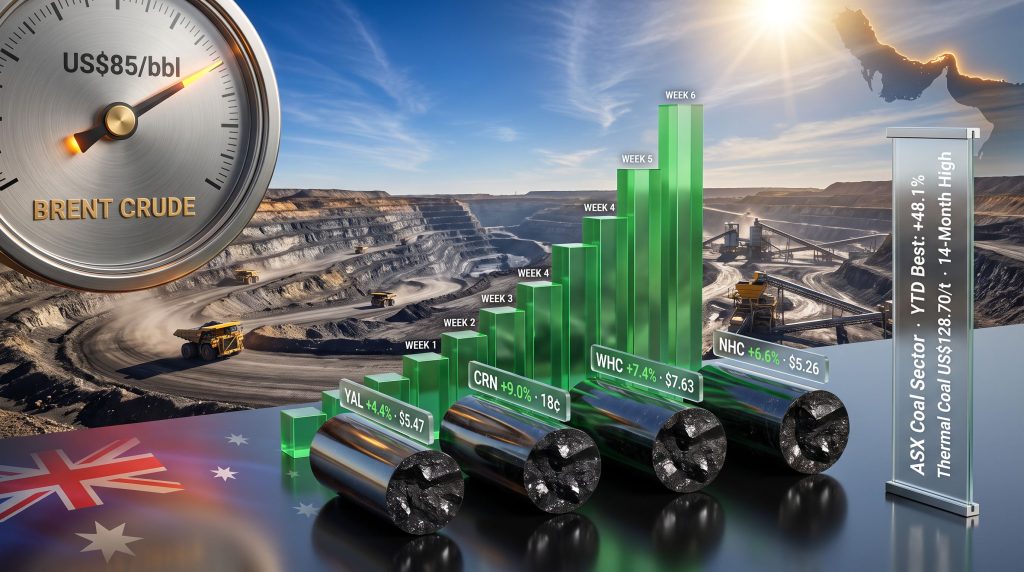
Furthermore, Brent crude touching US$85.10/bbl before settling in the US$84.32 to US$84.66 range during the week of July 15, 2026 represents more than a single-session event. This price level had not been reached since July 2024, making the recovery a genuine 12-month milestone for oil market volatility. The approximately 8.4% to 8.5% single-session price move in crude is among the more significant daily movements recorded in recent months, and its scale was sufficient to trigger the coal equity re-rating mechanism across the ASX.
Geopolitical Fragility and the Strait of Hormuz Factor
The driver behind the crude surge traces directly to renewed military conflict in the Middle East. The Strait of Hormuz remains one of the world's most operationally critical maritime chokepoints, with approximately 20% of global crude oil transiting through this narrow passage daily. Any credible disruption to free passage through the Strait creates immediate supply anxiety in futures markets, which is reflected in price within hours.
What makes the 2026 cycle particularly significant is the cumulative nature of the disruptions. Escalating US-Israel-Iran tensions through the year have contributed to a cumulative 25% rise in global coal prices since early 2026, as the market has repeatedly repriced supply risk. Each round of conflict escalation adds a new layer to what traders call the geopolitical risk premium embedded in energy prices.
The seaborne coal market is also directly affected by Hormuz instability, though through a different mechanism. When shipping routes are disrupted or diverted, freight costs for all seaborne commodities increase. For coal, which is predominantly traded via bulk carrier vessels on long-haul routes from Australian ports to Asian buyers, freight cost increases tighten the effective supply available at any given spot price. This dynamic has helped push thermal coal spot prices to approximately US$128.70 per tonne, representing a 14-month high and an 8.6% increase in recent weeks.
| Geopolitical Trigger | Direct Market Impact | Secondary Coal Market Effect |
|---|---|---|
| Strait of Hormuz disruptions | Brent crude +8.4% to 8.5% in a single session | Seaborne coal freight costs increase |
| US-Israel-Iran conflict escalation | Global oil supply uncertainty | Coal demand substitution expectations rise |
| European gas supply concerns | LNG spot price volatility | Coal-fired power generation demand increases |
| Middle East diplomatic progress (reversal risk) | Oil price pullbacks | Coal stocks retreat from recent highs |
A less commonly understood dimension is the European demand overlay. European energy buyers facing potential gas shortages have emerged as an additional, independent source of seaborne coal demand pressure in 2026. This adds a Western demand component to what has historically been an Asia-dominated market for Australian thermal coal exports, creating a more geographically diversified demand base than existed in prior cycles.
ASX Coal Sector Performance: Week 29, 2026
The practical translation of these dynamics into share price performance has been notable. As at midday AEST on Wednesday, July 15, 2026, all four major ASX coal producers had registered meaningful week-on-week gains, significantly outpacing the broader benchmark index.
| Stock | Week-on-Week Change | Price (Mid-July 2026) | YTD Performance |
|---|---|---|---|
| Yancoal Australia (YAL) | +4.4% | $5.47 | ~+48.1% |
| Coronado Global Resources (CRN) | +9.0% | 18 cents per share | Not specified |
| Whitehaven Coal (WHC) | +7.4% | $7.63 | ~+15.8% |
| New Hope Corporation (NHC) | +6.6% | $5.26 | ~+28.9% |
| Stanmore Resources (SMR) | +2.5% | $2.87 | ~+20.4% |
| ASX 200 (Benchmark) | Flat to negative | 8,848 pts | -1.1% |
Data sourced from publicly available market reporting as at mid-July 2026. Readers should verify figures against real-time data sources before making investment decisions.
Several dynamics within this performance table are worth examining individually. Yancoal's year-to-date gain of approximately 48.1% makes it one of the ASX's standout performers across all sectors in 2026, not merely within the coal space. This reflects a genuine earnings re-rating built on sustained export volumes and elevated realised coal prices, rather than purely speculative positioning.
Coronado Global Resources presents a different profile. Its status as the only major coal name trading in the green intraday on Wednesday, July 15, while peers including Whitehaven, Yancoal, and New Hope all pulled back during the session, illustrates a dynamic that experienced small-cap traders will recognise immediately. Lower nominal share prices attract retail speculative flows during momentum events. At 18 cents per share, Coronado's entry point is accessible to a broader retail audience, and its comparatively lower liquidity relative to the larger names means smaller buy orders can produce larger percentage moves. This is a structural characteristic of low-priced equities rather than a specific endorsement of Coronado's underlying fundamentals.
Is This Rally Built on Solid Ground?
Reading the Three-Month Chart Pattern
One of the more telling analytical observations from the current period is what the three-month price charts reveal when all four major producers are overlaid. Despite the week-on-week gains, every stock in the group remains below the price levels it reached in early to mid-June 2026, when a prior round of energy supply concerns drove a similar rally.
This recurring pattern has important implications for how investors should frame the current move:
- Each rally in 2026 has been triggered by energy price anxiety rather than confirmed step-changes in physical coal demand
- Each prior rally has subsequently failed to hold its highs, suggesting the market is repricing expectations rather than earnings
- The physical thermal coal market, while elevated, has itself retreated from a cycle peak of approximately US$150 per tonne to the current US$128.70 to US$135 range, indicating the spot market is not fully validating the equity enthusiasm
This divergence between equity market enthusiasm and physical market pricing is a classic pattern in commodity equities. It does not necessarily mean the rally will fail, but it does mean investors should apply a higher burden of proof before treating short-term price moves as evidence of a sustained re-rating.
The Bull and Bear Case Framework
The bull and bear case for Australian coal stocks hinges on a relatively narrow set of variables, and the asymmetry of outcomes is worth understanding carefully.
"Bull Case: Middle East tensions remain elevated, Brent crude holds above US$80/bbl, diesel costs stay high enough to drive measurable coal substitution in industrial markets, and thermal coal retests the US$150/tonne level. ASX coal producers push to new 2026 highs."
"Bear Case: A diplomatic development in the Middle East drives oil back below US$75/bbl, removing the primary sentiment catalyst. Coal stocks retrace to early-June levels or lower, consistent with the pattern already visible in three-month chart data. Physical coal prices follow equities lower."
The asymmetry here is worth noting. Diplomatic resolutions tend to be announced suddenly and without warning, while geopolitical escalation is typically gradual. Investors positioned purely on the oil-coal correlation are consequently exposed to rapid, non-telegraphed downside events.
Key Risk Factors Every Australian Coal Investor Should Monitor
The Divergence Between Metallurgical and Thermal Coal
A frequently overlooked distinction within the Australian coal sector is the difference between metallurgical coal (also called coking coal) and thermal coal (steam coal). These are not interchangeable commodities. Metallurgical coal prices respond to steel production dynamics, while thermal coal is used primarily for electricity generation and sold into an entirely different buyer base.
Australian producers have varying exposure to each grade:
- Yancoal is predominantly a thermal coal producer with significant Hunter Valley operations
- Coronado Global Resources has material metallurgical coal exposure through its Queensland Bowen Basin assets
- Whitehaven Coal has been actively building its metallurgical coal exposure following its acquisition of BHP's Daunia and Blackwater mines
- New Hope Corporation is largely a thermal coal business centred on its New Acland and Bengalla operations
This distinction matters because the demand drivers and price cycles for each grade differ. A crude oil spike primarily supports the thermal coal substitution narrative, not metallurgical coal demand, which is driven by steel industry dynamics in China, India, and Japan.
Export Market Concentration and Currency Risk
Australian coal producers are heavily exposed to Asian export markets. Any deterioration in China steel demand, which has been navigating structural overcapacity concerns, or softening in Indian power sector coal procurement would have an outsized revenue impact on the sector. The AUD/USD exchange rate adds another layer of earnings variability for producers with unhedged revenue streams, as a strengthening Australian dollar compresses realised prices in domestic currency terms.
Long-Term Structural Demand Uncertainty
While near-term coal demand remains resilient across Asian markets, the global energy transition introduces structural demand uncertainty at the 5 to 7 year horizon and beyond. European coal demand, currently supported by gas supply disruption concerns, remains subject to legislated phase-out timelines across multiple EU member states. Investors with longer holding periods should consequently account for the possibility that the demand base supporting current valuations may contract meaningfully in the back half of the decade.
The next major ASX story will hit our subscribers first
FAQ: Australian Coal Stocks and the Brent Crude Connection
Why do Australian coal stocks rise when oil prices increase?
Higher crude oil prices push up the cost of diesel, which is a primary fuel for industrial operations and backup power generation globally. When diesel becomes materially more expensive, operators in markets with existing coal infrastructure reassess coal-fired energy as a cost-competitive alternative. Equity markets price in this anticipated substitution demand before it actually occurs in the physical market, driving speculative buying in ASX coal names.
Which ASX coal stock has shown the highest sensitivity to recent oil price moves?
Based on week-on-week trading patterns in mid-July 2026, Coronado Global Resources recorded the largest percentage gain at +9.0%, and was the only major producer trading in positive territory intraday on July 15. This sensitivity reflects its lower nominal share price and comparatively thinner liquidity profile rather than a unique fundamental advantage.
What does Brent crude at US$85/bbl signal for the coal sector?
US$85/bbl is a psychologically significant threshold that had not been breached since July 2024. At this level, diesel-intensive industrial operations face materially higher input costs, strengthening the economic case for coal-fired energy substitution in markets where the infrastructure already exists. The Australian coal stocks uptick as Brent crude returns to US$85/bbl is therefore not coincidental but reflects this well-established market mechanism.
Is the current ASX coal rally likely to be sustained?
Three-month chart patterns across all four major ASX coal producers show a recurring cycle: each energy-anxiety-driven rally in 2026 has failed to hold above the prior cycle's highs. This suggests the market is trading on expectations rather than confirmed physical demand growth. Sustainability will depend on whether Brent crude holds above current levels and whether physical thermal coal prices recover toward their prior cycle peak of approximately US$150/tonne.
Key Takeaways
- The Australian coal stocks uptick as Brent crude returns to US$85/bbl reflects both a real cost-substitution mechanism and a speculative sentiment channel operating simultaneously
- All five tracked ASX coal producers have significantly outperformed the ASX 200, which is down 1.1% year-to-date in 2026, with individual coal names delivering gains between 15.8% and 48.1%
- Three-month chart analysis reveals a repeating pattern where each oil-driven coal rally fails to hold above prior highs, signalling expectation-driven rather than demand-driven re-ratings
- The distinction between metallurgical and thermal coal exposure is critical for evaluating which producers benefit most from each type of market catalyst
- Investors should monitor Brent crude trajectory, Middle East diplomatic developments, and physical thermal coal spot prices as the three leading indicators for near-term ASX coal sector direction
This article is intended for informational and educational purposes only and does not constitute financial advice. All figures and performance data referenced are sourced from publicly available market reporting as at mid-July 2026. Readers should conduct independent research and consult a licensed financial adviser before making any investment decisions. Past performance is not indicative of future results.
Want to Catch the Next Major ASX Energy or Resource Discovery the Moment It Hits?
Discovery Alert's proprietary Discovery IQ model scans ASX announcements in real time, instantly transforming complex commodity data into actionable insights across more than 30 commodities — so subscribers are positioned ahead of the broader market before sentiment shifts move prices. Start a 14-day free trial today, or explore Discovery Alert's discoveries page to see how historic mineral discoveries have generated extraordinary returns for early-positioned investors.