July 15, 2026
When Fuel Becomes a Variable You Cannot Hedge Away
In large-scale open-cut mining, the economics of extraction are rarely determined by ore grade alone. Infrastructure reach, logistics reliability, and input commodity costs all converge to define whether a world-class deposit translates into world-class margins. Of these inputs, diesel fuel sits at the intersection of operational necessity and macroeconomic volatility — a cost lever that even the most efficient producers cannot fully insulate themselves from when global energy markets shift unexpectedly.
That tension is playing out in real time for Rio Tinto (ASX: RIO), whose Pilbara iron ore division delivered its strongest June-quarter export result since 2020, only for the gain to be partially offset by an energy cost surge linked to geopolitical disruption thousands of kilometres away. Understanding how Rio Tinto iron ore exports rebound and diesel costs jump simultaneously requires looking at both the operational machinery behind the Pilbara and the macro forces reshaping global fuel markets in 2026.
When big ASX news breaks, our subscribers know first
Pilbara Shipments: A June Quarter That Stands Out
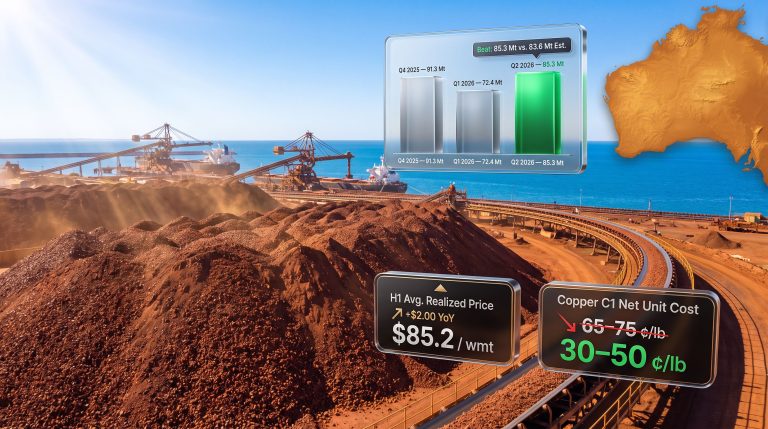
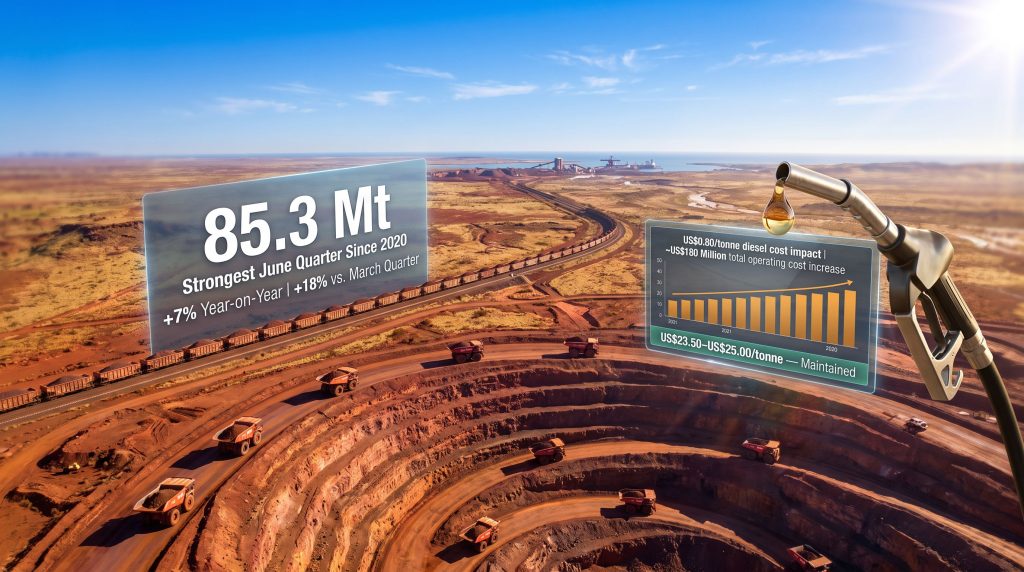
The June quarter of 2026 produced 85.3 million tonnes in Pilbara iron ore shipments, a result that exceeded market expectations and represented the division's highest June-quarter output in six years. On a year-on-year basis, volumes rose 7%, and compared to the disrupted March quarter, the rebound was an even more striking 18% increase.
The first half of 2026 cumulatively delivered 157.7 million tonnes in Pilbara sales, sitting 5% above the prior corresponding period. To contextualise this performance, it helps to understand what the March quarter disruption actually involved. Furthermore, the iron ore demand prospects heading into H2 remain closely tied to how Beijing responds to ongoing property sector weakness.
The Cyclone Effect and What It Tells Us About Q2's True Character
Cyclonic activity across Western Australia's Pilbara region in Q1 2026 is a well-understood weather risk for iron ore producers. What is less commonly appreciated is the cascading logistics consequence these events create. When cyclones force rail haulage to suspend, ore that has already been extracted from the pit begins to accumulate at intermediate stockpile points. When operations resume, producers face a sequencing challenge: clearing the backlog while simultaneously maintaining normal extraction rates.
This creates a natural volume surge in the subsequent quarter that is partly catch-up and partly genuinely improved throughput. The Q2 2026 result contains both elements. Rio indicated that improved productivity across its mine-to-port supply chain contributed to the stronger result alongside the recovery of deferred tonnes. Investors should interpret this carefully: the sustained component of the Q2 uplift is arguably more valuable than the weather-recovery component when projecting H2 volumes.
Analyst note: Distinguishing between structural productivity gains and weather-driven volume recovery is critical for accurate H2 guidance modelling. A quarter that is 50% catch-up and 50% genuine improvement has different forward implications than one that is predominantly structural.
Rio Tinto's Standing in Global Iron Ore Trade
In May 2026, Rio Tinto held the position of the world's leading iron ore exporter, shipping 28.2 million tonnes in a single month. This ranking reflects the scale and infrastructure maturity of the Pilbara network, which spans multiple mining hubs connected by thousands of kilometres of privately operated rail corridors feeding into dedicated port facilities at Dampier and Cape Lambert.
What many outside the industry do not fully appreciate is the degree to which Rio's export capacity is constrained not by ore availability but by rail and port throughput. The Pilbara contains virtually inexhaustible iron ore resources; the binding constraint on any given quarter's shipment volume is logistical, not geological. This is why cyclone-driven rail disruptions have an outsized impact relative to pit-level events.
Full-Year Guidance: The H2 Arithmetic
Annual Shipment Target: 323 to 338 Million Tonnes
With 157.7 million tonnes shipped through the first half, Rio Tinto requires between 165 and 180 million tonnes across H2 to satisfy its full-year guidance corridor of 323 to 338 million tonnes. At the Q2 run-rate of approximately 85 million tonnes per quarter, the lower end of guidance appears achievable under normal operating conditions.
| Scenario | H2 Required Volume | Implied Assessment |
|---|---|---|
| Lower end (323Mt) | ~165Mt | Achievable without major disruptions |
| Upper end (338Mt) | ~180Mt | Requires Q2-equivalent pace or better |
| Below guidance | Less than 165Mt | Possible under adverse weather or operational events |
The critical variable is whether Q2's productivity improvement can be sustained rather than mean-reverting. Rio's Pilbara operations have historically demonstrated strong H2 seasonality, as the northern Australian wet season risk diminishes through the second half of the calendar year.
Diesel Costs: When Geopolitics Hits the Mine Gate
The Mechanics of Fuel Cost Exposure in Open-Cut Mining
Rio Tinto's confirmed disclosure that elevated diesel prices are adding approximately US$0.80 per tonne to Pilbara production costs, translating to an estimated US$180 million increase in operating expenditure, is significant not just in its quantum but in what it illustrates about the structural diesel dependency of large-scale open-cut operations.
Pilbara iron ore mining consumes diesel across three primary vectors:
- Haul truck fleets that move ore from blast sites to primary crushers, often across kilometre-scale haul roads within each pit complex
- Rail locomotive operations running across hundreds of kilometres of private rail network between mine and port
- Port equipment, ancillary infrastructure, and camp power generation at remote operational sites
What makes this exposure particularly difficult to manage is that many of these consumption points are resistant to short-term substitution. Electric haul trucks exist in early commercial deployment but represent a small fraction of global fleet capacity. Autonomous trucks, which Rio has deployed extensively in the Pilbara, improve fuel efficiency per tonne moved but do not eliminate diesel dependency.
What Is Driving the 2026 Diesel Price Surge?
The current fuel cost environment reflects a convergence of supply-side pressures. In addition, monitoring crude oil price trends remains essential for understanding how distillate costs may evolve through the remainder of the year:
- Middle East conflict escalation has elevated crude oil risk premiums and disrupted established shipping routes through key transit corridors
- Russian export restrictions under Western sanctions have removed a significant volume of diesel from Atlantic Basin markets, displacing demand toward alternative supply sources
- Refinery capacity constraints from unplanned outages have reduced the conversion of crude oil into distillate products precisely when demand is elevated
- U.S. benchmark pricing movements, with diesel spiking to US$4.04 per gallon following a single-session surge of 14.7 cents, the highest level in nearly two years, have set a high floor for global distillate pricing
Industry observers have flagged that diesel and jet fuel supply tightness is expected to persist through H2 2026, with limited relief anticipated from either refinery capacity additions or geopolitical de-escalation in the near term.
Cost Sensitivity: What Different Diesel Scenarios Mean for Rio
| Diesel Price Change | Estimated Per-Tonne Impact | Annualised Cost Impact (330Mt basis) |
|---|---|---|
| +US$0.20/gallon | ~US$0.20/tonne | ~US$66 million |
| +US$0.50/gallon | ~US$0.50/tonne | ~US$165 million |
| +US$0.80/gallon (current) | ~US$0.80/tonne | ~US$180 million (confirmed) |
| +US$1.20/gallon | ~US$1.20/tonne | ~US$396 million |
Note: Figures are illustrative estimates based on disclosed per-tonne impact data and published production guidance. Actual outcomes will depend on hedging positions, contract structures, and operational mix.
Unit Cost Guidance Held: What That Signals
Despite the US$180 million diesel headwind, Rio Tinto maintained its Pilbara unit cost guidance at US$23.50 to US$25.00 per tonne. This is a meaningful operational signal. It suggests one of two things, or a combination of both: the company's internal fuel price assumptions already incorporated a degree of upside volatility, or productivity improvements and other cost efficiencies are actively offsetting the fuel escalation at the margin.
Holding cost guidance steady in the face of a confirmed nine-figure cost increase demonstrates a level of operational cost discipline that is not universally present across the sector. It also provides investors with a more stable basis for margin modelling heading into the H2 earnings period. Notably, Rio Tinto taxes and royalties obligations remain a further consideration for net margin assessments across multiple jurisdictions.
Copper Portfolio: Production Decline and a Gold-Driven Cost Offset
Why Copper Output Fell 7% in Q2 2026
Rio Tinto's copper division produced 213,000 tonnes in the June quarter, a 7% decline from the prior corresponding period. Two assets drove the shortfall:
- Escondida (Chile): Lower ore grades moving through the processing circuit reduced overall recoverable copper volumes. Grade variability at porphyry copper deposits like Escondida is a well-understood geological phenomenon; as mining progresses through different ore zones, average head grades fluctuate, directly affecting recovery yields
- Kennecott (Utah, USA): An unplanned furnace outage at the smelting facility disrupted conversion of copper concentrate into refined metal, creating a processing bottleneck independent of ore availability
The By-Product Credit Mechanism and Gold's Role
One of the less commonly understood dynamics in copper economics is the by-product credit system. Large porphyry copper deposits frequently contain economically meaningful concentrations of gold, silver, and molybdenum alongside the primary copper mineralisation. When these by-products are recovered during processing, their sale revenue is netted against total operating costs, reducing the reported cost per tonne of copper produced.
In 2026, elevated gold prices have materially increased the value of these by-product credits at both Escondida and Kennecott. The effect is significant enough that Rio Tinto was able to lower its copper unit cost guidance for the full year despite producing fewer tonnes than the prior period. This is a powerful illustration of how commodity price correlations create natural, if imperfect, internal hedges within diversified mining portfolios. Consequently, understanding broader copper market trends is increasingly important for contextualising Rio's evolving cost and production outlook.
The by-product credit dynamic is rarely discussed in mainstream market coverage but can represent the difference between a copper operation appearing cost-competitive or marginal, particularly during periods of grade decline.
What Rio's Q2 Result Means for the Broader Iron Ore Market
Supply and Demand Dynamics in Seaborne Trade
When the world's largest iron ore exporter records its strongest June-quarter output in six years, the seaborne supply balance shifts. Elevated Pilbara throughput, sustained across multiple quarters, creates modest but real downward pressure on spot iron ore prices, particularly if Chinese steel mill demand remains below the highs of prior expansion cycles.
Chinese buying activity was identified as a supporting factor behind Rio's Q2 export strength, with restocking behaviour at steel mills contributing to elevated demand for Pilbara product. However, the dynamics of China steel and iron ore markets continue to be shaped by structural headwinds in the property sector, which temper the outlook for sustained steel consumption growth. Infrastructure-led stimulus from Beijing represents the primary upside scenario for iron ore demand in H2 2026, though the timing and scale of any such stimulus remains uncertain.
How Investors Read the Dual Signal
The market's response to Rio's Q2 update was constructive. RIO shares gained 1.32% on the day of the announcement, reflecting a market interpretation that volume outperformance relative to expectations carries more weight than near-term cost escalation, particularly when full-year cost guidance has been maintained intact.
The forward questions that will determine Rio's H2 narrative are:
- Whether Q2 export momentum can be sustained without weather disruption
- Whether diesel prices stabilise or continue escalating through the northern hemisphere autumn
- How quickly the Kennecott furnace issue is resolved and copper production recovers
- Whether Chinese steel demand strengthens materially or continues to drift sideways
The next major ASX story will hit our subscribers first
Key Metrics at a Glance: Rio Tinto Q2 2026
| Metric | Result | Context |
|---|---|---|
| Pilbara iron ore shipments | 85.3 million tonnes | Strongest June quarter since 2020 |
| Year-on-year volume change | +7% | Ahead of market expectations |
| Quarter-on-quarter volume change | +18% | Recovery from Q1 cyclone disruptions |
| H1 2026 Pilbara sales | 157.7 million tonnes | +5% on prior corresponding period |
| Full-year shipment guidance | 323 to 338 million tonnes | Maintained |
| Diesel cost impact per tonne | US$0.80 | Driven by Middle East conflict |
| Total diesel cost increase | ~US$180 million | Based on current production volumes |
| Pilbara unit cost guidance | US$23.50 to US$25.00/tonne | Unchanged despite fuel headwinds |
| Copper production (Q2 2026) | 213,000 tonnes | -7% year-on-year |
| RIO share price movement (15 Jul) | +1.32% | Day of quarterly update release |
FAQ: Rio Tinto Iron Ore Exports and Cost Pressures in 2026
What drove the Rio Tinto iron ore exports rebound in Q2 2026?
The rebound to 85.3 million tonnes combined the recovery of deferred volumes from Q1 cyclone disruptions with genuine productivity improvements across the Pilbara mine-to-port supply chain. According to analysts, sustained export momentum at these levels could place modest downward pressure on spot iron ore pricing if Chinese demand does not keep pace.
How much are rising diesel prices costing Rio Tinto in 2026?
Approximately US$0.80 per tonne, equating to an estimated US$180 million increase in total operating expenditure based on current production volumes.
Has Rio Tinto changed its full-year cost or production guidance?
No. Pilbara unit cost guidance remains US$23.50 to US$25.00 per tonne and full-year shipment guidance remains 323 to 338 million tonnes.
Why did Rio Tinto's copper production decline in Q2?
Output fell 7% to 213,000 tonnes due to lower ore grades at Escondida and an unplanned furnace outage at the Kennecott operation in Utah.
How are gold prices helping Rio Tinto's copper cost structure?
Gold recovered as a by-product of copper processing is credited against operating costs. Higher gold prices in 2026 increased the value of these credits, enabling Rio to lower copper unit cost guidance despite the production shortfall.
What is driving the global diesel price surge?
A convergence of Middle East geopolitical conflict, Western sanctions reducing Russian diesel availability, and unplanned refinery outages has tightened distillate supply globally and pushed benchmark U.S. diesel to nearly US$4.04 per gallon.
This article is for informational purposes only and does not constitute financial or investment advice. Readers should conduct their own research and consult a qualified financial adviser before making any investment decisions. Forecasts, scenario analyses, and cost sensitivity estimates are illustrative and subject to material uncertainty.
Want to Catch the Next Major ASX Mineral Discovery Before the Market Does?
Discovery Alert's proprietary Discovery IQ model delivers real-time alerts on significant ASX mineral discoveries, turning complex mineral data into actionable insights for both short-term traders and long-term investors — explore the historic returns major discoveries have generated and begin your 14-day free trial at Discovery Alert to position yourself ahead of the broader market.