
June 9, 2026
The Structural Fragility Behind Uranium's Bullish Moment
Most commodity bull markets are driven by demand surprises. Uranium's current cycle is different. The defining risk is no longer whether the world will consume more nuclear fuel — it is whether the world can actually produce enough of it. That shift from demand uncertainty to supply fragility represents one of the most significant structural changes in the uranium sector in decades, and it is creating a very specific type of opportunity for exploration companies, including those behind the ATHA Energy Angilak uranium project drilling program, operating in underexplored basins with confirmed mineralisation.
The numbers illustrate the vulnerability clearly. Canada's flagship uranium operations, including the McArthur River and Key Lake complex and the Cigar Lake mine, collectively produce an estimated 15 to 18 million pounds of U₃O₈ per annum. These are tier-one, world-class assets. Yet their very concentration means that a single infrastructure disruption — such as a flooding event and ice buildup on a bridge in Saskatchewan during a late spring thaw — can temporarily place an enormous share of global uranium supply at risk.
That real-world demonstration of uranium supply-demand volatility in 2026 served as a sharp reminder that physical infrastructure, not geopolitical headlines, can be the most immediate threat to uranium market stability.
Nuclear energy commitments across the United States, China, and most industrialised nations have created a structurally durable demand floor. Every major economy appears to be reinforcing its nuclear energy ambitions, and energy security has become a bipartisan priority across multiple governments. That combination of structurally growing demand and a highly concentrated, physically fragile supply base creates the foundational context within which the ATHA Energy Angilak uranium project drilling program must be understood.
When big ASX news breaks, our subscribers know first
Where Junior Explorers Sit in a Maturing Uranium Capital Cycle
Commodity equity cycles follow a broadly predictable capital flow pattern. Producers move first, capturing investor attention as commodity prices rise and operating margins expand. As cycles mature, investors seeking greater leverage and return potential progressively shift capital toward developers and then toward earlier-stage explorers. This pattern has played out across gold, copper, and lithium cycles with reasonable consistency.
Uranium, however, has a structural anomaly that makes the junior exploration opportunity more asymmetric than in most other commodities. Understanding the broader uranium market dynamics helps explain why the middle of that pipeline — development-stage companies and resource-stage companies genuinely emerging toward development — is unusually thin in a way that is not typical of mature commodity sectors.
This scarcity creates a specific investment dynamic. When capital eventually rotates into the junior uranium space, the number of genuinely well-positioned targets is limited. Companies that have already de-risked discovery, built capital runways, and assembled experienced technical teams are positioned very differently from generative explorers still searching for initial mineralisation signals.
The distinction matters: not all junior uranium exposure is equivalent. In a thin pipeline environment, the market tends to concentrate its re-rating on companies where discovery risk has already been addressed and the next phase of value creation is structural continuity, not geological proof of concept.
Furthermore, the uranium supply challenges underpinning this cycle reinforce the argument that well-positioned junior explorers with confirmed mineralisation deserve closer attention from investors seeking asymmetric returns.
What Is the Angilak Uranium Project and Why Does It Matter Geologically?
The Angilak project is located in Nunavut, Canada, situated in the geological corridor north of the Athabasca Basin and between the Athabasca and Thelon Basins. ATHA Energy controls the entire Adjucanlin Basin, giving it exclusive jurisdictional command over the project area. This is not a joint venture arrangement or a partial interest position — it is full control of an entire sedimentary basin.
The geological setting is significant. The Athabasca Basin is the world's highest-grade uranium district, and the structural and depositional characteristics of the Adjucanlin Basin share features that uranium geologists associate with high-grade mineralisation potential. The Angilak project area hosts both sedimentary basin-margin uranium mineralisation and structurally controlled corridor-style deposits, which is the combination typically observed in prolific uranium systems.
The Lac 50 Deposit as an Exploration Signal
ATHA's decision to acquire Latitude Uranium was driven primarily by the Lac 50 deposit. However, the acquisition thesis was not simply about acquiring an existing resource. The deposit's position at the basin edge was interpreted as a geological signal of broader metal endowment potential within the surrounding basin. An edge-of-basin deposit is geologically meaningful because it suggests the basin interior, which is often more prospective for mineralisation, remains substantially untested.
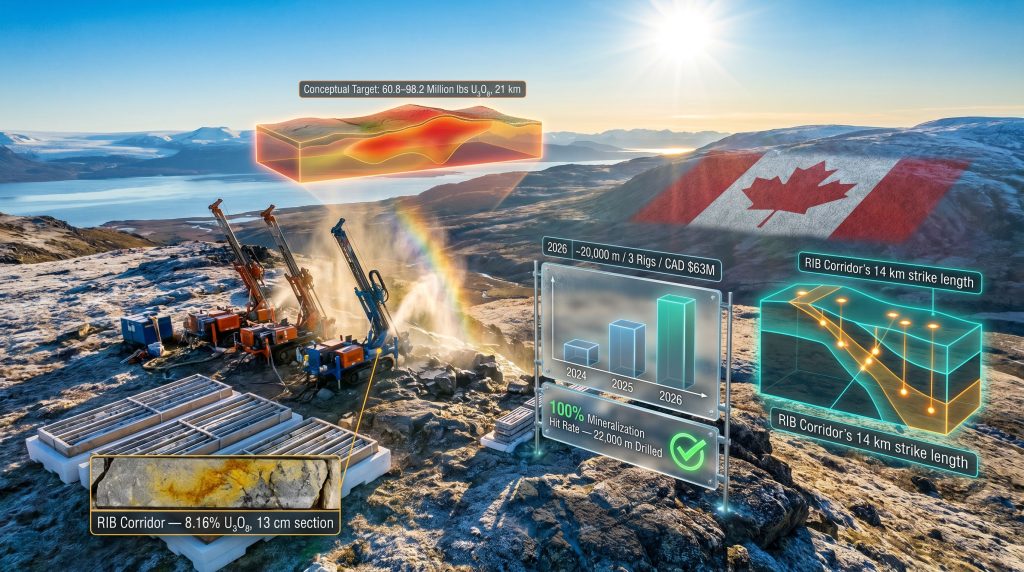
The current conceptual exploration target for the Lac 50 area sits between 60.8 and 98.2 million pounds U₃O₈. It is important to note that conceptual exploration targets are not formal mineral resources under NI 43-101 or equivalent reporting standards. They represent an order-of-magnitude estimate of potential and are subject to substantial uncertainty pending further drilling and resource estimation work.
What changed the nature of the Lac 50 opportunity materially was the application of 3D geological modelling to existing geophysical data. When ATHA's technical team reprocessed the Lac 50 geophysical dataset using inversion methodology following the 2025 RIB Corridor drilling program, the results revealed that the structural trend associated with Lac 50 extends for 21 kilometres. The previously interpreted strike length had been estimated at 5 to 7 kilometres — the extension was not a minor revision. It fundamentally altered the scale of the untested opportunity adjacent to the known deposit.
Of the full 21 km structural trend, drilling has only been conducted within the Lac 50 deposit proper. The remaining extension is geophysically defined but geologically untested.
The 2024 and 2025 Drilling Programs: Building an Unprecedented Discovery Record
Over the 2024 and 2025 field seasons, ATHA drilled approximately 22,000 metres across the Angilak project. None of these holes were drilled into the existing Lac 50 deposit — every metre of drilling was deployed against new exploration targets in the surrounding basin.
The outcome was a 100% mineralisation hit rate across all targets tested. Every exploration hole returned uranium mineralisation. This conversion rate is described by the company's technical leadership as unprecedented for a greenfield exploration programme, and it shifts the fundamental risk profile of the project from discovery-stage uncertainty toward scale and continuity definition.
The RIB Corridor: A Standalone Discovery Within the Adjucanlin Basin
The most significant discovery from the 2025 programme was the mineralised RIB Corridor, a structurally controlled uranium system within the Adjucanlin Basin. The 2025 drilling programme tested this corridor with 13 drill holes across a 14 kilometre strike length, with holes spaced approximately 1.5 to 2 kilometres apart. This spacing is reconnaissance-scale, not delineation-scale. The objective was not to define a resource but to determine whether the structural corridor was uniformly mineralised across its length.
Every hole returned uranium mineralisation. The best intersection from the 2025 programme was 34.7 metres of composite uranium mineralisation downhole, including 13 metres of continuous mineralisation grading above 0.5% U₃O₈, with peak grades reaching 8.16% U₃O₈ within that interval.
| Drilling Parameter | RIB Corridor (2025 Season) |
|---|---|
| Total Holes Drilled | 13 |
| Strike Length Tested | 14 km |
| Average Hole Spacing | 1.5 to 2 km |
| Mineralisation Hit Rate | 100% |
| Best Composite Intersection | 34.7 m downhole |
| Best Continuous Grade Interval | 13 m above 0.5% U₃O₈ |
| Peak Grade Within Interval | 8.16% U₃O₈ |
To understand the significance of these grades, it helps to know the industry context. The Athabasca Basin hosts deposits where grades above 1% U₃O₈ are considered high-grade and grades above 5% are considered exceptional. The peak interval at the RIB Corridor sits within that exceptional category. Importantly, these are grades from widely spaced reconnaissance drilling, not from delineation holes targeting the highest-grade zones.
The structural and geological setting of the RIB Corridor was described by ATHA's technical team as analogous to Athabasca Basin-style unconformity uranium systems — the geological architecture responsible for the world's highest-grade uranium deposits.
How 3D Inversion Modelling Changed the Targeting Strategy
A key enabler of the 2025 RIB Corridor success was the application of a proprietary 3D inversion modelling process to interpret geophysical data. Standard geophysical surveys collect surface or airborne measurements of electrical conductivity variations in the subsurface. Inversion modelling takes those measurements and constructs a three-dimensional representation of subsurface conductive structures, which in uranium geology are often associated with the graphitic or altered zones that host mineralisation.
The advantage of this approach is precision. Rather than drilling based on broad geophysical anomalies, ATHA's team was able to target specific subsurface structural features with much higher confidence. The subsequent application of this same methodology to the Lac 50 area — after RIB drilling was complete — revealed the 21 km structural extension that was previously unrecognised. This retroactive discovery of target scale illustrates why the technology is now central to the 2026 drill targeting strategy.
The 2026 Angilak Drilling Program: Scale, Structure, and Strategy
The ATHA Energy Angilak uranium project drilling program for 2026 is the largest single-season investment the company has made in the project since its acquisition. According to the official programme announcement, the programme plans approximately 20,000 metres of diamond drilling across three rigs, running from May through September 2026. This exceeds the combined meterage of the entire 2024 and 2025 seasons.
The capital supporting this programme came from a CAD $63 million financing closed in Q1 2026, one of the largest capital raises in the junior uranium exploration sector for that period. Mobilisation of drilling equipment was completed in late April 2026, with equipment transported by ATR aircraft from Yellowknife and Baker Lake to the Angilak winter landing strip.
The financing did not occur in isolation. It followed three years of systematic exploration work, two of which produced a 100% mineralisation hit rate across all exploration targets tested. The capital raise reflects institutional confidence in a track record of delivery, not speculative optimism about an untested concept.
Three Rigs, Three Strategic Objectives
The three-rig programme is structured around distinct geological objectives, each building on findings from prior seasons.
Rigs 1 and 2: RIB Corridor Continuity Building
Two drill rigs are allocated to building mineralisation continuity within the RIB system. The 2025 holes established that mineralisation exists across a 14 km structural trend at wide reconnaissance spacing. The 2026 programme will step inward from those discovery holes to begin demonstrating structural continuity between the confirmed mineralised intercepts. This phase is a prerequisite for delineation drilling in 2027. The geophysical footprint of the RIB system extends materially beyond the drilled 14 km, providing additional exploration upside beyond continuity confirmation.
Rig 3: Lac 50 Structural Extension Testing
The third rig is directed at the 21 km Lac 50 structural extension identified through 3D inversion reprocessing. This target is geophysically well-defined and represents one of the highest-priority untested opportunities in the project. The drilling objective is to determine whether the structural extension hosts fertile uranium mineralisation comparable to the deposit itself — a binary geological question with significant implications for the overall project scale thesis.
Supplementary Survey: Basin-Wide MMT Geophysics
An aerial Magnetotelluric (MMT) geophysical survey covering the full Angikuni Basin is scheduled to commence in late June 2026. MMT surveys measure variations in natural electromagnetic fields to map deep conductive structures, providing geological information at depths beyond the reach of standard airborne methods. The 3D inversion modelling results from this survey are targeted for Q4 2026 and will provide the targeting framework for the 2027 delineation and optimisation drilling phase.
Understanding the News Flow: How to Interpret Radiometric Results
ATHA's investor reporting convention follows a two-stage release sequence that is worth understanding in detail. Consequently, investors should familiarise themselves with both stages to properly interpret results as they emerge throughout the programme.
Downhole gamma probe results — also called radiometric results — are released first. A gamma probe is lowered into a completed drill hole to measure natural radioactivity at depth. Since uranium is naturally radioactive, elevated gamma probe readings provide an immediate proxy indicator of uranium mineralisation before laboratory assay results are available. For guidance on interpreting drill results in this context, understanding the distinction between radiometric readings and formal assays is essential.
Formal assay results require physical laboratory processing of drill core samples, a process that can take weeks to months depending on laboratory throughput and sample volume. ATHA has indicated it intends to release results on approximately a monthly cadence, with frequency increasing as assay data returns through the second half of the programme.
| Result Type | Timing | Information Provided |
|---|---|---|
| Radiometric (Gamma Probe) | Immediately post-drilling | Radioactivity proxy, structural context |
| Formal Assay | Weeks to months after drilling | Confirmed grade (% U₃O₈), interval lengths |
| MMT Survey Modelling | Q4 2026 | Deep structural targeting for 2027 |
For investors, this means the first wave of information from the 2026 programme will come in radiometric form. Radiometric results are directionally meaningful but not definitive. A strong gamma probe reading does not guarantee a particular assay grade, though it is a well-established exploration tool with a reliable correlation to uranium mineralisation in similar geological settings.
The next major ASX story will hit our subscribers first
The 24-Month Path Toward Resource Definition
The 2026 drilling programme is explicitly designed as a continuity-building phase, not a resource-definition phase. Understanding this distinction matters for setting appropriate expectations around what the programme will and will not deliver.
Uranium resource estimation requires drilling at delineation spacing — typically in the range of tens of metres between holes rather than the 1.5 to 2 km reconnaissance spacing used in 2025. Before delineation drilling can be conducted efficiently, geologists need to know where the highest-quality and best-connected mineralised zones within a large system are located. The 2026 programme answers that question by stepping inward from the widely spaced 2025 holes to establish continuity patterns.
Once continuity is defined, the 2027 programme can be designed with delineation objectives, targeting the zones of best continuity and highest grade for tight-spaced drilling that supports formal resource estimation. Management has described this trajectory as a 24-month window toward resource growth, beginning from the current programme phase.
| Milestone | Expected Timing |
|---|---|
| First radiometric results (Batch 1) | Q2 2026 |
| First formal assay results | Q3 2026 |
| MMT geophysics survey completion | Late Q2 to Q3 2026 |
| 3D inversion modelling from MMT | Q4 2026 |
| Continuity definition across RIB Corridor | End of 2026 field season |
| Transition to delineation drilling | 2027 |
| Potential resource update | 2027 to 2028 |
Disclaimer: All milestones and timelines above are forward-looking and subject to change based on weather, equipment availability, laboratory processing times, results, and management decisions. They do not constitute guarantees or commitments. Investors should exercise their own due diligence.
The Broader Portfolio: Strategic Optionality Beyond Angilak
ATHA assembled a 3.5 million acre land package across Canada's premier uranium jurisdictions between April 2023 and mid-2024, combining mergers, acquisitions, and organic claim staking. The portfolio spans the Athabasca Basin, Thelon Basin, Angikuni Basin, and the Central Mineral Belt in Labrador. While Angilak is receiving the concentration of capital and operational focus, the other assets are being advanced through data acquisition, desktop studies, geophysical surveys, and targeting work.
Management has been clear that non-core assets are not being ignored. The objective is to mature the generative portfolio in parallel, advancing projects toward drill-readiness while maintaining a concentrated capital focus on Angilak. As these assets mature, the company is evaluating mechanisms to surface their value for shareholders, including joint ventures and earn-in partnerships rather than outright sales.
The NexGen Carried Interest: Zero-Cost Embedded Optionality
One of the less prominent but structurally interesting components of ATHA's portfolio is its 10% carried interest through to feasibility on NexGen Energy's SW1, SW2, and SW3 exploration projects in the Athabasca Basin.
A carried interest in this context means ATHA participates in the economic upside of any discovery made on those projects without contributing to exploration costs during the carry period. At feasibility, ATHA can elect to convert the carry into either a participatory working interest or a net smelter return royalty, at ATHA's discretion.
The financial logic is straightforward:
- Cost to ATHA to maintain the interest: zero dollars through to feasibility
- Economic exposure: 10% participation in any discovery made on SW1, SW2, or SW3
- Conversion flexibility: participatory interest or NSR royalty at ATHA's election
- Strategic rationale: passive exposure to NexGen's exploration track record at no capital cost
NexGen Energy is the developer of the Arrow deposit in the Athabasca Basin, one of the highest-grade undeveloped uranium deposits in the world. Whether the SW projects ultimately host commercial mineralisation is speculative, but the carried interest structure means ATHA bears none of the cost risk of finding out.
M&A Landscape and ATHA's Defensive Positioning
The broader uranium junior sector is entering a period where consolidation conversations are becoming more frequent. Larger producers and developers face a structural challenge: the pipeline of near-term uranium projects is thin, and organic exploration timelines are long. Acquisition of pipeline-stage assets with confirmed mineralisation is a logical response to that constraint.
ATHA's primary stated objective is internal value creation through asset maturation rather than positioning for acquisition. The Q1 2026 investment by Warren Gilman through Queen's Road Capital is viewed by management as both a strategic endorsement of the project's development trajectory and a defensive anchoring factor in an M&A environment.
Management has identified three categories of risk that have been substantively addressed:
- Discovery risk: Addressed through a 100% mineralisation hit rate across all 2024 and 2025 exploration targets.
- Capital risk: Addressed through the CAD $63 million financing, providing a clear runway to execute the full 2026 programme and plan toward 2027.
- Team risk: Addressed through the assembly of a Saskatoon-based technical team with direct Cameco, NexGen, and Cigar Lake operational experience.
Technical Leadership: Why Team Depth Matters in Complex Exploration
Uranium exploration in remote Nunavut basins is operationally and technically demanding. The quality of geological interpretation, geophysical targeting, and drilling execution directly determines whether exploration capital is spent efficiently or wasted on poorly designed programmes.
ATHA's CEO Troy Bourjolet brings direct experience from Cameco and NexGen Energy, including involvement in advancing what became one of the world's highest-grade uranium deposits during a period when the uranium market was trading at depressed levels. Building a world-class asset in an adverse market environment is a fundamentally different test of technical and operational capability than advancing projects during a bull cycle.
VP of Exploration Cliff Revering carries a track record that is particularly relevant to the current phase of Angilak's development. His background as Chief Geologist at Cigar Lake during its transition into production, combined with his role as Principal Resource Geologist for SRK and Qualified Person on multiple global uranium resource estimates, provides the exact technical expertise required to navigate the transition from discovery-stage drilling toward formal resource estimation.
The team's physical location in Saskatoon, Saskatchewan is a practical advantage that is easy to underestimate. Saskatoon hosts one of the globally highest concentrations of uranium geology expertise, given its proximity to the Athabasca Basin and the historical presence of Cameco's operations and technical headquarters. In addition, access to that labour market meaningfully expands the pool of experienced professionals available to a growing exploration company.
Frequently Asked Questions: ATHA Energy Angilak Uranium Project
What Is the ATHA Energy Angilak Uranium Project Drilling Program for 2026?
The 2026 programme plans approximately 20,000 metres of diamond drilling across three rigs from May through September 2026. Two rigs are focused on building mineralisation continuity within the RIB Corridor, and one rig is testing the 21 km structural extension of the Lac 50 deposit trend.
What Grades Has Drilling Returned at Angilak?
The best intersection from 2025 drilling at the RIB Corridor returned 34.7 metres of composite uranium mineralisation downhole, including 13 metres of continuous mineralisation above 0.5% U₃O₈ and peak grades of 8.16% U₃O₈ within that interval.
What Is the Lac 50 Conceptual Exploration Target?
The conceptual exploration target for the Lac 50 area is 60.8 to 98.2 million pounds U₃O₈. This is not a formal mineral resource under NI 43-101 or equivalent standards and should not be treated as such. It is an order-of-magnitude estimate subject to significant uncertainty.
How Is ATHA Energy Funded for the 2026 Program?
ATHA closed a CAD $63 million financing in Q1 2026, providing capital to execute the full 2026 exploration programme and plan toward the 2027 delineation phase.
What Is the RIB Corridor?
The RIB Corridor is a structural uranium mineralisation system discovered during ATHA's 2025 field season. Thirteen drill holes across a 14 km strike length all returned uranium mineralisation at reconnaissance-scale spacing of 1.5 to 2 km between holes.
What Happens After the 2026 Program?
If 2026 drilling successfully establishes continuity of mineralisation across key corridors, the 2027 programme is expected to transition toward delineation drilling in the best-defined zones, targeting a formal resource update within a 24-month window from the current phase.
This article is for informational purposes only and does not constitute financial advice or a recommendation to buy or sell any securities. Exploration results, resource estimates, timelines, and financial projections involve forward-looking statements subject to material risks and uncertainties. Always conduct independent due diligence and consult a qualified financial adviser before making any investment decisions.
Want To Catch the Next Major Uranium Discovery Before the Broader Market?
Discovery Alert's proprietary Discovery IQ model scans ASX announcements in real time, delivering instant alerts on significant mineral discoveries — including uranium — so subscribers can act on high-potential opportunities the moment they emerge. Explore how historic discoveries have generated substantial returns on Discovery Alert's dedicated discoveries page, and begin your 14-day free trial today to position yourself ahead of the market.