June 11, 2026
The Long Game in Uranium: How Mine Restarts Shape the Global Supply Curve
Few investment narratives in the resources sector are as misunderstood as the uranium mine restart. Conventional thinking frames a mine recommissioning as a simple switch being flipped back on. The operational reality is far more nuanced. Equipment that sat idle through years of care-and-maintenance requires systematic recommissioning. Processing chemistry must be recalibrated. Geological models built during a prior operational phase need updating against freshly exposed ore. Workforce capability has to be rebuilt from the ground up. Understanding these dynamics is essential context for evaluating what is currently unfolding at one of Africa's most strategically positioned uranium operations, where Langer Heinrich Mine uranium production is steadily reshaping supply expectations.
When big ASX news breaks, our subscribers know first
Understanding Langer Heinrich Mine Uranium Production in Its Operational Context
Situated within Namibia's Erongo Region, approximately 80 kilometres east of Swakopmund and 85 kilometres northeast of Walvis Bay, the Langer Heinrich Mine operates as an open-pit uranium extraction and processing facility under Mining Licence 140. The operation produces uranium oxide concentrate, commercially referred to as U₃O₈ or yellowcake, the standard chemical form that enters the nuclear fuel cycle and is ultimately processed into fuel for commercial nuclear power plants.
Ownership is structured with Paladin Energy holding a 75% controlling interest through its subsidiary Langer Heinrich Uranium (Pty) Ltd, with the remaining 25% held by EPANGELO Mining, a Namibian state-owned entity. This structure reflects a common pattern in African resource development where host-country participation is embedded through sovereign ownership of minority stakes.
The Erongo Region's geological significance cannot be overstated. This strip of Namibian terrain hosts three of Africa's most productive uranium operations: Langer Heinrich, Rössing, and Husab. The region's uranium mineralisation is hosted within alaskite intrusions, a relatively rare geological formation where uranium concentrates in granitic rocks rather than sedimentary sequences.
This orebody type behaves differently during both mining and processing compared to sandstone-hosted uranium deposits common in Kazakhstan and other major producing nations, a distinction with real implications for recovery chemistry and ore characterisation work. Furthermore, broader uranium supply-demand volatility continues to influence how investors and utilities assess assets like this one.
From First Production to Suspension to Recommissioning
Langer Heinrich first began producing uranium oxide in 2007, and over approximately a decade of continuous operations, the mine delivered a cumulative total exceeding 43 million pounds of U₃O₈ to global uranium utilities. The operation was suspended in 2018 following a prolonged period of depressed spot prices that rendered continued production economically unviable.
The mine remained on care-and-maintenance for approximately six years before infrastructure upgrades and materially improved market conditions justified recommissioning. The first yellowcake concentrate from the restarted operation was produced on 30 March 2024, and the inaugural customer shipment of 319,229 pounds of U₃O₈ departed Namibian shores on 12 July 2024. This shipment marked Langer Heinrich's formal re-entry into active nuclear fuel supply chains.
The six-year suspension period at Langer Heinrich was not merely a commercial pause. It represented a structural withdrawal of meaningful supply from global uranium markets at a time when demand dynamics were quietly but fundamentally shifting.
Quarterly Production Trajectory: Reading the Ramp-Up Curve
The ramp-up trajectory of Langer Heinrich Mine uranium production since recommissioning provides a detailed case study in how open-pit mining operations build toward operational steady-state. The progression has not been linear, which is entirely consistent with standard mine restart dynamics where equipment availability, processing optimisation, and geological understanding improve sequentially.
| Period | Production (lb U₃O₈) | Key Development |
|---|---|---|
| To June 30, 2024 | 517,597 | Initial restart phase; partial equipment availability |
| December 2024 (single month) | 308,604 | Best single month to that point in restart sequence |
| Q1 FY2026 (ended Sept 2025) | 1,066,496 | 63% increase in material mined vs. prior quarter |
| Q2 FY2026 (ended Dec 2025) | 745,484 | 17% QoQ increase; plant recovery reaching 88% |
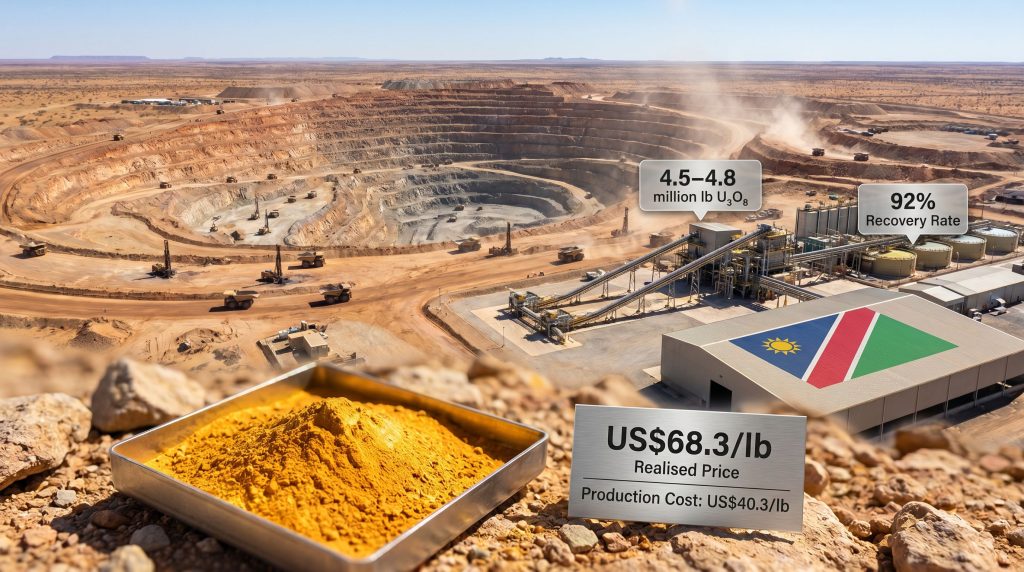
| Latest Reported Quarter | 1,290,000 | 92% recovery rate; full fleet commissioned |
The jump to 1.29 million pounds in the most recently reported quarter is particularly significant when viewed against the full-year FY2025 result of approximately 3 million pounds of U₃O₈ across more than 3.6 million tonnes of ore processed. That annualised rate represented an average recovery of around 84% across the year. The progression to 92% recovery in the latest quarter indicates meaningful processing plant optimisation has occurred, moving the operation closer to its nameplate efficiency potential.
What Is Actually Driving the Acceleration in Output?
Several distinct operational factors have converged to drive the production step-change visible in recent quarterly data:
-
Mining fleet commissioning completion: The delivery and commissioning of the final load-and-haul equipment resolved a previously binding constraint on ore movement rates. Earlier quarters operated with partial fleet availability, which capped how quickly material could be drilled, blasted, and delivered to the crusher.
-
G pit concentration: Drilling, blasting, and haulage activities became concentrated in the G pit, enabling more systematic bench progression and predictable ore delivery. Total mined material in the latest quarter reached 6.17 million tonnes, representing a 12% increase from the preceding period.
-
MG3 stockpile utilisation: Processing of previously mined MG3 stockpiles alongside freshly mined ore from lower G pit benches has maintained crusher feed consistency during the ramp-up. This is a strategically important operational detail, as stockpile processing provides a buffer that prevents crusher throughput from fluctuating when pit-level ore delivery faces temporary constraints.
-
Crusher throughput performance: The crusher processed 1.21 million tonnes during the latest quarter at an average ore feed grade of 503 parts per million (ppm) uranium. This grade figure is within a reasonable range for alaskite-hosted uranium orebodies and suggests blend management between stockpile and fresh ore is maintaining feed grade stability.
-
Processing plant efficiency: Achieving a 92% average recovery rate reflects well-calibrated leaching and solid-liquid separation circuits. In uranium heap leaching and agitated leaching operations, recovery rates are sensitive to ore mineralogy, acid consumption, and retention times. An 8% improvement in recovery from the FY2025 full-year average to the latest quarter's result represents a significant operational gain.
Production Economics: The Cost Structure That Matters to Investors
For investors and market observers, the economics of Langer Heinrich Mine uranium production are arguably more revealing than the production volumes themselves. The cost structure at this stage of operations carries an important nuance that is frequently overlooked. In addition, understanding uranium market dynamics helps contextualise how this cost profile compares against broader industry benchmarks.
| Economic Metric | Latest Quarter | FY2026 Guidance |
|---|---|---|
| Production volume | 1.29 million lb U₃O₈ | 4.5–4.8 million lb U₃O₈ |
| Sales volume | 1.03 million lb U₃O₈ | 3.8–4.2 million lb U₃O₈ |
| Realised price | US$68.3/lb | Not guided |
| Quarterly production cost | US$40.3/lb | US$44–US$48/lb (full year) |
| Gross margin per pound | ~US$28.0/lb | Variable |
| Life-of-mine C1 cost | US$27.40/lb | Unchanged |
The current quarterly production cost of US$40.3 per pound is partially supported by MG3 stockpile processing, which carries lower incremental cost per tonne than fresh pit mining because the pre-mining capital was expensed during the original operational period. As stockpile volumes are progressively consumed and the operation transitions fully to open-pit ore delivery, unit costs are expected to migrate toward the guided range of US$44 to US$48 per pound, which still leaves a substantial margin against the latest realised price of US$68.3 per pound.
The life-of-mine C1 cost estimate of US$27.40 per pound represents the long-run average cost once the operation reaches full steady-state and amortises fixed costs across peak production volumes. The gap between this figure and prevailing uranium prices reflects the structural economic case for the asset across its remaining mine life.
Understanding Base-Escalated Uranium Contracts
A critical detail in Langer Heinrich's revenue profile is the contract structure through which uranium is sold. Unlike spot commodity markets where prices are set by real-time supply and demand, the majority of uranium transactions occur through long-term contracts with nuclear utilities. These agreements typically incorporate a base price with escalation provisions tied to inflation indices, uranium market benchmarks, or a combination of both.
This structure means that Paladin's realised price in any given quarter reflects a blended rate across multiple customer contracts with different pricing mechanisms, delivery schedules, and payment terms, rather than the spot price prevailing on the day of shipment. The US$68.3 per pound realised price should therefore be understood as a contract-weighted average, not a spot transaction price. Notably, the ongoing spot-term price divergence in global uranium markets means that as new contracts are negotiated at higher floor prices, realised pricing can improve gradually over time even without spot price appreciation.
FY2026 Guidance Revision: Decoding the Signal
On 17 April 2026, Paladin Energy revised its full-year FY2026 production guidance upward based on year-to-date operational performance. The revision carried several concurrent messages:
- Production guidance raised from 4.0–4.4 million lb U₃O₈ to 4.5–4.8 million lb U₃O₈
- Sales guidance unchanged at 3.8–4.2 million lb U₃O₈
- Cost of production guidance unchanged at US$44–US$48/lb
- Capital and exploration expenditure guidance reduced from US$26–US$32 million to US$15–US$17 million
The simultaneous upward revision to production and downward revision to capital expenditure is a combination that typically signals operational maturity rather than scope reduction. The heavy capital phase, primarily fleet acquisition and commissioning, has concluded. The operation is now generating output without requiring proportionally equivalent capital reinvestment. This dynamic improves capital efficiency metrics and, all else equal, increases free cash flow generation per pound of uranium produced.
The unchanged sales guidance relative to increased production guidance implies that near-term contract delivery schedules constrain how quickly additional production converts to revenue, which is standard for utilities-focused supply chains where delivery timing is agreed months in advance.
Resource Expansion Drilling: Building the Long-Term Base
Alongside operational ramp-up, Paladin has maintained active resource definition drilling within Mining Licence 140. During the latest quarter, 9,427 metres of resource drilling were completed using six active drill rigs operating concurrently within the licence boundary.
The technical work extends beyond conventional diamond or reverse circulation drilling. High-resolution ground electromagnetic (EM) geophysical surveys are being trialled to map subsurface clay distribution and improve three-dimensional geological understanding of the orebody. This is an area where less-discussed but practically significant operational risks exist in uranium processing.
Clay content in uranium orebodies directly affects two critical processing variables:
- Leaching efficiency: High clay content can slow acid penetration and reduce uranium extraction rates from ore particles during the leach circuit.
- Solid-liquid separation: Clay-rich slurries are notoriously difficult to filter and settle, increasing reagent consumption and reducing throughput through thickeners and filtration circuits.
By mapping clay distribution before mining rather than discovering it during processing, the geological team can plan pit sequences and ore blending strategies that minimise the proportion of high-clay ore entering the plant at any given time. This proactive approach to orebody characterisation is a hallmark of operationally mature uranium mining practices and has direct implications for sustained recovery rate performance.
The updated life-of-mine production target now stands at 77.4 million pounds of U₃O₈, slightly higher than the previous estimate of 76.1 million pounds, with a revised life-of-mine C1 cost of US$27.40 per pound compared to the prior US$26.90 per pound.
| Life-of-Mine Metric | Previous | Updated |
|---|---|---|
| Production target | 76.1 million lb | 77.4 million lb |
| C1 cost estimate | US$26.90/lb | US$27.40/lb |
The next major ASX story will hit our subscribers first
Langer Heinrich Within the Global Uranium Supply Architecture
Understanding where Langer Heinrich Mine uranium production sits within the global supply picture requires context on both the scale of world uranium demand and the fragility of current supply concentrations. Global annual uranium production has historically ranged between approximately 130 and 160 million pounds of U₃O₈, with Kazakhstan's uranium dominance through low-cost in-situ recovery (ISR) extraction methods accounting for a significant share. Canada's Athabasca Basin operations, led by Cameco's Cigar Lake and McArthur River mines, represent the other major high-grade supply source.
Namibia occupies a structurally important position as an alternative supply jurisdiction. Unlike ISR-dominated Kazakhstan or the extreme-grade but operationally complex Athabasca deposits, Namibia's alaskite-hosted open-pit operations offer a combination of large-scale mineable resources, established export infrastructure, and a stable political and regulatory environment. These characteristics collectively make Namibian uranium attractive to utilities seeking supply diversification beyond a single dominant producer.
According to recent reporting on southern Africa's uranium sector, the region's production outlook is strengthening considerably as demand forecasts improve. At the revised FY2026 production guidance midpoint of approximately 4.65 million pounds, Langer Heinrich's output would represent roughly 3% of global annual production at historical levels, a meaningful contribution for a single asset.
The Demand Side: Why Nuclear Utility Buying Behaviour Is Shifting
Several structural forces are reshaping uranium demand beyond simple electricity generation growth:
- The operational life extensions of existing nuclear fleets in the United States, France, and Belgium are extending uranium consumption further into the future than previously modelled.
- New reactor construction programmes across South Korea, China, India, and Eastern Europe are adding incremental long-term demand that takes years to appear in spot market buying activity but ultimately requires secured supply.
- Small modular reactor (SMR) development pipelines in the United States, United Kingdom, and Canada represent a speculative but potentially significant source of additional uranium demand over a longer time horizon.
- The Russian uranium import ban has prompted Western utilities to accelerate procurement of diversified feedstocks, which has structurally supported contract pricing above where pure spot fundamentals would otherwise suggest.
This article contains forward-looking statements, production guidance figures, and scenario projections sourced from company operational reporting. These should not be construed as financial advice. Uranium price assumptions, cost forecasts, and production targets are subject to material uncertainty and may differ from actual outcomes. Readers should conduct their own due diligence before making investment decisions.
Transition to Steady-State: What Full Operational Capacity Means in Practice
Paladin has confirmed the expectation that Langer Heinrich will complete its transition to full mining and processing plant operations before the end of FY2026. The practical meaning of this transition involves several distinct shifts from current operating conditions:
- Stockpile dependency reduces: As MG3 stockpile volumes are progressively exhausted, the proportion of ore feed sourced from fresh G pit benches increases. This raises per-tonne mining costs but improves long-term production predictability.
- Grade profile normalisation: The blend management currently employed between stockpile ore and fresh pit ore will simplify as the mine becomes entirely pit-fed. Grade consistency will then depend entirely on geological variability within the active mining benches.
- Cost migration toward guided range: As stockpile contribution diminishes, the quarterly production cost per pound is expected to drift toward the US$44–US$48 per pound guided range from its current US$40.3 per pound level.
- Capital requirements stabilise: Having completed fleet commissioning and the primary infrastructure refurbishment phase, sustaining capital requirements should settle into a more predictable maintenance-driven profile.
Applying a scenario framework: if Langer Heinrich achieves steady-state production at the upper end of revised FY2026 guidance (4.8 million pounds annually) against a realised price of US$68 per pound and a production cost of US$46 per pound, the operation would generate approximately US$105.6 million in annual gross margin. Extrapolated across the life-of-mine production target of 77.4 million pounds, and assuming constant real pricing for illustrative purposes only, total life-of-mine gross value would exceed US$5.2 billion. This figure is presented as a structural illustration of asset scale, not a forecast, and is highly sensitive to uranium price, cost trajectory, and production delivery assumptions.
At a Glance: Langer Heinrich Mine Key Statistics
| Metric | Detail |
|---|---|
| Location | Erongo Region, Namibia |
| Ownership | 75% Paladin Energy / 25% EPANGELO Mining |
| Mine type | Open-pit |
| Ore type | Alaskite-hosted uranium |
| Licence | Mining Licence 140 |
| Historical cumulative output | >43 million lb U₃O₈ |
| Production restart | March 2024 |
| First customer shipment | July 2024 (319,229 lb) |
| Latest quarterly production | 1.29 million lb U₃O₈ |
| Latest recovery rate | 92% |
| Ore feed grade | 503 ppm uranium |
| Latest realised price | US$68.3/lb |
| Latest production cost | US$40.3/lb |
| Life-of-mine C1 cost | US$27.40/lb |
| FY2026 production guidance | 4.5–4.8 million lb U₃O₈ |
| Life-of-mine production target | 77.4 million lb U₃O₈ |
| Resource drilling (latest quarter) | 9,427 metres, six rigs |
| FY2026 capex guidance | US$15–US$17 million |
For ongoing coverage of Namibia's uranium sector and broader developments across African mining markets, uranium production expansion at Langer Heinrich is covered in detail at African Mining Market, which publishes regular operational and investment reporting.
Want To Stay Ahead of the Next Major Uranium Discovery on the ASX?
Discovery Alert's proprietary Discovery IQ model delivers real-time alerts the moment significant mineral discoveries — including uranium — are announced on the ASX, transforming complex data into clear, actionable opportunities for investors at every level. Explore historic examples of discovery-driven returns or start your 14-day free trial today to position yourself ahead of the broader market.