
May 13, 2026
Sedimentary Uranium Systems and the Case for Near-Surface African Deposits
Among the various geological frameworks that define uranium exploration economics, few carry as much structural appeal as shallow, sedimentary-hosted systems. Unlike high-grade underground deposits that demand intensive capital for shaft sinking, ventilation, and ground support, bulk-tonnage near-surface uranium mineralisation offers a fundamentally different value proposition: large volumes of material at moderate grades, amenable to open-pit extraction at relatively modest capital intensity. This architectural distinction is why exploration capital has been steadily gravitating toward Africa's sedimentary uranium belts, where Zambia in particular is drawing renewed attention.
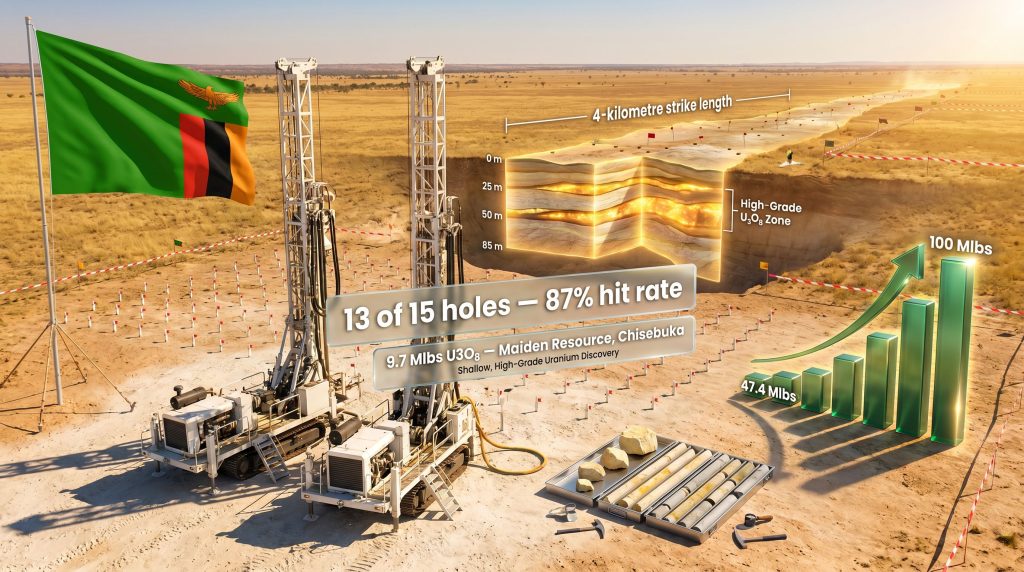
The Chisebuka target uranium drilling in Zambia, part of Atomic Eagle Limited's broader Muntanga Uranium Project campaign, is producing early results that illuminate both the geological character of this system and the scale of resource growth still within reach. With the first phase of the 2026 program delivering an 87% mineralisation hit rate across 15 holes, the data is beginning to define a project with characteristics that investors in uranium exploration have long sought: low discovery cost, shallow depth profiles, and genuine expansion optionality across a large licence footprint.
When big ASX news breaks, our subscribers know first
Why Zambia's Uranium Geology Deserves Serious Attention
The Sedimentary Framework That Makes Zambia Different
Zambia's uranium endowment is not a product of the high-temperature hydrothermal or intrusive processes that generate the spectacular grades found in Canada's Athabasca Basin. Instead, uranium in southern Zambia occurs within sedimentary sequences where uranium-bearing fluids have migrated through permeable rock units and precipitated uranium minerals at redox boundaries. This is a roll-front or tabular sedimentary style of mineralisation, sharing conceptual similarities with the systems found across Namibia and Niger, where some of the world's largest open-pit uranium mines operate.
What distinguishes Zambia's version of this geological story is the depth of mineralisation. At Chisebuka, all drill intersections to date have been recorded at less than 85 metres below surface. That is not a minor operational detail. In the economics of open-pit uranium mining, the strip ratio — which measures the volume of waste rock removed per unit of ore — is the primary variable governing whether a project is viable at a given uranium price. Near-surface mineralisation dramatically compresses this ratio, reducing the pre-production earthmoving burden and accelerating the path to first ore.
For context, Namibia's Rössing mine, one of the world's longest-operating uranium mines, built its entire production history on a similar near-surface, open-pittable alaskite-hosted system. While the mineralisation style differs, the economic logic of open-pittable geometry at shallow depth is the same: lower mining costs per tonne, faster payback periods, and greater resilience to uranium market volatility.
Understanding eU3O8: Why Uranium Grade Is Measured Differently
One technical nuance that distinguishes uranium exploration from most other commodity sectors is that grade is rarely determined through conventional chemical assay during the early drilling phase. Instead, uranium explorers rely on downhole geophysics — specifically gamma ray logging — as a proxy for uranium content. The notation eU3O8 rather than simply U3O8 reflects this distinction: the "e" prefix means equivalent, signifying that the grade has been derived from radioactivity measurements rather than direct chemical analysis.
The science behind this involves measuring gamma rays emitted by the decay products of uranium, particularly bismuth-214 and lead-214, which are members of the uranium-238 decay chain. A gamma tool lowered into a drill hole detects these emissions through a sodium iodide (NaI) crystal, converting gamma ray flux into counts per second. The raw counts are then transformed into uranium grade through a series of correction factors:
- K factor: a tool-specific calibration constant determined during standardised testing
- Dead time correction: an adjustment for the tool's finite response time at high count rates, which can cause underreporting in high-grade zones
- Environmental corrections: adjustments for borehole diameter, casing presence, drilling fluid density, and fluid composition
A critical assumption underlying this method is secular equilibrium, meaning that the decay chain has had sufficient time to reach a steady state between parent uranium and its radioactive daughters. In young mineralising systems or where uranium has been recently remobilised, this equilibrium may not hold, and gamma-derived grades can either over- or underestimate true uranium content. Future direct assay data from RC or diamond drill holes, which Atomic Eagle has indicated are planned, will be essential for confirming whether equilibrium conditions prevail at Chisebuka.
The practice of using gamma logging as a primary grade measurement tool is deeply embedded in sedimentary uranium exploration. Its efficiency advantage over conventional assay is significant during resource growth phases, but the eventual cross-validation against chemical assays is a non-negotiable quality milestone before any resource estimate can be fully relied upon for investment decisions.
The Muntanga Project: Scale, Structure, and Strategic Position
A Multi-Target System Across 1,100 Square Kilometres
The Muntanga Uranium Project is not a single deposit story. Atomic Eagle holds a 1,100 km² licence area in southern Zambia, 100% owned, across which eight discrete uranium targets have been identified. Six of those eight carry priority exploration status, meaning they display geophysical or geochemical signatures considered sufficiently compelling to justify drilling evaluation.
The existing mineral resource base, established prior to the 2026 drill campaign, sits across three deposits: Muntanga, Dibbwi, and Dibbwi East. Together these carry a combined Measured and Indicated resource of 40.0 million pounds (Mlbs) of U3O8, supplemented by 7.4 Mlbs in the Inferred category, for a total project resource of 47.4 Mlbs. That figure positions Muntanga as a meaningful uranium development-stage project in a sub-Saharan African context, though it remains well short of the scale required to attract the largest institutional investors who typically seek 100 Mlbs or more in pre-production uranium projects.
That gap is precisely what the 2026 campaign is designed to close.
The Resource Gap and What Doubling Means for Project Economics
Management at Atomic Eagle has set a publicly stated objective of growing total Muntanga resources beyond 100 Mlbs U3O8 by year-end 2026. Achieving that target from a starting point of 47.4 Mlbs requires more than doubling the resource base within a single calendar year — a genuinely ambitious undertaking. The feasibility of that trajectory depends on the cumulative success across Chisebuka expansion drilling, maiden resources at Namakande 1, Namakande 2, and Muntanga North, and conversion of currently Inferred material to higher confidence categories through infill drilling at approximately 100 metre by 100 metre spacing.
The strategic logic of reaching that threshold is not merely about bragging rights. Resource scale in uranium development projects has a direct bearing on project economics through several mechanisms:
- Mine life extension: A larger resource base supports longer operating periods, distributing fixed capital costs across more production tonnes and improving the all-in cost per pound of uranium produced.
- Throughput flexibility: Greater total mineralisation allows processing plant designers to optimise feed grades and blend lower-grade peripheral material with higher-grade core zones, maintaining consistent output.
- Capital market access: Projects exceeding 100 Mlbs of uranium tend to cross a threshold of institutional relevance, making them legible to specialist resource fund managers and strategic investors who impose minimum scale screens.
- Offtake negotiating leverage: Utilities securing long-term uranium supply contracts prefer counterparties with large, well-defined resource bases that underpin reliable delivery commitments across multi-decade supply arrangements.
What the Chisebuka 2026 Drill Results Actually Show
Program Design: Why Vertical Holes Matter for True Thickness
The architecture of the 2026 Chisebuka drilling program reflects a deliberate technical choice. All holes are drilled vertically, a methodology selected specifically to intersect the true thickness of the mineralised horizons rather than an apparent thickness that would occur if a dipping drill hole crossed a sub-horizontal mineralised layer at an oblique angle. Understanding true versus apparent widths is critical here, as vertical drilling maximises the accuracy of thickness measurements and, by extension, the reliability of grade-thickness calculations used in resource estimation.
With approximately 120 vertical holes planned across the Chisebuka target for 2026, and two drill rigs operating concurrently, the program is the company's most intensive drilling effort in its 17-year project history. At the time of reporting, 15 holes totalling 1,540 metres had been completed from that planned 120-hole sequence, representing roughly 12.5% of the planned Chisebuka hole count.
First-Phase Results: The Numbers Behind the Headlines
The statistical performance of the first 15 holes is the critical data point for investors evaluating the program's early trajectory:
| Metric | Value |
|---|---|
| Holes completed (first phase) | 15 |
| Total metres drilled | 1,540 m |
| Holes with uranium intersections | 13 of 15 |
| Hit rate | 87% |
| New zone identified | Southwest sector |
| SW zone dimensions | 600 m x 300 m |
| Zone status | Outside existing MRE boundary |
| Maximum intersection depth | Less than 85 m |
An 87% hit rate in a sedimentary bulk-tonnage uranium system is a strong early indicator, though investors should note that hit rate alone does not determine resource quality. The grade, thickness, and continuity of individual intersections are equally important variables. What gives this particular set of results additional significance is the spatial location of the new southwest zone: it falls outside the previously defined Mineral Resource boundary, confirming that the maiden resource estimate captured only a portion of the mineralised system and that genuine expansion is underway rather than simple infill drilling within known boundaries.
The Southwest Zone: A Deposit Within a Deposit
The identification of the Chisebuka southwest zone represents a qualitatively different type of discovery from the 2025 program. Where the 2025 drilling was largely focused on converting known mineralisation within a defined footprint into a formal resource, the 2026 southwest zone is genuinely additive, defined by new holes in an area not previously incorporated into any resource estimate.
The zone measures 600 metres by 300 metres in its current delineated extent, though with only 15 holes completed from a 120-hole program, these boundaries should be understood as preliminary. The zone has been characterised by the company as displaying near-surface, higher-grade characteristics relative to the broader Chisebuka system, though specific grade figures for the southwest zone intersections had not yet been published at the time of reporting. Furthermore, Atomic Eagle's latest results confirm the zone sits entirely outside the existing resource boundary, reinforcing the significance of this expansion.
Investor Note: The distinction between infill drilling and genuine boundary extension is consequential for resource growth modelling. Infill drilling tightens confidence classifications but does not add new tonnes. Boundary extension drilling, which is what the southwest zone represents, adds previously uncategorised mineralisation to the inventory. The southwest zone's identification from just the first 12.5% of planned holes raises the prospect of further boundary extensions as the remaining 85% of the program is executed.
How the Maiden Chisebuka Resource Was Built So Quickly
From Zero to 9.7 Million Pounds in Months
The Chisebuka maiden Mineral Resource Estimate stands as one of the more instructive examples of capital-efficient resource definition in recent African uranium exploration. During 2025, Atomic Eagle completed a 69-hole program covering 7,235 metres across the northeastern portion of the Chisebuka target. Rather than attempting to delineate the entire known 4-kilometre strike length, the program focused on the northeast zone — an area measuring 800 metres by 600 metres — drilling it to sufficient density to support formal JORC-compliant resource classification.
The outcome was a maiden resource of 19.9 million tonnes at 220 ppm U3O8, containing 9.7 million pounds of uranium, defined at a total drilling cost of approximately USD $700,000. That translates to a discovery cost of roughly $0.07 per pound of uranium resource defined, a figure that benchmarks favourably against exploration discovery cost metrics in most other uranium jurisdictions. For additional detail on interpreting drill results of this type, the methodology behind these calculations is worth examining closely.
What 220 ppm Means in the Context of Open-Pit Uranium Economics
The average grade of 220 ppm U3O8 requires some contextualisation for readers unfamiliar with uranium grade conventions. Unlike gold, where grades are expressed in grams per tonne and a deposit at 1 g/t is considered moderate quality, uranium is typically expressed in parts per million (ppm) or as a percentage. To convert: 220 ppm U3O8 is equivalent to approximately 0.022% U3O8, or about 0.44 pounds per tonne of ore.
This grade sits within the range typical of large open-pit sedimentary uranium mines. Namibia's Rössing mine, for example, has historically processed ore at grades broadly in the 200 to 300 ppm U3O8 range. The economic viability of such grades depends critically on operating cost structure, primarily mining cost per tonne and processing recovery rates. Near-surface mineralisation at Chisebuka, combined with the simple, soft sedimentary host rock, is expected to support favourable cost parameters relative to harder rock or deeper underground systems.
The critical insight here is that grade is not the primary differentiator in bulk sedimentary uranium systems. Tonnage, geometry, depth, and processing characteristics collectively determine economics. A project at 180 ppm with enormous tonnage and 10-metre average mineralised thickness at 20 metres depth may be vastly superior in economic terms to a higher-grade deposit at 350 ppm requiring 50 metres of pre-stripping and narrow, discontinuous ore lenses.
Namakande and Muntanga North: The Next Wave of Resource Growth
Why Ground Radiometrics Precede Drilling
Before a single hole is drilled at Namakande 1, Namakande 2, or Muntanga North, Atomic Eagle is conducting ground radiometric surveys across each of these targets. This phased approach reflects sound exploration practice: airborne geophysical surveys, which use fixed-wing aircraft or helicopters to collect radiometric data across large areas, provide regional target identification but lack the spatial resolution required to precisely locate drill holes. Ground-based radiometric surveys close this resolution gap by walking measurement instruments across the surface at tighter station spacings, typically 10 to 50 metres, to refine anomaly boundaries and identify the most prospective drill locations.
The fact that both Namakande targets and Muntanga North display geophysical and geochemical signatures consistent with known uranium mineralisation elsewhere across the licence area is encouraging, but it does not guarantee that drilling will intersect mineralisation. Radiometric anomalies can result from several geological phenomena beyond uranium mineralisation, including potassium-rich sedimentary layers, thorium-bearing heavy mineral concentrations, or secondary uranium remobilisation that does not represent economic accumulations. The ground radiometric phase is designed to filter these scenarios before committing drill resources.
Comparative Target Status
| Target | Ground Survey Status | Drill Status | Geological Indicators |
|---|---|---|---|
| Chisebuka | Complete | Active (2 rigs, 120 holes planned) | Confirmed 9.7 Mlbs resource + SW expansion |
| Namakande 1 | Underway | Q2 2026 planned | Airborne anomaly, geochemical consistency |
| Namakande 2 | Underway | Q2 2026 planned | Airborne anomaly, geochemical consistency |
| Muntanga North | Underway | Q2 2026 planned | Airborne anomaly, geochemical consistency |
Drilling at the three new targets is expected to commence during Q2 2026 following completion and interpretation of the ground radiometric surveys. If any of these targets returns mineralisation comparable in scale or grade to the northeast Chisebuka zone, the cumulative resource additions could make a material contribution toward the 100 Mlbs year-end objective.
The next major ASX story will hit our subscribers first
Project Feasibility Parameters and the Path to Development
What the January 2026 Feasibility Study Established
Atomic Eagle published a feasibility study in January 2026 outlining the economic framework for developing the Muntanga Uranium Project based on the resource base existing at that time. The feasibility study process established the following key parameters:
| Economic Parameter | Value |
|---|---|
| Annual Production Target | 2.2 Mlbs U3O8 |
| Mine Life | 12 years |
| Projected Development Start | 2028 |
| Capital Expenditure | USD $281.9 million |
| 2026 Exploration Cash Budget | ~USD $20 million |
These metrics are grounded in the existing 47.4 Mlbs resource base. A successful 2026 drilling campaign that materially expands the resource would not automatically improve all of these parameters, but it could extend the assumed mine life beyond 12 years, increase the average annual throughput if additional higher-grade material is identified, or allow processing plant designers to incorporate blending strategies that optimise head grade over a longer production period.
The USD $281.9 million capital expenditure figure warrants contextualisation. For a sedimentary open-pit uranium project, this capex sits within the range expected for operations of similar scale. The capital intensity of open-pit uranium projects is substantially lower than underground equivalents of comparable annual output, primarily because shaft sinking, underground development headings, and ventilation systems are not required. Most of the capex in open-pit sedimentary uranium projects is allocated to earth-moving equipment, heap leach or agitated tank leach processing circuits, and product drying and packaging facilities.
Disclaimer: All financial projections and feasibility study parameters referenced in this article are drawn from company-published materials. Resource estimates, capital costs, and production timelines represent forward-looking statements subject to material revision based on future exploration results, commodity price movements, regulatory approvals, and financing outcomes. This article does not constitute financial advice, and readers should conduct independent due diligence before making investment decisions.
Gamma Logging, Calibration, and Data Integrity: What It Means for Resource Confidence
The Quality Assurance Chain at Chisebuka
One of the less-discussed but operationally critical aspects of uranium resource development is the quality assurance chain that underlies gamma-derived grade estimates. At Chisebuka, Atomic Eagle employs a multi-layer calibration and cross-validation framework:
- Pre-deployment calibration: The gamma tool is calibrated at the internationally recognised Grand Junction calibration pits operated by Mt Sopris prior to arriving on site. These pits contain concrete blocks of known uranium concentration and geometry, providing an absolute reference standard against which tool response can be measured.
- On-site repeatability testing: The tool is run weekly in a lined test hole on site, providing a continuous record of measurement consistency throughout the drilling campaign. Any drift in tool response — which can occur due to crystal degradation, electronic component aging, or physical damage — would be detected through this protocol.
- Cross-validation with historical data: Results from the current Atomic Eagle logging tool were compared with data from independent contractor Terratec, which logged the majority of holes during the preceding four years. A calibration correction factor was applied to ensure the 2026 dataset is consistent with the historical record, maintaining data continuity across the entire programme history.
- Future assay verification: RC and diamond drill holes are planned in subsequent programs, with direct chemical assay results to be used to verify the gamma-derived grade estimates. This is the ultimate validation step and is essential before any resource estimate derived from gamma logging alone can be considered fully robust.
This calibration architecture reflects the technical reality that eU3O8 grades derived from gamma logging are only as reliable as the chain of corrections applied. The Grand Junction calibration pits have been the global uranium industry's primary tool calibration standard since the 1970s, giving the methodology a decades-long track record of use across thousands of uranium exploration programs worldwide.
Benchmarking Chisebuka Against the Broader African Uranium Landscape
Where Muntanga Sits in the African Uranium Development Hierarchy
Understanding the relative positioning of the Muntanga project requires an honest comparison against other uranium systems across the continent. However, broader uranium market dynamics also play a significant role in determining how development-stage projects like Muntanga are valued relative to operating mines:
| Project | Country | Total Resource | Depth Profile | Stage |
|---|---|---|---|---|
| Muntanga (Chisebuka) | Zambia | 47.4 Mlbs + (expanding) | Less than 85 m | Active exploration, MRE growth |
| Rössing | Namibia | Historical multi-hundred Mlbs | Open pit | Long-term operating mine |
| Husab | Namibia | Large-scale | Open pit | Operating |
| Letlhakane | Botswana | Significant | Near-surface | Development stage |
| Arlit Basin | Niger | Large-scale | Open pit | Operating |
The comparison underscores an important reality: Muntanga is not yet in the same resource category as the continent's operating uranium mines, all of which required decades of exploration and development before reaching production scale. What distinguishes Chisebuka target uranium drilling in Zambia's current trajectory is the velocity of resource growth: defining 9.7 Mlbs in the northeast zone within months, at approximately $700,000 in drilling costs, and immediately identifying a new southwest expansion zone in the first 15 holes of the 2026 program suggests that the mineralised system may be substantially larger than the current 47.4 Mlbs total resource implies.
The speculative but analytically grounded scenario is that a project demonstrating this kind of rapid resource addition — with a defined feasibility pathway, open-pit geometry, and near-surface depth profile — becomes a more credible candidate for strategic partnership conversations as the global nuclear fleet expansion through the late 2020s and 2030s tightens the long-term uranium supply picture. Whether Muntanga reaches that threshold will depend on what the remaining 87.5% of the 2026 Chisebuka drill program reveals, and what initial holes at Namakande and Muntanga North return.
Key Milestones to Track Through the Remainder of 2026
For readers monitoring the Muntanga project's development trajectory, the following near-term and medium-term milestones are the most consequential indicators of whether the resource growth thesis is on track:
| Milestone | Target Timing |
|---|---|
| Additional 2026 Chisebuka drill results | Ongoing, near-term releases |
| SW zone grade and extent confirmation | Dependent on hole completions |
| Ground radiometrics interpretation at Namakande and Muntanga North | Q2 2026 |
| First reconnaissance holes at Namakande and Muntanga North | Q2 2026 |
| Updated Chisebuka MRE incorporating 2026 drilling | 2026 |
| Progress toward 100 Mlbs total resource objective | Year-end 2026 |
| Mine development commencement | 2028 (projected) |
| First uranium production | Post-2028 |
The next release of results from the ongoing Chisebuka target uranium drilling in Zambia will be particularly important for assessing whether the southwest zone mineralisation extends beyond the initial 600 metre by 300 metre footprint currently defined, and whether the grade profile of the SW zone intersections is consistently above or below the 220 ppm average established in the maiden northeast zone resource. Consequently, those two data points will determine whether the 2026 program is tracking toward a resource outcome that materially re-rates the project's scale and development economics.
Want to Capitalise on the Next Major Uranium Discovery Before the Market Does?
Discovery Alert's proprietary Discovery IQ model scans ASX announcements in real time, delivering instant alerts on significant mineral discoveries — including uranium exploration breakthroughs like those reshaping Africa's sedimentary basins — so subscribers can act on actionable opportunities ahead of the broader market. Explore how historic discoveries have generated substantial returns on Discovery Alert's dedicated discoveries page, and begin your 14-day free trial today to position yourself at the forefront of the next major find.