May 13, 2026
The Hidden Clock Ticking Inside Every ISR Uranium Project
Not every capital raise in the mining sector signals genuine operational momentum. Many are defensive manoeuvres, designed to buy time rather than build capacity. The structural difference between the two is subtle but consequential for investors: one preserves optionality while the other locks in a production trajectory. Understanding which category a funding package falls into requires looking past the headline figure and examining what the capital is actually being asked to do, and by when.
In the world of in-situ recovery uranium mining, timing is not merely a logistical consideration. It is a geological and regulatory constraint that creates hard deadlines baked into the production lifecycle. The 12-month lead time from development commencement to first acidification of a new header house is not a management estimate subject to acceleration. It encompasses regulatory approval cycles, monitoring well drilling programmes, and delineation activities that regulators require before any new mine unit can commence production. Miss the window, and a production gap becomes arithmetically unavoidable.
This is precisely the context within which the Peninsula Lance uranium project funding package must be understood: not as an announcement of ambition, but as a time-sensitive operational necessity.
When big ASX news breaks, our subscribers know first
What In-Situ Recovery Uranium Mining Actually Involves
Before examining the funding structure, it is worth establishing why ISR uranium operations differ so fundamentally from conventional hard-rock mining, because that difference shapes every financial and operational decision Peninsula Energy is making at Lance.
ISR uranium extraction does not involve physically removing ore from the ground. Instead, a chemical solution called a lixiviant is injected through a network of wells into the uranium-bearing sandstone aquifer. The solution dissolves uranium from the host rock in place, and the uranium-laden fluid is then pumped to the surface for processing. At Lance, Peninsula uses a low pH ISR approach, meaning the lixiviant is acidic, using sulphuric acid as the primary leaching agent rather than the alkaline carbonate chemistry used at some other US operations.
Low pH ISR has distinct advantages in uranium recovery efficiency for certain ore types, but it introduces chemical management challenges that neutral or alkaline ISR operations do not face to the same degree. Chief among these is the precise control of the ratio between sulphuric acid and hydrogen peroxide injection. An imbalance between these two reagents can cause dissolved gas accumulation within the pore spaces of the sandstone aquifer, physically impeding fluid movement through the ore body and reducing flow rates independent of any change in uranium grade or deposit geometry.
Peninsula has publicly acknowledged that gas build-up from sulphuric acid and hydrogen peroxide ratio imbalances affected wellfield flow rates during recent operations, and that site team adjustments have since delivered improvements. This is a technically important disclosure: it confirms that the low pH chemistry at Lance is performing as theoretically expected once calibration is achieved, which de-risks the broader leaching programme at scale.
Breaking Down the Peninsula Lance Uranium Project Funding Package
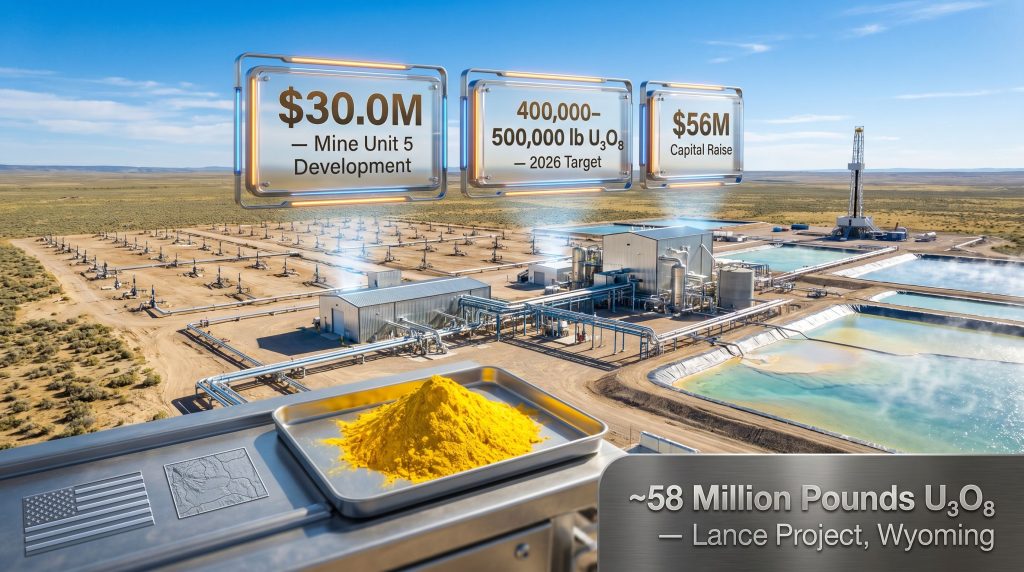
The $56 million funding package secured by Peninsula Energy is structured across three distinct capital instruments, each serving a different function within the company's financing architecture.
| Funding Component | Instrument Type | Amount (AUD) | Amount (USD) | Key Terms |
|---|---|---|---|---|
| Institutional Placement | Equity | ~A$21.8M | ~$15.7M | ~62.4M new shares at A$0.35/share, fully underwritten |
| Accelerated Entitlement Offer | Equity | Up to A$14.2M | ~$10.2M | 1-for-11 non-renounceable, A$0.35/share, fully underwritten |
| Convertible Note Facility | Debt | Not specified | $30M | Binding commitment via Washington H Soul Pattinson and Co |
| Total Package | Combined | ~$56M |
The institutional placement raises approximately A$21.8 million through the issue of around 62.4 million new shares at A$0.35 each, fully underwritten. The accelerated non-renounceable entitlement offer allows existing eligible shareholders to participate on a 1-for-11 basis at the same price, raising up to A$14.2 million, also fully underwritten. The fully underwritten status of both equity tranches is significant because it eliminates execution risk on the equity component regardless of broader market conditions at the time of the offer closing.
The third and largest single component is a $30 million binding convertible note facility anchored by Washington H Soul Pattinson and Co, an Australian investment firm with a long history of patient, strategic capital deployment across industrial and resources businesses. Washington H Soul Pattinson is not a typical short-tenor hedge fund lender. Furthermore, the firm is known for taking considered long-duration positions in businesses it views as strategically undervalued, which makes its willingness to commit $30 million in convertible debt a meaningful signal of institutional conviction in Peninsula's production trajectory. Investors should note, however, that convertible notes carry dilution risk if converted to equity, and the specific conversion price, maturity date, and coupon terms of this facility are not publicly disclosed at this stage.
How the Capital Will Be Deployed Across the Lance Project
Peninsula has provided a granular breakdown of how the combined proceeds from the equity raise and debt facility, used alongside existing cash reserves, will be allocated across the Lance project's development priorities.
| Expenditure Category | Allocated Capital |
|---|---|
| Mine Unit 5 Development Capex | $30.0M |
| Mine Unit 6 Initial Development Capex | $10.8M |
| Additional Deep Disposal Well | $6.5M |
| Additional Evaporation Pond Capacity | $1.5M |
| Infrastructure, Wellfield and Header House Development | $7.6M |
| Outstanding Debt Repayment | $4.2M |
| Total (with existing cash) | ~$60.6M |
Mine Unit 5 at the Kendrick area receives the largest single allocation at $30 million, representing roughly half of total planned expenditure. This concentration reflects the mine unit's critical role in bridging production beyond the projected depletion of Mine Unit 4 in late 2027. Given the 12-month minimum lead time from development commencement to first acidification, any delay in initiating Mine Unit 5 activities risks creating a production gap in the second half of 2027 that no amount of additional capital could retrospectively close.
The $6.5 million deep disposal well and $1.5 million evaporation pond expansion are infrastructure investments that are directly correlated to increasing production throughput. In ISR operations, higher wellfield flow rates generate proportionally larger volumes of spent lixiviant and process water that must be managed. Deep disposal wells inject this fluid into designated subsurface formations, while evaporation ponds handle surface water management. Peninsula characterises these investments as standard practice for ISR projects scaling production, which is accurate. What distinguishes Lance is the scale of the ramp-up underway, which is making these infrastructure expansions necessary concurrently rather than sequentially.
The $4.2 million debt repayment component signals balance sheet discipline alongside growth capital deployment, reducing legacy obligations while simultaneously funding forward development. Broader uranium supply challenges across the sector further reinforce why securing this level of committed capital is strategically important for Peninsula at this stage of development.
Production Guidance, Cost Revisions, and What They Actually Signal
Peninsula has maintained its production guidance for the current year and 2027, while simultaneously revising cash operating cost guidance materially upward. These two pieces of information in combination tell a more nuanced story than either does in isolation.
Production Targets: Horizon 3 and the Step-Change Logic
| Year | Production Guidance Low | Production Guidance High |
|---|---|---|
| 2026 | 400,000 lb U₃O₈ | 500,000 lb U₃O₈ |
| 2027 | 500,000 lb U₃O₈ | 600,000 lb U₃O₈ |
The maintained production guidance is a positive signal in isolation. The company is not walking back output expectations despite the acknowledged gas build-up challenge in the wellfield. This implies that the operational adjustments implemented by the site team have been sufficiently effective to preserve the production profile, even as cost assumptions have changed.
The Cost Guidance Revision: Four Drivers Explained
Cash operating costs have been revised from the prior guidance of $20 to $25 million per year to $30 to $35 million per year for both 2026 and 2027. This is a 25 to 40 percent increase and warrants close scrutiny. Peninsula attributes the revision to four specific factors:
-
Reduced Mine Unit 3 productivity: Lower volumes from Mine Unit 3 reduce the output-per-fixed-cost efficiency ratio, spreading overhead across fewer pounds of U₃O₈ produced.
-
Elevated acid consumption from Mine Unit 1: Operations at Mine Unit 1 appear to be in an aggressive leach phase requiring higher sulphuric acid input relative to uranium recovered, suggesting the ore body in this unit may be at a point in its production cycle where reagent intensity increases.
-
Higher sulphuric acid input prices: Sulphuric acid is both the primary reagent in low pH ISR and a commodity whose price is influenced by sulphur supply chains, smelter byproduct availability, and logistics costs. Price increases here flow directly into variable operating costs.
-
Increased wellfield maintenance expenditure: As low pH chemistry scales across multiple mine units simultaneously, maintenance demands increase. Acidic chemistry is corrosive to well casings, pump components, and surface pipework, and managing this at scale requires recurring intervention.
The distinction between volume-driven cost increases and input price inflation is critical for investors. Volume-driven inefficiencies are temporary and self-correcting as production ramps. Input price pressures, particularly for sulphuric acid, are externally driven and may persist.
It is also worth noting that this cost revision does not indicate operational failure. Running ISR operations in low pH mode is inherently more chemically intensive than neutral pH operations, and the cost profile of acid-based leaching at scale reflects this chemistry. The question for investors is whether the uranium price environment justifies the higher cost structure, and whether cost efficiency improves as the Horizon 3 production levels are approached. Consequently, understanding the current uranium market dynamics provides essential context when evaluating Peninsula's production economics.
The 12-Month Lead Time Problem: Why Timing Drives Everything at Lance
One of the least appreciated dynamics in ISR uranium development is the regulatory timeline embedded into mine unit progression. Unlike open-pit or underground mining where new mining zones can be accessed relatively quickly once the ore is exposed, ISR operations require regulatory sign-off before any new aquifer zone can be injected into.
The process involves:
-
Drilling of monitoring wells around the proposed mine unit perimeter to establish baseline groundwater conditions.
-
Delineation hole drilling to confirm ore body continuity and grade distribution within the proposed production zone.
-
Regulatory submission and approval from Wyoming state regulators and relevant federal bodies, incorporating monitoring well data and delineation results.
-
Construction of wellfield infrastructure including injection and production well completions, header house construction, and pipeline connections to the central processing facility.
-
First acidification of the header house, marking the commencement of active uranium extraction from the new mine unit.
From initiation of step one to completion of step five takes approximately 12 months under normal conditions. This is not a management estimate that can be compressed through additional capital or personnel without regulatory accommodation. It is a hard timeline governed by the pace of data collection, regulatory review cycles, and construction sequencing.
Peninsula has made clear that Mine Unit 5 development must commence in the current quarter to avoid a production gap when Mine Unit 4 reserves are projected to exhaust in late 2027. Mine Unit 6 initial development is targeted to begin in March 2027, ensuring sequential continuity beyond Mine Unit 5.
The next major ASX story will hit our subscribers first
Comparing the Lance Project to Other US ISR Uranium Operations
The Lance uranium project occupies a distinct position within the US ISR uranium landscape, not only in terms of scale but also in terms of its technical approach. The ongoing US uranium production rebound has brought renewed attention to domestic ISR operators, making Lance's scale and resource base increasingly relevant to the broader supply picture.
| Metric | Lance Project (Peninsula Energy) | Typical Smaller US ISR Project |
|---|---|---|
| Resource Scale | ~58 million lb U₃O₈ | 5 to 20 million lb (smaller operations) |
| Production Guidance 2026 | 400,000 to 500,000 lb U₃O₈ | Varies significantly |
| Cash Operating Cost Guidance | $30M to $35M per year | Project-dependent |
| ISR Chemistry | Low pH (sulphuric acid) | Conventional neutral or alkaline pH |
| Location | Wyoming, USA | Wyoming, Nebraska, Texas |
| Production Model | End-to-end yellowcake production | Varies by operator |
At approximately 58 million pounds of U₃O₈, Lance represents one of the largest independent uranium resource bases in the United States. This scale creates a long production runway that differentiates Peninsula from smaller ISR operators whose mine lives may be measured in a handful of years rather than decades.
Wyoming is the dominant US state for ISR uranium production, with a regulatory framework and experienced workforce that supports ISR development more readily than many other jurisdictions. The state's geological setting, featuring uranium-bearing Tertiary sandstone formations, is well-suited to in-situ recovery extraction. The regulatory agencies responsible for ISR permitting in Wyoming have processed multiple ISR project applications over the past two decades, creating institutional familiarity with the process that reduces uncertainty compared to jurisdictions without this track record.
In addition, the geopolitical dimension of US domestic uranium supply has grown in relevance. The Russian uranium import ban has accelerated efforts to build out domestic production capacity, and this policy backdrop is broadly supportive of US-based ISR operators such as Peninsula.
Header House 14: The Technical Progress Indicator Investors Should Watch
Among the operational milestones disclosed alongside the funding announcement, the acidification of Header House 14 stands out as a near-term de-risking event for the broader Lance production programme.
Header House 14 represents Peninsula's current leading edge of production expansion, and its acidification was reported as progressing ahead of schedule at the time of the funding announcement. Critically, initial head grades, meaning the uranium concentration in the solution being pumped to surface, were described as encouraging.
Head grade is one of the most important near-term indicators of ISR project health. A new header house that delivers strong initial head grades confirms that:
- The delineation drilling accurately characterised the ore body grade distribution.
- The injection chemistry is effectively dissolving uranium from the host rock.
- The wellfield design is achieving adequate sweep efficiency across the production zone.
- The analytical and geological models used to justify the capital allocation were reliable.
Positive head grades from Header House 14 therefore validate not just this specific header house, but the geological and operational methodology being applied across the broader mine unit development programme. This is a meaningful technical endorsement of the low pH ISR approach at Lance's scale of operation.
Investor Considerations: Risk Factors and Potential Catalysts
Key Risks Across the Development and Production Ramp-Up Period
-
Regulatory approval timelines for Mine Unit 5 and Mine Unit 6 represent the single largest scheduling risk, as delays compress the production buffer before Mine Unit 4 depletion.
-
Wellfield flow rate consistency under continued low pH chemistry will determine whether operational adjustments deliver sustainable improvement or require further intervention.
-
Sulphuric acid price volatility creates an externally driven cost variable that management cannot fully control within the existing operational structure.
-
Convertible note dilution risk exists if Washington H Soul Pattinson exercises conversion rights, the terms of which have not been publicly disclosed.
-
Execution risk on Mine Unit 5 development capex is elevated given the concentration of half the total capital programme in a single mine unit.
Positive Catalysts That Could Accelerate the Production Growth Trajectory
-
Ahead-of-schedule completion of Mine Unit 5 regulatory approvals, compressing the timeline to first production from the new mine unit.
-
Sustained wellfield flow rate improvement delivering production volumes toward the upper end of guidance ranges.
-
Movements in spot and term uranium prices improving project economics and potentially justifying acceleration of the Horizon 3 programme.
-
Successful Mine Unit 6 development progressing in parallel with Mine Unit 5, de-risking the post-2027 production profile earlier than currently planned.
-
Expanded US domestic uranium procurement frameworks benefiting producers with operating assets on US soil, though no project-specific support or designation has been confirmed for Lance. However, Peninsula Energy's updated corporate strategy positions the company to benefit materially should such frameworks expand further.
This article is intended for informational purposes only and does not constitute financial or investment advice. All forward-looking statements and production guidance figures are sourced from Peninsula Energy's public disclosures and are subject to material risks and uncertainties. Past performance of comparable projects does not guarantee future results. Investors should conduct their own due diligence and seek independent financial advice before making any investment decisions.
Want To Be First When The Next Major Uranium Discovery Hits The ASX?
Discovery Alert's proprietary Discovery IQ model delivers real-time alerts on significant ASX mineral discoveries, instantly cutting through complex data to surface actionable opportunities — explore historic discoveries and their returns to understand the scale of what early positioning can mean, then begin your 14-day free trial at Discovery Alert to stay ahead of the market.