
July 10, 2026
Why the North American De-Icing Salt Market Is More Structurally Constrained Than Most Investors Realise
Road salt is one of the least glamorous commodities in existence, yet it underpins the operational continuity of entire economies during winter months. The northeast United States and eastern Canadian provinces collectively represent one of the highest-demand, most logistics-dependent salt markets on the planet. Despite this, the regional supply chain has historically leaned on import routes that are vulnerable to freight disruptions, geopolitical instability, and seasonal bottlenecks. For infrastructure-minded investors, that structural gap is precisely where opportunity tends to concentrate, and it is the gap that the Atlas Salt Great Atlantic Salt Project construction permitting trajectory is directly targeting.
Understanding where this project sits today requires moving beyond headline announcements and examining what the permitting milestones, ground conditions, and team assembly actually signal about execution readiness and financing confidence.
When big ASX news breaks, our subscribers know first
Project Fundamentals: Scale, Location, and Strategic Positioning
The Great Atlantic Salt Project is located on the west coast of Newfoundland, Canada, a geography that offers direct Atlantic marine export access to northeast US ports. This locational advantage is not incidental. Freight economics for bulk commodities like de-icing salt are profoundly sensitive to distance and shipping complexity, and proximity to high-demand markets materially improves cost competitiveness relative to long-haul international supply sources.
The project's core parameters establish its scale ambitions:
| Parameter | Detail |
|---|---|
| Location | West Coast, Newfoundland, Canada |
| Primary Target Market | Northeast US and Eastern Canada |
| Total Project Financing | $350M to $400M |
| Steady-State Production Target | 4 million tonnes per annum |
| Commercial Production Target | 2030 |
| Early Works Permit Coverage | Over $150M in capital activities |
A steady-state target of 4 million tonnes per annum positions this as a large-scale underground rock salt operation. De-icing salt demand is non-discretionary in nature. Municipal governments, highway authorities, and airport operators purchase it as an operational necessity rather than an economic preference, making demand relatively inelastic through commodity price cycles. Supply chain resilience concerns, amplified by global logistics disruptions over recent years, have furthermore elevated the strategic value of regionally proximate production sources.
How the Three-Tier Permitting Architecture Structures Construction Progress
One of the most instructive aspects of this project for investors and industry observers is its regulatory sequencing. The permitting framework operates across three distinct tiers, each building on the last and creating a compliance architecture that governs all construction activity. Understanding mining permitting fundamentals is essential context for appreciating why this tiered approach represents a significant milestone.
Tier One: Environmental Assessment
The foundation of the entire permitting structure is the Environmental Assessment conditionally cleared by the Government of Newfoundland and Labrador in 2024. This approval establishes the overarching compliance framework. Every downstream permit, whether provincial or municipal, must demonstrate alignment with the commitments made during the EA process. Critically, the EA defines the boundaries of what can be built, how it must be built, and what consultation obligations the developer must maintain with local stakeholders throughout construction.
Tier Two: Provincial Early Works Plan Approval
Building directly on the EA, the provincial government granted approval of the Early Works Mine Development Plan in 2025. This authorisation covers more than $150 million in capital activities, encompassing the full scope of early-stage mine development works. To contextualise this figure: at a total project financing envelope of $350M to $400M, the early works programme represents approximately 38% to 43% of anticipated total project capital.
This is not pre-development spending in the speculative sense. These are activities embedded within the updated feasibility study's capital schedule, representing permanent infrastructure that forms part of the mine as built.
Tier Three: Municipal Development Permit
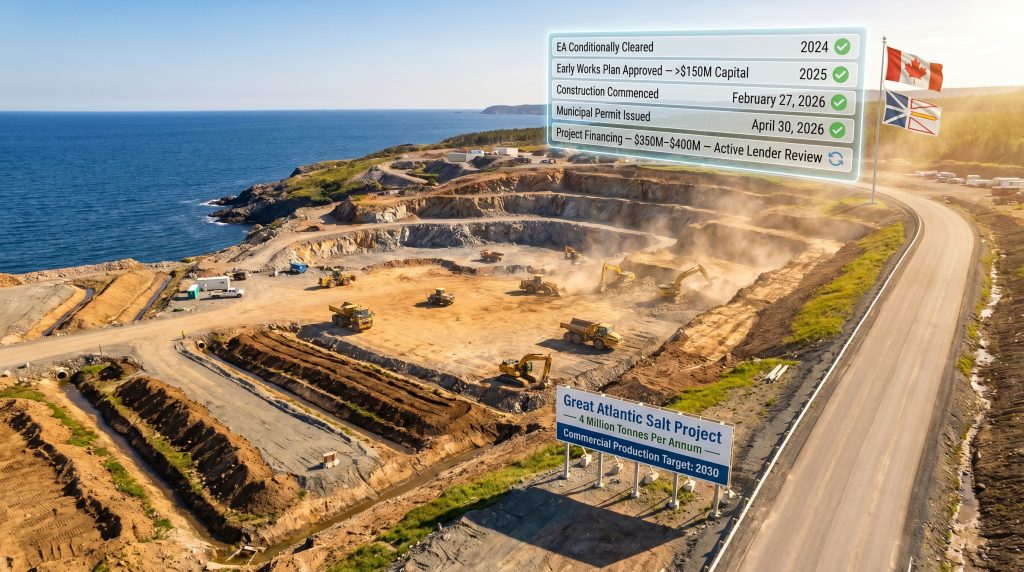
The most recently issued authorisation came from the Town of St. George's on April 30, 2026: a consolidated Development Permit covering the complete Early Works Mine Development Plan and Rehabilitation and Closure Plan under a single unified instrument.
What makes this permit architecturally significant is not simply its issuance, but the model under which it was issued. Previously, each discrete construction activity required individual submissions to the town for review and sign-off. The municipality shifted to a consolidated permitting model, aligning the full scope of early works under one authorisation rather than maintaining a piecemeal review process.
The operational implications of this consolidation are material:
- Eliminates repetitive submission cycles for individual construction elements such as roads and drainage infrastructure
- Reduces administrative overhead on both the developer and municipal sides simultaneously
- Synchronises municipal approval timelines with the provincial permitting schedule
- Creates over 12 months of pre-authorised construction activity, deliberately overlapping with the detailed engineering timeline for the main capital development permit
- Accelerates the pathway to underground drift development authorisation
It is worth noting that the discretion available to the Town at the permitting stage is narrow by design. Permit issuance is conditional on demonstrating that proposed construction methods align with EA commitments, meet applicable safety standards, and conform to local regulatory requirements. If those conditions are met, the permit follows. The process is confirmatory rather than discretionary in the subjective sense.
The town's decision to consolidate rather than fragment its review process is widely read within project circles as an institutional expression of alignment with the project's advancement. In many resource jurisdictions, administrative processes function as a friction mechanism. The inverse dynamic here is a meaningful signal. This approach mirrors broader mining claims frameworks that increasingly favour consolidated regulatory instruments.
Atlas Salt Great Atlantic Salt Project Construction Permitting: What Is Actually Happening on Site
The transition from pre-development capital to feasibility-study capital was formally announced on February 27, 2026. This distinction carries more significance than it might initially appear. Many junior resource developers talk extensively about being construction-ready while remaining in perpetual pre-development mode. The February 2026 announcement marked the point at which Atlas Salt moved from preparation into permanent works, with capital being deployed on infrastructure that will form part of the operational mine.
Completed Early Works Activities
As of mid-2026, the following activities have been completed or are actively progressing:
- Full site clearing within the defined project footprint, including vegetation and shrub removal
- Topsoil and overburden stripping, with material stockpiled for future rehabilitation use during eventual mine closure
- Subgrade preparation progressing to bedrock level
- Terrace formation and drainage ditch installation for water management
- Initial geological and hydrogeological test work underway
One detail worth highlighting: cleared timber from the site was distributed to the local community for use as firewood, a small but operationally meaningful element of the social licence framework that reflects the active community engagement model in place.
Active and Near-Term Construction Priorities
- Permanent access road construction and road siding installation
- Site power infrastructure preparation
- Building pad construction for permanent structures
- Procurement and contractor engagement processes advancing in parallel with surface works
The Box Cut: The Next Major Construction Threshold
The next significant milestone is the excavation of the box cut, described as the surface-level entry point that enables underground drift access. This activity is planned for several months ahead and represents the transition from surface preparation into underground mine development. The drift access corridor is approximately 1.5 kilometres in length, and the ground conditions along this corridor represent the primary geotechnical variable influencing both capital efficiency and construction schedule.
What Early Ground Conditions Reveal About Project Risk
One of the more technically significant observations to emerge from early construction activity is that ground conditions are drier than originally modelled in the feasibility study. For an underground mining project where drift advance rates and support requirements are directly sensitive to ground saturation and structural competency, this finding carries real financial implications if it holds across the broader site footprint.
The updated feasibility study incorporated design modifications to account for ground conditions assessed as less structurally competent than initially anticipated during the project's earlier development phase. Traditional hard rock mining methods were originally envisioned, but geotechnical drilling conducted during the feasibility update process revealed ground competency characteristics that required accommodation within the engineering design. Those mitigations are built into the current plan.
The early works programme is now generating data that may either validate or refine those assumptions:
| Variable | Feasibility Study Assumption | Early Works Observation |
|---|---|---|
| Ground moisture levels | Moderate saturation expected | Drier than anticipated |
| Ground competency | Mitigations included in design | Early indicators positive |
| Drift advance risk | Design accommodations in place | Initial data encouraging |
| Capital efficiency | Base case estimate | Upside scenario possible |
Important qualification: These observations are based on limited early-stage test work across a portion of the site footprint. Definitive conclusions about conditions across the full drift corridor cannot be drawn until more comprehensive geotechnical data is collected during detailed engineering. Early indications are encouraging, but engineering conservatism demands that this data be treated as preliminary until confirmed at greater depth and lateral extent.
The reasoning for monitoring this closely extends beyond technical interest. Every incremental improvement in ground conditions translates into potential time savings, capital savings, and reduced contingency requirements. On a 1.5-kilometre drift, even modest improvements in advance rates compound materially across the full construction schedule. Consequently, these early signals carry meaningful weight in assessing the broader mining project risk evolution between now and commercial production.
How Atlas Salt Is Structuring Its Construction Execution Team
One of the less-discussed but strategically important dimensions of the project's current phase is the pre-mobilisation staffing approach being adopted. Rather than waiting for major project financing to be finalised before assembling a construction team, Atlas Salt is building internal capacity during the early works phase so that personnel are operational when large-scale capital deployment begins.
The logic here is straightforward but often overlooked by development-stage companies. If project financing were secured at year-end 2026 with no pre-assembled team in place, the company would face simultaneous rapid hiring, onboarding, and capital deployment under pressure. That scenario creates operational risk at the precise moment when execution certainty matters most to lenders.
Current Internal Team Structure
- Project Director (Andrew Smith): Leading site-level construction execution and day-to-day operations
- Senior Project Engineer: More than 30 years of experience with prior roles at Vale, Hudbay, and Newmont, responsible for overseeing construction activity with a track record spanning over $1 billion in mining construction projects
- Site staff: Safety, contracts, and administration personnel being progressively onboarded as activity scales
- Hatch (Integrated Project Delivery Partner): Leading detailed engineering and providing specialist personnel capacity within an integrated project team structure
By building team capacity during the early works phase, the organisational infrastructure is in place before capital surges. When the financing package is finalised, the team is already embedded, processes are established, and the culture is set. Lenders do not want to provide capital only to watch it sit idle during a personnel ramp-up period.
This approach also serves a due diligence function for the financing process. A team with demonstrated construction experience at scale, embedded within an active construction programme, provides a materially different risk profile than a team assembled on paper in advance of a financing close.
The next major ASX story will hit our subscribers first
The Sequencing Logic: Permitting, Engineering, and Financing Running in Parallel
The architectural elegance of the current construction sequencing lies in how the three major workstreams — physical construction, detailed engineering, and project financing — are deliberately overlapped rather than sequenced end-to-end. This mirrors the approach observed across successful mining industry consolidation strategies, where parallel workstreams reduce timeline risk.
Construction and Permitting Milestone Roadmap
| Phase | Key Activity | Status / Timeline |
|---|---|---|
| Environmental Assessment | Provincial EA conditional clearance | Completed 2024 |
| Early Works Plan Approval | Provincial authorisation covering >$150M | Completed 2025 |
| Construction Commencement | Early works mobilisation announced | February 27, 2026 |
| Municipal Permit Consolidation | Town of St. George's single permit issued | April 30, 2026 |
| Detailed Engineering | Contractor-ready design package | In progress 2026 |
| Box Cut Excavation | Surface entry point for drift access | Planned months ahead |
| Main Capital Development Permit | Authorisation for underground drift development | Pending detailed design |
| Project Financing Finalisation | $350M to $400M debt and equity package | Active lender review |
| Commercial Production Target | First salt production | 2030 |
The consolidated municipal permit provides over 12 months of pre-authorised construction activity. This window deliberately overlaps with the detailed engineering timeline for the main capital development permit required for underground drift construction. The practical result is that:
- Surface works and site preparation are completed before underground permits are required
- Detailed engineering outputs feed directly into the main permit application without construction gaps
- Lenders reviewing the financing package observe continuous construction progress rather than a static pre-development asset
- The project avoids the scenario where financing is secured but capital cannot be deployed immediately due to permitting delays
This sequencing logic also provides important comfort to potential lenders around schedule predictability — one of the primary variables that influences lender confidence in project-financed mining developments.
Primary Technical and Execution Risks Between Now and Steady-State Production
No objective analysis of this project is complete without a clear-eyed examination of the risks that remain between the current construction phase and the targeted 4 million tonne per annum steady-state production in 2030.
Geotechnical Risk
Ground conditions across the full 1.5-kilometre drift corridor remain to be fully characterised. Early indications are positive but are based on limited test work. The design accommodations built into the updated feasibility study provide a baseline mitigation framework, but actual conditions during drift development will ultimately determine construction speed and cost.
Contractor Pricing Risk
Feasibility study capital estimates are indicative until detailed engineering packages are placed with contractors for scope and duration pricing. Contractor market conditions in Newfoundland and broader Atlantic Canada will influence both cost outcomes and construction schedule. The gap between feasibility estimates and contractor-priced scopes is a critical validation point for the financing package. In addition, the cut-off grade economics embedded in the feasibility model must hold under real-world contractor pricing conditions.
Schedule Compression Risk
The project's financing attractiveness is directly linked to construction schedule predictability. Material deviations from definitive feasibility study parameters, even if not dramatically large, can introduce doubt at the lender level. Proactive geotechnical data collection and early contractor engagement are the primary tools for reducing schedule uncertainty before the main capital raise is finalised.
Regulatory Sequencing Risk
The main capital development permit for drift construction must be secured before underground works can commence. Detailed engineering must reach a sufficient stage of completion to support that permit application. The current permitting structure shows no indication of regulatory opposition, but timeline execution on the engineering side remains the critical dependency.
Stakeholder Engagement and the Social Licence Framework
Atlas Salt has established a formal community liaison structure with the Town of St. George's, creating a standing committee that facilitates regular engagement between local government representatives and the project's on-site engineering team. Environmental monitoring programmes are operational during construction, and the project maintains bidirectional feedback mechanisms between site operations and municipal stakeholders.
The community resource sharing during site clearing — distributing timber to local residents — is a small but symbolically important expression of the social licence philosophy in action. In resource jurisdictions where community opposition has derailed projects at advanced stages, the collaborative framework in place at St. George's represents a meaningful risk mitigation factor that carries genuine operational significance.
Key Takeaways: Atlas Salt Great Atlantic Salt Project Construction Permitting Progress
- Completed: Environmental Assessment conditionally cleared 2024
- Completed: Early Works Mine Development Plan approved, covering more than $150M in capital activities, 2025
- Completed: Construction commenced February 27, 2026
- Completed: Consolidated municipal Development Permit issued April 30, 2026
- Positive signal: Early geotechnical data showing conditions better than feasibility study baseline
- Operational: Integrated project team assembled including Hatch as delivery partner with 30-plus years of relevant experience
- In progress: Detailed engineering advancing toward main capital development permit application
- In progress: $350M to $400M project financing under active lender review
- Planned: Box cut excavation as next major construction milestone
- Target: Commercial production 2030
This article is intended for informational purposes only and does not constitute financial advice. Forecasts, timelines, and financial projections referenced herein are based on publicly disclosed company information and management commentary. Actual outcomes may differ materially from those described. Readers should conduct their own due diligence before making any investment decisions.
Want to Identify the Next Major Resource Discovery Before the Broader Market?
Discovery Alert's proprietary Discovery IQ model scans ASX announcements in real time, delivering instant alerts on significant mineral discoveries so investors can act on actionable opportunities the moment they emerge — explore historic discoveries and their returns to understand the scale of what early positioning can achieve, then begin your 14-day free trial at Discovery Alert to secure your market-leading edge.