July 10, 2026
The Geopolitical Fault Line Beneath Africa's Largest Undeveloped Gas Frontier
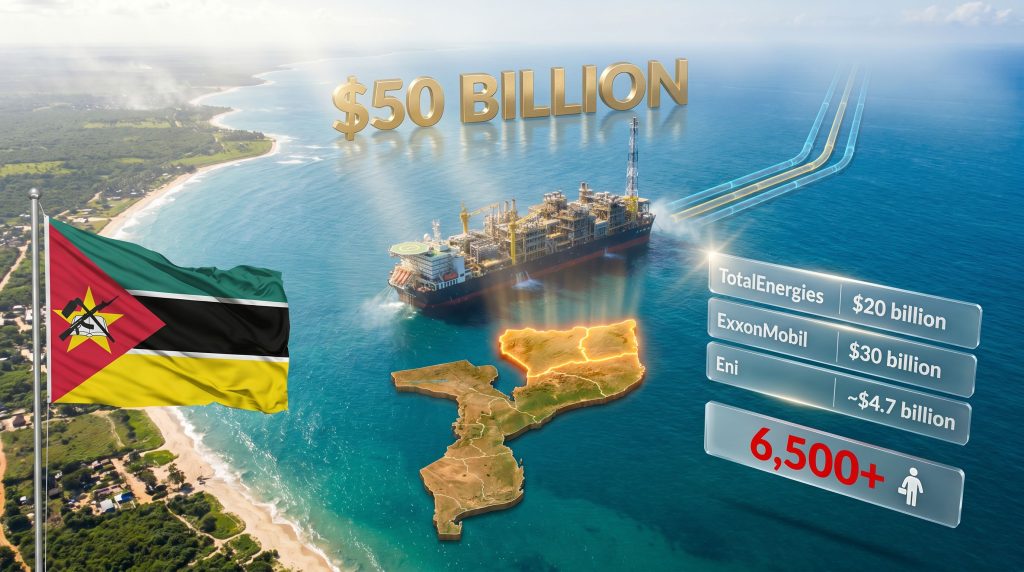
When global energy markets fracture, capital flows toward certainty. The scramble to secure alternative gas supplies following years of disruption to established trade routes has elevated a handful of frontier basins from speculative prospects to strategic imperatives. Few have attracted more concentrated attention than the Rovuma Basin off the coast of northern Mozambique, where more than $50 billion in planned liquefied natural gas investment now sits at the intersection of insurgent violence, competing great-power ambitions, and Russia military support for Mozambique LNG projects.
Understanding what is actually at stake here requires looking beyond the headline security offer from Moscow and examining the deeper architecture of interests, histories, and financial exposures that make Mozambique one of the most analytically complex energy frontiers on the planet.
When big ASX news breaks, our subscribers know first
Why the Rovuma Basin Rewrote Africa's Energy Map
The offshore gas discoveries in the Rovuma Basin, straddling the maritime border between Mozambique and Tanzania, rank among the most significant hydrocarbon finds of the past two decades globally. Recoverable gas estimates across the basin are measured in the hundreds of trillions of cubic feet, a scale that places the region in the same category as established export heavyweights rather than emerging frontier plays.
What makes the Rovuma particularly significant from a supply-chain perspective is its geographic positioning. Mozambique sits on the southeastern coast of Africa, offering relatively efficient shipping routes to both European import terminals and the rapidly expanding regasification infrastructure across South and Southeast Asia. Unlike West African producers such as Nigeria, which must route cargoes around the continent or through congested Atlantic lanes, Rovuma Basin LNG can reach Indian Ocean markets with considerably lower transit costs.
Prior to the gas discoveries, Mozambique occupied a position among the lowest-ranked economies in sub-Saharan Africa by GDP per capita. The transformational arithmetic is straightforward: if the full portfolio of planned LNG projects reaches production capacity, Mozambique's fiscal architecture would be fundamentally reconstructed, generating sovereign revenues that dwarf current government budgets. Analysts tracking the LNG supply outlook have noted that the combined Rovuma portfolio could, within a decade of full ramp-up, position Mozambique inside the top ten global LNG exporters.
That trajectory, however, is entirely contingent on resolving a security crisis that has persistently threatened to render the resource inaccessible.
The Cabo Delgado Insurgency: Quantifying a Crisis That Froze $50 Billion
The armed insurgency that emerged in Cabo Delgado province in 2017 did not materialise in isolation. The province, despite sitting above extraordinary offshore wealth, had long been characterised by deep structural poverty, weak state presence, and socioeconomic exclusion that created fertile conditions for militant recruitment by networks linked to regional jihadist affiliates.
The conflict escalated steadily from localised attacks on villages into coordinated assaults on strategic infrastructure. The defining moment came in March 2021, when militants attacked the town of Palma, located immediately adjacent to TotalEnergies' Afungi LNG construction site. The assault forced TotalEnergies to declare force majeure and suspend construction on what was then one of the largest active greenfield LNG projects in the world.
The cumulative toll of the insurgency is staggering by any measure:
| Impact Category | Estimated Scale |
|---|---|
| Conflict-related deaths | 6,500+ (ACLED data) |
| Civilian displacement | Hundreds of thousands |
| Combined LNG investment at risk | $50+ billion |
| TotalEnergies force majeure duration | Approximately 5 years (2021 to 2026) |
| ExxonMobil FID status | Pending, post-force majeure conditions |
The Armed Conflict Location and Event Data Project (ACLED) has tracked the insurgency's progression comprehensively, documenting more than 6,500 fatalities across the duration of the conflict. Beyond the human cost, the economic suppression effect has been severe: foreign direct investment commitments were placed in indefinite suspension, infrastructure development stalled, and the window for Mozambique to capitalise on a particularly favourable LNG demand environment began to close.
A critical and often underappreciated detail in the project risk calculus is the role of the Afungi peninsula. This narrow strip of land functions as the physical nerve centre for LNG liquefaction, storage, and loading infrastructure. Its protection is not merely operationally important; it is the non-negotiable precondition for any project financing arrangement. Insurers and multilateral development bank lenders assess Afungi's security status as a primary variable in their risk models, making it, in effect, the single most strategically sensitive geographic point in Mozambique's entire LNG ambition.
The $50 Billion Investment Portfolio: Three Operators, Three Distinct Positions
The Rovuma Basin's development is spread across three major international energy companies, each at a different stage of commitment and each carrying different exposure to the security variable.
The combined capital commitment across Mozambique's LNG portfolio represents one of the largest concentrations of planned energy infrastructure investment on the African continent, rivalling established petrostates that have been exporting hydrocarbons for generations.
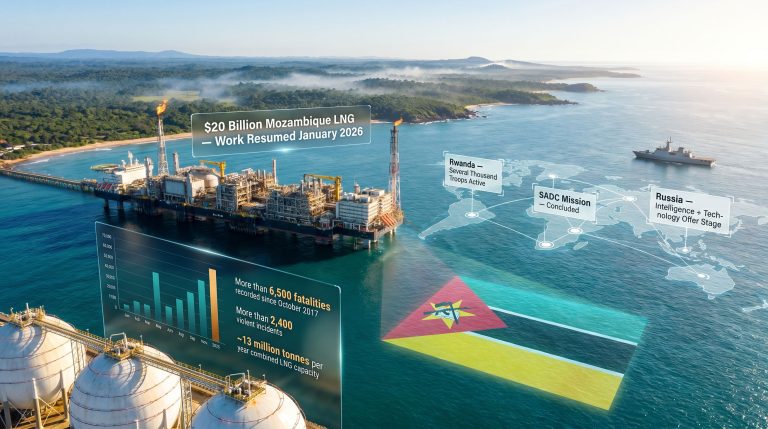
TotalEnergies restarted construction on its $20 billion Mozambique LNG project in 2026, nearly five years after the Palma attack forced the company to halt work. The resumption was made possible by measurable improvements in the security environment around the Afungi peninsula, improvements credited substantially to the deployment of Rwandan military forces in the province. The project, when operational, will be one of the largest LNG facilities in the southern hemisphere.
ExxonMobil's adjacent $30 billion Rovuma LNG development represents the larger and more consequential prize still awaiting commitment. The project shares critical infrastructure corridors with TotalEnergies' facility, creating interdependencies that both reduce per-unit capital costs and concentrate risk. ExxonMobil has indicated that its final investment decision is conditional on the full lifting of force majeure conditions and the confirmation of stable security around the operational zone. A production commencement target of approximately 2030 has been discussed, contingent on timely FID approval.
Eni occupies the most advanced operational position, with its Coral South floating LNG vessel already producing in Mozambican waters. The Coral South FLNG, valued at approximately $4.7 billion, demonstrated that offshore production in the Rovuma Basin is technically viable and commercially operational. Eni's Coral Norte project represents the next expansion phase, adding incremental capacity to the basin's output profile.
| Project | Operator | Estimated Value | Status (mid-2026) |
|---|---|---|---|
| Mozambique LNG | TotalEnergies | $20 billion | Construction resumed |
| Rovuma LNG | ExxonMobil | $30 billion | Awaiting final investment decision |
| Coral South FLNG | Eni | ~$4.7 billion | Operational |
| Coral Norte | Eni | To be confirmed | Development phase |
Russia's Security Offer: Diplomatic Gesture or Strategic Architecture?
During Russian Foreign Minister Sergey Lavrov's July 2026 visit to Maputo, Moscow signalled its readiness to assist Mozambique in addressing the insurgency in the country's north, subject to a formal request from the Mozambican government. The diplomatic framing was careful: an offer on the table, not a commitment in the field. Lavrov's visit also covered trade frameworks, economic modernisation discussions, and preparations for the Russia-Mozambique Intergovernmental Commission, reflecting a comprehensive rather than purely security-focused agenda.
Critically, this offer does not represent a new Russian interest in Mozambique. The relationship between Moscow and Maputo has deeper roots than the current headlines suggest, reflecting broader shifting energy geopolitics across multiple resource-rich regions:
- 2015: A bilateral defence cooperation agreement covering military training programs and equipment supply channels was formalised.
- April 2019: A naval cooperation memorandum simplified Russian naval vessel access to Mozambican ports, granting Moscow a maritime foothold in the Indian Ocean region.
- 2019: Approximately 200 Russian paramilitary personnel were deployed to Cabo Delgado. The deployment ended after the force sustained significant losses against insurgent tactics it was not configured to counter effectively.
- October 2019: Mozambican officials confirmed military equipment transfers from Russia to Mozambican defence forces.
- Energy sector: Rosneft holds three licensed exploration blocks in Mozambique and has pursued discussions around expanded acreage. Gazprombank has engaged in financing conversations with Mozambican leadership around Rovuma Basin development.
This layered pattern, spanning defence agreements, naval access arrangements, paramilitary deployments, equipment transfers, and energy sector positioning, suggests a deliberate and coordinated long-term strategy rather than an opportunistic response to the current LNG revival moment.
Russia's Africa Corps Model: Security as a Resource Extraction Vehicle
To understand the strategic logic behind Russia military support for Mozambique LNG projects, it is necessary to examine the operating template that Moscow has refined across multiple African theatre engagements. Following the rebranding of Wagner Group operations into the Africa Corps framework, Russia has deployed a consistent model across the Sahel and central Africa:
- Identify a government facing an intractable security challenge that Western partners are unwilling or unable to resolve on favourable terms.
- Offer security assistance through a combination of paramilitary personnel, equipment, training, and intelligence support.
- Bundle the security relationship with preferential access to mineral extraction rights, energy concessions, and diplomatic alignment at multilateral forums.
- Monetise the relationship over time through resource sector participation that generates direct economic returns for Russian state-linked entities.
This model differs structurally from Western security assistance frameworks, which typically involve more stringent conditionality around governance, human rights compliance, and procurement transparency. Furthermore, it differs from Chinese infrastructure financing models, which prioritise physical asset construction and debt-denominated returns. Russia's approach is more transactional and faster to deploy, which gives it a competitive advantage in crisis environments where governments need results quickly.
The critical analytical question for Mozambique is whether accepting Russian security assistance would be additive to the existing security architecture or whether it would create friction with the Western energy companies whose capital is essential to the LNG projects' completion. Indeed, analysts examining the geopolitical risk landscape across resource-rich nations have observed similar tensions playing out across multiple jurisdictions simultaneously.
The next major ASX story will hit our subscribers first
Three Scenarios: What a Formal Russia-Mozambique Security Agreement Could Produce
Scenario A: Complementary Arrangement
Russia's security contribution supplements Rwanda's existing operational presence and Tanzanian border security, accelerating insurgency suppression across a wider geographic area. ExxonMobil's FID proceeds on schedule, Western energy companies continue operating, and Russian energy entities secure minority participation or financing roles within the commercial structure.
Scenario B: Competitive Displacement
A formalised Russian military presence triggers reassessment by Western project operators' home governments. Sanctions risk exposure under US, EU, and UK regulatory frameworks forces insurers and project finance lenders to reassess their participation. ExxonMobil's FID is delayed, and TotalEnergies' financing arrangements face added complexity.
Scenario C: Strategic Leverage Play
Russia uses its security role as negotiating currency to extract preferential terms for Rosneft's exploration portfolio expansion or Gazprombank's financing participation, effectively converting a military presence into a commercial concession without requiring a direct confrontation with Western operators.
Mozambique's sovereign interest almost certainly lies in preventing Scenario B from materialising while carefully managing the boundary between Scenarios A and C. Maintaining neutrality in great-power competition is the only posture that preserves access to the broadest pool of capital and offtake partners simultaneously.
The Global Gas Market Dimension: Why Timing Is Everything
The Mozambique LNG revival is not occurring in isolation from global gas market dynamics. European procurement strategies have undergone a structural shift over recent years, with importing nations actively seeking to diversify supply sources and reduce dependency on single-corridor routes. African LNG from multiple producers has consequently moved from a supplementary consideration to a strategic planning priority in European energy security discussions.
Mozambique's geographic advantage relative to European import terminals is meaningful but not overwhelming on a standalone basis. Where it becomes more compelling is when combined with the scale of available reserves and the potential to negotiate long-term offtake agreements that provide price stability for buyers seeking to replace disrupted supply arrangements.
On the Asian side of the demand equation, growth projections through the early 2030s point to a persistent LNG supply gap as industrialising economies expand gas consumption for power generation and industrial feedstock applications. The risk of geopolitical entanglement, however, introduces a sanctions exposure dimension that could materially disrupt this alignment. Supply chain disruptions resulting from geopolitical miscalculation have, in other energy corridors, imposed multi-year delays on projects that were otherwise commercially ready to proceed.
The Current Security Patchwork: Multiple Actors, One Theatre
Mozambique's security landscape in Cabo Delgado as of mid-2026 involves several distinct external contributors operating with different mandates and varying degrees of operational effectiveness:
- Rwanda: Approximately 5,000 deployed troops, credited by multiple security analysts with reclaiming key towns from insurgent control and creating the conditions that enabled TotalEnergies' construction resumption. Rwanda's role is operationally focused and geographically concentrated around the LNG infrastructure zone.
- Tanzania: Maintaining border security across the northern zones adjacent to the conflict area, preventing cross-border supply chains that historically sustained insurgent operations.
- SADC Mission: The Southern African Development Community's regional military mission concluded its operational mandate after contributing to partial stabilisation in the province.
- Russia (historical): Approximately 200 paramilitary personnel deployed in 2019, subsequently withdrawn after sustaining losses. Current Russian position is a standing offer conditional on a formal government request.
The contrast between Rwanda's operational footprint of approximately 5,000 personnel and Russia's historical deployment of 200 is analytically significant. It illustrates both the scale of effort required to meaningfully suppress the Cabo Delgado insurgency and the gap between Russia's current offer and the actual security commitment required to protect a $50 billion investment corridor. Notably, analysts at Jamestown Foundation have examined why Mozambique has historically outsourced elements of its counter-insurgency strategy to Russia, highlighting the hidden financial and strategic dimensions of these arrangements.
What Investors and Project Operators Should Watch
For those tracking Russia military support for Mozambique LNG projects from an investment or market perspective, the key variables to monitor include:
- ExxonMobil's FID timeline: The formal decision to proceed on the $30 billion Rovuma LNG project is the single largest pending binary event in African LNG development. Any signal of acceleration or delay carries significant market implications.
- Security incident frequency around Afungi: Insurance and project finance coverage is directly indexed to security conditions in the peninsula's immediate vicinity. Any escalation would reset the risk premium calculation for lenders.
- Mozambique's formal response to Russia's security offer: Whether Maputo requests Russian assistance, declines it, or leaves it in a deliberate state of ambiguity will define the geopolitical risk environment for Western operators.
- Rosneft's exploration block activity: Movement on Russia's existing three licensed blocks would signal deepening commercial engagement independent of the security relationship.
- Offtake agreement announcements: Long-term supply contracts signed with European or Asian utilities would validate the project's commercial viability and support financing close timelines.
In addition, broader trends in African project finance are worth monitoring closely, as shifts in lender appetite and multilateral development bank posture will directly influence the debt structures that underpin the Rovuma Basin's next development phase.
Disclaimer: This article is intended for informational purposes only and does not constitute financial or investment advice. Forecasts, scenarios, and timelines referenced herein involve inherent uncertainty and should not be relied upon as the basis for investment decisions. Readers should conduct independent due diligence and consult qualified professional advisers before making any investment-related decisions.
Want to Stay Ahead of Major Resource Discoveries Before the Broader Market Catches On?
Discovery Alert's proprietary Discovery IQ model delivers real-time alerts on significant ASX mineral discoveries, transforming complex resource data into actionable investment insights — explore the historic returns major discoveries have generated and begin your 14-day free trial at Discovery Alert to position yourself ahead of the market.