
July 10, 2026
The Governance Transformation Rewriting the Rules of Indian Mining
The global race for critical mineral security has entered a new phase, one where technical extraction capability and capital access are no longer the sole determinants of project success. Across every major mining jurisdiction, a structural pattern is emerging: projects with robust community and stakeholder relationships advance, while those that treat communication as an afterthought accumulate delays, injunctions, and reputational damage that compound into existential financial risk. India, now executing one of the most ambitious mineral self-reliance programmes in its modern history, is confronting this reality at scale — and India critical minerals board-level communication has become the governance question that can no longer be deferred.
Understanding why India's critical minerals board-level communication imperative has arrived requires looking past the policy announcements and examining what makes large-scale mining projects fail in practice. The answer, more often than regulators or investors acknowledge, is governance architecture that was designed for a simpler era.
When big ASX news breaks, our subscribers know first
India's National Critical Mineral Mission: Scale, Ambition, and Structural Complexity
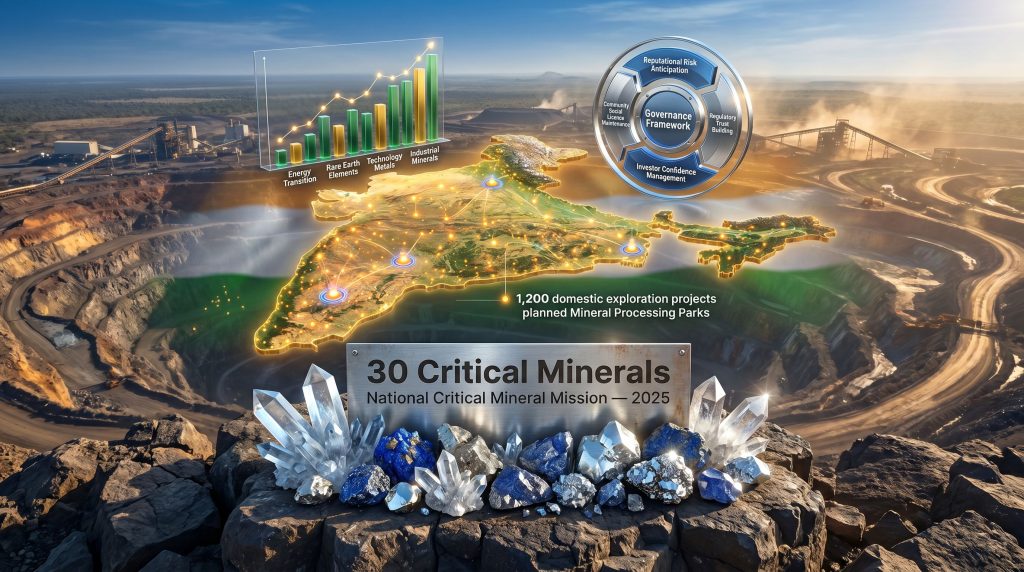
Launched in 2025, the National Critical Mineral Mission (NCMM) represents a generational commitment by India to reduce its dependence on imported critical minerals. The programme's scope is sweeping: 1,200 domestic exploration projects are envisaged, while Public Sector Undertakings (PSUs) have been tasked with acquiring 26 overseas mines to secure supply at the source. Complementing these extraction mandates, the government has planned four Mineral Processing Parks and three Centres of Excellence to develop India's downstream value chain capabilities.
At its core, the NCMM designates 30 minerals as critical, a classification that spans energy transition metals, rare earth elements, technology metals, and industrial minerals. Furthermore, the critical minerals demand surge globally has accelerated India's urgency to act.
| Mineral Category | Key Minerals | Primary Strategic Application | Current Supply Vulnerability |
|---|---|---|---|
| Energy Transition | Lithium, Cobalt, Nickel | EV batteries, grid storage | High — import-dependent |
| Rare Earth Elements | Neodymium, Dysprosium | Defence, wind turbines | Very High — China-concentrated |
| Technology Metals | Gallium, Germanium | Semiconductors, electronics | High — limited domestic production |
| Industrial Minerals | Graphite, Manganese | Battery anodes, steel | Moderate |
Rare earth elements carry the highest geopolitical risk premium within this portfolio. Unlike lithium or nickel, where multiple producing nations exist, the processing infrastructure for rare earths remains heavily concentrated in China, creating structural vulnerability that bilateral diplomacy alone cannot rapidly resolve. The Geological Survey of India (GSI) has been positioned as the technical intelligence backbone of the NCMM, generating exploration data that underpins project selection and strategic decision-making at the board level.
The NCMM also introduced a fast-track regulatory approval mechanism designed to compress project timelines. This acceleration, while commercially attractive, creates a less-discussed consequence: it narrows the windows available for community consultation, which paradoxically elevates social licence risk precisely when project momentum is highest.
From Import Dependence to Strategic Self-Reliance: The Policy Architecture Shift
India's pre-NCMM mineral policy was largely reactive, characterised by import dependence and a fragmented domestic exploration ecosystem. The NCMM fundamentally reorients this posture around four strategic pillars:
- Domestic exploration at scale, with the GSI leading systematic geological intelligence gathering
- Overseas asset acquisition, with PSUs directed toward geopolitically aligned partner nations
- Downstream value chain development, reducing India's exposure to processed mineral imports
- Strategic stockpile creation, building buffer capacity against supply disruptions
These pillars connect directly to India's EV manufacturing ambitions, its renewable energy transition commitments, and the localisation push within the defence sector. The NCMM is not simply a resource programme; it is an industrial policy instrument with consequences that extend across multiple ministries and economic domains. In addition, critical minerals and energy security are now deeply intertwined in India's long-term industrial planning.
India's Bilateral and Multilateral Supply Chain Strategy
India has pursued international partnerships as a parallel track to domestic exploration. The United States-India Critical Minerals Framework, formalised in May 2026, establishes trusted supply chain cooperation and co-investment protocols between the two nations. This agreement carries governance implications that extend beyond trade: US partnership expectations align with international-standard disclosure practices, traceability requirements, and third-party verification frameworks comparable to SEC and emerging federal ESG standards.
India also participates actively in the Mineral Security Partnership (MSP), a coalition of allied nations coordinating supply chain resilience, and engages with the FORGE initiative to diversify sourcing away from China-concentrated refining infrastructure.
This multilateral positioning contrasts sharply with China's state-directed vertical integration model, where a single governance authority controls exploration, processing, and export. India's partnership-based approach is inherently more complex to coordinate, but it distributes geopolitical risk more effectively, provided that the companies involved can operate transparently across multiple regulatory environments simultaneously.
The PSU mandate to acquire 26 overseas mines introduces a further layer of governance complexity. Target geographies are expected to align with India's diplomatic partnerships, spanning Australia, Canada, Africa, and other MSP-aligned jurisdictions. Each of these operating environments brings distinct community expectations, Indigenous consultation frameworks, and reputational risk profiles that Indian boards are not historically structured to manage.
The Governance Gap That Scale Has Exposed
Traditional mining board composition in India has been built around four disciplines: capital allocation, operational engineering, legal compliance, and financial oversight. This architecture was well-suited to a sector that was primarily domestically oriented, operationally focused, and subject to a relatively contained stakeholder environment.
The NCMM has fundamentally altered those parameters. Mining projects are now being pursued in ecologically sensitive zones, tribal regions, and politically contested geographies where stakeholder opposition can halt progress regardless of whether regulatory approvals are in place. Overseas acquisitions require boards to simultaneously navigate sovereign risk, community relations across different cultural contexts, and reputational exposure in jurisdictions where Indian state-linked entities have no established track record.
Sunil Duggal, former Group CEO of Vedanta Group and former CEO of Hindustan Zinc, has articulated that board responsibilities have fundamentally expanded. Where board discussions once centred on capital allocation, operations, and compliance, directors are now expected to provide oversight of reputation, stakeholder confidence, ESG performance, and organisational resilience. In his view, corporate communication brings a strategic stakeholder perspective that strengthens board deliberations and supports better decision-making.
This assessment from a practitioner with direct experience at the Vedanta Group level carries particular weight. Hindustan Zinc, one of India's largest mining operations, has operated in contexts where community relationships and stakeholder perceptions have materially influenced operational continuity. The observation that board composition needs to reflect this reality is grounded in operational experience, not theoretical governance theory.
Why India's Critical Minerals Board-Level Communication Has Become a Strategic Imperative
The concept of India's critical minerals board-level communication functions at two distinct levels that are often conflated but should be analytically separated.
The first is operational communication: press releases, media management, community liaison officers, and regulatory submissions. This has always existed in large mining organisations, albeit inconsistently practised.
The second is board-level strategic intelligence: the systematic collection, analysis, and integration of stakeholder sentiment, reputational risk signals, and community expectation data into the highest level of strategic decision-making. This is the capability that is structurally absent from most Indian mining boards, and it is the gap that the NCMM's scale and visibility has made impossible to ignore. Consequently, mining communication risk management has emerged as a priority discipline across the sector.
Pavan Kaushik, an adviser to boards and CEOs on corporate communication and reputation strategy, and author of The Fifth Estate, has argued that India's mineral security ambitions will be realised not only through investment and technology, but through stakeholder confidence. His position is that corporate communication brings the stakeholder perspective into the boardroom, helping directors anticipate reputational risks and build trust with governments, regulators, investors, employees, and communities before decisions are finalised rather than after consequences emerge. Experts at The Hindu BusinessLine have similarly called for board-level focus on communication as India's mineral ambitions intensify.
This framing matters for investors and analysts. Communication capability at board level is not a soft governance metric; it is a risk-adjusted project delivery variable. The financial implications are substantial.
Industry benchmark data suggests that project delays in large-scale mining can cost USD 20 million or more per week in lost production value and carrying costs. In a sector where NCMM-linked projects are expected to run into billions of dollars of committed capital, the cost of a three-month social licence dispute that was foreseeable and preventable represents a material governance failure, not merely a communications shortcoming.
The Social Licence to Operate: No Longer a Soft Concept
Defining Social Licence in India's Mining Context
A social licence to operate (SLO) is the ongoing acceptance and approval granted by local communities, civil society, and government stakeholders to a mining or industrial project. Unlike a regulatory permit, which is issued through a defined administrative process, an SLO cannot be granted by any government authority. It must be earned through transparent communication, demonstrated community benefit, and consistent environmental accountability, and it must be actively maintained throughout a project's operational life.
This distinction is critical in the Indian context. A project can hold every required environmental clearance, forest clearance, and mining lease, and still face blockades, litigation, or political opposition sufficient to suspend operations. India's recent mining history contains multiple examples where technically compliant projects encountered social licence failures that no regulatory approval could resolve.
The Stakeholder Ecosystem for NCMM-Linked Projects
| Stakeholder Group | Primary Concern | Communication Channel | Risk if Neglected |
|---|---|---|---|
| Local Communities | Land rights, livelihoods, environmental impact | Community forums, local media, grievance mechanisms | Project blockades, litigation |
| State and Central Government | Regulatory compliance, revenue sharing | Formal reporting, policy engagement | Permit delays, policy reversal |
| Institutional Investors | ESG performance, governance standards | Annual reports, investor briefings | Capital withdrawal, valuation discount |
| Environmental Regulators | Ecological impact, remediation commitments | Environmental impact assessments, audits | Injunctions, fines |
| Media and Civil Society | Transparency, accountability | Press releases, stakeholder reports | Reputational damage, public opposition |
The stakeholder map for a typical NCMM-linked project is more complex than any previous generation of Indian mining operations had to navigate. The convergence of tribal land rights considerations, environmental litigation activism, institutional ESG screening by investors, and heightened media scrutiny creates a multi-front stakeholder environment where a board without dedicated communication intelligence is effectively navigating blind.
The next major ASX story will hit our subscribers first
Restructuring Mining Boards: A Practical Governance Framework
A Step-by-Step Architecture for Communication-Integrated Governance
- Establish a Stakeholder Intelligence Function — create a dedicated internal capability or appoint external advisers to monitor community sentiment, media narratives, and regulatory signals on a continuous basis, not just at project inception
- Elevate Communication Reporting to Standing Board Agenda Status — reputational and stakeholder risk reporting should carry equivalent standing to financial and operational reporting at every board meeting
- Appoint Independent Directors with Communication Specialisation — recruit board members with demonstrated expertise in reputation management, ESG communication, and stakeholder engagement specifically for NCMM-linked project oversight
- Integrate GSI Technical Data with Stakeholder Narratives — geological and exploration intelligence from the Geological Survey of India should be translated into accessible community and investor communications that build project credibility from the outset
- Develop Pre-Emptive Crisis Communication Protocols — board-approved response frameworks for foreseeable stakeholder escalation scenarios should be in place before exploration commences, not drafted reactively after incidents occur
- Align ESG Reporting with Strategic Investor Relations — sustainability disclosures must evolve from compliance documents into instruments of investor trust-building that connect ESG performance to NCMM project delivery outcomes
Pavan Kaushik's observation that independent directors with communication, reputation management, and stakeholder engagement expertise can help protect enterprise value, reduce execution risks, and strengthen long-term organisational resilience is particularly relevant when viewed against the governance frameworks operating in peer mining jurisdictions. Furthermore, defence critical materials governance frameworks in allied nations offer instructive parallels for how India might integrate communication accountability into its own strategic mineral architecture.
Comparative Governance Standards Across Critical Mineral Jurisdictions
| Jurisdiction | Board Communication Requirement | Social Licence Framework | ESG Disclosure Standard |
|---|---|---|---|
| Australia | Mandatory stakeholder reporting for major projects | Embedded in approvals process | ASX Listing Rules plus ISSB alignment |
| Canada | Indigenous consultation legally mandated | Free, Prior, Informed Consent (FPIC) | CSA disclosure requirements |
| United States | SEC ESG disclosure rules evolving | State-level community engagement | Emerging federal standards |
| India (NCMM Era) | Evolving — board-level communication push underway | Social licence increasingly recognised | MCA plus SEBI ESG frameworks |
| China | State-directed — limited independent disclosure | Minimal independent SLO framework | Limited international alignment |
The gap between Australia and Canada's embedded social licence frameworks and India's current position is significant, particularly given that Indian PSUs are now pursuing acquisitions in Australian and Canadian jurisdictions where FPIC obligations and mandatory stakeholder reporting are legal requirements, not optional governance enhancements.
The FIMI Position and Industry-Wide Credibility Standards
The Federation of Indian Mineral Industries (FIMI) has formally acknowledged that the mining industry's commitment to responsible development must be accompanied by clear and transparent communication about sustainability efforts. FIMI's position reflects an understanding that without public trust and investor confidence, the sector's capacity to attract the capital required for NCMM-scale projects will be structurally constrained.
This industry body position carries practical importance. When a sectoral association establishes communication transparency as a shared standard, it creates a credibility baseline that benefits all participants. Companies that exceed this baseline gain competitive advantage in accessing institutional capital and international partnerships. Those that fall below it face not only project-level consequences but sectoral reputational spillover that can affect the entire industry's social licence. India's critical minerals strategy has attracted detailed analytical scrutiny from international energy and finance bodies precisely because the governance stakes are so high.
Frequently Asked Questions: India Critical Minerals and Board-Level Communication
What does board-level communication mean in the context of Indian mining governance?
Board-level communication refers to the integration of stakeholder intelligence, reputational risk analysis, and ESG narrative management into the strategic decision-making processes of a company's board of directors. It is distinct from operational public relations or media liaison, which are downstream execution functions. At board level, communication expertise shapes which decisions are made, how they are sequenced, and how risk trade-offs are assessed before projects advance.
Which minerals are included in India's list of 30 critical minerals?
India's 30 critical minerals include lithium, cobalt, nickel, and rare earth elements such as neodymium and dysprosium (used in defence systems and wind turbines), technology metals including gallium and germanium (critical for semiconductors), and industrial minerals such as graphite and manganese. The full list spans energy transition, defence, electronics, and industrial applications.
What is the National Critical Mineral Mission and when was it launched?
The NCMM was launched in 2025 as India's most comprehensive state-directed mineral security programme. Its mandates include 1,200 domestic exploration projects, the acquisition of 26 overseas mines by PSUs, the establishment of four Mineral Processing Parks and three Centres of Excellence, and the creation of strategic stockpiles. A fast-track regulatory approval system was also introduced to accelerate project timelines.
How does the social licence to operate affect mining project timelines in India?
Social licence failure can halt projects regardless of regulatory approval status. The NCMM's accelerated approval timelines compress community consultation windows, which increases the risk of stakeholder opposition emerging mid-project rather than being resolved during the approval phase. Combined with the USD 20 million per week cost benchmark for production delays in large-scale mining, social licence failure represents a financially material risk that board-level communication capability is specifically designed to mitigate.
What role does the Geological Survey of India play in the NCMM?
The GSI functions as the technical intelligence backbone of the NCMM, generating exploration data that informs project selection and resource estimation. From a board governance perspective, the GSI's technical outputs need to be translated into accessible stakeholder narratives that build project credibility with communities, investors, and regulators — functions that require communication expertise rather than purely technical capability.
How does the US-India Critical Minerals Framework affect governance requirements?
The May 2026 framework introduces expectations of supply chain transparency, provenance reporting, and third-party verification aligned with international governance standards. Indian companies participating in trusted supply chain arrangements under this framework may face disclosure expectations comparable to SEC standards and international ESG frameworks. Companies that proactively adopt these standards position themselves competitively for US-linked offtake agreements and financing.
Why are independent directors with communication expertise being recommended for mining boards?
The governance gap exposed by the NCMM is structural: boards designed around capital, legal, and operational expertise are being asked to make decisions with significant reputational, social, and political dimensions without dedicated intelligence at the table. Independent directors with communication expertise close this gap by ensuring that stakeholder risk is assessed at the same level of rigour as financial or regulatory risk, protecting enterprise value before, not after, execution challenges emerge.
Communication as Competitive Differentiation in India's Critical Mineral Race
The long-term trajectory of India's NCMM points toward mandatory ESG and stakeholder disclosure requirements under both SEBI and MCA frameworks as projects scale. This regulatory direction is consistent with global trends: every major mining jurisdiction is moving toward formalised communication accountability, and India will not remain an exception.
The meaningful differentiation is emerging now, before these requirements are codified. Mining companies that embed communication intelligence at board level in advance of regulatory mandates will be structurally better positioned to access capital from ESG-screened institutional investors, qualify for international partnership frameworks like the MSP and FORGE, and maintain the social licence continuity that determines whether extraction timelines translate into actual production.
| Governance Dimension | Legacy Approach | NCMM-Era Requirement |
|---|---|---|
| Board Composition | Finance, legal, operations | Plus communication, ESG, stakeholder expertise |
| Risk Management | Regulatory and financial risk | Plus reputational and social licence risk |
| Stakeholder Engagement | Periodic, compliance-driven | Continuous, intelligence-driven |
| ESG Reporting | Annual compliance document | Strategic trust-building instrument |
| Communication Function | Operational PR | Board-level strategic intelligence |
India's critical mineral ambitions will ultimately be measured not only in the volume of lithium secured or rare earth processing capacity built, but in whether the stakeholder relationships underpinning each project proved durable enough to sustain operations over decades. Boards that position India critical minerals board-level communication as a strategic governance function rather than a support service are not simply improving their reputational hygiene. They are building the organisational architecture that determines whether India's most ambitious industrial programme in a generation actually delivers.
Further context on India's critical mineral policy landscape and mining governance developments is available through ET EnergyWorld at energy.economictimes.indiatimes.com.
Want to Stay Ahead of the Next Major Mineral Discovery on the ASX?
Discovery Alert's proprietary Discovery IQ model delivers real-time alerts on significant ASX mineral discoveries — instantly turning complex mineral data into actionable investment insights for both short-term traders and long-term investors. Explore Discovery Alert's dedicated discoveries page to understand how historic mineral discoveries have generated substantial market returns, and begin your 14-day free trial today to position yourself ahead of the broader market.