June 21, 2026
The Atomic Engineering Behind Modern Electronics
The electronics revolution extends far beyond the visible components we touch and see. While permanent magnets dominate discussions about rare earth strategic importance, a quieter dependency operates at the microscopic level within virtually every electronic device. Rare earth elements in multilayer ceramic capacitors rely on quantities measured in micrograms, yet these trace dopants enable the electrical stability that modern technology demands.
Understanding this relationship requires examining how atomic-scale engineering transforms basic ceramic materials into precision electronic components capable of operating reliably across extreme temperature ranges, high voltages, and demanding environmental conditions that characterise aerospace, defence, and automotive applications.
When big ASX news breaks, our subscribers know first
Understanding Multilayer Ceramic Capacitors in Modern Electronics
Multilayer ceramic capacitors serve as the electrical infrastructure underlying contemporary electronic systems. These components, measuring merely millimetres across their largest dimension, integrate hundreds of individual ceramic and metallic layers into monolithic structures capable of precise voltage regulation, signal conditioning, and energy storage functions.
Component Architecture and Construction Methods
The fundamental MLCC design consists of alternating ceramic dielectric layers and metallic electrode patterns, compressed and sintered into unified blocks. The ceramic layers, typically ranging from 0.8 to 15 micrometers in thickness depending on voltage and capacitance requirements, determine the electrical characteristics of the finished component.
Modern MLCC manufacturing employs sophisticated tape casting processes where ceramic slurries are formed into thin sheets, screen-printed with electrode patterns, and laminated into multilayer assemblies. The resulting structures contain 100 to 500+ individual layers, with total thickness controlled to precise tolerances for surface-mount compatibility.
MLCC Integration Density by Application:
• Consumer Electronics: Flagship smartphones incorporate 800-1,500 individual MLCCs across power management circuits, RF filtering stages, and signal processing modules
• Automotive Systems: Electric vehicles require 10,000-20,000+ ceramic capacitors distributed throughout battery management systems, motor controllers, and onboard charging infrastructure
• Aerospace Platforms: Military aircraft contain 50,000+ MLCCs supporting radar, communication, navigation, and electronic warfare systems operating across -55°C to +200°C temperature ranges
• Industrial Equipment: Power conversion systems employ thousands of MLCCs for harmonic filtering, EMI suppression, and voltage regulation in motor drives and renewable energy inverters
Electrical Functions Across System Hierarchies
MLCCs perform four primary electrical roles that cannot be substituted by alternative capacitor technologies in space-constrained, high-reliability applications:
-
Voltage Regulation: Smoothing DC supply voltages from switching power converters, maintaining stable power delivery to sensitive analogue and digital circuits
-
Signal Conditioning: AC coupling between circuit stages, blocking unwanted DC bias whilst preserving signal integrity in communication and measurement systems
-
Energy Storage: Delivering burst currents for transient loads such as camera flash systems, motor startup, and pulse-power applications
-
EMI Suppression: Attenuating high-frequency noise generated by digital switching circuits, preventing interference with nearby electronic systems
These functions operate simultaneously within individual components, requiring precise control of dielectric properties achievable only through advanced ceramic chemistry and rare earth dopant integration.
The Science of Rare Earth Dopant Integration
Barium titanate ceramics in their pure form exhibit electrical properties insufficient for demanding electronic applications. Temperature-dependent capacitance variations, ageing characteristics, and dielectric losses limit their usefulness in precision circuits. Rare earth elements address these limitations through ionic substitution mechanisms that modify the fundamental crystal structure and electrical behaviour of the ceramic material.
Ionic Substitution Chemistry and Lattice Modifications
Rare earth ions integrate into barium titanate crystal lattices by replacing either barium or titanium ions at specific atomic sites. This substitution occurs based on ionic radius compatibility and charge balance requirements, creating controlled modifications to the ceramic's electrical properties.
Primary Dopant Elements and Substitution Characteristics:
| Dopant Element | Ionic Radius (Å) | Substitution Sites | Electrical Functions |
|---|---|---|---|
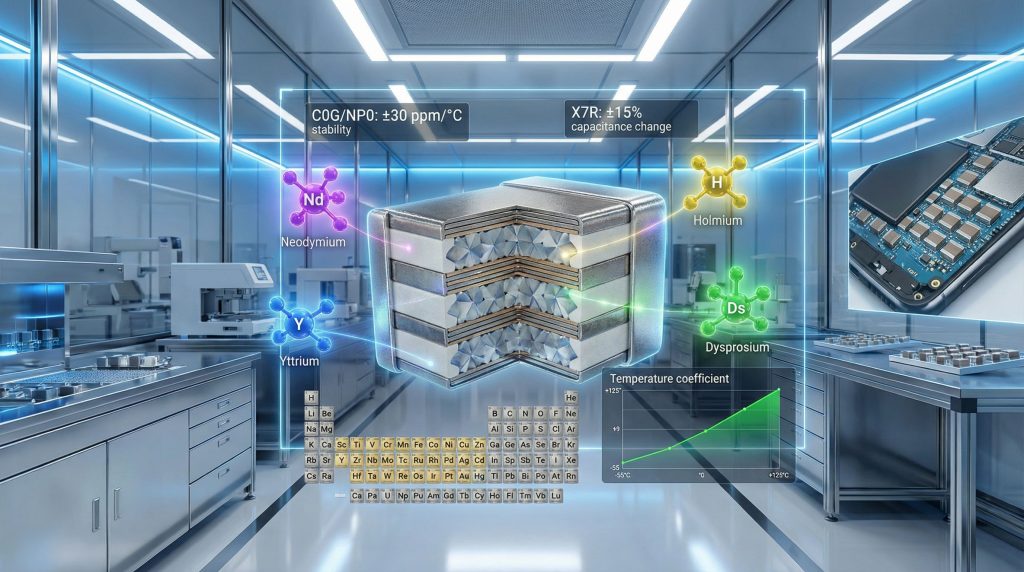
| Neodymium (Nd³⁺) | 0.983 | Ba²⁺ and Ti⁴⁺ dual sites | Grain boundary engineering, ageing suppression |
| Yttrium (Y³⁺) | 0.900 | Ti⁴⁺ preferential | Curie temperature adjustment, thermal stability |
| Holmium (Ho³⁺) | 0.901 | Ti⁴⁺ preferential | Phase transition control, temperature coefficient tuning |
| Dysprosium (Dy³⁺) | 0.912 | Ti⁴⁺ preferential | Dielectric loss reduction, high-frequency optimisation |
Neodymium demonstrates unique versatility among these dopants because its ionic radius positions it nearly equally between barium (1.35 Å) and titanium (0.605 Å) ionic radii. This intermediate size enables neodymium to substitute at both cation sites within the perovskite structure, providing multiple pathways for property modification.
Microstructural Control Through Dopant Chemistry
Rare earth dopants influence ceramic behaviour through several concurrent mechanisms operating at different length scales within the material structure:
Grain Boundary Engineering: REE ions preferentially segregate to grain boundaries during high-temperature sintering processes, creating energy barriers that inhibit grain growth. This segregation reduces final grain size from approximately 5-10 μm in undoped ceramics to 1-3 μm in optimally doped formulations, increasing grain boundary density and improving mechanical strength.
Defect Chemistry Management: Charge compensation effects associated with trivalent rare earth substitution reduce oxygen vacancy concentrations that would otherwise create electrical instability. When REE³⁺ ions replace Ba²⁺ sites, charge neutrality requires either oxygen vacancy creation or complementary dopant pairing, allowing precise control of defect populations.
Phase Transition Engineering: Dopant integration shifts the ferroelectric-paraelectric transition temperature (Curie temperature) by modifying crystal lattice parameters and domain interaction energies. This control enables capacitor designers to position operating temperatures relative to phase transitions for optimal temperature coefficient behaviour.
Electrical Performance Enhancement Through REE Integration
The integration of rare earth elements enables specific electrical characteristics required for different MLCC classifications and applications. Furthermore, mining industry innovation has advanced processing techniques that allow for more efficient extraction of these critical materials. Each dopant type and concentration provides distinct advantages for particular performance requirements.
Temperature Coefficient Engineering Strategies
Different MLCC performance classes require precisely controlled temperature behaviours achieved through specific rare earth dopant formulations:
Class I (C0G/NP0) Capacitors:
• Specification: ±30 ppm/°C capacitance stability across -55°C to +125°C
• Dopant Strategy: 15-25 mol% neodymium and samarium oxides
• Achieved Performance: Dielectric constants of 70-150 with exceptional voltage stability
• Applications: Precision timing circuits, RF resonators, voltage references
Class II (X7R) Capacitors:
• Specification: ±15% capacitance change across -55°C to +125°C
• Dopant Strategy: 2-8 mol% gadolinium and dysprosium compounds
• Achieved Performance: High capacitance density with acceptable temperature drift
• Applications: General-purpose electronics, power supply filtering, signal coupling
Reliability Enhancement Mechanisms
Rare earth dopants directly impact long-term reliability through multiple physical mechanisms:
Electromigration Resistance: Reduced oxygen vacancy mobility prevents degradation under DC bias conditions common in power supply applications. REE dopants create defect clusters that immobilise oxygen vacancies, preventing their migration under applied electric fields.
Dielectric Breakdown Strength: Modified grain boundary chemistry increases voltage tolerance by eliminating weak points where electrical breakdown typically initiates. Uniform dopant distribution creates consistent dielectric strength across the ceramic volume.
Ageing Characteristic Control: Controlled defect chemistry minimises capacitance drift over time by stabilising the ferroelectric domain structure and reducing internal stress evolution during thermal cycling.
Industry Dependencies and Applications
The strategic importance of rare earth elements in multilayer ceramic capacitors extends across multiple sectors where electronic reliability directly impacts operational capability and safety. Moreover, the ongoing critical minerals transition highlights the increasing importance of these materials in emerging technologies.
Aerospace and Defence Platform Requirements
Military and aerospace systems demand MLCCs capable of maintaining performance across extreme environmental conditions whilst providing the electrical stability required for mission-critical functions:
Radar and Communication Systems: C0G MLCCs with neodymium and yttrium dopants maintain frequency stability in oscillator and filter circuits operating across -55°C to +200°C temperature ranges. Signal processing accuracy depends on capacitance stability within 0.1-0.5 ppm tolerances.
Guidance and Navigation Electronics: Inertial measurement units require MLCCs with ageing rates below 1% per decade to maintain calibration accuracy over 20+ year operational lifetimes. REE-doped ceramics provide the temporal stability necessary for long-duration missions.
Electronic Warfare Platforms: High-power transmitter circuits employ MLCCs rated for kilovolt operation with pulse repetition frequencies in the megahertz range. Dysprosium and holmium dopants enable low-loss operation at these demanding power levels.
Automotive Electronics Evolution
Modern vehicles incorporate 3,000-5,000 MLCCs in conventional configurations, expanding to 15,000+ components in electric vehicle architectures. Rare earth dopants enable reliable operation across automotive temperature extremes:
Engine Control Systems: MLCCs operate at 150°C+ ambient temperatures in proximity to internal combustion engines. X7R formulations with gadolinium dopants maintain capacitance stability under these thermal stress conditions.
Battery Management Systems: Electric vehicle battery packs require MLCCs rated for 500-1000V operation whilst maintaining precision current and voltage measurements. REE dopants provide the voltage stability and ageing resistance necessary for safe battery operation.
Advanced Driver Assistance Systems: Camera, radar, and LiDAR sensor systems depend on MLCCs for power supply regulation and signal conditioning. Temperature coefficient stability ensures consistent performance across seasonal temperature variations.
Manufacturing Integration and Process Control
The incorporation of rare earth dopants into MLCC manufacturing requires precise control of chemical composition, particle size distribution, and thermal processing parameters to achieve target electrical properties. Additionally, recent advancements in asteroid mining advances suggest potential future sources for these critical materials.
Ceramic Powder Preparation Methods
REE oxides integrate into barium titanate matrices through carefully controlled powder processing sequences:
Precursor Mixing Stage:
-
REE oxides (typically 0.1-2.0 mol% for standard applications) undergo ball-milling with base ceramic powders using zirconia or tungsten carbide grinding media
-
Mixing duration ranges from 12-48 hours depending on target homogeneity levels and particle size requirements
-
Organic dispersants prevent agglomeration whilst maintaining controlled pH levels to optimise powder dispersion
Calcination Processing:
-
Heat treatment at 800-1000°C promotes solid-state reactions between REE oxides and barium titanate precursors
-
Controlled heating rates (1-5°C/min) prevent thermal shock and ensure uniform chemical composition
-
Atmosphere control prevents unwanted oxidation state changes that would affect final electrical properties
Particle Size Optimisation:
-
Secondary milling reduces particle size to 0.3-0.8 μm for uniform tape casting and layer formation
-
Size distribution control within narrow ranges ensures consistent dielectric layer thickness and electrical properties
-
Surface area measurement and chemical analysis verify composition uniformity before tape casting
Sintering Process Optimisation
The high-temperature firing process critically affects rare earth dopant behaviour and final component properties:
Temperature Profile Control: Sintering temperatures range from 1200-1450°C depending on dopant type and concentration. Neodymium-doped systems typically sinter at 1300-1400°C, whilst yttrium formulations require 1350-1450°C for complete solid-state diffusion.
Atmosphere Management: Oxygen partial pressure control prevents reduction of REE dopants to lower oxidation states that would compromise electrical performance. Controlled atmospheres maintain proper charge compensation within the ceramic lattice.
Cooling Rate Optimisation: Controlled cooling preserves desired crystal structure and dopant distribution whilst minimising thermal stress that could create microcracks or other defects affecting reliability.
The next major ASX story will hit our subscribers first
Supply Chain Dependencies and Strategic Implications
Whilst multilayer ceramic capacitors consume rare earth elements in microgram quantities per component, their strategic significance derives from the absence of practical substitutes and the critical nature of applications they enable. The establishment of European CRM facility initiatives reflects growing recognition of these dependencies.
Concentration vs Strategic Value Analysis
The apparent contradiction between low tonnage consumption and high strategic importance reflects several unique characteristics of MLCC applications:
Substitution Barriers: Alternative dopant systems cannot match the combined temperature stability, ageing resistance, and voltage handling capabilities of REE-doped ceramics in demanding applications. Transition metal dopants show promise for specific uses but exhibit performance gaps in critical parameters.
Processing Complexity: Achieving MLCC-grade purity (99.99%+ levels) requires specialised separation chemistry and quality control processes concentrated in limited global facilities. China maintains 85%+ market share in high-purity REE compounds suitable for electronic applications.
Economic Leverage: Whilst REE dopants represent less than 0.1% of total MLCC material costs, supply disruptions could halt production of components worth 1000x the dopant value. This leverage ratio creates strategic dependencies far exceeding apparent material consumption.
Processing vs Mining Dependencies
The strategic challenge extends beyond rare earth mining to encompass the chemical processing capabilities required for electronic-grade materials:
Separation Chemistry Expertise: China controls the majority of global capacity for producing REE compounds with the purity levels demanded by MLCC applications. Rebuilding Western processing capabilities requires 5-10 year development timelines and substantial capital investment.
Quality Control Standards: Electronic applications demand REE compounds with impurity levels below 10-100 ppm for elements that could affect electrical performance. These specifications require analytical capabilities and process control systems concentrated in limited facilities globally.
Technical Knowledge Transfer: The expertise required for electronic-grade REE processing encompasses complex coordination chemistry, analytical methods, and quality assurance protocols developed over decades of industrial experience.
Alternative Technologies and Future Pathways
Research efforts continue investigating substitute materials and processing methods that could reduce dependencies on rare earth dopants whilst maintaining the electrical performance standards required for critical applications. Recent developments in battery recycling breakthrough technologies demonstrate parallel efforts to create sustainable supply chains.
Current Substitute Research Directions
Transition Metal Systems: Manganese, iron, and cobalt-based dopants demonstrate potential for specific MLCC applications but exhibit limitations in temperature stability and ageing characteristics compared to REE systems. Performance gaps remain significant for aerospace and defence applications requiring 20+ year operational lifetimes.
Composite Ceramic Approaches: Multi-phase ceramic systems attempt to replicate REE dopant effects through controlled microstructural engineering. These approaches show promise but introduce manufacturing complexity and cost challenges that limit commercial adoption.
Advanced Processing Techniques: Atomic layer deposition and chemical vapour deposition methods may enable reduced dopant concentrations whilst maintaining performance. These technologies remain in laboratory development stages with uncertain scalability for high-volume MLCC production.
Recycling and Circular Economy Integration
The recovery of rare earth dopants from end-of-life electronics presents opportunities for supply chain diversification:
MLCC Recovery Methods: Hydrometallurgical processes can extract REE dopants from ceramic capacitors, though the distributed nature of MLCC applications creates collection and processing challenges. Economic viability depends on developing efficient separation methods for mixed electronic waste streams.
Urban Mining Potential: Concentrated electronic waste streams from data centres, telecommunications infrastructure, and military equipment replacement programmes may provide economically viable sources for REE recovery. Processing infrastructure development remains a critical requirement.
Technological Innovation: Advanced separation techniques under development at research institutions could improve the economics of REE recycling from low-concentration applications like MLCCs. Research on ceramic capacitors continues to explore innovative recovery methods for these critical materials.
Future Technology Roadmaps and Dependencies
Emerging technology trends indicate expanding dependencies on rare earth elements in multilayer ceramic capacitors, particularly as electronic systems evolve toward higher frequencies, increased power densities, and extended operational requirements.
Communication Technology Evolution
5G and 6G Infrastructure: Next-generation communication systems demand MLCCs with superior high-frequency performance and temperature stability. Operating frequencies approaching 100 GHz require precise dielectric constant control achievable primarily through REE dopant optimisation.
Satellite Communication Systems: Low-earth orbit satellite constellations require MLCCs capable of withstanding radiation exposure, thermal cycling, and extended operational lifetimes without performance degradation. REE-doped ceramics provide the stability necessary for these demanding applications.
Quantum Computing Support Systems: Cryogenic electronics supporting quantum processors require MLCCs with minimal dielectric loss and exceptional stability at ultra-low temperatures. Specialised REE dopant combinations enable operation at liquid helium temperatures.
Electric Vehicle and Energy Storage Advancement
High-Voltage Power Electronics: Electric vehicle drivetrain evolution toward 800V and 1200V architectures demands MLCCs capable of reliable operation at elevated voltages and temperatures. REE dopants provide the voltage handling and thermal stability required for these applications.
Fast-Charging Infrastructure: Ultra-rapid charging systems operate at power levels exceeding 350 kW with switching frequencies in the hundreds of kilohertz. MLCCs supporting these systems require low-loss characteristics achievable through advanced REE dopant formulations.
Grid-Scale Energy Storage: Utility-scale battery systems incorporate thousands of MLCCs for power conditioning and protection functions. Long-term reliability requirements demand ageing characteristics that only REE-doped ceramics currently provide.
Space and Defence Applications
Hypersonic Vehicle Electronics: Extreme thermal environments encountered by hypersonic platforms require MLCCs operating reliably at temperatures approaching 300°C. Advanced REE dopant systems enable ceramic stability under these unprecedented conditions.
Deep Space Missions: Extended duration space exploration missions demand electronic components with operational lifetimes measured in decades. REE-doped MLCCs provide the temporal stability necessary for missions to the outer solar system and beyond.
Directed Energy Systems: High-power microwave and laser systems require MLCCs capable of handling kilovolt pulse voltages with nanosecond rise times. Specialised REE formulations enable the power handling and frequency response required for these applications.
Furthermore, Rare Earth Exchange research emphasises how rare earth elements serve as the "nervous system of electronics," highlighting their critical role beyond just permanent magnet applications.
The intersection of rare earth chemistry and ceramic capacitor technology represents a dependency that extends throughout modern electronic infrastructure. Whilst individual components consume rare earth elements in microscopic quantities, their collective strategic importance touches virtually every aspect of contemporary technology from consumer electronics to national defence systems.
Disclaimer: This analysis is based on publicly available technical literature and industry sources. Investment decisions should incorporate additional due diligence and expert consultation. Technological developments and geopolitical factors may alter the strategic landscape for rare earth dependencies in electronic components. Market projections and technology roadmaps involve inherent uncertainties and should be evaluated accordingly.
Considering investing in critical rare earth metal opportunities?
Discovery Alert's proprietary Discovery IQ model delivers real-time alerts on significant rare earth and critical mineral discoveries across the ASX, instantly empowering subscribers to identify actionable opportunities ahead of the broader market. Begin your 30-day free trial today and secure your market-leading advantage in this essential sector driving modern electronics and technology infrastructure.