July 29, 2026
The Alumina Exemption: How One Irish Refinery Became Central to Europe's Sanctions Architecture
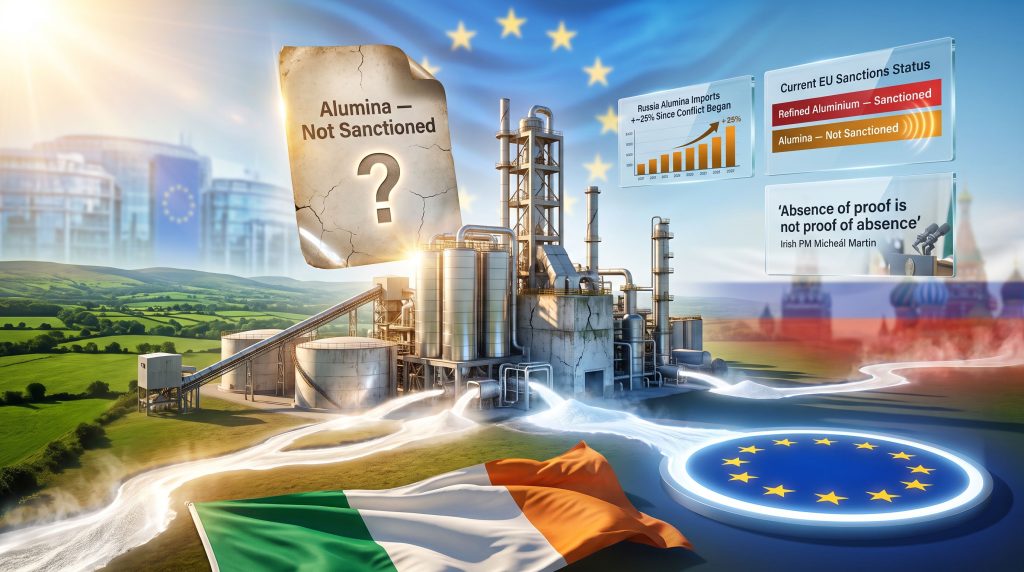
The global sanctions landscape has long struggled with a fundamental tension: the difference between restricting what a country produces and restricting what it needs to produce it. The European Commission examines Aughinish Alumina refinery exports to Russia as part of a broader reckoning with this precise structural gap. Refined aluminium from Russia has been subject to aluminium trade restrictions, yet alumina, the essential precursor that flows through the smelting process to become primary aluminium, has remained legally untouched.
This structural gap, deliberate in its original design, is now drawing scrutiny that reaches from the Shannon Estuary in western Ireland to the corridors of the European Commission in Brussels. Understanding why this matters requires a working knowledge of how the aluminium supply chain actually functions, and where its most strategically significant pressure points lie.
When big ASX news breaks, our subscribers know first
Alumina in the Aluminium Value Chain: Why the Intermediate Step Matters Most
Primary aluminium production follows a two-stage process that is often oversimplified in public discourse. Bauxite ore, extracted from tropical and subtropical deposits across Guinea, Australia, and Brazil, is first refined using the Bayer process into aluminium oxide, commercially known as alumina. That alumina is then fed into electrolytic smelters using the Hall-Heroult process to produce primary aluminium metal.
This means alumina is not merely a raw material. It is the indispensable intermediate input without which no smelter can function. A facility that loses access to alumina supply does not slow down production; it stops entirely. Furthermore, the ratio involved is significant: approximately two tonnes of alumina are required to produce one tonne of primary aluminium, making supply continuity a non-negotiable operational parameter for smelters across Europe.
"The aluminium value chain runs from bauxite mining through alumina refining to primary smelting and downstream fabrication. Each stage depends entirely on the one before it. Disrupting the alumina layer does not merely affect aluminium output; it effectively switches off smelting capacity altogether."
The sectors that depend on this supply chain are not peripheral. Transportation manufacturing, aerospace components, construction materials, defence equipment, and industrial packaging all rely on stable aluminium availability. Consequently, a sustained alumina disruption would propagate across these industries in ways that would be economically visible within weeks rather than months.
What Is Aughinish Alumina and Why Does Its Ownership Structure Matter?
Located on the banks of the Shannon Estuary in County Limerick, Aughinish Alumina is Ireland's only alumina refinery and one of the largest alumina production facilities in Europe. The plant processes bauxite imported primarily from Guinea into alumina, which is then distributed to aluminium smelters across the continent.
Ownership sits with United Company Rusal, the Russian aluminium group that also ranks among the top aluminium producers worldwide. Rusal's corporate structure spans bauxite mining in Guinea and Siberia, alumina refining across multiple jurisdictions, and primary aluminium smelting concentrated in Siberia. Aughinish represents a critical node within that vertically integrated structure, providing European-based refining capacity under Russian corporate control.
This ownership arrangement has attracted sustained attention since the outbreak of the Russia-Ukraine conflict in February 2022. While the EU moved progressively to restrict Russian aluminium imports and other commodity flows, alumina and the refining assets producing it remained outside the sanctions perimeter. The economic logic was straightforward: sanctioning Aughinish would immediately harm European aluminium producers who depend on its output, effectively imposing a self-inflicted supply disruption.
That calculation has now become considerably more complicated.
What the Irish Government Investigation Examined and What It Found
The Irish government conducted an investigation into whether alumina produced at Aughinish was being incorporated into Russian weapons manufacturing. The probe examined export destination data, trade flow records, and downstream end-use verification, applying what officials described as an evidentiary standard requiring concrete or definitive proof of weapons-related usage.
The investigation concluded without finding direct evidence that Aughinish alumina had entered Russian military production chains. According to RTÉ's Prime Time investigation, Irish Prime Minister Micheál Martin acknowledged the result while also noting that the absence of such evidence did not constitute an affirmative determination that no indirect linkages existed. This is a meaningful distinction in sanctions policy analysis: it creates a regulatory outcome that is neither clearance nor condemnation.
The findings were transmitted to the European Commission, which confirmed receipt and announced it would conduct its own examination of the refinery's export flows before determining whether further action was warranted.
The Evidentiary Challenge of Multi-Tier Supply Chains
The methodological difficulty in investigations of this type is substantial. Alumina is a bulk commodity traded through commercial networks involving multiple intermediary buyers, traders, and logistics operators. Tracing a specific tonne of alumina from an Irish refinery through a third-country intermediary and into a Russian industrial facility is not simply an administrative exercise.
It requires cooperation across jurisdictions, access to customs data, and the ability to connect documented trade flows to end-use verification in ways that courts and regulators would consider evidentially sufficient. This is precisely why the Irish investigation's framing was so carefully worded. Finding no concrete evidence of weapons incorporation is not equivalent to finding no risk.
Disputed Export Volume Data
Adding complexity to the Commission's task is a contested set of trade statistics. Investigative reporting by Euronews suggested that during early 2026, more than 80% of Aughinish's alumina output was directed toward Russia. Irish officials disputed both the figure and the methodology used to calculate it, questioning how export destination was being defined and measured across what are often multi-hop commercial arrangements.
The table below summarises the key claims and their current status:
| Claim | Source Type | Official Position |
|---|---|---|
| Over 80% of exports directed to Russia (early 2026) | Investigative media reporting | Disputed by Irish officials |
| No evidence of weapons manufacturing use | Irish government investigation | Confirmed |
| Alumina not currently under EU sanctions | EU regulatory framework | Confirmed |
| Russia's alumina imports up approximately 25% since 2022 | Reported trade data | Commission declined to comment |
The Commission's decision not to address the reported 25% increase in Russian alumina imports since 2022 is itself analytically significant. That figure, if accurate, implies a deliberate and sustained effort by Russia to secure aluminium production inputs through available channels, including potentially through intermediary third countries.
The European Commission Review: Process, Authority, and Possible Outcomes
The Commission's review operates within the EU's sanctions architecture, which distributes enforcement responsibility to individual member states while reserving policy design and expansion authority at the Brussels level. This structure creates a predictable tension: Dublin is responsible for monitoring compliance at Aughinish, while the Commission assesses whether the overall policy framework is adequate.
The Commission confirmed it is examining Aughinish's export flows to Russia and to third countries, indicating that the review is not limited to direct Russia-bound shipments. This is a critical detail. The transit risk, whereby alumina moves through intermediary jurisdictions before reaching sanctioned destinations, is potentially more significant than any direct trade flow.
The review could produce three meaningfully different outcomes:
- Status quo maintained: The Commission accepts the Irish findings and takes no action, preserving the current non-sanctioned status of alumina while potentially strengthening monitoring requirements.
- Targeted export controls introduced: New measures restrict alumina exports to Russia or specific intermediary third countries, applying pressure without triggering a full supply disruption for European producers.
- Full sanctions designation: Alumina is formally added to the EU's restricted materials list, carrying the broadest consequences for European aluminium production and the sharpest geopolitical signal.
"Any decision to formally sanction alumina as a restricted material would represent a significant departure from the EU's current approach of protecting European industrial supply chains while applying trade pressure to Russia."
Why Alumina Was Excluded from Early Sanctions Rounds
The original decision to exclude alumina from EU sanctions targeting Russian commodity flows was not an oversight. European policymakers deliberately drew the line at refined aluminium metal rather than its intermediate inputs, recognising that restricting alumina would create an immediate and severe supply problem for European smelters dependent on consistent alumina availability.
This logic reflects a broader principle in sanctions design: restrictions are most effective when the cost to the sanctioning party is manageable relative to the pressure applied. In addition, the EU metals action plan has highlighted the importance of maintaining European industrial competitiveness when designing such measures.
Ukraine has consistently advocated for extending EU sanctions to cover alumina, arguing that alumina feeds Russian aluminium production capacity that in turn supports military-industrial output. The Aughinish case has brought this advocacy into sharp relief, providing a specific, documented focal point for what had previously been a more abstract policy debate.
Comparative Sanctions Coverage Across the Aluminium Value Chain
| Material | Current EU Sanctions Status | Strategic Importance | Near-Term Sanctions Risk |
|---|---|---|---|
| Refined aluminium (Russian imports) | Sanctioned | High | Resolved |
| Alumina | Not sanctioned | Critical intermediate | Under active review |
| Bauxite | Not sanctioned | Upstream raw material | Low |
| Aluminium alloys and products | Partially restricted | Downstream | Moderate |
The next major ASX story will hit our subscribers first
The Third-Country Transit Problem and Its Policy Implications
One of the less-discussed dimensions of the Aughinish situation is the role of third-country intermediaries in potential circumvention. Alumina is not a finished product with identifiable end-use characteristics. It is a white powder, traded in bulk, with specifications that vary primarily by purity grade and particle size. Once it leaves an export port, tracing its final destination requires documentary cooperation across multiple jurisdictions.
The Commission's explicit reference to examining export flows to third countries signals awareness of this transit risk. Countries with significant aluminium industry capacity and limited political alignment with EU sanctions policy could serve as intermediary destinations. Closing this pathway without creating a bureaucratic burden that disrupts legitimate European alumina trade is a genuinely difficult regulatory design problem.
Russia's reported 25% increase in alumina imports since the start of the Ukraine conflict, if confirmed, would suggest that intermediary routing has already been operationalised to some degree. The trajectory of that figure matters as much as its level: if Russia has been successfully building alumina stockpiles while Aughinish continues to operate, the policy window for meaningful disruption through sanctions may be narrowing.
Ireland's Position and the Sovereignty Dimension
Irish Prime Minister Micheál Martin has emphasised that alumina is strategically important to Europe's industrial base, while also confirming that Ireland would work cooperatively with the Commission to ensure the material does not reach Russia through unauthorised channels. This dual commitment reflects the genuinely difficult position Ireland occupies as the host member state for a Russian-owned facility that is simultaneously a major European industrial asset.
Ireland has an economic interest in Aughinish's continued operation. The facility employs a significant local workforce, generates tax revenues, and contributes to Ireland's industrial base. However, a sanctions decision that resulted in the facility's closure or severe output reduction would carry real domestic economic costs that Irish policymakers cannot ignore.
At the same time, the existing EU sanctions framework already prohibits any direct or indirect cooperation with Russia's defence industry, regardless of the alumina sanctions question. The Commission's review does not change this existing obligation but may result in additional layers of scrutiny or reporting requirements.
What the Aughinish Case Signals for Future EU Industrial Sanctions Design
The broader policy significance of this review extends well beyond a single Irish refinery. The European Commission examines Aughinish Alumina refinery exports to Russia as part of a larger reckoning with how the EU addresses Russian-linked corporate structures embedded within European supply chains. Furthermore, the European raw materials security agenda adds another layer of complexity, as policymakers must balance sanctions pressure against industrial self-sufficiency goals.
If the Commission determines that alumina qualifies as a strategically sensitive material warranting export controls, the analytical framework used to reach that conclusion would have immediate implications for other bulk commodity intermediates. Other industries and other materials could find themselves subject to similar scrutiny using the same policy logic.
The emerging challenge for EU sanctions designers is developing frameworks capable of addressing what trade lawyers sometimes call dual-use industrial inputs: materials that serve entirely legitimate civilian purposes in the vast majority of applications but that, at sufficient scale and under specific ownership structures, may also contribute to military-adjacent production capacity. Establishing policy responses to that kind of indirect risk without creating supply disruptions or legal overreach will set precedents that shape European industrial sanctions architecture for years.
Concerns about the global bauxite supply chain add yet another dimension to this debate, as any restriction on alumina flows inevitably reverberates upstream through bauxite-producing nations and downstream through European smelters simultaneously.
Frequently Asked Questions: Aughinish Alumina and EU Sanctions
What is Aughinish Alumina and why is the European Commission examining its export flows to Russia?
Aughinish Alumina is Ireland's sole alumina refinery, owned by Russian aluminium group Rusal. The European Commission examines Aughinish Alumina refinery exports to Russia following a completed Irish government investigation into whether the facility's output may have implications for EU sanctions policy, particularly regarding materials reaching Russia or third-country intermediaries.
Is alumina currently covered by EU sanctions?
As of mid-2026, alumina remains outside the scope of EU sanctions targeting Russia. Refined aluminium imports from Russia are restricted, but alumina, the intermediate input used to produce primary aluminium, has not been designated as a sanctioned material. The Commission's review may change this position.
What did the Irish investigation conclude?
The investigation found no concrete or definitive evidence that Aughinish-produced alumina was incorporated into Russian weapons manufacturing. However, Irish authorities declined to fully exclude the possibility of indirect supply-chain connections, leaving the question open for Commission assessment.
What outcomes could the Commission's review produce?
The Commission could maintain the current non-sanctioned status of alumina, introduce targeted export controls on alumina flows to Russia or transit countries, or recommend formal sanctions designation, each carrying distinct consequences for European aluminium production and broader supply-chain stability.
What is significant about Russia's alumina import growth since 2022?
Reports indicate Russia's alumina imports increased by approximately 25% following the onset of the Russia-Ukraine conflict. This trajectory suggests deliberate efforts to secure aluminium production inputs through available channels. The Commission has not formally addressed this figure in its public statements.
Want to Stay Ahead of the Next Major Mineral Discovery on the ASX?
Discovery Alert's proprietary Discovery IQ model scans ASX announcements in real time, transforming complex commodity data across more than 30 minerals into clear, actionable insights — so subscribers can identify high-potential opportunities the moment they emerge. Explore historic discoveries and their returns, then begin your 14-day free trial at Discovery Alert to position yourself ahead of the broader market.