July 29, 2026
The World's Most Consequential 33 Kilometres: Inside Oman's Plan for Voluntary Fees in the Strait of Hormuz
Global energy markets have long understood that geography is destiny. No stretch of water illustrates this more starkly than the Strait of Hormuz, a narrow corridor between the Persian Gulf and the Gulf of Oman that functions as the circulatory system of the world's oil and gas trade. When that corridor is threatened, the consequences ripple outward to fuel prices, shipping costs, and energy security calculations on every inhabited continent.
The question facing diplomats today is not simply whether the strait reopens, but under what governance architecture it operates going forward, and whether a creative multilateral mechanism can bridge positions that appear, on the surface, to be mutually exclusive. The Oman plan for voluntary fees in the Strait of Hormuz represents precisely that kind of creative bridging mechanism. Backed by Gulf Cooperation Council member states and designed with deliberate attention to international maritime law, the proposal offers a potential pathway through one of the most complex diplomatic impasses in recent memory.
When big ASX news breaks, our subscribers know first
Understanding the Legal Terrain Before the Politics
Any serious analysis of the Oman plan for voluntary fees in the Strait of Hormuz must begin with the legal framework that shapes what is and is not permissible. The United Nations Convention on the Law of the Sea (UNCLOS) establishes the right of transit passage through straits used for international navigation. This is not a discretionary right that coastal states can condition or price; it is a foundational principle designed to prevent any single nation from leveraging geographic position into an economic toll gate.
The strait itself spans roughly 33 kilometres at its narrowest navigable point, with opposing shipping lanes each covering approximately 3 kilometres. Iran controls the northern shore; Oman controls the southern. Both hold sovereign coastal jurisdiction, which is precisely why any governance arrangement requires bilateral coordination rather than unilateral imposition.
What Is the Critical Legal Distinction?
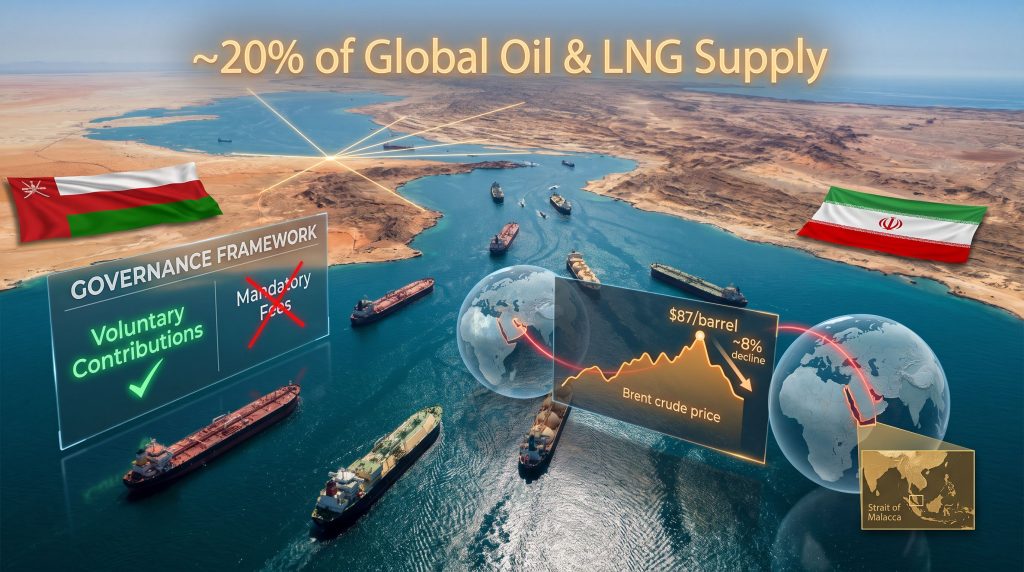
The critical legal distinction at the heart of the current dispute is the difference between a mandatory transit fee and a voluntary contribution. Under UNCLOS, mandatory fees imposed as a condition of transit passage would almost certainly constitute an unlawful restriction on navigation rights. A voluntary scheme, by contrast, occupies a legally distinct space — one where participation is genuinely optional and contributions are not prerequisites for safe passage.
The legal fault line is not merely semantic. Whether a contribution is truly voluntary or functionally compulsory, given the coercive environment in which it operates, will determine whether the entire governance framework holds up to international scrutiny.
What the Strait of Malacca Tells Us About What Is Possible
Oman's proposal does not emerge from a theoretical vacuum. It draws directly on the operational precedent established by the Strait of Malacca Cooperative Mechanism, arguably the most successful example of voluntary maritime contribution governance in operation today. Furthermore, the Malacca model involves Indonesia, Malaysia, and Singapore jointly administering a scheme under which shipping operators are invited to make voluntary financial contributions.
These funds are directed toward navigation safety infrastructure, environmental protection, and search-and-rescue capacity — none of which are specific to any one sovereign state's benefit. The parallels to the Hormuz proposal are structural, but so are the differences:
| Feature | Strait of Malacca Model | Oman's Hormuz Proposal | Iran's Original Demand |
|---|---|---|---|
| Fee Structure | Voluntary contributions | Voluntary contributions | Mandatory transit fees |
| Administrative Control | Trilateral (Indonesia, Malaysia, Singapore) | Bilateral (Iran and Oman) | Iran-dominant |
| Legal Compatibility (UNCLOS) | Broadly compatible | Designed for compatibility | Likely non-compliant |
| Fund Purpose | Navigation, environment, SAR | Navigation, safety, crisis management | Revenue generation |
| Regional/Western Support | Stable multilateral backing | GCC-supported | Rejected by Washington |
The most significant structural difference is the political environment. The Malacca model operates among states with stable bilateral relationships and no active military conflict in the surrounding region. The Hormuz proposal, however, must function amid unresolved tensions between Iran and major Western powers, an ongoing framework negotiation with an end-of-August deadline, and persistent threats of renewed military action.
A Western diplomatic source, as reported by Reuters, drew an analogy between the proposed voluntary contribution scheme and the opt-in carbon offset charge offered to airline passengers when purchasing tickets — where the choice to contribute is genuine and the flight proceeds regardless of whether the passenger ticks the box. According to reporting by Arab News, this analogy is instructive not because it minimises the stakes involved, but because it clarifies the governance design intent.
The Sequence of Events That Created the Governance Vacuum
The current diplomatic crisis at the Strait of Hormuz did not emerge suddenly. It is the product of a specific escalation sequence that progressively dismantled prior arrangements. Here is how the situation developed:
- A coordinated U.S.-Israeli military operation launched on February 28 prompted Iran to restrict maritime access through the strait to non-Iranian vessels.
- A subsequent bilateral agreement between Washington and Tehran partially reopened the waterway, but the arrangement collapsed in early July after Iranian forces fired on vessels using a transit channel they had not sanctioned.
- The United States responded with a 13-night renewed bombing campaign targeting military infrastructure, bridges, and tunnels across southern Iran, killing scores of people before being called off over the preceding weekend.
- Iran retaliated with strikes on U.S. military installations in neighbouring countries, killing four U.S. service members, and conducted additional strikes on civil infrastructure in Gulf states.
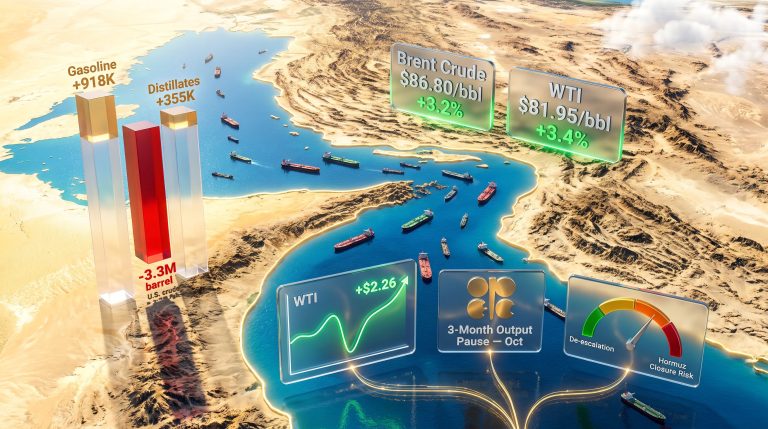
- The cessation of U.S. bombing triggered an approximately 8% decline in oil prices on the first trading day, with Brent crude futures continuing to soften, trading near $87 per barrel during mid-morning sessions on the day Oman's proposal was reported.
The oil price rally and subsequent reversal are analytically revealing. The conflict-risk premium embedded in benchmark crude prices during the period of active military operations was substantial. Its partial unwinding upon the cessation of hostilities signals that markets had been pricing in a scenario of sustained disruption to flows that, prior to the conflict, accounted for approximately one-fifth of global oil and liquefied natural gas supply.
Iran's Position and the Mandatory vs. Voluntary Fault Line
Understanding why the voluntary structure of Oman's plan matters requires understanding what Iran originally proposed and why that position is legally untenable under international maritime law. Iran's stated preference has been for a framework under which it exercises management authority over its side of the strait and collects charges as a condition of transit, not as an optional contribution.
Iran's Deputy Foreign Minister Kazem Gharibabadi separately proposed a directional management model in which Iran would oversee one-way shipping through its coastal corridor while Oman managed part of the opposing lane. This concept partially informed Oman's subsequent proposal but is structurally distinct from it. Under the Omani framework, Iran would not hold sole control, fees would be voluntary rather than mandatory, and oversight would be shared between Iran and Oman.
How Does Iran's Military Stance Complicate Matters?
Iran's joint military command has further complicated the diplomatic picture by categorically rejecting a separate Trump administration proposal to compensate vessel owners for damages from frozen Iranian assets. Beyond rejecting the mechanism, Iran's military command issued a warning that any country or company accepting such compensation would be denied passage through the strait by Iran's armed forces.
This warning introduces a coercive overlay that undermines the voluntary character of any governance arrangement and signals that strait access remains, from Iran's military perspective, an instrument of leverage rather than a neutral administrative function.
The coexistence of three structurally incompatible positions — Oman's voluntary bilateral framework, Iran's mandatory fee demand, and the U.S. frozen-assets compensation proposal — creates a three-track diplomatic architecture in which resolution requires at least one party to substantially revise its foundational stance.
The GCC's Institutional Role in Lending the Proposal Weight
One dimension of the Oman plan for voluntary fees in the Strait of Hormuz that deserves careful attention is the degree to which it represents a multilateral Gulf initiative rather than a purely bilateral Omani overture. The broader geopolitical landscape surrounding this region adds further complexity to an already intricate situation.
GCC foreign ministers convened via video conference to discuss the conflict's developments, with the Qatari Foreign Ministry confirming that discussions included cooperation on freedom of navigation and vessel safety through the waterway. This level of institutional coordination transforms Oman's proposal from a diplomatic favour to a regionally endorsed governance initiative, lending it substantially greater weight in international forums.
Furthermore, OPEC market influence over pricing decisions intersects directly with strait governance outcomes, as any prolonged disruption inevitably reshapes supply dynamics across member states. Oman's particular suitability as the proposing intermediary is grounded in geography and diplomatic history. Its longstanding practice of maintaining independent diplomatic channels with Iran, even during periods of broader Gulf-Iran tension, gives it credibility as a neutral facilitator that neither Tehran nor Riyadh can straightforwardly characterise as partisan.
The next major ASX story will hit our subscribers first
The Houthi Factor: A Second Maritime Chokepoint Enters the Equation
Any assessment of the Hormuz governance situation that ignores the simultaneous disruption in the Red Sea is analytically incomplete. On July 20, Houthi forces aligned with Iran declared a blockade of Saudi Arabian ports on the Red Sea, and subsequently reported firing ballistic missiles at a Saudi oil tanker, which was forced to reverse course.
The significance of this development for the Hormuz negotiations is structural. The Red Sea route had been functioning as a partial workaround for shippers seeking to circumvent Hormuz restrictions. With both waterways now subject to disruption, the only remaining alternative for energy cargo is the Cape of Good Hope routing, which adds approximately 10 to 14 days to voyage times and imposes substantially higher freight costs.
This dual-chokepoint dynamic changes the economic calculus for all parties. Prolonged simultaneous disruption of both the Strait of Hormuz and Red Sea shipping lanes carries compounding costs for global energy markets, creating structural economic pressure toward a negotiated settlement that no single party can entirely resist indefinitely. For a broader perspective on how this affects the crude oil market overview, the dual-chokepoint scenario represents an unprecedented test of market resilience.
The U.S. Position and the August Deadline
Washington's negotiating position centres on the restoration of pre-conflict conditions: unrestricted, fee-free transit for all vessels as the baseline outcome of any settlement. This position is grounded in both UNCLOS legal principles and the strategic concern that any fee-based access regime, even a voluntary one, sets a precedent for other contested maritime chokepoints globally.
President Trump, while halting the most recent bombing campaign, simultaneously retained the threat of renewed strikes contingent on diplomatic progress, specifically referencing the potential targeting of a fortified underground facility near Tehran's nuclear infrastructure. This dual-track posture — de-escalation combined with credible threat maintenance — reflects a negotiating strategy designed to preserve leverage while allowing diplomatic space to develop.
Washington and Tehran reached a framework agreement in June establishing a structure for substantive negotiations, with a target completion date at the end of August. Key unresolved issues within that framework include Iran's nuclear programme, the permanent governance structure of the strait, and the compensation mechanism for maritime damages. The trade war oil impact on global energy dynamics further compounds the pressure on negotiators to reach a workable arrangement before the deadline.
The Oman voluntary fee proposal appears positioned as a bridge mechanism: a workable interim governance arrangement that can stabilise strait operations while the broader framework negotiations proceed toward their August target.
What Resolution Could Look Like: Two Scenarios
If the Oman Proposal Is Accepted:
- Vessels transiting the strait face no mandatory charges but may opt into a contribution scheme funding maritime safety services
- Iran and Oman share administrative oversight, removing the prospect of Iranian unilateral control
- Iran gains a face-saving mechanism that generates some revenue without requiring Washington to formally concede to a mandatory fee regime
- GCC states gain a governance structure that materially reduces the risk of arbitrary strait closures
- Global energy markets progressively unwind remaining conflict-risk premiums embedded in crude benchmarks
If the Proposal Fails:
- Iran retains the option of reimposing unilateral access restrictions
- The U.S. faces pressure to resume military operations, with renewed oil price volatility
- Dual-chokepoint disruption continues to compound costs for global energy markets
- Brent crude would likely revert toward the elevated pricing levels that characterised the period of active military operations
Key Data Points at a Glance
| Metric | Value or Detail |
|---|---|
| Share of global oil and LNG through Hormuz (pre-conflict) | Approximately 20% |
| Oil price decline following U.S. bombing cessation | Approximately 8% on Day 1, continued Day 2 |
| Brent crude at time of Oman proposal | Approximately $87 per barrel |
| Duration of U.S. renewed bombing campaign | 13 nights |
| U.S. service members killed in Iranian counter-strikes | 4 |
| Framework negotiation deadline | End of August |
| Houthi Red Sea blockade declared | July 20 |
| Strait's navigable width at narrowest point | Approximately 33 kilometres |
| Cape of Good Hope rerouting time penalty | Approximately 10 to 14 additional days |
Frequently Asked Questions
Is Oman's voluntary fee plan legally compatible with international maritime law?
The voluntary structure is specifically designed to maintain compatibility with UNCLOS transit passage provisions, which prohibit coastal states from imposing mandatory conditions on vessels exercising transit rights. However, legal compatibility ultimately depends on implementation. As detailed by Brecorder, if voluntary contributions became a de facto condition of safe or unobstructed passage in practice, the arrangement could face challenges under the same legal framework it was designed to satisfy.
Why is the Strait of Malacca analogy important but imperfect?
The Malacca model demonstrates that voluntary maritime contribution schemes can operate sustainably in high-traffic international straits without triggering UNCLOS challenges. However, it functions in a politically stable environment among states with cooperative relationships. The Hormuz proposal must operate amid unresolved military conflict risk, active geopolitical tensions, and a party — Iran — whose military command has explicitly used strait access as a coercive instrument. The structural template transfers; the political conditions do not.
What role does the August framework deadline play?
The June agreement between Washington and Tehran established an end-of-August target for resolving major issues including the nuclear programme and strait governance. The Oman voluntary fee proposal may function as an interim stabilisation mechanism that keeps strait operations viable while the higher-stakes framework negotiations proceed toward that deadline.
Disclaimer: This article is intended for informational and analytical purposes only. It does not constitute financial, legal, or investment advice. Forecasts, scenario projections, and oil price references reflect conditions and reporting as of the date of the source material and are subject to rapid change given the volatile geopolitical environment described.
Want to Stay Ahead of the Commodity Market Movements Driven by Geopolitical Events Like the Hormuz Crisis?
Discovery Alert's proprietary Discovery IQ model scans ASX announcements in real time, instantly identifying significant mineral discoveries and actionable investment opportunities across 30+ commodities — explore historic examples of exceptional returns that major discoveries have delivered, and begin your 14-day free trial at Discovery Alert to position yourself ahead of the broader market.