July 29, 2026
The Structural Forces Behind Every Aluminium Price Cycle
Base metal markets have a rhythm that experienced traders recognise instinctively. Prices surge on a confluence of macro triggers, sentiment amplifies the move beyond fundamentals, and then gravity reasserts itself as those triggers fade. Aluminium is particularly susceptible to this pattern because its price is shaped by an unusually wide range of variables: energy costs at smelters, Chinese domestic production policy, global dollar dynamics, warehouse inventory mechanics, and geopolitical risk premiums that can appear and disappear within weeks.
Understanding why the LME aluminium price cools after a brief recovery requires looking beyond any single session's data and instead examining the layered forces that build, sustain, and ultimately dissolve price momentum. The July 28, 2025 close offers a textbook example of this dynamic in action, and furthermore, it connects directly to broader shifts across aluminum and alumina markets that have been evolving throughout 2025.
When big ASX news breaks, our subscribers know first
Understanding the July 28 Price Data Across the Curve
The session on July 28 saw broad-based selling pressure across every major LME aluminium contract. This was not an isolated move in one part of the curve but a consistent retreat that affected cash, three-month, and longer-dated positions simultaneously. That uniformity is meaningful: when selling pressure is distributed across the forward curve rather than concentrated in spot contracts, it typically reflects a shift in macro positioning rather than a short-term inventory adjustment.
Contract-by-Contract Price Breakdown
The full picture of the July 28 session is best understood through the contract-level data:
| Contract Type | July 27 Price (USD/t) | July 28 Price (USD/t) | Change (%) |
|---|---|---|---|
| Cash Bid | 3,191 | 3,159 | -1.00% |
| Cash Offer | 3,192 | 3,159.50 | -1.02% |
| 3-Month Bid | 3,180 | 3,143 | -1.16% |
| 3-Month Offer | 3,181 | 3,143.50 | -1.18% |
| 3-Month Reference | 3,167.50 | 3,147.50 | -0.63% |
| Dec-27 Bid | 3,110 | 3,080 | -0.96% |
| Dec-27 Offer | 3,115 | 3,085 | -0.96% |
The fact that the three-month contracts declined more sharply than the cash contracts is a nuanced but important detail. It suggests that financial market participants were adjusting forward pricing expectations more aggressively than spot traders, which often indicates a reassessment of medium-term demand outlook rather than just a single-session reaction.
The Alumina Signal: Upstream Weakness Confirming the Trend
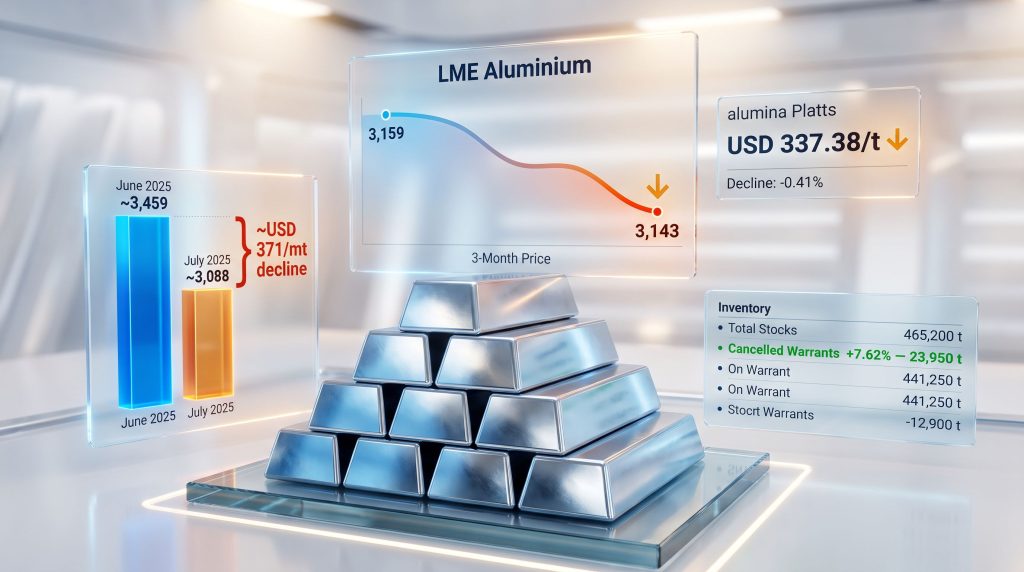
One of the less-discussed but highly informative data points from July 28 was the movement in the LME alumina Platts price. The benchmark dropped 2.56% in a single session, closing at USD 337.38 per tonne compared to USD 346.25 per tonne the prior day.
This matters for several reasons:
- Alumina is the intermediate product refined from bauxite before being smelted into primary aluminium. Its price trajectory feeds directly into smelter cost structures.
- When alumina and aluminium prices decline in the same session, it signals softening sentiment across the entire upstream chain, not just at the finished metal level.
- Historically, sustained alumina price weakness can compress smelter margins, prompting output curtailments that eventually tighten aluminium supply and support prices. However, that mechanism operates over months, not days.
- A 2.56% single-session decline in alumina is substantially larger than the moves seen in aluminium contracts on the same day, suggesting alumina markets are pricing in a faster deterioration of upstream demand conditions.
What Is Actually Driving the LME Aluminium Price Cooldown?
The Geopolitical Premium Has a Half-Life
In mid-2025, aluminium markets were significantly influenced by geopolitical developments in the Middle East. LME aluminium surged to a four-year high in early June 2025, driven by supply disruption fears that injected a substantial risk premium into prices. That kind of premium is real but inherently temporary. Consequently, the global metal tariff impacts that accompanied this period added further layers of complexity to an already volatile pricing environment.
Geopolitical risk premiums in commodity markets tend to be short-lived unless supply disruption materialises physically. When the threat recedes without tangible impact on production flows, prices typically revert toward fundamental equilibrium.
By late July, the unwinding of that premium was largely complete on the LME. However, SHFE aluminium markets demonstrated a different reaction: when US-Iran tensions re-escalated in late July, SHFE aluminium moved sharply higher on heavy trading volume, while LME markets failed to sustain equivalent momentum. This divergence reflects the distinct demand bases and risk sensitivities of each exchange, a distinction explored in more detail later in this article.
Dollar Dynamics: The Mechanical Headwind
A less dramatic but more persistent force weighing on LME aluminium prices is the strength of the US dollar. Because LME contracts are denominated in USD, any appreciation in the dollar creates an automatic increase in the effective cost of aluminium for buyers operating in other currencies. This reduces demand from global purchasers and mechanically compresses the dollar price.
This is not a new phenomenon. Dollar strength has repeatedly acted as a ceiling on base metal rallies throughout 2025, and aluminium's inability to sustain prices above USD 3,200 per tonne reflects this headwind as much as any fundamental supply or demand shift. In addition, the US aluminium tariffs introduced earlier in the year have further complicated the pricing calculus for international buyers.
Inventory Data: A Bullish Signal Overwhelmed by Macro Forces
Perhaps the most intellectually interesting aspect of the July 28 session is that the physical inventory data was broadly supportive of prices, yet prices fell anyway. This disconnect between physical fundamentals and financial market pricing is a recurring feature of LME aluminium markets.
| Inventory Metric | Previous Level | July 28 Level | Change |
|---|---|---|---|
| Opening Stocks | 272,775 tonnes | 271,275 tonnes | -0.55% |
| Live Warrants | 245,350 tonnes | 245,350 tonnes | Stable |
| Cancelled Warrants | 25,925 tonnes | 23,950 tonnes | +7.62% |
Three distinct signals emerge from this data:
- Declining total stocks (271,275 tonnes) continue a trend that has been building through mid-2025, suggesting physical supply available through LME warrant is contracting.
- Stable live warrants at 245,350 tonnes indicate no flood of new metal entering the exchange system, which would otherwise signal oversupply.
- Rising cancelled warrants (up 7.62% to 23,950 tonnes) is typically the most forward-looking of the three metrics. When metal is cancelled from warrant, it means a buyer has designated that specific aluminium for physical removal from an LME warehouse. This is direct evidence of real-world demand for physical metal.
The fact that all three of these signals lean bullish, yet prices still fell approximately 1% on the session, underscores a fundamental principle of commodity markets: financial positioning and macro forces can override physical fundamentals in the short term, even when the physical data is unambiguous.
The 2025 Aluminium Price Cycle in Context
From Peak to Correction: The Scale of the Unwind
To appreciate where July 28 fits within the broader narrative, the monthly price trajectory provides essential context:
| Month | Average LME Cash Settlement (USD/mt) | Context |
|---|---|---|
| June 2025 | ~3,459 | Near four-year high; geopolitical premium peak |
| July 2025 (avg) | ~3,088 | Post-rally correction; macro headwinds dominant |
The approximately USD 371 per tonne decline from June's average to July's average represents one of the sharper single-month corrections in recent aluminium market history. It also reveals that the June peak was heavily influenced by speculative and sentiment-driven positioning rather than a durable shift in physical supply-demand balance.
Why USD 3,100 Per Tonne Is the Line That Matters
The aluminium market has oscillated around the USD 3,100 per tonne level throughout July 2025, with prices testing both above and below this threshold. This level functions as both a psychological reference point for traders and a technical support level that algorithmic trading systems monitor closely.
A sustained close below USD 3,100 per tonne would carry different implications than the current pattern of brief dips followed by recoveries. It would signal that even the post-correction base is eroding, potentially triggering further systematic selling. Conversely, a sustained recovery above USD 3,150 per tonne could attract momentum buying that amplifies the move.
LME vs. SHFE: Why the Two Markets Tell Different Stories
Understanding the Structural Divergence
One of the most practically important dynamics for anyone tracking global aluminium markets in July 2025 is the divergence between LME and SHFE pricing. While LME aluminium was retreating on July 28, SHFE aluminium was simultaneously rallying on heavy volume in response to the reignition of US-Iran tensions. This divergence also mirrors tensions visible in the Chinese steel market outlook, where domestic and international pricing signals have frequently diverged throughout 2025.
This is not simply a matter of time zone differences. It reflects fundamentally different market structures:
- LME reflects a global consensus price driven by international financial participants, dollar dynamics, and global supply-demand signals. Macro and financial forces carry significant weight.
- SHFE is more directly influenced by Chinese domestic consumption trends, Chinese smelter economics, and regional geopolitical supply chain concerns. Chinese buyers are the world's largest consumers of primary aluminium, so SHFE pricing carries significant weight for production-side economics within China.
The Arbitrage Implication
When SHFE aluminium premiums rise relative to LME prices, a commercially important incentive structure emerges. Chinese producers and traders face stronger financial incentives to direct metal toward domestic consumption rather than exporting, which can gradually tighten the ex-China global supply picture. This arbitrage mechanism is one of the more subtle but consequential channels through which Chinese market dynamics influence global aluminium pricing.
Procurement teams and trading desks that monitor only one exchange are effectively operating with incomplete information about where global supply is flowing at any given moment. Furthermore, the role of aluminium supply leaders in managing output decisions adds another variable that single-exchange analysis tends to overlook.
Cancelled Warrants as a Predictive Tool
Why This Metric Deserves More Attention
Among LME aluminium market indicators, cancelled warrants receive less mainstream attention than headline stock levels but frequently provide earlier signals of upcoming physical tightness. The mechanics are straightforward: once a warrant is cancelled, that aluminium is committed to physical delivery and is removed from the available LME stock pool within days.
A 7.62% single-session rise in cancelled warrants to 23,950 tonnes on July 28 is a meaningful signal that physical buyers are actively drawing down LME-held metal. If this trend persists across subsequent sessions, total stocks could fall meaningfully below the current 271,275 tonne level, which would begin to reassert the physical tightness narrative as a price driver. For broader context on how aluminium prices have tracked inventory movements throughout 2025, the pattern of declining stocks preceding price recoveries is well established.
What to watch: If cancelled warrants continue rising while total stocks decline further below 270,000 tonnes, the physical tightness narrative could reassert itself as a price support, particularly if dollar headwinds begin to ease simultaneously.
The next major ASX story will hit our subscribers first
Frequently Asked Questions: LME Aluminium Price Mechanics
What does the 3-month LME price represent and why is it the primary benchmark?
The 3-month LME aluminium price is the global reference used to price the vast majority of physical aluminium supply contracts. Producers, smelters, fabricators, and end-users typically denominate long-term contracts against this benchmark. This means any sustained change in the 3-month price flows through the entire supply chain's contract valuations, affecting margins at every stage from smelter to end product manufacturer.
How do cancelled warrants differ from live warrants?
Live warrants represent aluminium stored in LME-approved warehouses that is available for physical delivery against an LME contract. Cancelled warrants represent metal where a buyer has initiated the withdrawal process, meaning it will leave the exchange warehouse system within a short window. A rising proportion of cancelled warrants relative to total stocks typically signals increasing physical demand and can precede further drawdowns in total inventory levels.
Why can physical fundamentals point bullish while prices still fall?
This is one of the most counterintuitive aspects of LME commodity markets. Financial market participants including hedge funds, commodity trading advisors, and macro funds trade LME contracts based on broader risk sentiment, currency dynamics, and systematic technical signals rather than daily warehouse data. When this financial layer is in a risk-off or liquidation mode, it can overwhelm even genuinely bullish physical signals in the short term. Over longer horizons, physical fundamentals tend to reassert themselves as the dominant pricing force.
Key Takeaways for Buyers, Sellers, and Market Watchers
The July 28 LME aluminium session encapsulates several principles that apply broadly to how this market operates:
- The LME aluminium price cools after a brief recovery when the catalysts driving that recovery — geopolitical premium, dollar weakness, sentiment momentum — dissipate faster than physical fundamentals can fill the gap.
- Physical inventory signals on July 28 were broadly supportive: declining total stocks, stable live warrants, and rising cancelled warrants all lean in a bullish direction.
- Macro forces dominated the session: dollar dynamics and the fade of the geopolitical premium overrode the physical data.
- The alumina market confirmed the softer tone, with a 2.56% single-session decline reinforcing that upstream commodity sentiment has weakened.
- USD 3,100 per tonne remains the critical technical and psychological threshold to monitor in the near term.
- The LME-SHFE divergence offers procurement teams and traders a richer picture of global aluminium flows than either exchange provides in isolation.
Strategic implication for buyers and procurement teams: The current price cooling window may represent a tactical opportunity for spot purchasing or contract locking, particularly if physical demand signals — including continued cancelled warrant growth and stock drawdowns — reassert upward price pressure in coming sessions. However, any purchasing decision should account for prevailing dollar dynamics and the potential for further macro-driven volatility before a sustained recovery takes hold.
This article contains forward-looking analysis and market commentary. Commodity price movements are inherently unpredictable and subject to rapid change. Nothing in this article constitutes financial or trading advice. Readers should conduct their own due diligence before making any commercial or investment decisions based on commodity market data.
Want to Know When the Next Major ASX Mineral Discovery Hits the Market?
Discovery Alert's proprietary Discovery IQ model scans ASX announcements in real time, instantly transforming complex commodity data into actionable investment opportunities — just as it did for historic discoveries like De Grey Mining and WA1 Resources. Explore Discovery Alert's dedicated discoveries page to understand why major mineral discoveries can generate extraordinary returns, and begin your 14-day free trial today to position yourself ahead of the broader market.