July 29, 2026
The Strait of Hormuz Has Always Been a Chokepoint. What Has Changed Is the Doctrine Behind It.
Throughout modern energy history, the Strait of Hormuz has functioned as the world's most consequential maritime passage, with roughly one-fifth of global oil supply passing through its narrow waters at any given time. Analysts, insurers, and military planners have long modelled the consequences of a Hormuz closure as a tail-risk scenario — an extreme but theoretically improbable event. What the events of late July 2026 have demonstrated is that the probability distribution has shifted fundamentally. Iran attacks US bases in the Middle East have accelerated this shift, and the strait is no longer facing a hypothetical closure.
Understanding what this moment represents requires stepping back from the immediate military exchange and examining the structural architecture of how Iran projects power, why its asymmetric capabilities are specifically resistant to conventional military degradation, and what the energy market, diplomatic, and investor implications are across multiple time horizons.
When big ASX news breaks, our subscribers know first
Iran Attacks US Bases in the Middle East: What Happened on July 28, 2026
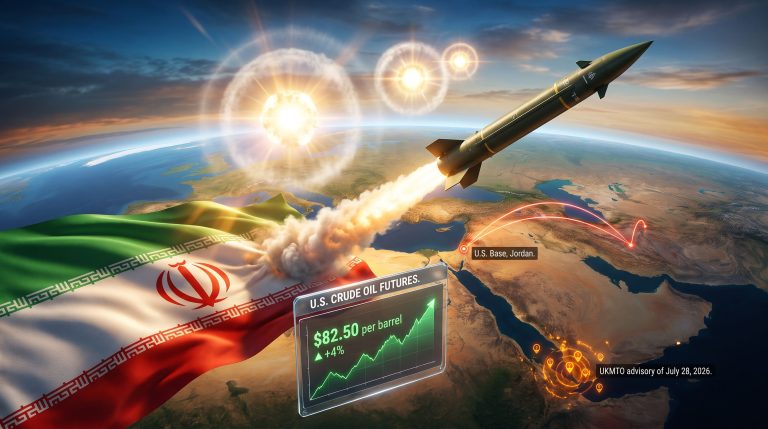
At 21:45 GMT on July 28, 2026, Iranian forces launched a coordinated missile and drone assault against US military installations across multiple countries in the Middle East. According to the US Central Command (CENTCOM), which oversees all US forces in the region, every incoming missile was intercepted before impact during this particular strike. Iranian state sources did not immediately issue confirmation or explanation of the attack.
The strike came as a significant tactical surprise, not because the broader conflict was unexpected, but because it represented a departure from the pattern Iran had followed throughout the preceding weeks. Prior to July 28, Iranian military responses had been reactive, timed in retaliation to US offensive actions rather than initiated independently.
The 13-Day Escalation Cycle and the Failed Pause
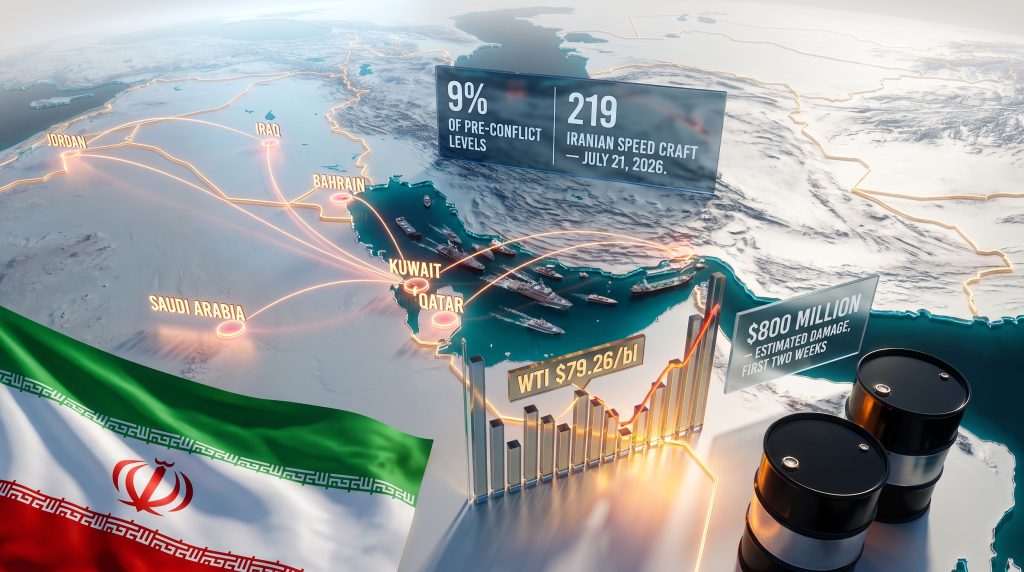
The attack on July 28 followed a continuous 13-day period of mutual strikes between US and Iranian forces. A ceasefire window opened on July 24 and held until July 27, during which diplomatic back-channels were reportedly active. This brief pause had a measurable effect on oil markets: September Nymex WTI futures settled at $79.26 per barrel on July 28, reflecting reduced risk premium as traders priced in the possibility of a sustained halt to hostilities.
The resumption of Iranian offensive action immediately reversed that sentiment. Consequently, what the episode reveals is how acutely sensitive forward energy pricing is to even temporary conflict pauses, and how rapidly the oil price shock can re-enter the market when those pauses collapse.
Key Insight: The failure of a diplomatically brokered pause to hold, despite active back-channel engagement, indicates that surface-level ceasefire arrangements are structurally inadequate without resolution of the foundational disputes driving the conflict, particularly competing claims over transit governance in the Strait of Hormuz.
Which US Military Bases Were Targeted Across the Region?
Iran's strikes encompassed facilities across at least six countries, making this one of the broadest coordinated attacks on US military infrastructure in the region's recorded history. The scale and verification level varies by location.
| Country | Facility Targeted | Method Reported | Assessed Damage |
|---|---|---|---|
| Bahrain | Sheikh Isa Air Base; Fifth Fleet facilities | Missiles and drones | Radar and air defence systems |
| Kuwait | Ahmed Al-Jaber, Ali Al Salem, Camp Arifjan | Drones and missiles | Communications and radar infrastructure |
| Qatar | Al Udeid Air Base | Ballistic missiles | Intercepted; no confirmed casualties |
| Jordan | Undisclosed US installation | Missiles | Claimed F-15 destruction; missile-defence radar |
| Iraq | US-used military facilities | Mixed | Partial damage reported |
| Saudi Arabia | US-linked infrastructure | Mixed | Damage to US-used sites |
Independent open-source analysis drawing on satellite imagery and media verification estimated that at least 228 structures and pieces of equipment across these installations were damaged or destroyed across the full 13-day conflict period. Financial damage assessments based on open-source methods placed the cumulative cost at approximately $800 million across the first two weeks of conflict.
Al Udeid Air Base in Qatar, the largest US military facility in the broader Middle East region, represented the highest-profile confirmed target. The operational strain placed on US missile defence systems, even when interceptions are successful, carries its own strategic cost in terms of munitions consumption, system readiness, and crew fatigue.
Why Military Force Cannot Resolve the Hormuz Problem
This is perhaps the most consequential analytical insight to emerge from the conflict, and one that has significant implications for how markets, policymakers, and energy planners should model the duration of the disruption.
Iran's Asymmetric Arsenal: Designed for Persistence, Not Decisive Engagement
Iran's capacity to threaten commercial shipping through the Strait of Hormuz does not rely on conventional naval confrontation with the US Fifth Fleet. It is built around an asymmetric toolkit specifically engineered to impose maximum disruption at minimum resource cost:
- Fast attack craft capable of swarming large commercial vessels
- Cruise missiles with sufficient range to strike targets throughout the strait corridor
- Drone swarms that can saturate air defence systems and overwhelm interception capacity
- Maritime mines deployable at scale across shallow-water transit corridors
Maritime security tracking recorded 219 Iranian speed craft operating within the Strait of Hormuz on a single day, July 21, 2026, the largest single-day count recorded since May 15. This figure alone illustrates the volume of resources Iran can deploy without committing conventional military assets.
Research from the Center for Naval Analyses (CNA), a US government-funded independent analysis organisation, concluded that the volume of firepower Iran requires to sustain commercial shipping disruption is deliberately minimal. This creates a fundamental asymmetry: degrading Iran's capability to zero would require a military operation of such scale that it is operationally implausible without a ground invasion.
Joshua Tallis, a research program director at CNA, has stated publicly that absent a massive ground campaign, there is no military pathway to eliminating Iran's ability to threaten commercial traffic through the strait, and that the only structurally viable resolution is a negotiated diplomatic settlement. Shipping industry association BIMCO had similarly observed as early as March 2026 that reducing Iran's motivation to disrupt shipping was likely more achievable than reducing its capability through military means. That distinction, between capability reduction and motivation reduction, is fundamental to understanding why the conflict has no clean military off-ramp.
Vessel Traffic Collapse: The Numbers Behind the Hormuz Blockade
The practical impact on global energy flows is severe and measurable. Furthermore, the oil market disruption caused by this conflict has no direct modern precedent:
- Combined vessel transits through the Strait of Hormuz had fallen to approximately 9% of pre-conflict levels by late July 2026, based on tracking data from maritime intelligence firm Windward
- On July 25, only one outbound crossing was detected on the northern Iranian-controlled route, the lowest single-day figure recorded since the June ceasefire collapsed
- Over the July 26-27 weekend, US-assisted transits totalled 26 vessels across both days combined, according to data from the UK Trade Maritime Organisation (UKTMO) and the US Naval Cooperation and Guidance for Shipping (NCAGS)
- Between July 20-24, the northern Iranian-controlled traffic lane carried between 88 and 100 percent of all Hormuz transits, with the July 24 data showing every single transiting vessel using the northern Iranian corridor exclusively
The concentration of what little traffic remains onto northern lanes controlled by Iranian oversight is itself a strategic signal. It reflects the success of Iranian interdiction pressure in forcing commercial operators to seek implicit approval from Iranian authorities simply to transit the waterway.
The US Blockade: Enforcement Metrics and Legal Complexity
Operating in parallel to Iran's disruption of commercial traffic, the United States has maintained a naval blockade of vessel traffic bound to and from Iranian ports since July 14, when the brief US-Iran ceasefire collapsed. CENTCOM reported the following enforcement actions between July 14 and July 28:
- 18 commercial vessels redirected away from Iranian port destinations
- 2 vessels boarded for compliance verification
- 2 vessels disabled
The very large gas carrier Lavine, also operating under the name Disha and subject to existing US sanctions, was disabled on July 24. The MR2 tanker Charminar was boarded on July 25 as part of blockade compliance checks.
The legal framework governing these enforcement actions remains contested. The US blockade's compatibility with UNCLOS provisions governing innocent passage through international straits has not been formally adjudicated, creating a layer of international legal uncertainty that complicates third-party responses and insurers' risk frameworks.
A notable absence in the traffic data is any meaningful diversification toward the southern Omani corridor. UKTMO confirmed in its July 28 advisory that no sustained traffic increase along that alternative route had been observed in the preceding 72 hours, reflecting the operational constraints facing large commercial vessels seeking to avoid the primary transit lanes.
Multi-Vector Maritime Risk: The Red Sea Dimension
The Hormuz crisis does not exist in isolation. Yemen's Houthi militant group has reportedly resumed targeting Saudi oil shipping in the Red Sea, introducing a simultaneous second front of maritime energy disruption. The convergence of Hormuz transit restrictions, active US blockade enforcement, and renewed Red Sea targeting creates a compounding risk architecture for global crude export infrastructure that has no modern precedent in terms of its simultaneity.
Insurers operating in the war risk segment of the marine market are pricing this multi-vector exposure. War risk premiums on vessels transiting either the Hormuz corridor or Red Sea approaches have risen substantially from pre-conflict baselines, adding a structural cost layer to any cargo that does successfully transit these zones.
The Iran-Ukraine-Russia Triangulation
A parallel diplomatic episode on July 28 added further complexity to the geopolitical risk landscape. Iranian and Ukrainian foreign ministers held a direct telephone conversation to address a Ukrainian missile strike against an Iranian commercial vessel operating in the Caspian Sea. Iranian Foreign Minister Abbas Araghchi confirmed he sought financial compensation for crew losses and vessel damage. Both governments indicated they were not pursuing further escalation from this specific incident, representing a notable exercise in diplomatic compartmentalisation against a backdrop of broader conflict.
The next major ASX story will hit our subscribers first
How Iran Attacks on US Bases Are Reshaping Global Energy Markets
Crude Oil Price Architecture Under Geopolitical Stress
The oil market's response to this conflict has demonstrated a new volatility architecture. Traditional commodity markets assume that geopolitical risk premiums are transient, fading as situations stabilise. However, the crude oil geopolitics driving the Hormuz crisis have challenged that assumption by transforming what began as an acute shock into what appears increasingly likely to become a structural supply disruption embedded in forward market expectations.
The temporary July 24-27 ceasefire drove WTI futures to settle at $79.26/bl, demonstrating how powerful even a brief diplomatic pause can be as a downward price catalyst. The resumption of Iranian offensive action reversed this immediately. With Hormuz vessel traffic at roughly 9% of pre-conflict norms, the forward curve now reflects persistent disruption as its base case rather than its tail scenario.
Latin America's Unexpected Energy Dividend
One of the less-reported but structurally significant consequences of the Hormuz closure has been the accelerated repositioning of Latin American crude into supply gaps created by constrained Middle Eastern exports.
Brazilian and Guyanese combined crude exports have risen by approximately 500,000 barrels per day from 2025 levels, reaching 3.28 million b/d in 2026, according to Vortexa trade analytics data. European imports of Brazilian and Guyanese crude increased by roughly 135,000 b/d year-on-year to approximately 1 million b/d, while West African imports into Europe fell by around 115,000 b/d over the same period.
The competitive dynamics between Latin American and West African grades illustrate a nuanced market tension:
- Brazilian Buzios crude has averaged $5.50/bl cheaper than Nigerian Forcados on a delivered northwest Europe basis over the past year
- However, Forcados carries a $13/bl product value advantage over Buzios in terms of diesel yield, according to Argus refinery gate value assessments
- European refiners have increasingly favoured the lower feedstock cost of Brazilian grades over the product value optimisation offered by West African barrels
This dynamic is pushing West African grades toward a more arbitrage-based role in their traditional markets rather than serving as base-load supply, a structural market shift that may persist beyond the resolution of the current conflict.
Private Capital Repositioning: M&A Acceleration in Non-MENA Basins
The geopolitical instability radiating from the Middle East has accelerated deal-making activity in US shale basins as institutional investors and private equity sponsors seek supply exposure in jurisdictions with significantly lower geopolitical risk. Notable transactions completed in proximity to the July escalation include:
- Magnolia Oil & Gas acquiring WildFire Energy from Kayne Anderson and Warburg Pincus for approximately $4.1 billion, representing the largest Eagle Ford-focused transaction in over a decade according to energy consultancy Enverus. The deal adds roughly 810,000 net acres in the Giddings field and approximately 53,000 boe/d of production
- Matador Resources acquiring EnCap-backed Paloma Permian for $1.3 billion, adding 16,235 net undeveloped acres and 11,100 boe/d of output in New Mexico's Delaware Basin, bringing Matador's total Delaware Basin acreage to approximately 240,000 net acres
These transactions reflect a broader investment thesis: as Middle Eastern supply uncertainty extends, the scarcity premium on quality acreage in low-risk jurisdictions increases. The WildFire deal in particular ranks among the top five private equity-backed upstream sales since 2024.
What a Durable Diplomatic Resolution Would Actually Require
The Core Dispute Architecture
The foundational disagreements driving this conflict run deeper than the immediate military exchange. In addition, the global trade tensions generated by this conflict mean any settlement framework that could hold over time would need to resolve several interconnected issues:
- Iranian sovereignty assertions over Hormuz transit rights and the legal status of the US naval blockade under international law
- Commercial shipping guarantees providing non-belligerent third-party vessels with enforceable protections
- IRGC operational constraints within the internationally recognised traffic separation scheme governing the strait
- Economic incentive structures that reduce Iran's motivation to maintain the disruption, recognised by BIMCO as potentially more tractable than capability reduction
The June 2026 memorandum of understanding that temporarily paused hostilities collapsed without resolving any of these foundational elements. The pattern suggests that pauses achieved without structural resolution will continue to fail.
Scenario Modelling: Three Potential Trajectories
| Scenario | Trigger Conditions | Hormuz Traffic Outcome | Oil Price Impact |
|---|---|---|---|
| Negotiated Framework | Resolution of blockade legality and sovereignty disputes | Gradual recovery toward 60-70% of pre-conflict levels | Significant downward pressure on geopolitical risk premium |
| Prolonged Stalemate | Neither side achieves decisive advantage | Traffic sustained at 10-20% of pre-conflict norms | Elevated price floor with periodic volatility spikes |
| Wider Escalation | Third-party involvement or major infrastructure strike | Near-complete Hormuz closure | Severe supply shock; potential $30-50/bl price surge |
Strategic Assessment: The prolonged stalemate scenario currently appears most probable given the absence of structural diplomatic progress. Neither party has demonstrated sufficient leverage to impose a decisive military resolution, yet both retain the capability to sustain indefinite disruption. This equilibrium distributes economic costs globally through energy price volatility, shipping insurance premiums, and supply chain rerouting, creating diffuse pressure for third-party diplomatic intervention that has not yet materialised at scale.
Frequently Asked Questions: Iran Attacks on US Military Bases
Did Iran cause significant damage to US military infrastructure?
Across the full 13-day conflict cycle preceding July 28, independent open-source analysis estimated that at least 228 structures and pieces of equipment across US military installations in the region were damaged or destroyed. CENTCOM confirmed that all missiles launched in the specific July 28 attack were intercepted, but prior strikes caused verified structural damage to facilities in multiple countries.
How many countries hosted targeted US facilities?
Iranian strike activity encompassed facilities across at least six countries: Bahrain, Kuwait, Qatar, Jordan, Iraq, and Saudi Arabia. Al Udeid Air Base in Qatar, the largest US military installation in the region, was among the confirmed high-profile targets.
Why is the Strait of Hormuz still disrupted if US forces are actively operating there?
Iran's asymmetric capabilities, including fast attack craft, drone swarms, and cruise missiles, require minimal resources to sustain. Degrading these capabilities to the point where commercial shipping faces no meaningful threat would require a military operation on a scale that analysts at the Center for Naval Analyses have described as implausible without a full ground invasion. A diplomatic resolution addressing Iran's motivations is considered the only structurally viable pathway to restoring normal transit volumes.
What is the current oil price environment?
WTI crude settled at $79.26/bl during the brief July 24-27 ceasefire window before the renewed Iranian offensive reintroduced upward pressure. The full market impact remains dependent on the duration and intensity of Hormuz disruption, with the prolonged stalemate scenario supporting an elevated price floor and the escalation scenario carrying the potential for a dramatic supply shock.
Is the Strait of Hormuz completely closed?
No complete closure has occurred, but combined vessel transits had fallen to approximately 9% of pre-conflict levels by late July 2026. The functional disruption to global crude flows is severe even without a formal closure, and what little traffic does transit the strait is overwhelmingly concentrated on northern Iranian-controlled lanes. Iran attacks US bases in the Middle East continue to shape the trajectory of this disruption and the broader geopolitical calculus surrounding the world's most critical maritime energy corridor.
Disclaimer: This article contains forward-looking analysis, scenario projections, and market commentary based on publicly available information as of July 28, 2026. It does not constitute financial or investment advice. Oil price trajectories, diplomatic outcomes, and military developments are inherently uncertain and may differ materially from scenarios described herein. Readers should conduct independent due diligence before making any investment or commercial decisions based on the information contained in this article.
Want to Stay Ahead of the Next Major Commodity Market Shift?
The Hormuz crisis is reshaping global energy flows and accelerating capital into non-MENA resource basins — and Discovery Alert's proprietary Discovery IQ model scans ASX announcements in real time, delivering instant alerts on significant mineral discoveries so investors can identify actionable opportunities before the broader market reacts. Explore how historic discoveries have generated substantial returns and begin your 14-day free trial at Discovery Alert to secure a market-leading edge.