July 29, 2026
The Hidden Architecture of the World's Most Important Nickel Corridor
The global race to control critical mineral supply chains has produced many bilateral relationships, but few carry the structural depth or strategic consequence of China and Indonesia nickel ties. While much media attention focuses on headline trade figures and diplomatic posturing, the real story is embedded in the industrial architecture that has quietly taken shape over the past decade and a half. Understanding this relationship requires moving beyond simple trade statistics and into the mechanics of how two very different economies have become functionally inseparable in one of the most strategically important commodity markets in the world.
When big ASX news breaks, our subscribers know first
Why This Relationship Is Unlike Any Other Resource Deal
Most resource relationships between a capital-rich nation and a resource-rich nation follow a familiar pattern: one party extracts raw material, the other processes and manufactures it. The China-Indonesia nickel relationship began that way but has since evolved into something structurally distinct.
Chinese firms did not simply arrive in Indonesia to mine ore and ship it home. They built industrial parks, installed smelting and refining infrastructure, transferred processing technology, and created entire value chains on Indonesian soil. This model transformed Indonesia from a country that exported unprocessed laterite ore into one that now dominates global output of processed nickel intermediates.
The investment was not passive portfolio allocation. It was operational, hands-on, and deeply embedded in Indonesian industrial geography. This distinction matters enormously for understanding the relationship's durability and its vulnerabilities.
The Scale of Chinese Capital in Indonesian Nickel Processing
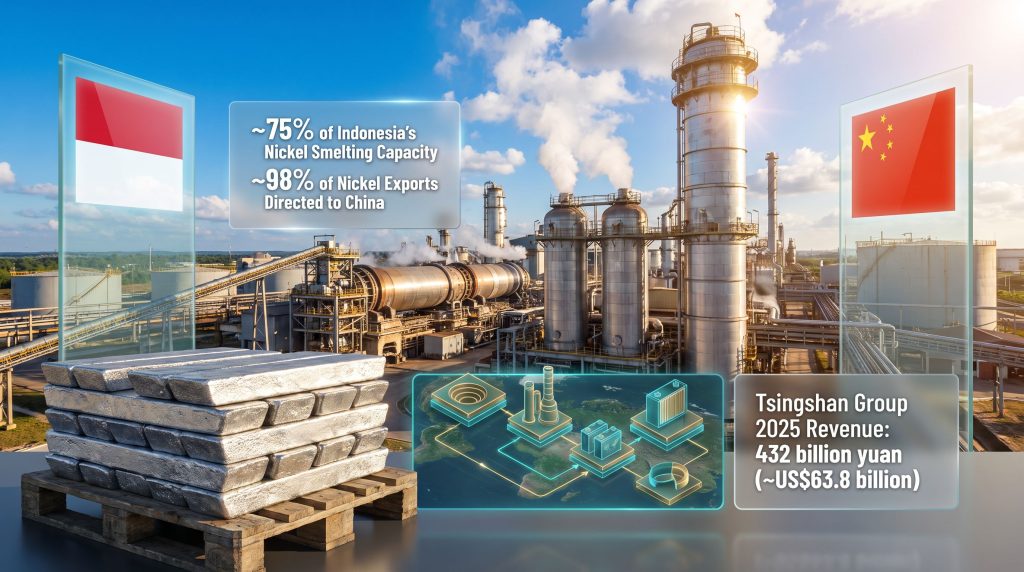
The figures that define this relationship are striking. China's investment in Indonesia nickel has resulted in Chinese companies controlling approximately 75% of Indonesia's nickel smelting and refining capacity, a concentration of industrial ownership that has no real parallel in other major resource corridors. Furthermore, roughly 98% of Indonesian nickel exports flow directly to Chinese buyers, creating a single-market dependency that shapes every commercial decision made within the sector.
Tsingshan Group, founded in Wenzhou in China's Zhejiang province, exemplifies how early strategic positioning translated into extraordinary industrial scale. The company made its initial commitment to Indonesia in 2009, when the opportunity was far from obvious. By leveraging access to Indonesia's laterite nickel deposits — the world's largest reserves of the metal — Tsingshan developed the capability to produce nickel pig iron and later intermediate battery materials at a cost structure that reshaped global price benchmarks.
The company joined the Forbes Global 500 in 2021 and recorded revenue of 432 billion yuan (approximately US$63.8 billion) in 2025, with operations now spanning multiple continents.
| Metric | Estimated Figure |
|---|---|
| Chinese share of Indonesia's nickel smelting/refining capacity | ~75% |
| Share of Indonesian nickel exports directed to China | ~98% |
| Tsingshan Group 2025 revenue | 432 billion yuan (~US$63.8 billion) |
| Year Tsingshan joined Forbes Global 500 | 2021 |
Tsingshan's trajectory is not an isolated case. It represents the leading edge of a broader pattern in which Chinese industrial capital found in Indonesia both the raw material and the regulatory incentive to construct vertically integrated processing operations.
How Indonesia's Export Restrictions Created an Investment Magnet
Indonesia's decision to restrict exports of unprocessed nickel ore, implemented in stages and solidified by 2020, was the critical policy lever that accelerated Chinese downstream investment. By closing the door on raw ore exports, Jakarta forced any party that wanted access to Indonesian nickel to build processing capacity inside the country.
Chinese firms, already experienced with large-scale metallurgical operations and motivated by strategic supply chain considerations, responded with significant capital deployment. The result was a rapid construction of industrial parks, most notably the Indonesia Morowali Industrial Park and the Indonesia Weda Bay Industrial Park, which became the physical centres of Chinese-led nickel industrialisation in the archipelago.
These facilities house smelters, refining plants, and increasingly, precursor chemical production units oriented toward battery material supply chains.
Indonesia's export restriction policy was not designed as a gift to Chinese investors. It was a resource nationalism tool intended to force industrialisation on Indonesian terms. The irony is that the primary beneficiaries of that policy, in terms of operational control, have been Chinese firms with the capital and technology to move fastest.
The EV Battery Connection: Why Nickel's Strategic Profile Has Risen Sharply
For much of its industrial history, nickel's primary demand driver was stainless steel production, where it serves as the key alloying element that provides corrosion resistance and structural strength. Chinese stainless steel manufacturers, seeking to secure reliable and cost-competitive nickel inputs, were the original force behind Chinese investment in Indonesian processing.
However, the emergence of nickel-manganese-cobalt (NMC) battery chemistry as a dominant technology in electric vehicle cathodes has introduced an entirely new strategic dimension. Indonesian nickel in the energy transition has consequently become a critical consideration for the entire global EV supply chain. High-purity, battery-grade nickel sulphate is now a priority input for Chinese battery manufacturers supplying both domestic and global EV markets.
| Application | Nickel's Role | China's Dependency Level |
|---|---|---|
| Stainless steel production | Primary alloying element | High: Indonesia is dominant supplier |
| EV battery cathodes (NMC) | Key cathode material | High: battery-grade nickel demand rising |
| Aerospace and defence alloys | Specialty applications | Moderate |
One technically important distinction that receives insufficient attention in mainstream coverage is the difference between nickel pig iron (NPI) — adequate for stainless steel but unsuitable for batteries — and mixed hydroxide precipitate (MHP) or nickel matte, which can be refined into battery-grade material. Indonesian operations have been actively transitioning toward producing these higher-value intermediates, deepening the strategic significance of the corridor for the EV supply chain specifically.
The Structural Logic of Mutual Dependency
Academic analysis from Renmin University of China characterises this relationship as an increasingly integrated economic ecosystem in which resource endowment and industrial capability have been deliberately combined to create mutual economic reliance. This framing captures something important: the dependency runs in both directions, even if it is not symmetrical.
Indonesia needs Chinese capital and technical expertise to operate its processing infrastructure. Chinese firms, in turn, need Indonesian ore and the Indonesian processing base to maintain cost-competitive supply for downstream manufacturing. Neither party can easily exit the relationship without significant disruption to its own industrial objectives.
The value chain progression can be understood in three broad stages:
- Upstream mining: Laterite ore extracted from Indonesian deposits, primarily in Sulawesi and the Maluku Islands.
- Intermediate processing: Ore converted into nickel pig iron, ferronickel, NPI, or MHP at Chinese-operated industrial park facilities in Indonesia.
- Downstream manufacturing: Processed intermediates exported to Chinese stainless steel mills and battery precursor chemical producers.
Each stage deepens the structural lock-in between the two economies.
The next major ASX story will hit our subscribers first
Resource Nationalism and the Emerging Tension
Indonesia's regulatory environment is not static. Jakarta has progressively asserted greater state influence over its natural resource sector, and the Indonesian nickel industry challenges around divestment requirements, royalty structures, and processing permit conditions have introduced meaningful investor caution among Chinese firms that had previously operated with considerable latitude.
The core tension is straightforward: Indonesia wants to capture more of the value created by its nickel resources, but the processing infrastructure that generates that value is overwhelmingly owned and operated by Chinese companies. Policies designed to increase Indonesian state participation can, if implemented abruptly, deter the ongoing investment needed to expand and upgrade processing capacity.
Three distinct scenarios could define how this tension resolves:
- Deepening integration: Indonesia continues attracting Chinese downstream investment, expanding into battery materials and EV component manufacturing, and both economies deepen mutual dependency without major structural disruption.
- Managed tension: Indonesia implements selective resource nationalism, retaining Chinese capital for processing while asserting greater state ownership of upstream assets. Friction rises but the relationship holds.
- Structural decoupling: Sustained regulatory unpredictability causes Chinese firms to accelerate diversification into alternative nickel jurisdictions, including the Philippines, New Caledonia, and various African nations with laterite deposits.
The Geopolitical Pressure Multiplier
How Are Western Nations Responding?
A dimension often missing from bilateral analysis is the growing influence of a third force: Western nations actively seeking to reduce their exposure to Chinese-dominated critical mineral supply chains. The United States Inflation Reduction Act and the European Union's Critical Raw Materials Act both create policy frameworks that incentivise sourcing of battery materials from jurisdictions outside the China-controlled processing network.
Indonesia, as the world's largest nickel producer, sits at the centre of this competition. According to a US security think tank analysis of China's grip on Indonesian nickel, Western governments and industrial firms have signalled increasing interest in establishing processing partnerships with Jakarta. This creates genuine strategic optionality for Indonesia that did not meaningfully exist a decade ago.
However, the practical barriers to replacing Chinese industrial capital in Indonesia are substantial:
- Chinese firms have a decade-plus head start in building processing infrastructure and operational expertise.
- The capital requirements for greenfield nickel processing facilities are enormous.
- Technology transfer for hydrometallurgical processing routes suitable for battery-grade output requires deep industrial experience.
- Western private capital has historically shown limited appetite for the risk profile of large-scale base metals processing in emerging markets.
Key Risks Facing the China-Indonesia Nickel Corridor
Several pressure points warrant close monitoring for anyone seeking to understand how this relationship might evolve. Furthermore, understanding the broader battery metals investment landscape helps contextualise why these risks carry such significant consequences for global supply chains.
- Regulatory unpredictability: Sudden policy shifts in Indonesia can impair the investment case for Chinese firms and slow capacity expansion.
- Nickel price volatility: The commodity price cycle directly affects project economics. Tracking nickel price momentum is therefore essential, particularly given the sharp price decline from 2023 peaks that placed pressure on operating margins across Indonesian processing facilities.
- Environmental and social governance pressure: A transparency assessment of Indonesian nickel operations has highlighted concerns around environmental practices, particularly regarding laterite mining's land use impact and industrial park waste management.
- Concentration risk: An export dependency ratio of approximately 98% toward a single destination creates vulnerability that Indonesian policymakers are increasingly aware of but have limited near-term tools to address.
Frequently Asked Questions: China and Indonesia Nickel Ties
Why Does China Invest So Heavily in Indonesia's Nickel Sector?
China's investment is driven by the need to secure reliable, cost-competitive nickel supply for its stainless steel and EV battery industries. Indonesia holds the world's largest nickel reserves, and Chinese firms were positioned to capitalise on Indonesia's export restriction policies by building processing infrastructure inside the country.
What Percentage of Indonesia's Nickel Processing Is Controlled by Chinese Companies?
Chinese firms are estimated to control approximately 75% of Indonesia's nickel smelting and refining capacity, reflecting the scale of capital and technology deployed by Chinese industrial groups since the late 2000s.
How Does Indonesian Nickel Connect to China's EV Battery Supply Chain?
Indonesian facilities are transitioning toward producing battery-suitable nickel intermediates such as mixed hydroxide precipitate and nickel matte, which can be refined into battery-grade nickel sulphate for use in NMC cathode production — a core component of electric vehicle batteries.
What Is Resource Nationalism and How Is It Affecting Chinese Investment?
Resource nationalism refers to policies that increase state ownership and control over natural resource extraction and processing. In Indonesia, recent regulatory changes around royalties, divestment requirements, and processing permits have introduced uncertainty that is affecting Chinese investor confidence in the sector.
Could Indonesia Replace Chinese Investment With Western Capital?
In the near term, a full replacement is highly unlikely. Chinese firms have a substantial head start in processing infrastructure, operational expertise, and technology. Western capital has shown limited appetite for the risk and capital intensity of large-scale nickel processing in emerging markets, though strategic interest is clearly increasing.
What Would a Breakdown in China-Indonesia Nickel Ties Mean for Global EV Supply Chains?
A significant disruption to China and Indonesia nickel ties would create supply shocks in nickel intermediates used for battery cathode production, affecting EV manufacturers globally. The concentration of processing capacity in Chinese-operated Indonesian facilities means there is no immediately available alternative supply network at equivalent scale.
What the Future of This Relationship Actually Depends On
Three variables will most decisively shape the trajectory of this critical bilateral relationship over the coming decade:
- Indonesia's regulatory consistency: Predictable, commercially sensible policy will sustain Chinese investment flows. Erratic or punitive changes will, however, accelerate Chinese diversification into alternative jurisdictions.
- The pace of Western alternative development: If the United States, European Union, and allied nations succeed in developing alternative nickel processing partnerships, Indonesia's bargaining position improves, but so does the complexity of managing competing investor relationships.
- Battery chemistry evolution: If the industry shifts substantially toward lithium iron phosphate (LFP) batteries, which require no nickel, demand growth for Indonesian nickel in the EV segment could moderate, altering the strategic calculus for both parties.
| Dimension | Current State | Key Risk |
|---|---|---|
| Chinese capital in processing | ~75% smelting capacity control | Regulatory reversal by Jakarta |
| Export concentration | ~98% of nickel exports to China | Single-market dependency |
| Strategic motivation (China) | Secure stainless steel and EV battery inputs | Supply disruption from policy shifts |
| Strategic motivation (Indonesia) | Industrialise via foreign capital and technology | Value capture limited by Chinese firm dominance |
| Geopolitical pressure | Rising Western interest in Indonesian nickel | Indonesia navigating competing major powers |
The China and Indonesia nickel ties relationship is neither a simple commodity trade nor a stable strategic alliance. It is an industrial interdependency built on complementary needs, mutual calculation, and significant structural asymmetry. Its future will be shaped not by diplomatic declarations but by investment decisions, regulatory choices, and the evolving demands of global battery supply chains. For investors, policymakers, and industry analysts, few bilateral relationships in the critical minerals space carry more consequence for the decade ahead.
This article contains forward-looking analysis and scenario projections based on publicly available data. Readers should be aware that commodity markets, regulatory environments, and geopolitical dynamics are subject to rapid change. Nothing in this article constitutes financial or investment advice.
Want to Track the Next Major Nickel or Battery Metals Discovery Before the Market Does?
Discovery Alert's proprietary Discovery IQ model scans ASX announcements in real time, instantly identifying significant mineral discoveries across nickel, battery metals, and more than 30 other commodities — translating complex data into clear, actionable opportunities for investors at every level. Explore historic examples of major mineral discoveries and their market returns, then begin your 14-day free trial at Discovery Alert to position yourself ahead of the market.